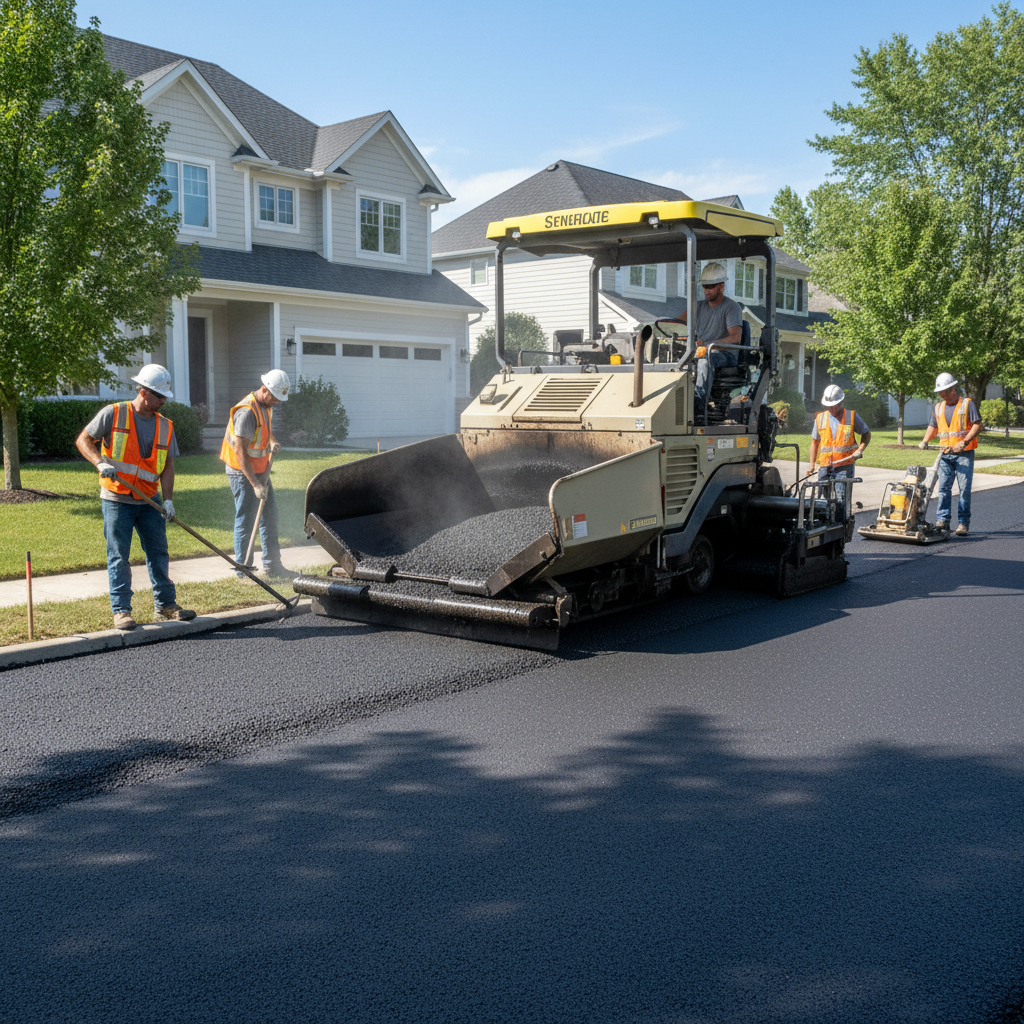
Driveway paving options and costs in Georgetown
Georgetown homeowners often start with the same question: “What will it cost to pave my driveway?” With a population of 44,058 (Statistics Canada, 2021 Census) and a lot of neighbourhood streets built around single-family homes, driveways here are typically the kind of job that gets noticed—both for curb appeal and for day-to-day usability after winter. In Georgetown’s busier pockets such as the downtown/Main Street area (where access can be tight and contractors schedule around street activity), paving and interlock demand tends to run steady through the season.
In the Toronto economic region, pricing is heavily influenced by frost depth and freeze–thaw cycles. Ground freezing to roughly 3–4 feet means the driveway has to be built on a deeper, well-compacted granular base with reliable drainage; otherwise, trapped water can lead to heaving and cracking when it freezes. The paving season is also effectively concentrated into late spring through early fall, so prime dates can carry a premium—particularly when multiple crews are booked around Georgetown, Acton, and nearby GTA communities.
To help you compare options quickly, here are typical price ranges and expected performance for the most common driveway materials. Use this as a budgeting baseline, then align the design (base thickness, drainage, and edging) to your lot conditions before you lock in a quote.
| Material |
Lifespan |
Maintenance |
Best For |
Price per sq ft |
| Asphalt (new installation, proper base) |
15–25 years |
Seal 6–12 months after install, then every 3–5 years |
Most cost-effective durable surface with good snow-plough performance |
$3.50–$8.00 |
| Asphalt (overlay on existing gravel base) |
10–20 years |
Seal as above; monitor for base settlement |
When you already have a stable base and want to avoid full tear-out |
$3.25–$7.50 |
| Interlocking concrete pavers |
25–40 years |
Regular sweeping/rinsing; joint sand top-ups as needed |
High curb appeal, easy spot repairs without replacing the whole driveway |
$9.00–$20.00 |
| Poured concrete (broom finish) |
25–35 years |
Occasional patching; seal if desired for stain resistance |
Low maintenance and a clean, uniform look |
$6.00–$15.00 |
| Exposed aggregate concrete |
25–35 years |
Seal for colour/stain resistance; repair spalls as needed |
Premium appearance with good traction |
$8.50–$18.00 |
| Gravel / crushed stone (budget option) |
3–10 years |
Re-grade and re-top every 1–3 years; weed control |
Temporary solution or maximum budget flexibility |
$2.00–$5.00 |
Prices are estimates only and vary by project scope, site access and material selection.
What affects the price of paving in Georgetown
In the Toronto region, it’s common to see quotes for “the same driveway” come back 30–50% apart once base design, drainage, and tear-out are clarified. Even when your driveway dimensions match on paper, the real differences are usually: (1) how deep and how well the granular base must be engineered to handle frost, (2) how much grading is needed to direct water away from the slab/asphalt, and (3) whether an existing surface can be left in place or must be removed.
Frost depth and freeze–thaw cycles are decisive cost factors here. With ground freezing to about 3–4 feet, deeper compacted granular base and subgrade prep are essential to prevent heaving and cracking. In Ontario’s climate, that typically means building thickness and compaction practices that go beyond what you’d use in milder conditions. Separately, the paving season in Ontario is tighter—hot-mix asphalt placement requires favourable air/road temperatures (often above 10°C air), so contractors concentrate work into a shorter window. When schedules compress, prime-date availability can push total costs up, even if labour crews are similar across bids. Asphalt mix design also needs to be freeze–thaw rated, which can add cost compared with a basic mix.
Two concrete examples of how Georgetown conditions change the budget: if your driveway slopes toward the garage or low spots hold water after rain, drainage corrections can add several thousand dollars by requiring re-grading and subdrain work. If your existing slab is badly cracked or uneven, removing and hauling out broken concrete (plus disposal) will increase cost compared to jobs where we can mill or stabilize an existing layer.
That’s why a basic asphalt install might start near the $3,500–$8,000 band, while upgrades that include deeper excavation, improved drainage, and proper edging can move the project closer to the higher end. For homeowners who want a longer service life and easier repairs, interlocking pavers often land in the $9,000–$20,000 range once base and restraint are engineered for freeze–thaw.
| Price Factor |
Why It Matters |
Cost Impact |
| Driveway area in sq ft |
Most materials and machine time scale directly with square footage |
High—often the biggest driver of total installed cost |
| Base depth required |
Frost line determines granular thickness and compaction needs |
High—deeper excavation and more aggregate increase cost |
| Grading and drainage work |
Proper slope and water management reduce freeze damage |
Medium to High—subdrains/reshaping can add significantly |
| Tear-out of existing surface |
Broken concrete/asphalt removal affects labour and disposal |
Medium to High—can swing a bid by thousands |
| Edge restraints and curbing |
Keeps pavers/asphalt in place under thermal movement |
Medium—often required for long-term performance |
| Sealing requirement |
Asphalt needs sealing to resist oxidation and water intrusion |
Low to Medium—cost is small but timing matters |
| Site access |
Narrow driveways slow equipment movement and increase labour time |
Low to Medium—more time = more cost |
| Asphalt mix specifications |
Freeze–thaw rated mix helps reduce premature failures |
Low to Medium—increases material cost but improves longevity |
Permits & regulations in Ontario
In Ontario, paving a private driveway within your own property typically does not require a building permit. Most homeowners can proceed with asphalt or interlocking work on their lot—as long as the contractor follows standard excavation, erosion control, and drainage practices. However, permits and municipal approvals can be required when work touches municipal infrastructure.
Here’s what usually DOES require municipal approval: any new or modified curb cut, changes to the boulevard area, alterations to storm drainage, or work that impacts municipal right-of-way. If your driveway tie-in changes how water flows to the ditch or catch basins, that’s a common trigger for additional review. Some municipalities also have lot-grading rules that limit how close a hard surface can be to property lines and how drainage must be managed.
Step-by-step, for Georgetown homeowners:
- Start by calling Ontario One Call before excavation—this is essential for locating buried utilities.
- Confirm whether any portion of your plan includes the curb/boulevard or drainage connection; if yes, ask the municipality about approval requirements.
- Request the contractor’s Ontario licence details (where applicable) and keep copies for your records.
- Verify liability insurance: ask for a current certificate of insurance showing coverage amounts and the policy dates.
- Verify WSIB/WCB coverage (as applicable): request clearance letters or proof of coverage that matches the period the work will be performed.
- Ask what erosion/sediment controls will be used during base excavation.
Doing these checks before you sign helps avoid stop-work delays and protects your property.
Asphalt vs pavers vs concrete for Georgetown driveways
For Georgetown driveways, the “best” material is usually the one that matches your priorities—budget, curb appeal, and how much maintenance you want—while being engineered for Toronto-region freeze–thaw. Asphalt is the most budget-friendly upfront option in most cases. It’s also forgiving in heavy snow-plough seasons, but it does require sealing after installation and again periodically (commonly every 3–5 years) to slow oxidation and water penetration. Interlocking concrete pavers cost more at the start, yet they shine when you want curb appeal and the ability to replace small sections if something shifts or settles. Poured concrete often sits mid-range on price, but it needs careful mix design, air entrainment, proper control joints, and drainage planning to manage freeze–thaw movement and winter de-icing demands.
Because ground freezing can reach roughly 3–4 feet, all three systems depend on the base and drainage more than homeowners expect. Good slopes, a stable compacted granular base, and reliable water management are what prevent heaving and cracking. In practice, asphalt tends to perform well when the base is built deep and well-compacted and the surface is sealed on schedule. Pavers tend to perform well because their modular nature allows localized repairs. Concrete can last for decades, but if the base is weak or drainage is poor, cracks can develop and widen over cycles.
Where price differences are justified: say you have a driveway in the $3,500–$8,000 asphalt budget range. If your existing base is questionable or drainage is off, the “cheap” option can become expensive later. In that situation, spending more on interlocking (often within the $9,000–$20,000 band) may be justified by longer life and easier repairs—especially if you want to keep a sharp finish through winter.
| Material |
Frost Resistance |
Curb Appeal |
Repair Method |
Lifespan |
Price Band |
| Asphalt (sealed regularly) |
Good when base and drainage are engineered for freeze–thaw |
Medium—clean and modern, less decorative than pavers |
Mill and patch or overlay if surface deteriorates |
15–25 years |
$3,500–$8,000 |
| Interlocking concrete pavers |
Very good with proper bedding sand and restraints |
High—multiple styles, colours and edging options |
Remove and replace individual stones as needed |
25–40 years |
$9,000–$20,000 |
| Poured concrete (air-entrained) |
Good to very good with air-entrainment and correct joints |
Medium—uniform finish; can be upgraded with broom/exposed |
Patch the cracked areas; larger failures may require section replacement |
25–35 years |
$6,000–$15,000 |
| Exposed aggregate concrete |
Good with correct curing and drainage |
Very high—premium texture and traction |
Targeted repairs; appearance may differ unless matched carefully |
25–35 years |
$8,500–$18,000 |
| Permeable pavers (drainage grid) |
Very good for water management when designed correctly |
High—often used for eco-conscious curb appeal |
Replace affected units; underlying stone bed may require maintenance |
25–35 years (system-dependent) |
$10,000–$22,000 |
| Chip seal / tar-and-chip |
Fair to good depending on base stability and application quality |
Low—more utilitarian finish |
Spot repairs; eventual re-seal/chip required |
5–10 years |
$2,500–$6,500 |
How to choose a paving contractor in Georgetown
Choosing the right paving contractor in Georgetown is less about the lowest number and more about proof: proof they can build for freeze–thaw, proof they’re insured, and proof they’ll stand behind the workmanship. In Ontario, start by verifying liability insurance: ask for a current certificate of insurance and confirm the coverage dates. Next, confirm WSIB/WCB coverage (as applicable) by requesting clearance letters or proof of active coverage—this helps protect you if a worker is injured on site. Also ask for their business information (company name, contact details, and the specific individual who will manage your job).
For pricing, request 2–3 itemised written quotes. You want a breakdown that distinguishes excavation and base material, granular compaction, any drainage corrections, disposal/tip fees, and the paving/interlock/concrete labour. Avoid “lump sum” pricing that doesn’t clearly describe scope—especially when tear-out depth, base thickness, or edging details weren’t discussed.
Read exclusions carefully: does the quote include permit/municipal approval time if your driveway tie-in affects the boulevard, or is that excluded? Is disposal included for removed concrete/asphalt? What about utility locates and any required re-compaction? Ask about warranty: a workmanship warranty should be in writing (length, what’s covered, and how claims are handled). Clarify the product/manufacturer warranty too, and whether it’s transferable to a homeowner.
Finally, lock in a sensible payment schedule. A rule of thumb is never paying more than 10–15% upfront; keep a holdback until completion and final inspection. Get the start date and completion estimate in writing so you can plan around Ontario’s shorter paving window.
- Ask for their Ontario coverage documents before work begins.
- Request itemised labour/material breakdown (not just a total).
- Confirm base design details: thickness, compaction method, and drainage plan.
- Verify edging/restraints are included (critical for pavers and long asphalt life).
- Check what tear-out is included (depth, disposal, and haul distance assumptions).
- Confirm sealing is included for asphalt (timing within 6–12 months after install).
- Ask about cold-weather protection practices and how they handle weather delays.
- Ensure the scope includes proper slope to prevent ponding near garages.
- Get disposal/tip fees explicitly stated—avoid surprise charges.
- Request a written timeline with start and completion targets.
- Review warranty terms in writing, including claim process and coverage limits.
- Use a payment schedule with a holdback until final cleanup and quality check.
Concrete red flags I’ve seen in Georgetown: vague base depth numbers, missing insurance/WSIB paperwork, quotes that don’t mention drainage or edging, “too-good-to-be-true” timelines during peak season, and workmanship warranties that are not provided in writing or that quietly exclude freeze–thaw related failures.
Frequently asked questions — paving in Georgetown
How much does it cost to pave a driveway in Georgetown?
In Georgetown, driveway paving costs usually fall within the city’s Toronto-region pricing bands, mainly driven by square footage, excavation depth, drainage needs, and how much existing material must be removed. For asphalt driveway paving, typical estimates commonly land around $3,500–$8,000 depending on base prep and whether we’re installing new asphalt or doing a smaller overlay scenario. If you want interlocking concrete pavers for higher curb appeal and easier spot repairs, budgets often start closer to the $9,000–$20,000 range. Concrete is frequently priced between $6,000–$15,000 for a broom-finish driveway. Because Georgetown experiences repeated freeze–thaw conditions, the deeper granular base and reliable drainage are what prevent early failures—so “cheap” materials on a weak base usually cost more later.
Asphalt vs interlocking pavers vs concrete — which is best in Georgetown?
There isn’t one best option for every Georgetown driveway, but the decision usually comes down to your priorities and your site conditions. Asphalt is best if you want the lowest upfront cost and good winter practicality; just plan for sealing after installation and again every 3–5 years. Interlocking pavers are a top choice when curb appeal matters and you want the ability to replace a small section without redoing the entire driveway—useful if your lot has minor settling or you anticipate changes. Poured concrete can perform very well in Ontario when it’s air-entrained, properly jointed, and built on a stable base; however, concrete is more sensitive to poor drainage and improper curing. In Georgetown’s freeze–thaw climate, base prep and drainage engineering beat material marketing every time.
How long does a paved driveway last in Georgetown?
With proper base construction and drainage, you can expect many Georgetown driveways to last for decades, but lifespan depends heavily on how water is managed under the surface. Asphalt typically lasts about 15–25 years when the base is built for frost and you seal within the first 6–12 months, then periodically every 3–5 years. Interlocking concrete pavers often run 25–40 years because sections can be lifted and replaced if there’s localized movement. Poured concrete generally aims for 25–35 years when control joints are installed and the mix is air-entrained for freeze–thaw. If the driveway has low spots that pond after rain or if excavation doesn’t address frost-related heaving risk (ground freezing can reach around 3–4 feet in the Toronto region), any material’s lifespan can drop significantly.
When is the best time of year to pave in Georgetown?
The best time in Georgetown is late spring through early fall, when roads and subgrades are warm enough for proper paving and compaction. Asphalt installation usually needs favourable conditions—hot-mix asphalt placement is typically done when air/road temperatures are high enough (often above about 10°C). Freeze–thaw stress accelerates if you pave over a marginal subgrade or if water gets trapped during early cold snaps. That’s why contractors in the Toronto area often book prime dates in summer and may delay work when temperatures dip. If your project requires major excavation and base work, scheduling it earlier in the season can help ensure the base can be built, compacted, and allowed to settle before surface placement.
How deep should the base be for Georgetown's frost?
Base depth isn’t a single fixed number because it depends on your existing soil condition, drainage, and driveway build-up height. However, Toronto-region frost risk is the reason the granular base in Georgetown is usually deeper than homeowners expect. With ground freezing roughly 3–4 feet, a properly engineered, compacted granular base and subgrade preparation are critical to reduce heaving and cracking from freeze–thaw cycles. In practice, contractors typically design for deeper excavation and more granular thickness than you’d see in milder climates, with careful attention to compaction and drainage corrections. A good contractor will explain the proposed base thickness, moisture/compaction approach, and how water will be directed away from the pavement before they pour or pave.
How often should I seal my asphalt driveway?
For Georgetown driveways, asphalt sealing is about protecting the surface from water intrusion and oxidation—both of which matter in Ontario’s freeze–thaw climate. Plan to seal within the first 6–12 months after installation, assuming the surface has cured properly and the contractor recommends the timing. After that, most homeowners should budget for re-sealing every 3–5 years, depending on traffic, sun exposure, and how much winter maintenance you do (plough frequency and the amount of sand/salt can affect the surface). If your asphalt is already drying out, oxidizing, or showing fine surface cracks, sealing can help slow deterioration—sometimes as a lower-cost maintenance step versus full replacement. Ask your contractor what product they use and whether the sealing schedule is included in their maintenance plan.