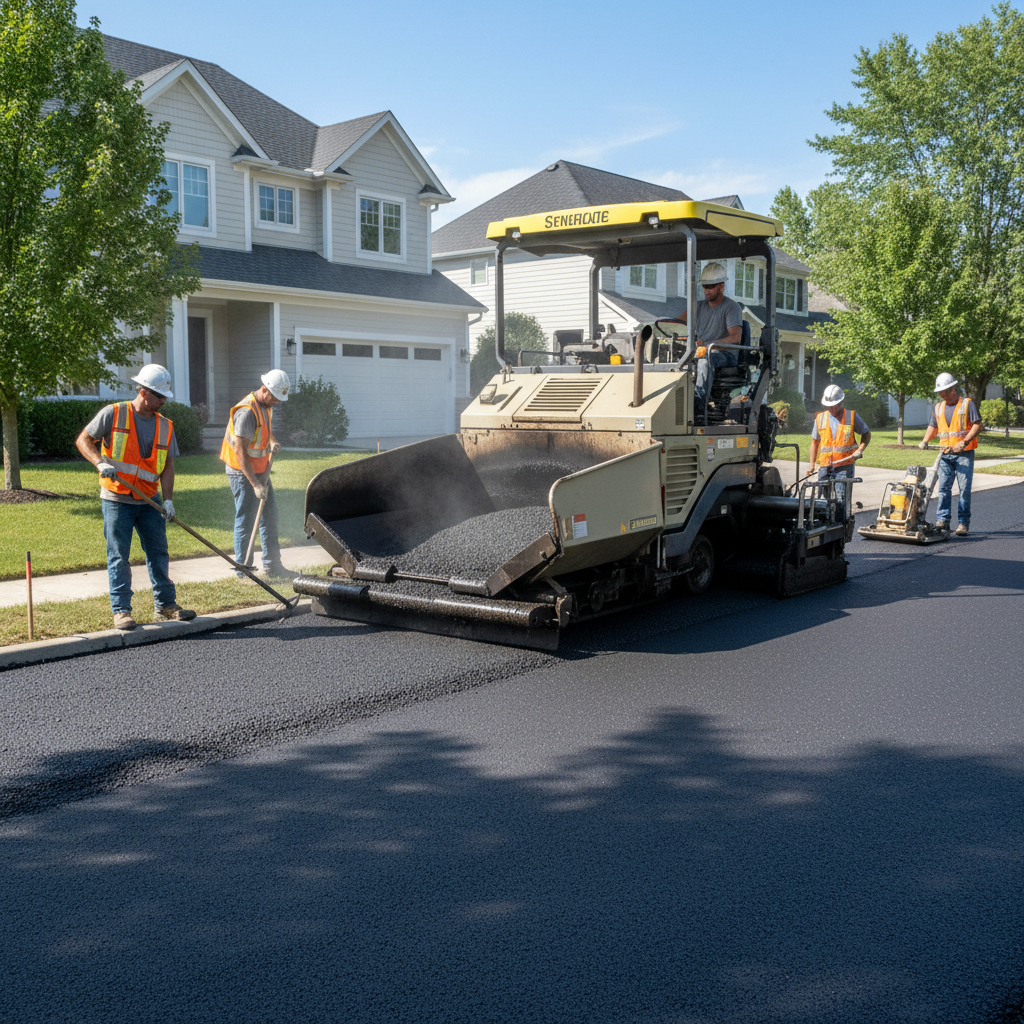
Driveway paving options and costs in Walnut Grove
In Walnut Grove, homeowners typically choose between asphalt, interlocking pavers, and concrete based on curb look, budget, and how well the surface will handle the Lower Mainland–Southwest’s heavy rain periods and shoulder-season storms. With a population of 25,683 (Statistics Canada, 2021 Census), there’s a steady mix of older residences and newer infill, so driveways range from simple gravel renewals to full-depth rebuilds. Because most private driveways here serve detached homes, the addressable market is large and competition among local crews helps keep mainstream pricing in a predictable band.
In the Lower Mainland–Southwest, frost penetration is relatively shallow compared with Interior or Northern BC, but regional practice still assumes a frost line around 18" for exposed driveway conditions. That means base prep and drainage matter more than “going thicker for extreme cold.” Wet soils in parts of the Fraser Valley, combined with freeze–thaw movement near that shallow frost zone, is why reputable contractors price excavation, compacted granular base, and proper slope/drainage as part of the job—not as add-ons.
Demand is especially noticeable in the newer residential pockets around Walnut Grove Drive and the broader family neighbourhood grid where many homeowners are upgrading curb appearance. Below is a practical comparison of typical material lifespans and current price ranges for driveways of similar design, so you can benchmark quotes before a site visit.
| Material |
Lifespan |
Maintenance |
Best For |
Price per sq ft |
| Asphalt (new installation, proper base) |
15–25 years |
Seal every 3–5 years; patching as needed |
Best value, smooth ride, reliable performance with good drainage |
$12 – $20 |
| Asphalt (overlay on existing gravel base) |
10–18 years |
Seal every 3–5 years; more frequent patching if base is weak |
Budget renewal when old base is stable and well-drained |
$12 – $18 |
| Interlocking concrete pavers |
25–35 years (often longer with relaying) |
Rake/replace occasional units; polymeric sand upkeep; reseal only if desired |
High curb appeal and repairability without full replacement |
$20 – $40 |
| Poured concrete (broom finish) |
20–30 years with correct mix and base |
Minimal routine care; occasional crack repairs |
Clean look, straightforward maintenance |
$18 – $35 |
| Exposed aggregate concrete |
20–30 years |
Sealing recommended; crack control depends on base and jointing |
Slip resistance and a decorative surface |
$22 – $40 |
| Gravel / crushed stone (budget option) |
5–10 years |
Top-ups annually; raking; weed control |
Lowest upfront cost while you plan a full rebuild |
$8 – $14 |
Prices are estimates only and vary by project scope, site access and material selection.
What affects the price of paving in Walnut Grove
In the Lower Mainland–Southwest, it’s common to see quotes for the “same driveway” differ by 30–50% once you compare the fine print. The usual drivers are excavation depth, how much grading/drainage correction is included, and whether the contractor is pricing a full, properly compacted base or a partial solution. That gap can widen across British Columbia because labour rates, material logistics, and scheduling pressure change by region—even when the surface looks similar.
Frost line depth and freeze–thaw cycles are decisive cost factors for Walnut Grove. Even with milder coastal winters, the regional assumption of an ~18" frost line for exposed conditions means you can’t skimp on compacted granular thickness. In colder provinces, contractors often go heavier (commonly 6–12 inches compacted granular base in more severe freeze regions), while coastal BC jobs may target the 4–6 inch range only when conditions are exceptionally well-drained. In Walnut Grove, clay-heavy pockets and saturated ground after intense rainfall can push contractors toward deeper, better-draining base builds to prevent heaving, rutting, and cracking.
The paving season is also longer than Northern BC, but work windows still tighten in spring and late fall. Asphalt needs favourable air and surface temperatures (typically above 10°C for hot-mix paving), so scheduling and mix logistics can affect price. On the concrete side, air-entrained mix design and proper jointing matter for freeze–thaw durability.
Concrete examples: if your driveway currently pools water near the garage slab, fixing drainage and slope can add cost even if the final surface is the same. If there’s old asphalt that must be removed and hauled away, tear-out changes the budget quickly—often pushing a project toward the higher end of the paving bands (for example, asphalt commonly sits in the $12–$20 per sq ft range when full-depth base work is included).
| Price Factor |
Why It Matters |
Cost Impact |
| Driveway area in sq ft |
Labour, base, asphalt thickness, and materials scale directly with surface area |
High—often the single biggest driver |
| Base depth required |
Frost line assumptions determine granular thickness and compaction |
Medium–High—small depth changes can add truckloads of material |
| Grading and drainage work |
Proper slope and drainage reduce freeze–thaw movement near the surface |
Medium—adds excavation, shaping, and sometimes drains/curbs |
| Tear-out of existing surface |
Breaking, loading, and disposal of old asphalt or concrete increases labour and equipment time |
High—especially for thick slabs |
| Edge restraints and curbing |
Prevents paver spread and maintains straight driveway edges |
Medium—materials plus extra prep time |
| Sealing requirement |
Asphalt performs best with sealcoat after installation (and then periodically) |
Low–Medium—timing matters (typically after 6–12 months) |
| Site access |
Narrow gates, steep approach, or limited parking slows equipment movement |
Medium—more labour and smaller lifts |
| Asphalt mix specifications |
Freeze–thaw-rated mix design can cost more but reduces early surface failure |
Low–Medium—can push total toward the upper $12–$20 per sq ft range |
Permits & regulations in British Columbia
In British Columbia, paving a private driveway within your own property usually does not require a building permit. In most Walnut Grove driveway projects, the common “no permit” work includes installing new asphalt or pavers on your lot, replacing an existing driveway surface, and re-grading within the private property limits—so long as you’re not changing how stormwater flows onto neighbouring properties.
Work that does typically require municipal approval includes anything in the municipal right-of-way. Examples include: creating or modifying a curb cut where it affects the road/boulevard, altering the boulevard area, changing existing storm drainage connections, or making changes that affect municipal infrastructure. Some areas also have lot-grading rules (for example, limits on how close hard surfaces and drainage swales can be to property lines). Because these details vary by municipality, confirm the applicable requirements with your local municipal office before excavation.
Before a contractor digs, insist on utility locates. In BC, call BC One Call for line marking so excavation doesn’t damage buried services. Next, check the contractor’s legitimacy: verify their BC licence/registration through the appropriate provincial listings, review their Certificate of Insurance for general liability (and request to be listed as an additional insured if offered), and ask what coverage they carry for workers (commonly WSBC/WCB coverage) through their paperwork. A clear, current certificate and a willingness to provide it quickly are good signals that the contractor is accountable and properly insured.
Asphalt vs pavers vs concrete for Walnut Grove driveways
For Walnut Grove driveways, asphalt, interlocking concrete pavers, and concrete each fit different homeowner priorities under a Lower Mainland–Southwest freeze–thaw and rainfall pattern. Asphalt typically has the lowest upfront cost, with the smoothest “walk-on” feel, but it performs best when sealed regularly—usually every 3–5 years after installation. The key is that asphalt needs a well-built granular base and drainage so moisture doesn’t feed freeze–thaw movement near that ~18" frost-zone assumption for exposed applications.
Interlocking concrete pavers cost more upfront, often landing in the $20–$40 per sq ft band, but they shine for curb appeal and repairability. If a utility needs service or a localized area settles, pavers can be lifted and reset without replacing the entire driveway. That flexibility is valuable in neighbourhoods where older drainage patterns sometimes need gradual correction.
Poured concrete sits in the mid-range (often $18–$35 per sq ft), but it’s more sensitive to poor base support and weak jointing. In BC’s wet winters, air-entrained concrete and correct finishing/joint spacing help manage freeze–thaw stresses. Exposed aggregate can be attractive and slip resistant, while permeable options may help in water management designs where the site supports infiltration.
Cost example: if a 500 sq ft driveway is quoted at the asphalt band low end, you might see an asphalt price near $6,000 – $10,000 (area dependent within $12–$20 per sq ft). If pavers come in closer to the upper band, that same driveway could be $10,000 – $20,000. For many Walnut Grove homeowners, that additional cost is justified when they want “front door impact” and long-term repairability rather than periodic asphalt sealing. Salt and sand in winter mainly affect surface wear; the bigger durability differentiator remains how the base and drainage are built from day one.
| Material |
Frost Resistance |
Curb Appeal |
Repair Method |
Lifespan |
Price Band |
| Asphalt (sealed regularly) |
Good with proper base and drainage; best when sealed on schedule |
Medium (clean, modern look) |
Patch the affected area and re-seal locally |
15–25 years |
$12 – $20 |
| Interlocking concrete pavers |
Very good; tolerates minor movement when base is correct |
High (varied patterns and colours) |
Lift/reset individual pavers; relay small sections |
25–35 years |
$20 – $40 |
| Poured concrete (air-entrained) |
Good with air-entrained mix, joints, and drainage |
Medium (depends on finish and edging) |
Crack repair or partial resurfacing; full replacement if widespread |
20–30 years |
$18 – $35 |
| Exposed aggregate concrete |
Good when well supported; surface finish helps grip but doesn’t replace base needs |
High (decorative texture) |
Localized repairs; often more visible than asphalt |
20–30 years |
$22 – $40 |
| Permeable pavers (drainage grid) |
Very good for water management; performance depends on subgrade permeability |
High (modern look) |
Replace or reset affected units and clean system if clogged |
25+ years when maintained |
$24 – $45 |
| Chip seal / tar-and-chip |
Fair to good; sensitive to poor base or poor drainage |
Low–Medium (utility-grade look) |
Localized repairs; periodic top-ups |
7–15 years |
$10 – $16 |
How to choose a paving contractor in Walnut Grove
Choosing the right paving contractor in Walnut Grove is mostly about verification and scope clarity. First, confirm British Columbia coverage and legitimacy. Request the contractor’s licence/registration details (where applicable for their work type) and check it through the official online registry/processes. Then review their Certificate of Insurance (general liability) to ensure it’s current and relevant to paving/excavation work. Ask directly whether they carry workers coverage through WSBC/WCB; a serious contractor should provide proof without pressure or delay. If they can’t produce documentation, treat it as a red flag.
Next, get 2–3 itemised written quotes. You want a breakdown that separates labour and materials—especially excavation, granular base, compaction, asphalt/paver/concrete supply, disposal, and edging or restraints. Avoid “lump sum” only quotes that don’t show thickness and base depth; in the Lower Mainland, a driveway that fails early is usually a base/drainage problem disguised as a surface problem.
Read the exclusions and inclusions carefully. Is permit/municipal approval work included when it’s required in the right-of-way? Is disposal of concrete/asphalt included? What about forming and dowels for concrete? For asphalt, is sealcoat scheduled after cure (often after 6–12 months)? Confirm warranty terms: workmanship warranty length, whether the product/manufacturer warranty applies to the installed system, and if warranties transfer if you sell the home.
Payment schedule matters. Never pay more than about 10–15% upfront. Hold back a portion until the site is cleaned, compacted, and complete. Also insist on a written timeline with an expected start date and a completion estimate, since weather and scheduling windows in BC can tighten.
- Verify their BC registration/licence details before work starts.
- Request and review insurance proof (certificate of insurance) and confirm coverage limits.
- Ask for WSBC/WCB coverage proof for workers, not just the owner.
- Get 2–3 itemised quotes with base depth, thickness, and materials listed.
- Confirm tear-out scope (what’s removed, what’s kept) and whether disposal is included.
- Check drainage plan: slope direction, catch basins/drains if needed.
- Ask about compacted granular base spec and compaction testing/standards.
- Ensure edge restraints/curbing are included, especially for pavers.
- For asphalt, ask when sealcoat will be applied and whether it’s included.
- For concrete, confirm air-entrainment and jointing details.
- Confirm warranty coverage for workmanship and how long it lasts.
- Keep deposits low (10–15%) and hold back until the job is fully complete.
Red flags we see in Walnut Grove: contractors who won’t provide insurance documents or licence details, quotes that don’t specify base thickness and drainage scope, “cheap” asphalt pricing without disposal/haul-away for old material, pressure for large upfront deposits, and vague warranty language with no written terms.
Frequently asked questions — paving in Walnut Grove
Asphalt vs interlocking pavers vs concrete — which is best in Walnut Grove?
For many Walnut Grove homeowners, asphalt is the best blend of cost and performance when the base is built correctly and drainage is addressed. Asphalt typically lands in the $12–$20 per sq ft band, and it will perform well for years if it’s sealed regularly. Interlocking pavers are the premium curb-appeal option (often $20–$40 per sq ft), and they’re easier to repair because you can lift and reset individual stones if a localized settlement or future utility work occurs. Poured concrete is a mid-range choice ($18–$35 per sq ft) but it needs an air-entrained mix, proper jointing, and solid base support to handle Walnut Grove’s freeze–thaw movement near the frost line. If you’re prioritizing front-door look and long-term repairability, pavers often win; if budget matters most, asphalt usually makes the most sense.
How long does a paved driveway last in Walnut Grove?
With proper prep for Walnut Grove’s wet winters and freeze–thaw cycles, asphalt driveways commonly last around 15–25 years. The lifespan depends heavily on base thickness, compaction, and how well water is directed away from the driveway surface. Interlocking concrete pavers are often the longest-lived option, typically 25–35 years, because repairs are localized and the system tolerates minor movement better than a single rigid slab. Poured concrete can last about 20–30 years when it’s air-entrained and joints are done correctly. The bigger risk factor in British Columbia isn’t deep frost like in the Interior—it’s moisture movement and saturation during heavy rain periods. Skipping sealcoat on asphalt (or sealing too late) can shorten the service life even when the initial installation was otherwise solid.
When is the best time of year to pave in Walnut Grove?
In Walnut Grove, the best paving windows are typically late spring through early fall, when weather is steadier and asphalt plants can reliably supply hot-mix. Asphalt generally needs favourable air and surface conditions (commonly above about 10°C) to compact properly. Heavy winter rains and shoulder-season storms can delay scheduling and reduce workable installation windows, which is why spring and summer often book faster. For concrete, you also want consistent temperatures for curing and finishing—cold snaps and wet conditions can complicate workmanship. If you’re planning asphalt, you’ll also want to think ahead for the sealcoat timing, which is often applied after curing—commonly after 6–12 months—so your driveway is protected before the next wet season. Scheduling early helps you avoid rush pricing later in the season.
How deep should the base be for Walnut Grove's frost?
Even though coastal BC has milder winters than the Interior, Walnut Grove driveway projects still need base preparation that accounts for the region’s frost-line assumption of roughly 18" in exposed conditions. In practice, that doesn’t mean every job needs the same number of inches because drainage and subgrade conditions control how moisture behaves. For typical residential asphalt, local best practice often targets about 6" of compacted granular base with around 2.5–3" of asphalt surface thickness, with deeper excavation when the soil is weak or saturated. If your site has clay-heavy soils or evidence of water pooling, a contractor may increase granular thickness and improve drainage to reduce freeze–thaw heaving and cracking. The correct answer comes from an on-site assessment—especially checking for soft spots, water movement, and the driveway’s slope.
How often should I seal my asphalt driveway?
For asphalt driveways in British Columbia (including Walnut Grove), sealing is one of the most cost-effective maintenance steps. A common schedule is to seal every 3–5 years after installation. Sealcoat is usually applied only after the asphalt has cured—often after 6–12 months—so the surface is stable enough for the sealer to bond properly. If you wait too long, oxidation and surface wear progress faster, and you’ll typically need more patching before a new sealcoat can restore the surface. Climate also matters: the Lower Mainland–Southwest gets intense rainfall and wet cycles, so keeping water from penetrating cracks and seams helps reduce freeze–thaw-related deterioration. If your driveway already has many repairs or raveling areas, you may need localized patching before sealing.
Why does my driveway crack and heave in winter?
Cracking and heaving in Walnut Grove’s winter is usually a symptom of moisture and base issues rather than just “normal wear.” During heavy rains, water can saturate the granular base or subgrade. When temperatures drop near the frost line, that moisture can freeze and expand, creating upward movement (heaving). As thaw cycles repeat, the surface may crack, and edges can lift or rut where the base isn’t properly compacted or drained. Clay-heavy soils in parts of the Fraser Valley can worsen this because they hold water longer. Another common cause is insufficient granular thickness for your site conditions, or a slope that doesn’t direct water away from the driveway. If you see cracking paired with pooled water or raised edges, address drainage and base build-up as part of the repair—not only the surface.