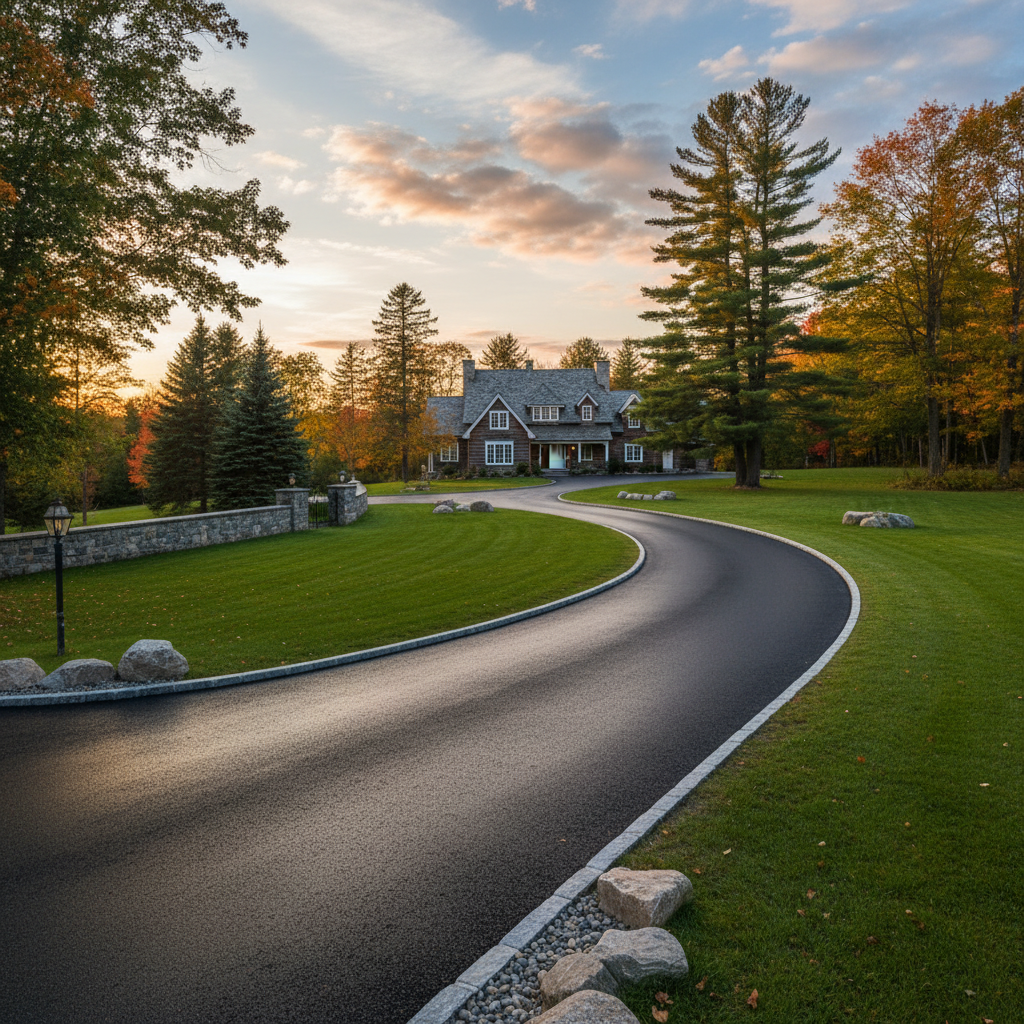
Driveway paving options and costs in Vernon
Driveway paving options in Vernon, British Columbia range from asphalt overlays to premium interlocking pavers, and the right choice usually comes down to your soil, drainage, and how much winter punishment the surface has to take. Vernon has a large base of homeowners—66.0% of households are owner-occupied (Statistics Canada, 2021 Census)—and a housing mix dominated by single-detached homes (47.6% of dwellings). That matters because most residential driveways are attached to detached properties, which is where contractors see the most consistent demand year-round.
In the Thompson–Okanagan region, pricing reflects more than material cost. Freeze–thaw cycling and a deeper effective frost risk for paved surfaces mean driveways are built thicker and stronger than coastal minimums. Crews also schedule around a shorter, weather-sensitive paving window—hot-mix asphalt generally needs warm conditions (typically air temps above 10°C), so spring starts and summer resealing campaigns create tight availability. Areas with steady access demand, like the North Okanagan sector around Okanagan Landing and parts of the Greater Vernon neighbourhoods, often see quicker booking and higher mobilization costs.
If you’re comparing quotes, look for consistency in excavation, compacted granular base, and drainage/grading work—those items can shift the job’s total by a few thousand dollars even when the finished surface looks similar. Use the table below as a practical baseline for budgeting before you meet a contractor.
| Material |
Lifespan |
Maintenance |
Best For |
Price per sq ft |
Price Range |
| Asphalt (new installation, proper base) |
15–25 years |
Seal after 6–12 months, then every 3–5 years |
Value-focused driveways with good drainage |
$4.50–$9.50 |
$4,500–$9,000 |
| Asphalt (overlay on existing gravel base) |
10–18 years |
Seal regularly; monitor edge settlement |
When the base is sound and height changes are limited |
$5.00–$10.50 |
$4,500–$8,500 |
| Interlocking concrete pavers |
25–35 years |
Low-touch; replace individual units if damaged |
Curb appeal and utility access/replacement flexibility |
$10.00–$18.00 |
$6,500–$14,000 |
| Poured concrete (broom finish) |
20–30 years |
Seal as needed; control joints and crack monitoring |
Clean, simple surface with proper jointing |
$10.50–$20.00 |
$7,000–$15,000 |
| Exposed aggregate concrete |
20–30 years |
Seal to protect appearance and reduce staining |
Slip resistance and upgraded look |
$12.00–$22.00 |
$8,000–$16,500 |
| Gravel / crushed stone (budget option) |
2–8 years (varies by grading and traffic) |
Top-up and re-grade as material migrates |
Temporary or low-budget solutions |
$2.00–$5.50 |
$2,500–$6,000 |
Prices are estimates only and vary by project scope, site access and material selection.
What affects the price of paving in Vernon
In Vernon and across the Thompson–Okanagan, two contractors can quote the “same” driveway and still come back 30–50% apart. The gap is usually not the asphalt or concrete itself—it’s the thickness and quality of the base, drainage/grading corrections, how much is being torn out, and how they manage the freeze–thaw risk that’s tougher in the interior than on the coast. Even within British Columbia, local scheduling and crew availability can change mobilization and overhead, so summer start dates and weather delays can also move numbers.
Frost line depth and freeze–thaw cycles are decisive cost factors. When you design for interior conditions, the compacted granular base typically needs more depth to reduce heaving, rutting and cracking. In Vernon, it’s common to target the “total structure” approach (often around the 8.5–9 inch range for residential asphalt and similar thinking for pavers), with approximately 6 inches of compacted base as a baseline for many driveways—then adjusted up for clayey subgrades, slopes, or poor drainage. Asphalt mix design also has to be freeze–thaw rated; mixes that better resist brittleness under repeated temperature swings cost more than minimal-spec material.
Concrete can shift the budget up or down based on how much prep and reinforcement it needs. For example, a driveway with poor drainage may require extra subdrainage and deeper excavation before concrete can be poured, raising the cost toward the $7,000–$15,000 band. On the other hand, if the existing base is stable and you’re staying with a straightforward broom finish, poured concrete can land near the lower end of $7,000–$15,000. Older homes built before 1981 are a sizeable portion of local housing stock (43.4% of dwellings), and those properties frequently have older grading patterns or earlier utility runs that affect excavation depth and disposal quantities.
| Price Factor |
Why It Matters |
Cost Impact |
| Driveway area in sq ft |
Most materials and labour scale directly with surface area. |
Major driver (often the biggest line item). |
| Base depth required |
Frost risk and moisture control determine granular thickness and compaction. |
Moderate to major ($1,000s if base must be upgraded). |
| Grading and drainage work |
Correct slope, swales, and subdrain keep water out of the structure. |
Can add $500–$3,500 depending on site complexity. |
| Tear-out of existing surface |
Breaking concrete or removing old asphalt/gravel adds disposal and labour. |
Often +10% to +30% for heavy tear-out. |
| Edge restraints and curbing |
Pavers and edges need containment to prevent migration and settlement. |
Commonly +$500–$2,000. |
| Sealing requirement |
Asphalt benefits from sealing; skipping early seal cycles increases failure risk. |
Typical add-on: $500–$2,000 total over the early years. |
| Site access |
Truck access, turning radius and staging affect how fast crews can work. |
Can add mobilization time and +$300–$1,500. |
| Asphalt mix specifications |
Freeze–thaw rated mixes improve longevity under Thompson–Okanagan cycling. |
Raises material cost but reduces early cracking/raveling. |
Permits & regulations in British Columbia
In British Columbia, paving a private driveway within your own property typically doesn’t require a building permit. Where it does get regulated is when you touch municipal infrastructure or the drainage regime around the boulevard. For Vernon homeowners, work that generally may require municipal approval/permits includes new or modified curb cuts, changes to boulevard areas, alterations that affect storm drainage, and any work that involves the municipal right-of-way (the area between the road and your fence line). Some properties also run into lot-grading bylaw requirements—especially where a new hard surface could change runoff direction toward neighbours.
Before any excavation, plan utility locates. In BC, call BC 1 Call (utilities may include power, telecom, and irrigation/low-voltage lines). Once locates are marked, a contractor should confirm they can work within the safe tolerance zone and verify any permitted limits for excavation and disposal.
To verify a contractor in Vernon, check three things step-by-step: (1) Licensing/registration for the contractor where applicable—start by reviewing their business profile online and confirming they’re properly set up to do paving work; (2) liability insurance—ask for a current certificate of insurance and confirm coverage limits and dates; and (3) work coverage—request proof of their WCB/coverage status (for workers they employ). A contractor should also provide a clear, written agreement and documentation you can keep with your records.
Asphalt vs pavers vs concrete for Vernon driveways
For Vernon driveways, asphalt, interlocking pavers and concrete each have a “right” place. Asphalt is usually the lowest upfront cost, but it needs disciplined sealing after installation—typically within 6–12 months—then every 3–5 years to protect against water intrusion and freeze–thaw damage. In Thompson–Okanagan winters, that moisture sensitivity matters; if water gets into micro-voids, it expands during freezing and accelerates surface cracking.
Interlocking concrete pavers cost more initially, but they handle maintenance better. If a utility line is repaired later, pavers can often be lifted and reset without replacing the whole driveway. That repairability is a practical advantage in older Vernon properties (43.4% built before 1981), where service lines and site grading can change over time. Pavers also perform well when edged with proper restraints and built on a compacted base with the right bedding sand.
Poured concrete sits in the middle for price and can last a long time when it’s properly air-entrained and jointed. However, freeze–thaw and de-icing habits can expose weak details—especially when joint spacing, finishing, or drainage is off. For example, if you compare $4,500–$9,000 asphalt to $6,500–$14,000 pavers, the extra budget is justified when you want top curb appeal, need easier spot repairs, or expect future utility adjustments. If your priority is the best cost per year and your drainage is solid, asphalt often wins. If your priority is the “finished look” and longevity with repair flexibility, pavers are hard to beat.
| Material |
Frost Resistance |
Curb Appeal |
Repair Method |
Lifespan |
Price Band |
| Asphalt (sealed regularly) |
Good when built on a proper granular base and sealed on schedule |
Medium (clean blacktop) |
Patch and re-seal targeted sections |
15–25 years |
$4,500–$9,000 |
| Interlocking concrete pavers |
Excellent with correct base, restraints, and drainage |
High (wide colour/pattern options) |
Lift and replace individual units |
25–35 years |
$6,500–$14,000 |
| Poured concrete (air-entrained) |
Very good when joints, finishing and drainage are correct |
Medium to high (clean slab look) |
Patch or re-surface; cracks may require targeted repairs |
20–30 years |
$7,000–$15,000 |
| Exposed aggregate concrete |
Very good with correct curing and sealing plan |
Very high |
Patch sections; aesthetic touch-ups limited but manageable |
20–30 years |
$8,000–$16,500 |
| Permeable pavers (drainage grid) |
Excellent for moisture management when designed correctly |
High (technical drainage look) |
Replace affected units; maintain permeability |
20–30 years |
$7,500–$16,000 |
| Chip seal / tar-and-chip |
Moderate; depends heavily on maintenance and traffic |
Low to medium |
Re-seal or re-chip as needed |
8–15 years |
$4,000–$8,000 |
How to choose a paving contractor in Vernon
Choosing the right paving contractor in Vernon starts with verifying British Columbia coverage and checking paperwork—not just the price on the sign. Ask for their liability insurance certificate (make sure it’s current and shows they’re covered for the work). If the contractor has employees, request proof of WCB/work coverage status. You should also confirm they’re properly set up for the type of work being proposed—your quote should show the scope clearly enough that it aligns with what they’re licensed/registered to perform.
Next, get 2–3 quotes that are truly comparable. Prefer itemised written estimates with a breakdown for excavation, hauling/disposal, base supply and compaction, geotextile (if used), granular bedding, surface installation, and any asphalt sealing. Avoid “lump sum” quotes that don’t state what’s included—especially around grading/drainage corrections and edge restraints.
Read the scope like a checklist: what’s excluded (like rock removal beyond a threshold), is permit work included if the project touches the right-of-way, and is disposal included in the hauling price? Warranty matters too: confirm workmanship warranty length, whether it covers both materials and labour or labour only, whether the warranty is from the installer versus the manufacturer, and whether it’s transferable if you sell the home.
Payment schedules should be conservative. Never pay more than 10–15% upfront; hold back the balance until the job is complete and deficiencies are addressed. Finally, demand a timeline in writing—start date and completion estimate—because weather risk is real in the Okanagan interior.
- Verify liability insurance (current certificate) and request it with your quote.
- Request WCB/work coverage proof if they employ workers.
- Confirm the quote includes excavation, hauling and disposal—not just “paving.”
- Ask how they’ll handle drainage: slope, swales, culvert tie-ins, or subdrain if needed.
- Confirm compacted base thickness and compaction method (no “we’ll do our best” language).
- For pavers, require edge restraints/locking details to prevent spread and washouts.
- For asphalt, confirm a sealing plan (timing and product) after installation.
- Check whether geotextile is included for separation if soil conditions warrant it.
- Get unit-rate items or allowances for unforeseen rock/clay so change orders are controlled.
- Ask for warranty terms in writing, including what triggers coverage and response time.
- Verify your payment schedule: 10–15% max deposit; holdback until final acceptance.
- Ensure the start date, completion window, and weather contingency plan are written.
Red flags I often see in Vernon include: vague base specs (no thickness/compaction), missing disposal/hauling line items, no written drainage plan, warranties described only verbally, and contractors pushing large upfront deposits. If a quote won’t clearly say what’s included—and can’t explain the frost-proof section design—you should walk away.
Frequently asked questions — paving in Vernon
What base thickness do I need for pavers in Vernon?
In Vernon, base thickness for interlocking pavers isn’t a one-size number—it’s driven by your subgrade (clay vs. granular), driveway slope, and how well water is drained away. As a practical baseline, many residential builds in the Thompson–Okanagan target a compacted granular base of about 6 inches, then complete the “total structure” with bedding sand and proper restraints. If you have soft or clayey soil, a steeper grade, or signs of past washboarding, contractors typically increase excavation and upgrade the granular section to reduce heaving and settlement during freeze–thaw cycles. Don’t accept “standard depth” without a subgrade assessment and a written cross-section.
How do I get the most accurate paving quote in Vernon?
For the most accurate quote in Vernon, ask for an on-site visit and a written scope that matches your actual conditions. Good contractors measure driveway area, check access for trucks and equipment, and assess drainage and existing base stability. Make sure the estimate states excavation depth, base type and thickness, compacted lift approach, and whether geotextile is included when needed. Compare apples-to-apples: ask what’s included for tear-out, disposal, edges/curbs, and (for asphalt) whether sealing is scheduled after curing. If a contractor gives only a rough range without listing these items, you may see surprises once work starts.
How much does it cost to pave a driveway in Vernon?
Cost depends mainly on driveway size, base prep, and whether you’re installing new pavement or overlaying an existing surface. In Vernon, typical budget bands for residential projects commonly fall into: asphalt driveway paving around $4,500–$9,000, interlocking pavers around $6,500–$14,000, and concrete driveway work around $7,000–$15,000. A key point in the Thompson–Okanagan interior is that freeze–thaw durability often requires more granular base and better drainage details than minimal builds. If your subgrade needs upgrading or you have significant tear-out, expect pricing to move toward the higher end of the band.
Asphalt vs interlocking pavers vs concrete — which is best in Vernon?
There isn’t one winner for every Vernon driveway, because homeowner priorities differ. Asphalt is often best for value when you maintain it—plan for sealing within 6–12 months, then every 3–5 years—so water can’t work its way into the structure during freeze–thaw. Interlocking concrete pavers usually cost more upfront (often $6,500–$14,000) but offer top curb appeal and easier spot repairs without replacing the entire surface. Poured concrete can be a strong mid-range option (commonly $7,000–$15,000) when it’s air-entrained, properly jointed, and installed over the right base with good drainage. The “best” choice is the one built to your soil and drainage situation.
How long does a paved driveway last in Vernon?
With correct installation and maintenance, many Vernon driveways last well into the decades. Asphalt often performs for roughly 15–25 years when it’s built on a proper compacted base and sealed on schedule. Interlocking pavers typically last about 25–35 years because damaged units can be replaced and water management is easier when the system is built correctly. Poured and exposed aggregate concrete can also reach around 20–30 years when joints, curing, and drainage are done right. In the Thompson–Okanagan, the biggest longevity factor is water control—standing water and poor grading lead to earlier cracking and settlement under repeated freezing and thawing.
When is the best time of year to pave in Vernon?
For Vernon in the Thompson–Okanagan, the best time is usually late spring through summer, when temperatures are consistently warm enough for paving and compaction. Asphalt installation generally requires warm air temperatures (commonly above 10°C) so the mix can be placed and compacted properly; crews also want dry working conditions to protect the base from getting saturated. For interlocking pavers and concrete, timing still matters because subgrade moisture and frost can affect compaction and finishing. Planning early can help because scheduling pressure builds during the short paving window. If the weather turns cold mid-project, a reliable contractor should have a plan to protect the unfinished work.