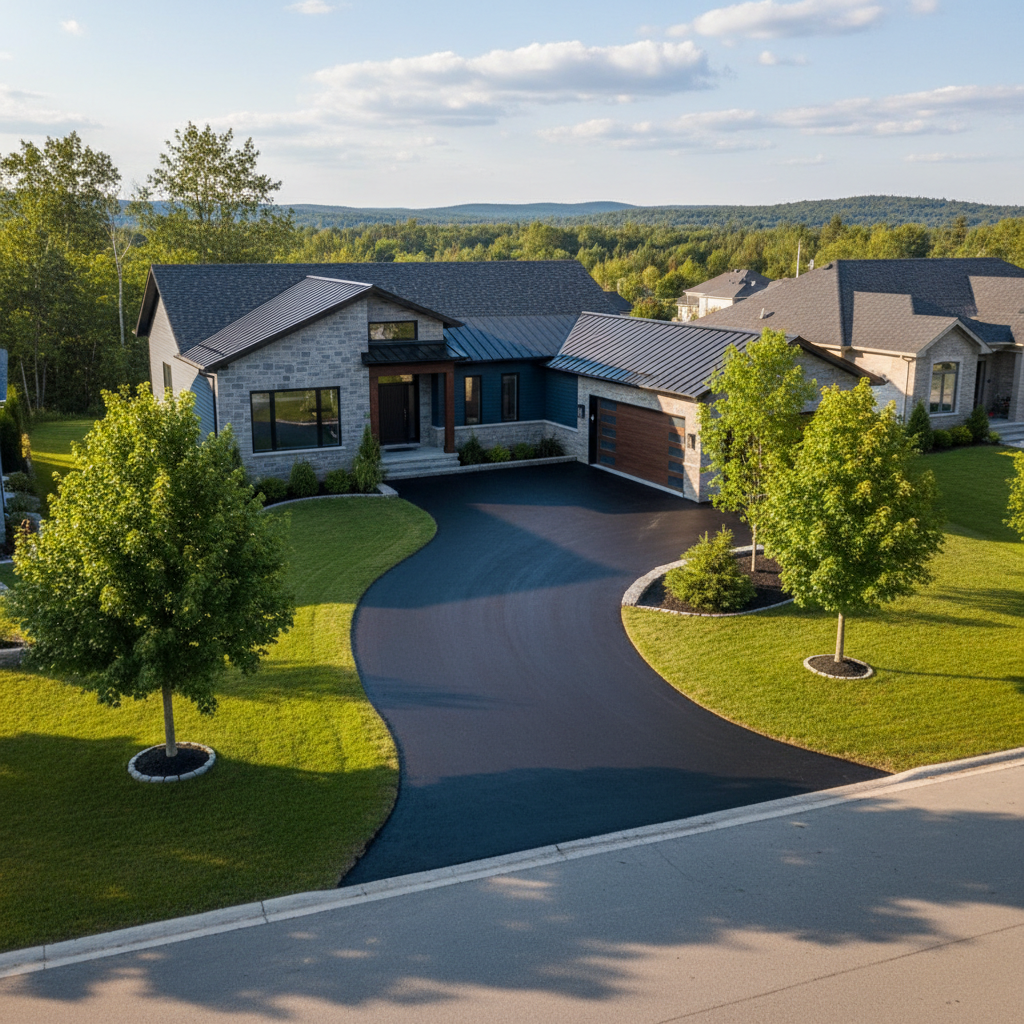
Driveway paving options and costs in Trail
Trail, British Columbia has a very different driveway reality than the Lower Mainland: colder interior temperatures and repeated freeze–thaw cycles mean your paving is only as good as the base, drainage, and compaction beneath it. That matters in Trail because the housing stock is older—87.4% of homes were built before 1981—so many driveways have been patched over the years, and the existing subgrade may need reworking. With 70.4% of dwellings being single-detached homes, most private driveways here are tied to detached properties, and that’s a large, consistent demand pool for asphalt, pavers, and concrete.
In the Kootenay region, frost depth is commonly around 45–60 inches depending on elevation and micro-climate. In plain terms: your contractor can’t “wing it.” Driveways, walkways, and pads typically need 6–10 inches of compacted granular base (and sometimes more if soils are weaker or clayey), plus reliable runoff direction away from the slab. Also, the paving season is shorter—hot-mix asphalt generally needs air temperatures above 10°C—so contractor availability and scheduling can affect final pricing.
You’ll also notice especially heavy traffic in established neighbourhoods like West Trail, where homeowners tend to refresh driveways as part of landscaping updates and snow-removal routines. Below is a practical comparison of options you’ll see in Trail quotes, with realistic price ranges to help you budget before you measure the driveway area and finalize materials.
| Material |
Lifespan |
Maintenance |
Best For |
Price per sq ft |
Price Range |
| Asphalt (new installation, proper base) |
15–25 years |
Seal coat at 3–5 years, then as needed |
Lowest upfront cost with solid performance |
$10–$20 |
$7,000–$13,000 |
| Asphalt (overlay on existing gravel base) |
10–18 years |
Seal coat earlier if overlay is thin |
Cost-controlled resurfacing when base is sound |
$9–$18 |
$6,500–$11,500 |
| Interlocking concrete pavers |
25–40 years |
Re-level sand joints as needed |
Curb appeal and repairs without full replacement |
$18–$28 |
$9,000–$16,000 |
| Poured concrete (broom finish) |
25–35 years (if properly air-entrained) |
Sealant every 5–10 years; crack monitoring |
Simple, durable surface with consistent appearance |
$16–$26 |
$11,000–$18,000 |
| Exposed aggregate concrete |
25–35 years |
Sealant every 5–8 years |
Slip-resistant look with premium feel |
$18–$30 |
$12,000–$20,000 |
| Gravel / crushed stone (budget option) |
3–10 years (varies by drainage and grading) |
Re-grade and top up 1–3 times per season |
Short-term budget solution or steep access constraints |
$4–$10 |
$3,500–$8,500 |
Prices are estimates only and vary by project scope, site access and material selection.
What affects the price of paving in Trail
In Trail, you can easily see the same driveway concept priced 30–50% differently depending on how each contractor builds the base, handles drainage, and what they include in their scope. Some quotes look “close” on paper, but one contractor may be assuming deeper excavation and better road base for freeze protection, while another may treat it as a simple resurfacing. Because the Kootenay region sits in a colder interior zone, frost depth and freeze–thaw cycles are decisive cost factors. In practical terms, deeper frost requires a thicker compacted granular base—closer to 6–12 inches in most interior driveway builds—so that the surface doesn’t heave, pump fines, or crack after spring melt. That base work adds excavation, compaction time, and imported materials.
The shorter paving season also compresses demand. Hot-mix asphalt generally requires air temperatures above 10°C, so scheduling risk is real; contractors may stage crews differently, and mobilization can be spread over fewer working weeks. For asphalt, mix design that meets freeze–thaw performance expectations can also affect cost within the regional asphalt band of $7,000–$13,000.
Concrete costs in Trail can rise when the slab needs more than “minimum thickness.” Two common examples: if your current driveway has soft spots or clayey subgrade, contractors often increase the base depth and require more granular separation; and if runoff from roofs and slopes currently directs water toward the slab, drainage correction (ditch shaping, compacted subdrains, or grading changes) adds labour but prevents premature settlement. If the project is a straightforward replacement with good access and firm subgrade, you’ll generally land nearer the lower end of concrete pricing (often around $11,000–$18,000) than on a full tear-out/rebuild.
| Price Factor |
Why It Matters |
Cost Impact |
| Driveway area in sq ft |
Materials and labour scale directly with surface area |
Major swing (often 50%+ of the variance) |
| Base depth required |
Frost protection depends on granular thickness and compaction |
Moderate to major increase when deeper base is needed |
| Grading and drainage work |
Proper slope and runoff control reduce water infiltration |
Can add significant labour and imported material |
| Tear-out of existing surface |
Breaking, hauling, and proper disposal take time |
Major increase on old asphalt/concrete |
| Edge restraints and curbing |
Prevents paver movement and asphalt raveling |
Moderate increase; protects long-term performance |
| Sealing requirement |
Asphalt typically needs sealing after initial cure period |
Small-medium add to schedule and long-term cost planning |
| Site access |
Narrow driveways slow delivery, staging, and machine movement |
Moderate increase due to labour time |
| Asphalt mix specifications |
Freeze–thaw-rated mixes can cost more |
Small-medium increase; helps reduce early cracking |
Permits & regulations in British Columbia
In British Columbia, paving a private driveway within your own property typically does not require a building permit when you’re simply installing a new surface on your lot. However, work that affects municipal infrastructure or drainage usually does require approval. In Trail, the key line to understand is whether your project touches the municipal right-of-way (boulevard/road allowance) or changes stormwater behaviour.
Work that commonly DOES require municipal approval includes: new or altered curb cuts, changes to boulevard grading, any adjustments that affect storm drainage (tie-ins, re-routing runoff, adding or modifying drainage structures in the right-of-way), and changes to lot grading that alter how water leaves your property. Work that typically does NOT require a permit includes: replacing asphalt or concrete strictly within your property limits, installing pavers on your private driveway footprint, and like-for-like repairs—assuming you’re not changing drainage patterns onto municipal property.
To verify compliance and contractor credibility in Trail, use a simple step-by-step process. First, ask for a Certificate of Insurance (general liability) and confirm coverage limits and that the certificate is current. Next, confirm the contractor’s clear business registration/licence information and that they have coverage through the proper provincial workers’ compensation system (often discussed as WCB/WSBC) so you’re not exposed if a worker is injured. You can also ask for a clearance letter. Finally, before excavation, call utility locates via BC 1 Call so they mark buried lines; the contractor should provide a locate reference number and re-check before digging.
Asphalt vs pavers vs concrete for Trail driveways
For Trail driveways, asphalt, interlocking concrete pavers, and concrete all work—but they suit different homeowner priorities under freeze–thaw. Asphalt is usually the lowest upfront option and performs well when built on a deep, well-compacted granular base with good drainage. The trade-off is maintenance: you should plan for sealing every 3–5 years to protect the surface and reduce moisture intrusion during spring melt. If your driveway sees heavy plowing and regular salt/sand use, sealing timing matters.
Interlocking concrete pavers cost more upfront, but they handle local movement better because individual stones can be lifted, re-leveled, and reset without replacing the entire driveway. That repair flexibility is a real advantage in older Trail properties—built before 1981—where subgrade issues may emerge later. Paver performance still depends on a proper base and edge restraints, especially with frost heave risk.
Poured concrete sits in the mid-range cost bracket. It can last a long time if the mix is air-entrained and the base is thick enough for interior frost depth. But concrete can crack from freeze–thaw and settlement if drainage isn’t corrected or if the slab was placed on weak soils. In Trail, an owner-focused comparison often comes down to: do you want the lowest first bill (asphalt, commonly within $7,000–$13,000) or the highest curb appeal with easier targeted repairs (pavers, commonly within $9,000–$16,000)?
Example: if your driveway quotes differ by about $3,000 between asphalt and pavers, that difference is usually justified when you want a long-term “keep-and-repair” approach and you expect future landscape or utility access work. If your subgrade is strong and you’re comfortable planning sealing, asphalt can be the better value for many homeowners.
| Material |
Frost Resistance |
Curb Appeal |
Repair Method |
Lifespan |
Price Band |
| Asphalt (sealed regularly) |
Good with deep base and drainage |
Good (clean, consistent finish) |
Mill/patch or overlay sections |
15–25 years |
$7,000–$13,000 |
| Interlocking concrete pavers |
Very good (flexible surface system) |
Excellent (wide design options) |
Lift/reset individual blocks |
25–40 years |
$9,000–$16,000 |
| Poured concrete (air-entrained) |
Good when properly built and drained |
Good to very good |
Crack repair and patching |
25–35 years |
$11,000–$18,000 |
| Exposed aggregate concrete |
Good (similar to concrete slab requirements) |
Very good (premium texture) |
Patch/replace affected sections |
25–35 years |
$12,000–$20,000 |
| Permeable pavers (drainage grid) |
Excellent for managing runoff into base |
Good to very good (modular look) |
Lift/reset blocks in affected areas |
20–35 years |
$10,500–$18,500 |
| Chip seal / tar-and-chip |
Moderate to good (surface wear varies) |
Functional, not high-cosmetic |
Spot cover and re-chip as needed |
7–15 years |
$6,000–$11,000 |
How to choose a paving contractor in Trail
Choosing a paving contractor in Trail is mainly about verifying coverage, comparing like-for-like scopes, and protecting yourself with payment structure. Start with British Columbia licensing and insurance. Ask for their general liability insurance certificate and confirm the coverage is current and adequate for driveway-scale work. For worker coverage, confirm they carry the proper provincial workers’ compensation coverage (commonly referenced as WCB/WSBC depending on wording) and request a clearance letter if available. If anything feels vague, move on.
Next, get 2–3 itemised written quotes. You want line items for excavation, granular base depth and type, drainage/grading work, disposal, and the paving surface itself—plus edge restraints/curbs for pavers. Avoid quotes that only show a total; in Trail’s freeze–thaw conditions, scope differences are where the money goes. Also confirm whether a permit or municipal approval is included when your driveway affects the boulevard, curb cut, or drainage in the right-of-way.
Warranty matters. Ask for workmanship warranty length (not just “materials”), what defects it covers, and whether it’s transferable to a future homeowner. Finally, use a smart payment schedule: never pay more than 10–15% upfront. Hold back a portion until the final walkthrough and close-out items are completed.
Timeline should be in writing with a start date window and completion estimate. In the Kootenays, crews can be affected by late spring weather, so a contract should reflect realistic scheduling for asphalt and concrete work.
- Ask for proof of insurance (certificate of liability) and verify the expiry date.
- Request confirmation of workers’ compensation coverage and a clearance letter if possible.
- Verify they’re licensed/registered appropriately in British Columbia for the scope of work.
- Get 2–3 quotes that list excavation and base thickness in inches.
- Confirm granular base spec (type) and how compaction will be done (thin lifts).
- Check whether drainage/grading corrections are included (slope away from the structure).
- Ask if tear-out, breaking, and disposal are included in the price—not “allowances.”
- For pavers, require edge restraints/curbing details to prevent spreading.
- For asphalt, confirm seal coat timing and whether it’s a starter and/or included future step.
- Ask how they handle utility locates (BC 1 Call reference before excavation).
- Confirm warranty: workmanship length, exclusions, and what triggers a service call.
- Use a payment schedule that holds back completion funds (target 10–15% at end).
Red flags in Trail include: (1) quotes that don’t mention granular base depth or compaction method, (2) “too-good-to-be-true” pricing that skips drainage correction, (3) no written scope for tear-out/disposal, (4) refusing to provide insurance/coverage paperwork, and (5) pressure to pay most of the total upfront before any materials are on site.
Frequently asked questions — paving in Trail
What base thickness do I need for pavers in Trail?
For Trail’s interior freeze–thaw conditions, paver base is typically built deeper than coastal applications. In most driveway builds, you’re usually looking at around 6–10 inches of compacted granular base (and sometimes more) depending on soil stability and the frost-protection design. Because Trail homes are older—87.4% built before 1981—some properties have subgrade that needs improvement, so a contractor may increase base depth or require additional granular separation if clayey soils are present. The most important part is compaction in thin lifts and a drainage slope that directs water away from the house. Ask your contractor to state the granular base depth in inches, not just “proper base.”
How do I get the most accurate paving quote in Trail?
For the most accurate quote in Trail, start by measuring the actual driveway area (length x width) and ask for an on-site visit so the contractor can assess the existing subgrade and drainage. Make sure each quote includes the same scope: excavation depth, granular base thickness, compaction approach, edge restraints/curbs for pavers, and tear-out/disposal if replacing an old surface. In Trail’s Kootenay climate, details matter because frost penetration can be commonly around 45–60 inches, so skipping drainage corrections can cause early movement. Request line items (labour + materials), not just a lump sum. Also confirm whether municipal approvals are needed if your work touches the boulevard or storm drainage in the right-of-way.
How much does it cost to pave a driveway in Trail?
Typical driveway paving costs in Trail usually land within the region’s asphalt, concrete, and paver price bands. Asphalt driveway paving is commonly quoted around $7,000–$13,000, with final cost depending on excavation, base depth, and whether it’s new installation versus overlay. Interlocking concrete pavers often price around $9,000–$16,000, while poured concrete driveway work is commonly in the $11,000–$18,000 range. If your driveway requires major tear-out or drainage/grading correction, the low end of the band may not apply. If the subgrade is firm and access is easy, bids often tighten toward the middle.
Asphalt vs interlocking pavers vs concrete — which is best in Trail?
There isn’t one “best” choice for Trail; it depends on how you handle maintenance and what you value most. Asphalt is usually best for homeowners wanting the lowest upfront cost and a smooth surface, as long as it’s sealed after the initial cure period and built on a deep, compacted granular base. Interlocking pavers are often the best match when you want curb appeal and repairability—if a section settles in freeze–thaw seasons, stones can be reset without replacing the whole driveway. Poured concrete can be durable, but it needs air-entrained concrete and good base/drainage to resist cracking from interior freeze–thaw and spring melt. If you compare costs, pavers’ higher upfront budget (often $9,000–$16,000) can be worth it where repairs and long-term appearance matter most.
How long does a paved driveway last in Trail?
In Trail’s cold interior climate, driveway lifespan depends heavily on base construction and drainage, not just the surface material. Asphalt typically lasts about 15–25 years when installed with a proper base and sealed regularly. Interlocking concrete pavers often last 25–40 years because the system can be repaired by lifting and resetting individual units if settlement occurs. Poured concrete commonly lasts 25–35 years when it’s air-entrained and placed on the right foundation. If a driveway is built too thin, water infiltrates the base, or compaction is inadequate, you’ll see earlier failures after repeated freeze–thaw cycles. That’s why older Trail homes—87.4% built before 1981—sometimes need deeper prep to reach the top end of these lifespans.
When is the best time of year to pave in Trail?
The best time to pave in Trail is late spring through early fall, when temperatures support production and curing. Asphalt typically requires air temperatures above 10°C, so spring scheduling often depends on daytime warmth and night frost risk. Concrete can also be affected by cold snaps; freezing temperatures during early curing can increase risk of surface issues, so crews usually plan around stable weather. In the Kootenays, weather volatility is a real factor, so it’s smart to book earlier in the season and ask for a written timeline that accounts for potential delays. If you’re comparing quotes, consider that peak summer demand may tighten availability and affect scheduling—even if the materials are the same.