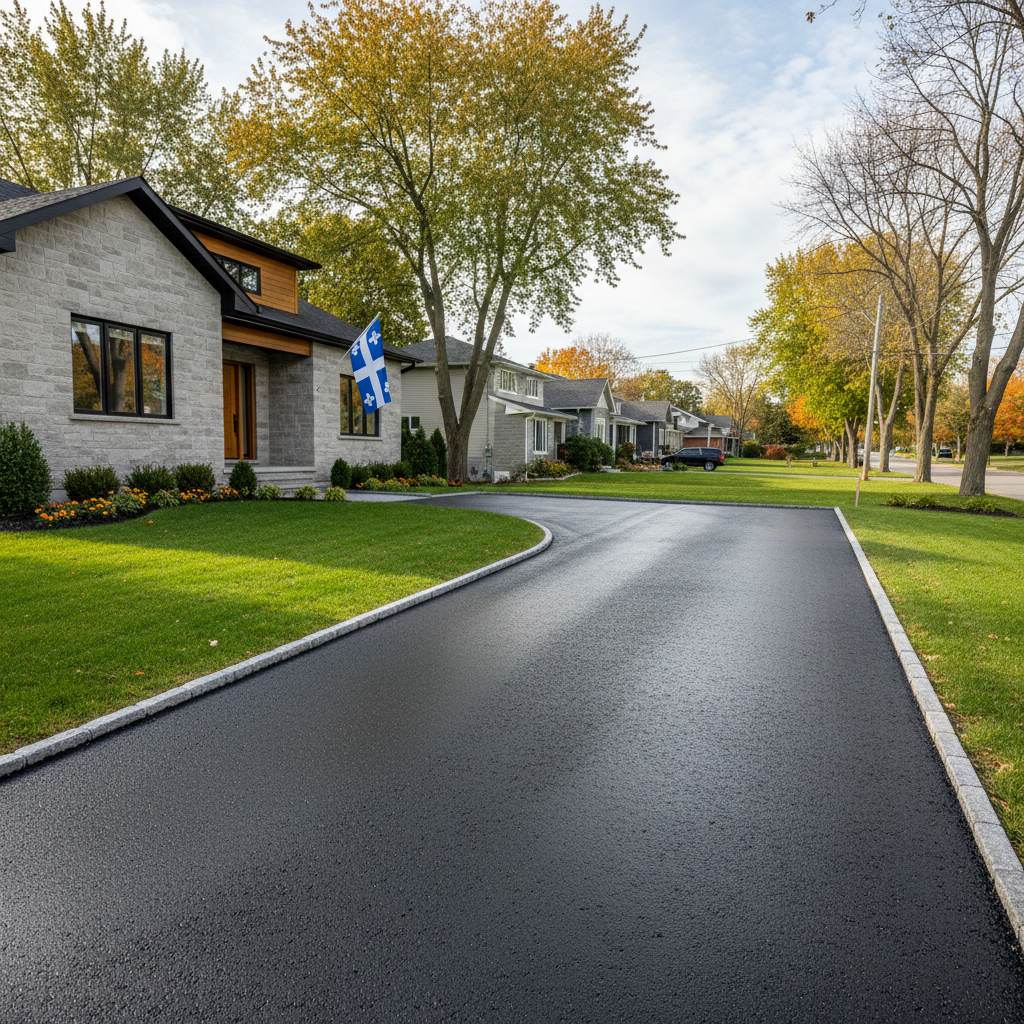
Driveway paving options and costs in Upper Lynn
Upper Lynn is a small community on the Lower Mainland–Southwest, with a population of 3,381 (Statistics Canada, 2021 Census). Most private driveways here are attached to single-detached homes, so driveway resurfacing and full replacements tend to be steady—especially around cul-de-sacs and older streets where original surfaces are nearing end of life. In the Lower Mainland–Southwest, intense rainfall and drainage matter more for long-term performance than deep interior-style frost. While the frost line is relatively shallow, local practice still plans for freeze–thaw activity around that zone, so a properly compacted granular base and correct slopes are what protect your driveway from rutting, heaving, and cracking. That focus on drainage and base prep is a big reason Lower Mainland pricing can be higher than “budget” expectations.
Contractor availability and scheduling also shape quotes. Even though the paving season is longer than in Northern BC, heavy shoulder-season storms (and spring saturation) can compress workable windows and tighten crews, which can shift labour pricing and start dates. If you’re in the Westwood-style pockets of Upper Lynn where lots are a bit tighter and drainage is more variable, expect extra attention to excavation, shaping, and edge restraint.
Below is a practical comparison of common materials and what they typically cost per square foot when installed with appropriate base and drainage.
| Material |
Lifespan |
Maintenance |
Best For |
Price per sq ft |
| Asphalt (new installation, proper base) |
15–25 years |
Seal every 3–5 years |
Value-focused driveways with good drainage and regular sealing |
$12–$20 |
| Asphalt (overlay on existing gravel base) |
10–18 years |
Seal every 3–5 years; monitor for base weakness |
When the existing base is sound and thickness is adequate |
$10–$16 |
| Interlocking concrete pavers |
25–35 years |
Replace individual stones as needed; re-level sand over time |
Higher curb appeal and easier spot repairs |
$20–$40 |
| Poured concrete (broom finish) |
25–30 years |
Seal selectively; occasional patching |
Low-maintenance, straight-edged driveway layouts |
$18–$35 |
| Exposed aggregate concrete |
25–30 years |
Seal periodically to reduce staining |
Slip-resistant finish with strong curb appeal |
$22–$40 |
| Gravel / crushed stone (budget option) |
3–8 years |
Top up and re-grade as needed |
Temporary solution or very budget-sensitive projects |
$6–$12 |
Prices are estimates only and vary by project scope, site access and material selection.
What affects the price of paving in Upper Lynn
Two quotes for what looks like the same driveway in Upper Lynn can differ by 30–50% across the Lower Mainland–Southwest and the wider British Columbia market because the “cheap” quote often assumes easier site conditions, thinner base, or less drainage work. In reality, paving cost is mostly controlled by excavation volume, base thickness and compaction, and the labour required to correct slope and manage water. That’s why an asphalt driveway at roughly $12–$20 per sq ft can jump when the base is weak or saturated, even though the surface material sounds similar.
Frost line depth and freeze–thaw cycles are decisive cost factors in the Lower Mainland–Southwest. Even though coastal frost is less severe than Interior BC, freeze–thaw around sensitive infrastructure still affects performance. Where deeper granular placement is needed (or where clay-heavy soils are present), contractors must increase compacted granular depth so the driveway doesn’t heave or crack. Practically, that means more than “just paving”: base gravel quantities and compaction time rise, and drainage corrections become essential. Asphalt mix design also matters; a freeze–thaw-rated mix that performs locally can cost more than a basic supply.
Local concrete pricing can move too. For example, if you need thickened edges or a strong apron transition to handle vehicle loads, poured concrete can land nearer the mid-to-upper end of $18–$35 per sq ft. Conversely, if your driveway is already well-graded, with a stable base and good outlet drainage, costs can settle closer to the low end because the labour hours are reduced.
| Price Factor |
Why It Matters |
Cost Impact |
| Driveway area in sq ft |
Most material and labour scale directly with surface area |
High (often the biggest single driver) |
| Base depth required |
Frost protection and stability depend on compacted granular thickness |
High (can materially change excavation and gravel volumes) |
| Grading and drainage work |
Proper slopes and outlets prevent pooling and weaken-freeze action |
Medium–High (more shaping, more shop time) |
| Tear-out of existing surface |
Concrete/asphalt removal includes breaking, loading, haul-off, and prep |
Medium–High (disposal and labour add quickly) |
| Edge restraints and curbing |
Prevents asphalt washout and paver spread under repeated traffic |
Medium (often overlooked until late) |
| Sealing requirement |
Asphalt needs sealing after installation for moisture resistance |
Low–Medium (small line item with big performance payoff) |
| Site access |
Narrow lots or limited staging slow equipment movement |
Medium (more time per tonne and per cut) |
| Asphalt mix specifications |
Freeze–thaw-rated mix and proper binder choices improve long-term durability |
Low–Medium (premium mix can be offset by fewer repairs) |
Permits & regulations in British Columbia
In British Columbia, paving a private driveway on your own property typically does not require a building permit when you’re staying within established setbacks and not altering municipal infrastructure. The common cases that do require municipal approval are when you work in the municipal right-of-way—such as creating or changing a curb cut (driveway apron), changing boulevard landscaping/grading that affects storm drainage, or tying into/altering stormwater infrastructure. Some areas also have lot-grading bylaws that limit how close a hard surface can be to property lines and how runoff must be directed. Because Upper Lynn is part of the broader Lower Mainland–Southwest region, drainage compliance is a recurring inspection concern after heavy rainfall.
Before digging, call for utility locates using BC 1 Call so marked services are protected. Then verify the contractor’s credentials: check their British Columbia business details (and any applicable contractor registration/credentials) online, ask for a current Certificate of Insurance showing general liability, and confirm coverage appropriate to the job. For workplace protection, you’ll want confirmation of the contractor’s coverage for their workers (commonly referenced as WSBC-related coverage in BC) before work starts.
Step-by-step for homeowners: (1) ask for proof of insurance and coverage; (2) request the licence/registration details and confirm them online; (3) review the written scope and who handles permits and inspections; (4) get it all in writing before excavation begins.
Asphalt vs pavers vs concrete for Upper Lynn driveways
For Upper Lynn driveways in the Lower Mainland–Southwest, asphalt, interlocking pavers, and concrete all can work—so the real decision comes down to upfront cost, drainage tolerance, and how you prefer to handle maintenance. Asphalt usually has the lowest upfront cost (often around $12–$20 per sq ft when installed with proper base and thickness). It performs well when the slope drains correctly, but it does need sealing every 3–5 years to protect the surface from moisture and fine cracking caused by repeated wetting and drying. Interlocking concrete pavers cost more—commonly in the $20–$40 range—but they’re highly repairable: if a settlement spot forms, you can lift and reset pavers rather than replacing the whole slab. Poured concrete sits in between (often $18–$35), yet it’s more susceptible to cracking if the base is weak or if freeze–thaw is paired with inadequate drainage and poor air-entrainment. In this region, de-icing salt isn’t as universally used as in colder provinces, but wet winters plus freeze–thaw still punish poorly prepared bases.
Base preparation still matters for all three. Even though frost penetration is relatively shallow compared with Interior BC, regional practice assumes a practical frost line and focuses on drainage and compacted granular base. If your soil is clay-heavy or holds water, expect deeper excavation and more granular material, which narrows the cost gap between “surface options.” Example: if an asphalt install runs near the middle of $12–$20 because the base needs correction, switching to pavers may be justified if you value easier long-term spot repairs and want the curb appeal that blends with Lower Mainland landscaping.
| Material |
Frost Resistance |
Curb Appeal |
Repair Method |
Lifespan |
Price Band |
| Asphalt (sealed regularly) |
Good when base is drained and sealed |
Good (clean, dark finish) |
Patch and re-level; seal scheduled |
15–25 years |
$12–$20 |
| Interlocking concrete pavers |
Very good with proper bedding sand and base |
Excellent (wide colour/shape options) |
Lift-and-reset individual pavers |
25–35 years |
$20–$40 |
| Poured concrete (air-entrained) |
Good with air-entrainment and stable base |
Good (especially broom or exposed styles) |
Crack repair/patching; slab replacement if severe |
25–30 years |
$18–$35 |
| Exposed aggregate concrete |
Good with proper curing and drainage |
Excellent (textured, premium look) |
Surface patching and sealing; limited full-area repair |
25–30 years |
$22–$40 |
| Permeable pavers (drainage grid) |
Very good when installed with engineered drainage |
High (clean look with environmental appeal) |
Replace affected units; clear drainage layers as needed |
20–30 years |
$26–$45 |
| Chip seal / tar-and-chip |
Moderate; performance depends on binder and aggregate |
Basic to fair |
Spot re-chip; periodic maintenance needed |
8–15 years |
$10–$18 |
How to choose a paving contractor in Upper Lynn
Start with verification. In British Columbia, ask for the contractor’s business information and licence/registration details relevant to their work, then confirm it via the appropriate online registry. Request a current Certificate of Insurance for general liability (and make sure the limits are sufficient for paving and excavation). For worker protection and compliance in BC, confirm they have the appropriate coverage for their crews (WSBC-related coverage is commonly requested and referenced in contractor documentation). If a contractor can’t provide paperwork promptly, treat that as a staffing and risk issue—not just an admin delay.
Next, get 2–3 itemised written quotes. You want a breakdown for labour and materials (excavation, granular base, compaction, asphalt/concrete/pavers, edge restraints, disposal, and finishing). Avoid lump-sum only quotes where exclusions are vague. Carefully read what’s not included: permit pull (if in right-of-way), traffic control, haul-off, and whether disposal is included or billed separately. Ask about waste handling and whether they’re hauling to an approved disposal site.
Warranty matters. Demand workmanship warranty length (commonly 1 year for workmanship, but confirm the exact duration and what it covers). Also request the manufacturer/material warranty details and ask if it’s transferable to future owners. For payment, never pay more than 10–15% upfront; hold back a portion until the final completion inspection and clean-up are done. Finally, get an in-writing timeline: start date, weather-dependent pauses, and a completion estimate.
- Provide proof of insurance before any site work starts.
- Confirm contractor details online (licence/registration) and that they match the invoice.
- Ask who pulls permits if any work touches municipal right-of-way.
- Use an itemised quote (line items, not one total).
- Confirm base thickness, granular type, and compaction method.
- Require drainage/slope plan—don’t accept “we’ll pave it and see.”
- Ask how they handle saturated/clay soils after heavy rain.
- Verify edge restraint design (especially for pavers and asphalt transitions).
- For asphalt, confirm tack coat and whether sealing is recommended after installation.
- For concrete, confirm air-entrainment and jointing plan (control joints/spacing).
- Clarify disposal: removal, haul-off, and where debris goes.
- Put the schedule and weather allowances in writing.
Common red flags in Upper Lynn: they won’t show insurance or coverage paperwork; their quote skips base thickness and drainage details; they won’t commit to a start/completion window in writing; they demand large upfront payments; or they pressure you to approve a “low price” that’s missing tear-out, disposal, or permit/right-of-way responsibilities.
Frequently asked questions — paving in Upper Lynn
What causes potholes and how are they repaired?
Potholes usually start with water getting under the asphalt. In Upper Lynn and the broader Lower Mainland–Southwest, heavy rainfall and wet base conditions can soften the granular layers. When vehicles drive over a weak spot, the asphalt flexes, cracks, and the loss of support turns a small failure into a pothole—especially after freeze–thaw cycles around the shallow frost zone. Repairs are typically done by cutting back to sound material, removing all loose asphalt and any softened base, then replacing with compacted granular base and new asphalt (often with a proper tack coat). For long-term success, a good contractor checks drainage and slope near the failure; otherwise, the same spot can reappear.
How do I prepare for a paving project?
Preparation reduces delays in Upper Lynn, where winter rain can halt excavation and compaction. Clear the driveway and relocate vehicles so crews can stage equipment safely. Mark sprinkler lines or any underground services you know about, and make sure pets are secured. If tree roots or landscaping near the edges could interfere, discuss trimming/removal upfront so it’s not treated as “extra.” For concrete and pavers, protect nearby fences and planters; for asphalt, keep the area free of topsoil and organic debris to prevent base contamination. Finally, confirm your contractor’s plan for utility locates and waste disposal before work begins.
How do I compare paving quotes fairly?
Compare quotes line-by-line, not just the total. Ask each contractor to itemise excavation depth, base thickness, granular material, compaction steps, and whether drainage corrections are included. For asphalt, confirm thickness and whether a freeze–thaw-rated mix is specified; then ask whether sealing is recommended and when. For pavers, check bedding sand thickness, jointing sand type, and edge restraints. For concrete, request air-entrainment and joint spacing/control joint approach. If one quote is “cheaper” than the expected $12–$20 asphalt range or the $20–$40 paver range, look for missing tear-out, disposal, or base prep—those omissions are the usual cause of big differences.
Can asphalt be laid in cold weather in Upper Lynn?
Asphalt placement depends on air temperature, surface conditions, and moisture—not just the calendar. In Upper Lynn, you’ll often have cool, rainy days when contractors can’t get the mat hot enough for proper compaction. Local practice commonly targets air temperatures above about 10°C for paving so compaction is reliable; colder conditions can trap moisture or prevent full density, which leads to early cracking or raveling. If temperatures drop or the base is wet/saturated, crews typically reschedule. A reputable contractor will explain weather-dependent scheduling and how they protect the base from rain. Don’t accept “we’ll pave anyway” if the surface is damp or temperatures are borderline.
What is a driveway apron and do I need one in Upper Lynn?
A driveway apron is the section at the street/curb area that transitions from the roadway to your driveway. In Upper Lynn and across British Columbia, whether you need an apron (or an upgrade to an existing one) depends on how your current curb cut is shaped and whether drainage and storm runoff are managed correctly. If you’re changing or creating a new curb cut or modifying boulevard/storm drainage in the municipal right-of-way, that work typically requires municipal approval. Even when an apron isn’t strictly required for your lot, a properly built transition can reduce settlement and stop the “dip” that often forms right at the curb. Your contractor should confirm the scope and whether the apron is included in the quote.
How do I maintain my driveway through Upper Lynn winters?
Winter maintenance is mostly about controlling water and avoiding early surface damage. Keep the driveway draining—don’t allow leaves and debris to block ditches or edges, since pooled water accelerates breakdown. For asphalt, plan to reseal as recommended (often every 3–5 years) so the surface stays moisture-resistant; sealing delays moisture ingress that leads to potholes. Use sand for traction when possible; excessive rock salt can contribute to surface deterioration over time, particularly on concrete. After heavy storms, watch for soft spots or edge washouts—small issues are far cheaper than full resurfacing. If plowing is needed, ask your contractor to recommend blade settings that minimise gouging and edge damage.