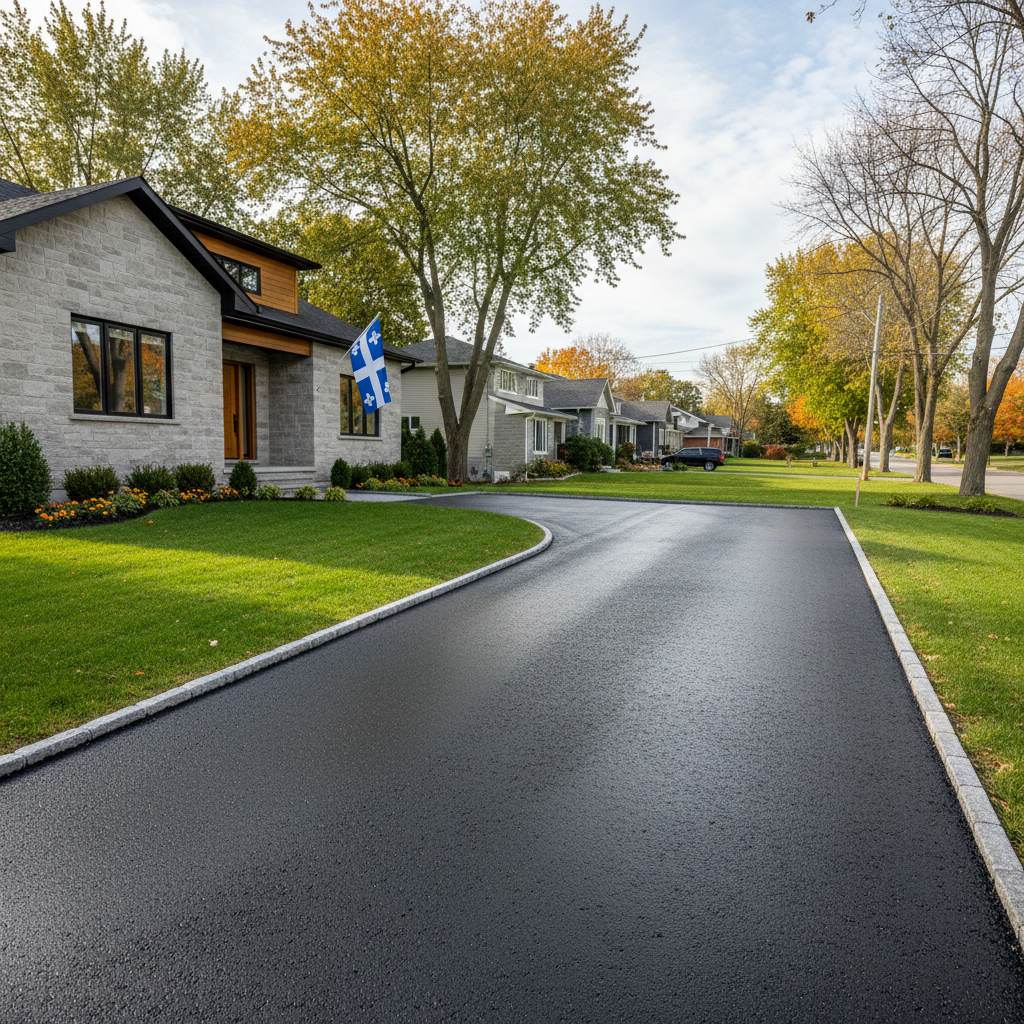
Driveway paving options and costs in Lynnmour
Lynnmour is a small community (2,265 residents per the 2021 Census, Statistics Canada), but it still sees steady driveway work because most local properties are residential and driveways are part of everyday access and curb appeal. In practical terms, you’re usually paving around a detached-home yard setup, often with room constraints for equipment and with heavy emphasis on drainage—Lower Mainland–Southwest rain can saturate soils quickly. That matters because clay-heavy pockets in parts of the Fraser Valley can hold water, and repeated wetting plus winter temperature swings near the shallow frost line can stress weak base and poorly graded edges.
In this region, pricing is shaped more by intense rainfall and how contractors build granular base and manage runoff than by extreme deep frost. Even though coastal frost penetration is relatively shallow, regional practice still assumes a frost line on the order of 18 inches for exposed, sensitive infrastructure—so competent excavations and compacted base thickness remain non-negotiable. Scheduling also tightens: the paving season runs longer than in Northern BC, yet shoulder-season storms still compress “dry working days,” which can affect crews and asphalt dispatch timing.
Demand is especially noticeable around the Lynn Valley / Lions Gate side and nearby hillside streets where drive access, slope, and drainage are common pain points. If you’re comparing options for a typical residential driveway, the table below summarizes real-world lifespan, maintenance expectations, and the common local price bands per square foot—so you can discuss your quote with confidence.
| Material |
Lifespan |
Maintenance |
Best For |
Price per sq ft |
| Asphalt (new installation, proper base) |
12–20 years |
Seal every 3–5 years |
Value-focused homeowners needing a smooth, quiet surface |
$12–$20 |
| Asphalt (overlay on existing gravel base) |
8–15 years |
Seal every 3–5 years; monitor for settlement |
When drainage/base is already in good shape |
$12–$18 |
| Interlocking concrete pavers |
20–30 years |
Occasional re-leveling; seal optional |
Curb appeal and easier repair of localized spots |
$20–$40 |
| Poured concrete (broom finish) |
25–35 years |
Light cleaning; re-surface as needed |
A strong, continuous surface with simple long-term upkeep |
$18–$35 |
| Exposed aggregate concrete |
25–35 years |
Seal every few years (as recommended) |
Slip resistance and premium look |
$22–$38 |
| Gravel / crushed stone (budget option) |
3–7 years |
Top up annually; re-grade |
Temporary solution or low-traffic areas |
$8–$14 |
Prices are estimates only and vary by project scope, site access and material selection.
What affects the price of paving in Lynnmour
For the same driveway dimensions, quotes in Lower Mainland–Southwest can land 30–50% apart in British Columbia due to differences in how deep excavation goes, what base and drainage measures are included, and whether the contractor is using freeze-thaw-rated mixes and proper compaction testing. In other words, two “asphalt driveway” bids can look similar on paper while one includes the granular base thickness and sub-drain steps needed for wet winters, and the other doesn’t. That’s why you’ll hear contractors talk about the base first—because a good surface can’t compensate for a weak foundation.
Frost line depth and freeze-thaw cycles are decisive in this region. Even in coastal BC where freeze penetration is shallower than Interior provinces, good practice still assumes a frost line around 18 inches for exposed, sensitive work. When granular base thickness isn’t sufficient, the driveway can heave, rut, or crack after repeated cycles and drainage failures. In colder regions, deeper frost typically drives thicker compacted granular base (6–12 inches in Ontario/Alberta vs. roughly 4–6 inches in coastal BC for many residential applications), but in Lynnmour you still need the right drainage and compaction so moisture doesn’t migrate into the frost zone.
Concrete examples that move cost up or down: adding proper slope corrections and a catch-basin or drain line can increase excavation and machine time, while a straightforward flat yard with stable soil can lower it. Similarly, exposed aggregate and air-entrained concrete generally cost more than broom finish; a well-designed drainage plan can prevent later cracking that would otherwise mean premature repairs. If your base prep is thorough, asphalt commonly falls into the $12–$20 per sq ft band, while pavers often land in the $20–$40 per sq ft band.
| Price Factor |
Why It Matters |
Cost Impact |
| Driveway area in sq ft |
Most line items scale directly with surface area |
High impact (largest driver) |
| Base depth required |
Frost line and moisture control determine granular thickness and compaction needs |
Moderate to high impact |
| Grading and drainage work |
Slope corrections and drainage pathways reduce water-related failure |
Moderate impact; can become high on problem soils |
| Tear-out of existing surface |
Breaking, hauling, and disposal affect labour and equipment time |
Moderate impact; higher for thick concrete |
| Edge restraints and curbing |
Prevents paver spread and asphalt edge deterioration under wet seasons |
Small to moderate impact |
| Sealing requirement |
Asphalt needs sealing after cure (often within 6–12 months) for binder protection |
Moderate long-term impact |
| Site access |
Narrow lots, tight turns, or slope limits slow equipment and increase labour |
Moderate impact |
| Asphalt mix specifications |
Freeze-thaw-rated mix and correct binder content reduce cracking and raveling |
Moderate impact |
Permits & regulations in British Columbia
In British Columbia, paving a private driveway on your own property typically does not require a building permit. Where homeowners do need approval is when the work touches the municipal right-of-way or affects stormwater function. For example, new or modified driveway aprons/city sidewalk or curb cuts, changes to boulevard landscaping that alter drainage, or alterations to storm drainage connections usually require municipal authorization. Some municipalities also have lot-grading and surface-area rules that restrict how close hard surfaces can be to property lines and how runoff must be handled.
Step-by-step, here’s how a homeowner in Lynnmour can verify a contractor is set up the right way. First, ask for their British Columbia business licensing details and check their company information online (your contractor should be able to provide a clear legal business name and contact details). Next, request a current certificate of insurance: you want liability coverage in place for the job and the certificate should match the contractor’s legal entity. For workers on site, confirm they have the appropriate worker coverage (commonly referred to as WSIB/WCB coverage in BC) and that it applies to the workforce doing your work. Finally, request a clearance letter (or equivalent proof) when applicable and keep copies with your contract.
Also, before excavation, insist on utility locates through BC 1 Call and make sure the contractor schedules it and marks the site. That’s where many delays start—protecting your budget means protecting that pre-job process.
Asphalt vs pavers vs concrete for Lynnmour driveways
For Lynnmour driveways, asphalt, interlocking pavers, and concrete all perform well when the base and drainage are designed for wet winters and freeze-thaw movement near the shallow coastal frost line. Asphalt is the lowest upfront choice and gives a smooth, quiet ride, but it does require sealing every 3–5 years to protect against binder aging from rain and UV, and it’s more sensitive to poor base drainage. Interlocking concrete pavers cost more up front, yet they’re repairable: if a localized area settles due to drainage or a utility disturbance, a contractor can lift and re-lay just the affected section. Poured concrete sits in the middle on cost and durability, but it can crack—especially if the slab isn’t properly supported or if it’s not air-entrained for freeze-thaw conditions and exposed exposure to winter de-icing practices.
Lower Mainland–Southwest design still typically assumes a frost line around 18 inches for exposed applications, so base prep and proper slope/drainage matter across all three options. Asphalt and concrete both rely on the sub-base being compacted and stable; pavers additionally need firm edge restraints to keep water from undermining the perimeter. In Lynnmour winters—plowing, sand, and wet freeze cycles—interlocking pavers tend to “take maintenance hits” better because localized fixes are straightforward. If your priority is curb appeal and long-term flexibility, pavers often justify the extra cost; if your priority is value and a clean finish with predictable maintenance, asphalt fits well.
Dollar reality example: a typical 400 sq ft asphalt driveway at $12–$20 per sq ft may land around $4,800–$8,000 for surface-and-base scope, while pavers at $20–$40 per sq ft can run roughly $8,000–$16,000. That higher paver cost is usually justified when you expect future utility work, want easy repairs, or you’re building for high curb impact in a neighbourhood where appearance matters.
| Material |
Frost Resistance |
Curb Appeal |
Repair Method |
Lifespan |
Price Band |
| Asphalt (sealed regularly) |
Good with proper base and freeze-thaw mix |
Medium (clean and uniform) |
Mill/patch localized areas |
12–20 years |
$12–$20 |
| Interlocking concrete pavers |
Excellent with stable base and edge restraints |
High (premium curb appeal) |
Lift and re-lay affected blocks |
20–30 years |
$20–$40 |
| Poured concrete (air-entrained) |
Good when air-entrained and properly reinforced/support |
Medium to high |
Crack repairs/patching; full replacement if severe |
25–35 years |
$18–$35 |
| Exposed aggregate concrete |
Good with correct mix and curing |
Very high |
Patch by section; limited aesthetic matching |
25–35 years |
$22–$38 |
| Permeable pavers (drainage grid) |
Very good where drainage design is correct |
Medium to high (depends on style) |
Replace individual units; maintain infill/grids |
20–30 years |
$22–$45 |
| Chip seal / tar-and-chip |
Fair to good; depends heavily on base and traffic |
Low to medium (utility look) |
Re-chip/overlay as aggregate ages |
7–12 years |
$8–$15 |
How to choose a paving contractor in Lynnmour
Start with proof, not promises. In British Columbia, ask the contractor to provide their business information and a certificate of liability insurance showing the job is covered (the certificate should name the correct legal entity). For worker coverage, confirm they have the applicable WSIB/WCB coverage for their employees and that it applies to the crew working your site; a clearance letter or equivalent proof is often requested for larger jobs. Don’t rely on verbal assurances—ask to see documents and keep copies for your records.
Next, get 2–3 itemised, written quotes. You want a breakdown that separates excavation, base materials, compaction, the asphalt or concrete thickness, and disposal. Avoid “lump sum” estimates that don’t show what you’re paying for. Read the scope carefully: is permit pull included if the project requires municipal approval (e.g., curb cut or drainage changes)? Is disposal included for removed concrete/asphalt? Are edge restraints, saw cutting, and proper slopes included? Also check exclusions like “soft soil conditions” or “unknown utilities,” and make sure they’re not hiding large add-on costs.
Warranty should be explicit: workmanship warranty length, what is covered (and for how long), and whether any product warranty is transferable. Payment schedule matters—never pay more than 10–15% upfront, and hold back a reasonable amount until completion and cleanup. Finally, demand a written start date and completion estimate; in Lynnmour, rain days can shift timelines, so a clear plan is important.
- Request proof of BC business registration and confirm the contractor’s legal name matches the quote.
- Verify liability insurance is current and the certificate covers your project location.
- Confirm WSIB/WCB coverage for workers and ask for clearance documentation if available.
- Ask for 2–3 recent local Lynnmour/Lower Mainland references with photos.
- Insist on itemised quantities: excavation depth, base thickness, and asphalt/concrete thickness.
- Make sure drainage/slope corrections are included in the scope (not assumed).
- Confirm tear-out disposal is included (breaking/hauling costs add up fast).
- Clarify edge restraints/curbing and whether pavers get proper polymeric sand if applicable.
- Ask about compaction method and whether they’ll meet density targets with proper equipment.
- Get a written cure/seal timeline for asphalt (typical sealing often after 6–12 months).
- Read the warranty section for exclusions like “acts of God” vs workmanship defects.
- Verify start/end dates and weather contingency terms in writing.
In Lynnmour, a few red flags to watch for: (1) no discussion of base thickness or drainage—just “we’ll pave it”; (2) refusing to itemise the quote or leaving tear-out/disposal vague; (3) vague or short warranty wording with no workmanship terms; (4) asking for large upfront payments beyond 10–15%; and (5) no proof of insurance/coverage when you request certificates.
Frequently asked questions — paving in Lynnmour
How do I compare paving quotes fairly?
To compare paving quotes fairly in Lynnmour (and across the Lower Mainland–Southwest), line up the scope first: driveway size, excavation depth, base type and thickness, drainage steps, and the finished asphalt/concrete thickness. A “cheap” quote often skips granular base depth, compaction, or edge restraints—then you pay later through settlement cracks or ruts. Ask for an itemised breakdown (not just lump sum), and make sure tear-out and disposal are included. Compare whether asphalt uses freeze-thaw-rated mix and whether concrete is air-entrained where relevant. Finally, check pricing against typical local bands: asphalt commonly falls around $12–$20 per sq ft when the base is done properly, while pavers usually land in the $20–$40 range. If two bids are far apart, the difference is usually base prep, drainage, or included materials—not just labour.
Can asphalt be laid in cold weather in Lynnmour?
Asphalt placement is possible in Lynnmour, but timing and temperature control matter. Hot-mix asphalt generally needs air temperature above about 10°C to place and compact correctly, and contractors also watch wind, ground temperature, and forecast rain. Even though coastal frost is relatively shallow compared with Interior BC, wet conditions and cool nights can slow curing and increase the risk of surface defects. If a contractor is pushing a pour during a cold snap, ask how they’ll manage temperature and compaction. A responsible crew will also consider shoulder-season storms: heavy rainfall can interfere with base preparation and drainage grading. If you’re seeing weather-driven schedule changes, it’s better to wait for a stable window than to accept a compromised surface.
What is a driveway apron and do I need one in Lynnmour?
A driveway apron is the paved section at the entrance that connects your driveway to the sidewalk, curb, or boulevard area—essentially the transitional “gateway” that handles vehicle turning loads and helps guide runoff. In Lynnmour, whether you “need” one depends on how your driveway meets the street and whether your curb cut or sidewalk connection is being modified. If your project involves work in the municipal right-of-way (for example, changing curb cuts, altering boulevard drainage, or adjusting the sidewalk/entry), municipal approval is commonly required. That’s where an apron matters: the apron must tie into the correct slope and drainage so water doesn’t pond and freeze-thaw cycles don’t damage the edges. Ask your contractor to clarify whether any apron work triggers municipal permitting in your specific location.
How do I maintain my driveway through Lynnmour winters?
Winter maintenance in British Columbia is mostly about managing water and preventing abrasion. For asphalt, keep the surface clean of debris so sand and water don’t trap around low spots. Plow carefully: avoid metal-on-asphalt contact and reduce aggressive scraping at the edges, since edges fail first when water gets under the surface. Use sand rather than aggressive salts where possible, because de-icing chemicals can accelerate binder aging on some asphalt mixes. For pavers, use joint sand as recommended and replace any washouts after heavy rain. If your driveway has a slope toward the street, confirm drainage outlets remain clear. The biggest “do-it-yourself win” is watching for early signs of trouble—small ponding, soft spots, or rising edges—then addressing them before cracks spread.
Is it worth sealing a new driveway right away in Lynnmour?
In Lynnmour, sealing is usually worth it, but it’s not typically done immediately. Asphalt needs time to cure and for excess moisture to dissipate; many contractors schedule sealing after the surface has properly cured and stabilized—often within about 6–12 months depending on weather and product. Sealing too early can trap moisture and reduce performance. A good seal coat helps protect the binder from rain-driven wear and UV aging, and it’s one reason properly maintained asphalt can reach the upper end of the lifespan range. If your quote is around $12–$20 per sq ft and includes proper base prep, plan for the first sealing cycle as part of long-term cost. Ask for the seal product type and the expected re-seal interval (commonly every 3–5 years).
What is a chip seal driveway and is it suited to Lynnmour?
Chip seal (tar-and-chip) is a surface treatment: a binder layer is sprayed and aggregate is broadcast for texture and traction. It’s often used as a budget option where you want a quick traction improvement rather than a long cosmetic “finish,” and it’s commonly suited to lower-traffic or utility-style driveways. In Lynnmour’s Lower Mainland–Southwest climate, heavy rain and wet seasons can be a challenge if the base isn’t built correctly; drainage and compaction are still the key. The lifespan is usually shorter than standard asphalt—think roughly 7–12 years depending on base quality and maintenance. If you’re expecting heavy turning loads or a driveway that needs premium curb appearance, asphalt or pavers generally hold up better. A chip seal driveway can be a reasonable stopgap when budget is tight, but confirm the prep standard and offer of re-chipping when aggregate loosens.