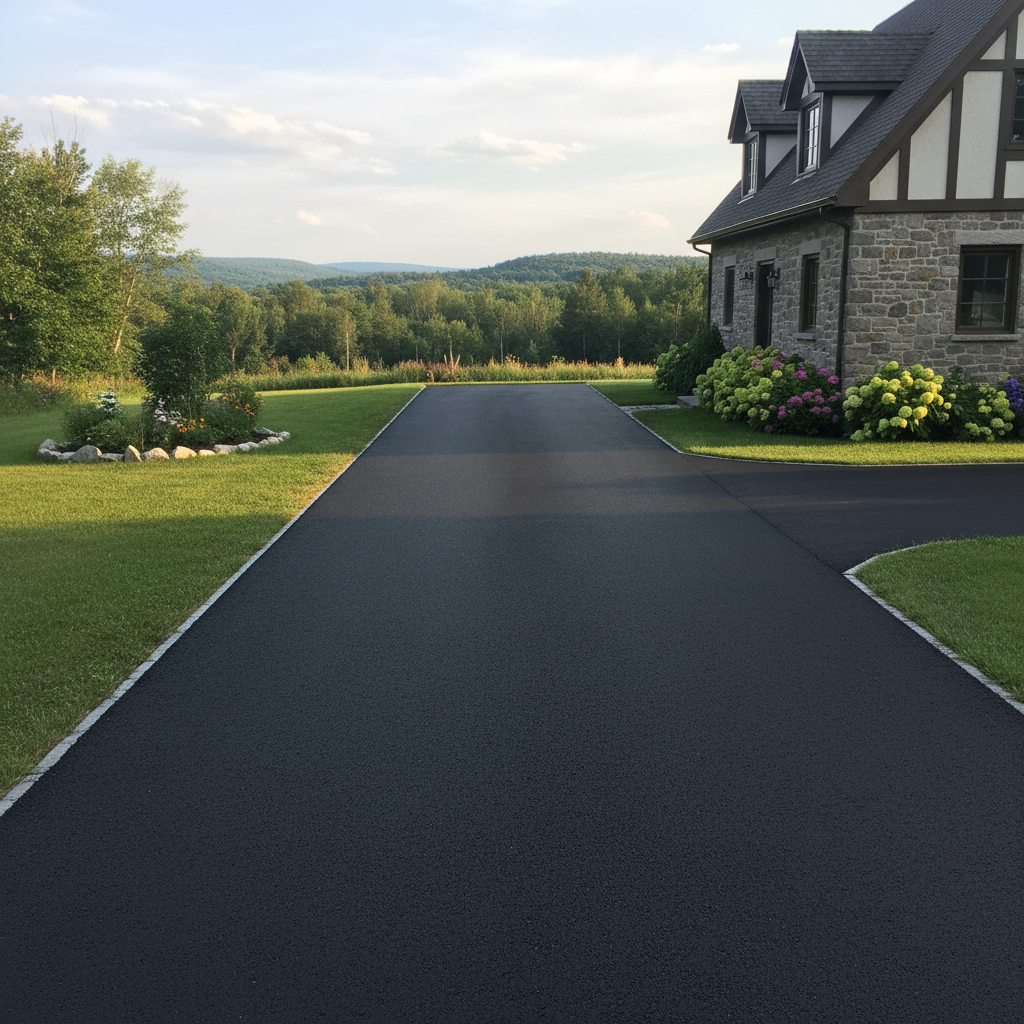
Driveway paving options and costs in Princeton
Princeton driveway paving options come down to three things: how long you want the surface to last, how much maintenance you’re comfortable with, and how the Thompson–Okanagan freeze–thaw cycle treats your base. With Princeton’s housing stock skewing heavily toward single-detached homes (66.2% of dwellings) and many properties dating back before 1981 (66.2% built earlier), a lot of driveways are due for upgrading from aging gravel or patched asphalt. That’s why you’ll see more demand around the downtown and along the Copper Mountain Road corridor, where lots tend to have straightforward access but winters are tough on moisture management.
In the Thompson–Okanagan, the real cost driver isn’t just the surface material—it’s the frost-resistant section under it. Asphalt and concrete both perform best when the granular base is compacted to a frost-safe thickness and drainage/grading keeps water from soaking into the sub-grade. Crews also price for a shorter paving window because permanent work typically concentrates in the drier, warmer months; hot-mix asphalt needs air temperatures generally above 10°C, so scheduling in spring can carry weather risk.
To help you compare apples-to-apples, the table below uses local budget ranges for Princeton-area driveway projects (not small patch work). Once you know your driveway size and whether you’re paving new base versus overlaying, the rest of the decision gets much simpler.
| Material |
Lifespan |
Maintenance |
Best For |
Price per sq ft |
Price Range |
| Asphalt (new installation, proper base) |
15–25 years |
Seal every 3–5 years; crack fill as needed |
Most practical choice for winter performance and value |
$5.50–$9.25 |
$4,500–$9,000 |
| Asphalt (overlay on existing gravel base) |
10–18 years |
Seal every 3–5 years; monitor low spots |
Upgrading without full tear-out when the base is sound |
$4.75–$8.50 |
$4,000–$8,000 |
| Interlocking concrete pavers |
25–40 years |
Replace individual stones if needed; re-sand/level as required |
Curb appeal and easy repairs without full replacement |
$9.50–$14.75 |
$6,500–$14,000 |
| Poured concrete (broom finish) |
25–35 years |
Occasional sealing; surface crack control |
Low maintenance with strong edges and good drainage |
$9.00–$15.50 |
$7,000–$15,000 |
| Exposed aggregate concrete |
25–35 years |
Sealing every few years; stain/efflorescence monitoring |
Slips resistance and premium look |
$11.00–$17.50 |
$8,000–$16,500 |
| Gravel / crushed stone (budget option) |
3–8 years |
Rake/refresh annually; re-grade after freeze-thaw |
Lowest upfront cost and short-term solution |
$3.00–$6.00 |
$2,000–$5,000 |
Prices are estimates only and vary by project scope, site access and material selection.
What affects the price of paving in Princeton
In Princeton and across the Thompson–Okanagan, two quotes for the same “driveway size” can swing by 30–50% once you account for the frost-resistant base, drainage scope, and how much prep is actually required. On similar projects, inland crews also factor in tighter paving-season schedules and mobilization costs because weather can delay placement—especially when the freeze–thaw cycle repeatedly saturates marginal sub-grades.
Frost line depth and freeze–thaw cycles are decisive cost factors. Even though the BC Building Code frost line for many structures is roughly 18 inches in much of the interior, paved surfaces and slabs typically see higher moisture exposure and wheel loads, so we build a substantially more robust granular section than a minimum “structural” allowance. In practice for asphalt and pavers, you’re often looking at an 8.5–9 inch total structure with about 6 inches of compacted base, and that thickness has to be achieved with the right granular gradation and compaction. Poor or clayey soils, slopes, and areas with drainage issues can push the scope toward deeper excavation and upgraded base, which directly moves your total from the lower end of price bands (like the mid-$4,000s for simpler asphalt) toward the upper end (closer to $9,000 for full-depth prep and proper compaction).
Concrete pricing shifts too. For example, a poured driveway can land in the $7,000–$15,000 range when you require proper sub-grade proof-rolling and thicker slabs/edging for stability. Conversely, if the existing base is already well-graded and drains correctly, overlays or re-surfacing can narrow the cost gap versus full tear-out.
| Price Factor |
Why It Matters |
Cost Impact |
| Driveway area in sq ft |
Labour and asphalt/concrete quantities scale directly with square footage |
High |
| Base depth required |
Frost resistance depends on compacted granular thickness and quality |
High |
| Grading and drainage work |
Slope, ditch/drain tie-ins, and removing water pathways prevent heaving and cracking |
Medium to High |
| Tear-out of existing surface |
Breaking, hauling, disposal and sub-grade rework add labour and equipment time |
Medium to High |
| Edge restraints and curbing |
Prevents paver spread and maintains asphalt/concrete joint stability |
Medium |
| Sealing requirement |
Asphalt sealcoating after 6–12 months protects binder and helps manage moisture intrusion |
Low to Medium (planned maintenance) |
| Site access |
Narrow lots slow equipment movement and extend handling time |
Medium |
| Asphalt mix specifications |
Freeze–thaw-rated mixes and proper lift thickness improve durability under interior winters |
Medium |
Permits & regulations in British Columbia
In British Columbia, paving a private driveway within your own property typically does not require a building permit. In most cases, the contractor can proceed as long as the work stays on private land and you’re not altering municipal infrastructure. However, work in the municipal right-of-way—such as creating or modifying a curb cut/driveway approach in the boulevard, changing how storm drainage is managed at the frontage, or altering anything tied to municipal drainage—usually requires municipal approval.
Some jurisdictions in BC also apply lot-grading rules through bylaw, which can affect how close a hard surface can be to property lines and how stormwater must be directed. Even when no “permit” is required for the paving itself, you should confirm grading/drainage expectations so water doesn’t get pushed onto a neighbour or into a ditch.
Before excavation, make sure utilities are located by calling BC 1 Call (or the provincial equivalent your contractor uses). Then, to verify your Princeton contractor is properly set up in BC, ask for: (1) their BC business/contractor licence (where applicable) via their online registry listing, (2) a current certificate of liability insurance naming you as additional insured if the quote/contract requires it, and (3) clearance for workers’ compensation coverage (WCB) if they have employees. Step-by-step, request these documents up front, confirm dates, and ensure the insurance coverage aligns with the start and completion window on your written quote.
Asphalt vs pavers vs concrete for Princeton driveways
For Princeton driveways, asphalt, interlocking pavers, and concrete all can work—if the base and drainage are built for the Thompson–Okanagan freeze–thaw cycle. Asphalt usually wins on lowest upfront cost, especially when you’re within the $4,500–$9,000 driveway paving band and the sub-grade can be corrected without major excavation. The trade-off is maintenance: a properly installed asphalt driveway still benefits from sealing after about 6–12 months and then roughly every 3–5 years to slow moisture and oxidation that can lead to raveling and early cracking.
Interlocking concrete pavers have the highest upfront cost (often in the $6,500–$14,000 band) but can be a better long-term value where you want easy, localised repairs. If you later have a cracked area from settlement or a drainage issue, you can lift and replace only the affected section rather than tearing out the entire surface.
Poured concrete is usually mid-range (commonly $7,000–$15,000), but it needs air-entrainment, proper curing, joints, and solid base preparation to resist freeze–thaw and surface scaling. In Princeton winters, de-icing and ploughing introduce extra abrasion and moisture—so concrete without the right mix and details can crack sooner. Pavers also do well with ploughing, but they rely on edge restraints and correct base compaction to stay level.
Here’s a practical example: if your asphalt quote comes in around $7,500 and pavers are $11,500, that extra $4,000 can be justified when you prioritize curb appeal and want repair flexibility—or if you expect future service work (like drainage corrections). If your priority is simply the best performance per dollar and you can commit to sealing, asphalt is often the smarter first choice in Princeton.
| Material |
Frost Resistance |
Curb Appeal |
Repair Method |
Lifespan |
Price Band |
| Asphalt (sealed regularly) |
Good with thick compacted base and drainage |
Medium |
Cut-out and patch; sealcoating and crack filling |
15–25 years |
$4,500–$9,000 |
| Interlocking concrete pavers |
Very good when edges and base are engineered |
High |
Lift/replace individual blocks; re-sand and re-level |
25–40 years |
$6,500–$14,000 |
| Poured concrete (air-entrained) |
Good with proper air entrainment and joints |
Medium |
Patch and grind; larger sections may require slab repair |
25–35 years |
$7,000–$15,000 |
| Exposed aggregate concrete |
Good with correct base and sealing |
Very High |
Stain/patch blending; limited rework options once set |
25–35 years |
$8,000–$16,500 |
| Permeable pavers (drainage grid) |
Excellent where drainage is a recurring issue |
High (styled look possible) |
Replace individual units; service the drainage layer if needed |
25–35 years (system dependent) |
$7,500–$16,000 |
| Chip seal / tar-and-chip |
Fair to good; best for certain low-traffic sections |
Low to Medium |
Re-surface and re-chipse; patching is limited |
7–12 years |
$3,500–$7,500 |
How to choose a paving contractor in Princeton
Start by verifying British Columbia setup and coverage. Request the contractor’s licence/business registration information (from the relevant online registry listing for their entity), then ask for a certificate of liability insurance that matches the project value and term. If they have employees, confirm WCB coverage and obtain clearance documentation; if they’re subcontracting labour, make sure you’re not left holding the liability gap. A reputable crew will provide these documents without pressure—before you sign.
Next, get 2–3 itemised written quotes. You want a breakdown that separates labour, granular base materials, asphalt/concrete quantity, disposal/tipping, compaction/testing (if applicable), and any safety/traffic control. Avoid “all-in” pricing if it doesn’t state what’s included. Clarify exclusions: permit pulls (if needed for curb/drainage changes), disposal of old asphalt/concrete, protection of landscaping, and whether grading ties into existing drainage. For asphalt specifically, confirm whether sealcoating is included or recommended after 6–12 months.
Warranty matters: ask for workmanship warranty length (usually for installation performance), what product/manufacturer warranty covers (if any), and whether warranties transfer to a new owner if you sell. Payment schedule should be conservative—never more than 10–15% upfront. Hold back the remainder until the driveway is completed, swept/cleaned, and any specified maintenance (like initial crack sealing plans) is done.
Finally, get a written timeline with a start date window and completion estimate. In Princeton, winter prep schedules and early spring weather can shift dates, so a clear plan protects you.
- Verify BC business registration/licence details before signing.
- Confirm liability insurance is current and request the certificate.
- Confirm WCB clearance if they have employees; don’t accept “we’re covered” verbally.
- Ask for 2–3 recent references for Princeton or nearby Thompson–Okanagan projects.
- Get itemised quotes: base depth, excavation, compaction, disposal, and surface thickness.
- Confirm whether quote includes utility locating costs and calling BC 1 Call.
- Clarify grading and drainage scope (catch basin tie-ins, ditch grading, slopes).
- Ensure edge restraints are included for pavers/asphalt transitions.
- Ask how cracks will be treated (first-year crack fill plan and timing).
- For asphalt, confirm sealcoat timing (often after 6–12 months) and whether it’s included.
- Review warranty terms in writing and whether they transfer to future owners.
- Agree on a payment schedule with a holdback until final inspection/cleanup.
Red flags in Princeton: (1) refusing to provide insurance/WCB documentation, (2) quoting asphalt or pavers without discussing base depth and drainage, (3) pressuring you for large upfront payments, (4) vague scope language like “prepared as needed” with no numbers, and (5) ignoring winter realities—no plan for freeze–thaw-proof base, joints/edges, or early-season scheduling.
Frequently asked questions — paving in Princeton
Do I need a permit to pave my driveway in British Columbia?
In most cases in British Columbia, paving a private driveway within your own property does not require a building permit. For Princeton homeowners, the common trigger for approval is work that touches the municipal right-of-way, such as changing a curb cut/driveway approach, altering boulevard elements, or changing storm drainage routing at the frontage. Some areas may also have lot-grading expectations that affect how your hard surface handles water near property lines. The safest approach is to tell your contractor exactly what you’re changing—especially at the street edge—then confirm with the municipality before work begins. Also ensure utility locates are completed before excavation, since moving base material without confirming underground services can create delays and safety issues.
How long before I can drive on new asphalt?
Typically, you can drive on new asphalt after it has cooled and the surface has set—often within about 24 to 48 hours, depending on weather and mix temperature. In Princeton, watch the nights: spring and fall temperature swings can slow cooling, and cooler conditions can affect initial setting. If the contractor requires a longer cure time for thicker lifts, you should follow their guidance. The biggest mistake is turning vehicles or moving equipment too soon, which can mark the surface before it fully bonds. Once installed, keep traffic off as directed and avoid turning into the driveway aggressively. For long-term protection in the Thompson–Okanagan freeze–thaw cycle, most asphalt jobs benefit from sealcoating after about 6 to 12 months—especially when winters are hard and moisture intrusion is a concern.
What causes potholes and how are they repaired?
Potholes usually start with trapped water. In the Princeton climate, repeated freeze–thaw cycles expand and contract water in small voids, which breaks down the asphalt surface and can undermine the base. Common causes include a weak or under-compacted base, drainage that allows water to pond, or minor surface cracks that weren’t sealed early. Pothole repairs are not just “dump asphalt on top”: a proper repair removes the damaged material down to stable base, cleans the area, and reinstalls asphalt in lifts so the repaired section compacts properly. If the base is failing, the contractor may need to rebuild part of the granular layer. A well-done repair prevents the same failure from reappearing within one winter.
How do I prepare for a paving project?
Preparation starts with accessibility and documentation. In Princeton, make sure the contractor can get equipment to the site—move vehicles, rocks, and garden items from the driveway and edges, and confirm where the materials will be staged. Before excavation, ensure utility locates are completed through BC 1 Call. Review your drainage: if there are low spots where water sits after rain or snowmelt, flag them so grading and drainage can be included in the quote. If you’re replacing older asphalt, confirm whether tear-out and disposal are included. If you plan to pave soon after spring melt, ask the contractor about weather readiness because hot-mix asphalt needs suitable conditions (commonly above 10°C). Finally, read the warranty and payment schedule—avoid paying more than 10–15% upfront.
How do I compare paving quotes fairly?
Compare quotes by scope, not just totals. Ask each contractor for an itemised breakdown of excavation/tear-out, base depth and granular type, compaction, drainage/grading work, and the final asphalt or concrete thickness. In Thompson–Okanagan projects, base construction is what protects the driveway from freeze–thaw heaving—so quotes that only vary on surface thickness can be misleading. Check whether asphalt includes sealcoating guidance after 6–12 months and whether disposal is included for old materials. Make sure paver quotes include edge restraints and bedding/sanding details, not just the blocks. If one quote lands near the lower end of typical driveway paving (for example, around the $4,500–$9,000 band for asphalt) but skips base upgrades for a clayey or poorly draining area, it may cost more in repairs later. Always request start-date and completion estimates in writing.
Can asphalt be laid in cold weather in Princeton?
Cold weather is where asphalt decisions get tricky in Princeton. Hot-mix asphalt placement generally requires warm enough air temperatures—often above 10°C—so the mix can be properly compacted and bond correctly. If it’s too cold, asphalt can cool before compaction is finished, leading to weak lift bonding and early cracking. In the Thompson–Okanagan, crews typically plan permanent work for the warmer, drier months to reduce weather risk and improve durability under freeze–thaw cycles. If work must happen near shoulder season, the contractor may propose process adjustments, but you should be cautious and ask how they’ll meet compaction and temperature requirements. The right granular base and drainage still matter just as much—cold weather only amplifies the consequences of shortcuts.