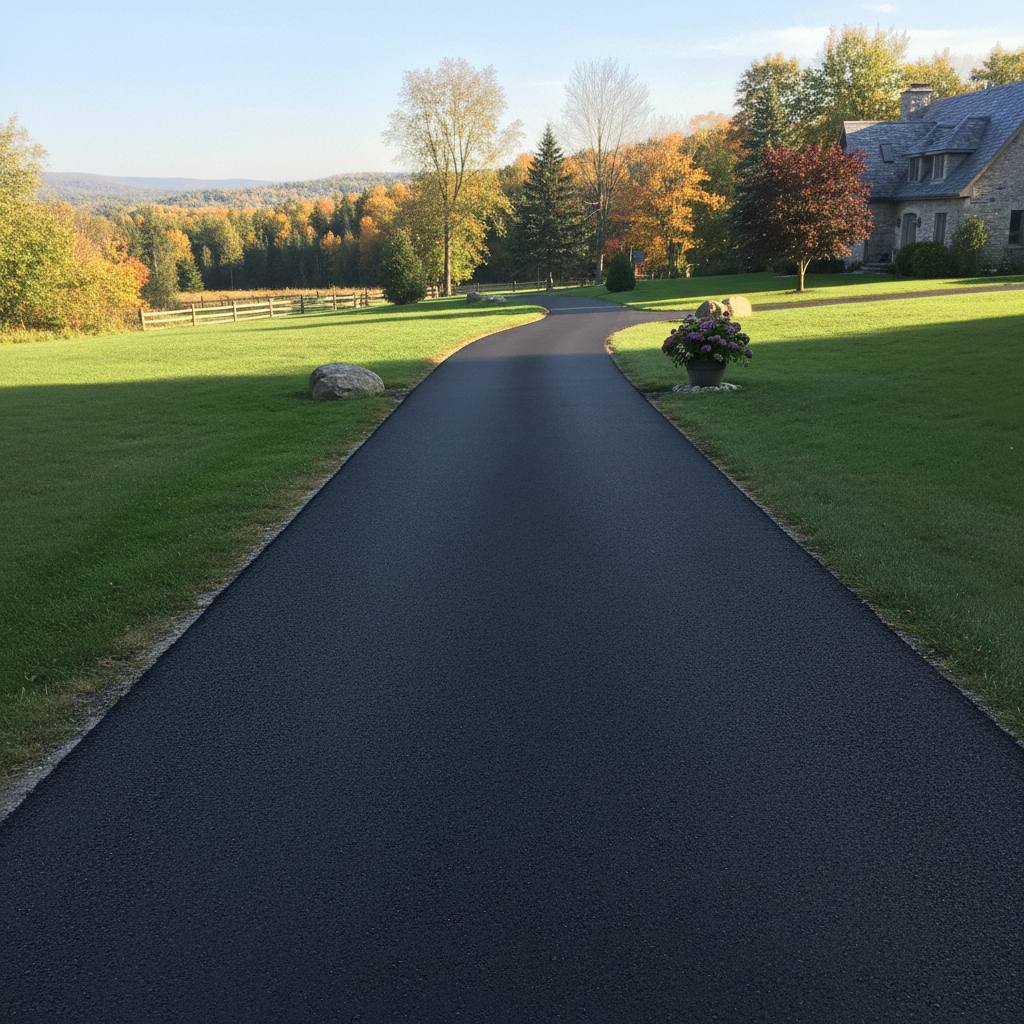
Driveway paving options and costs in Ladysmith
Ladysmith homeowners typically have a single driveway leading from the road to a home that’s usually part of a detached neighbourhood—about 67.5% of dwellings in the city are single-detached homes, and most driveways are tied to that housing type. With 3,170 homeowner households in the 2021 Census (Statistics Canada, 2021 Census), the demand for durable surfaces is consistent throughout the year, even though the paving season runs hottest in the spring and summer.
On Vancouver Island and the Coast, paving costs are shaped by a mild coastal climate, but frost and drainage still matter. Our frost line is relatively shallow compared with interior or northern regions, so we don’t automatically design driveways with the very deep granular bases you’d see elsewhere in Canada. However, localized freezing and repeat freeze-thaw cycles around Ladysmith and nearby commuter areas can still heave edges, loosen base material, and cause cracking if water can’t drain away.
Labour availability can also shift pricing. In peak weeks—especially when conditions are ideal—contractors may prioritize higher-access jobs, which can raise the “minimum charge” cost of smaller driveways. In Ladysmith, trades tend to see especially strong activity in established areas like the Cedar/College neighbourhood corridor where homeowners are upgrading older slabs and gravel approaches on lots with mature landscaping and tighter access.
Below is a practical comparison of driveway materials and typical per-project pricing ranges you can use when reviewing quotes, then we’ll break down what drives those numbers.
| Material |
Lifespan |
Maintenance |
Best For |
Price per sq ft |
Price Range |
| Asphalt (new installation, proper base) |
15–25 years |
Seal every 3–5 years |
Most cost-effective all-around option |
$10–$20 |
$3,800–$8,500 |
| Asphalt (overlay on existing gravel base) |
8–15 years |
Seal every 3–4 years |
Short-term upgrade when base is sound |
$10–$18 |
$3,000–$7,000 |
| Interlocking concrete pavers |
25–35+ years |
Occasional sand top-up; individual brick replacement |
Curb appeal + easy localized repairs |
$25–$45 |
$6,500–$15,500 |
| Poured concrete (broom finish) |
20–30 years |
Seal every 5–10 years (recommended) |
Clean, solid surface; minimal visual seams |
$18–$35 |
$5,000–$13,500 |
| Exposed aggregate concrete |
20–30 years |
Seal every 5–8 years |
High traction and premium look |
$22–$40 |
$6,500–$16,000 |
| Gravel / crushed stone (budget option) |
3–7 years (varies) |
Top up and re-grade annually |
Lowest upfront cost; temporary or rural lots |
$5–$12 |
$1,500–$4,500 |
Prices are estimates only and vary by project scope, site access and material selection.
What affects the price of paving in Ladysmith
On Vancouver Island and the Coast, it’s common to see quotes for the “same driveway” vary by 30–50% across Ladysmith, Nanaimo, Victoria and even farther north to Campbell River—mainly because the real costs are buried in the prep work. Two contractors can quote the same asphalt or concrete finish, but if one includes a proper base rebuild while the other assumes the existing base is fine, the final number can swing dramatically.
Frost and water management are decisive. Even with a relatively shallow frost line in coastal BC, localized freezing and repeated freeze-thaw cycles can heave weak subgrade and crack surfaces if water can’t move away. That’s why we budget for the granular base thickness and compaction appropriate to the driveway condition—not just a “standard” depth. In colder parts of Canada, designers often require 6–12 inches of compacted granular base; on the coast, we typically target a thinner range (often 4–6 inches) when the subgrade and drainage are engineered correctly, but the job still isn’t “one size fits all.”
Seasonality also pushes costs. Hot-mix asphalt needs warm air temperatures (above about 10°C), so scheduling compresses in spring and summer. When crews are busy, mobilization and minimum-charge work can effectively raise your per-square-foot rate. Mix design matters too: freeze-thaw-rated asphalt can cost more, but it improves long-term performance.
Concrete prices can rise when older homes (and many properties built before 1981—44.7% of dwellings, Statistics Canada, 2021 Census) have existing slabs or poor drainage that must be removed and corrected. If you’re tearing out old asphalt or breaking up a cracked slab, excavation and disposal can add several thousand dollars. For context, a properly built asphalt installation might land around the $10–$20 per sq ft backbone, while paver work often follows the $25–$45 range because of higher labour and edge restraint detail.
| Price Factor |
Why It Matters |
Cost Impact |
| Driveway area in sq ft |
Material and base quantities scale directly with area |
Largest driver; often 40–70% of total cost |
| Base depth required |
Frost line and subgrade condition determine granular thickness |
Can change cost significantly if base must be rebuilt |
| Grading and drainage work |
Slope, swales, and water routing control freeze-thaw damage |
Commonly adds material + machine time |
| Tear-out of existing surface |
Breaking, hauling, and disposal add labour and equipment costs |
Often adds several thousand dollars on older driveways |
| Edge restraints and curbing |
Prevents paver spread and holds asphalt edges in place |
Adds cost but improves long-term appearance and stability |
| Sealing requirement |
Asphalt needs sealing after initial curing to reduce oxidation |
Direct add-on in years 1–2 and every cycle after |
| Site access |
Narrow lots slow equipment movement and can require extra labour |
Can increase labour time and mobilization charges |
| Asphalt mix specifications |
Freeze-thaw rated mixes are engineered for coastal conditions |
Often modest per-sq-ft increase, better longevity |
Permits & regulations in British Columbia
For most Ladysmith homeowners, paving a private driveway within your own property generally doesn’t require a building permit. However, work that affects the municipal right-of-way typically does require approval. That includes creating or changing curb cuts, modifying boulevard areas, altering storm drainage, or changing how water flows at the driveway approach where it meets the street. If your plan changes the ditch line, adds swales, or ties into drainage infrastructure, you should expect municipal review.
A second common requirement is lot-grading. Some municipalities have bylaws that restrict how close grading changes can be to property lines or how hard surfaces can be built without managing runoff. The goal is simple: keep water from being redirected onto neighbours’ lots or into foundations.
Before excavation, always arrange utility locates—BC 1 Call is the key service in British Columbia—so crews can avoid underground services. Then, confirm lot-grading rules with the City/municipality (and any applicable bylaws) before finalizing your schedule.
To verify your contractor, follow a step-by-step checklist:
- Check licensing and contractor standing using the appropriate public registry resources (or ask the contractor to provide their business number/registration details).
- Request a Certificate of Insurance (liability) naming you as an additional insured when possible, and confirm coverage limits for paving operations.
- Verify workers’ compensation coverage (WSIB-style coverage is handled through the provincial system in BC); ask for a clearance letter or proof of account status.
- Confirm they carry equipment and disposal coverage for tear-out work and provide disposal details in the written scope.
Asphalt vs pavers vs concrete for Ladysmith driveways
Choosing driveway material in Ladysmith is really choosing how your surface will handle coastal freeze-thaw, standing water, and winter maintenance routines (ploughing and sand are common; de-icing salt may be used, and it matters most for concrete). Asphalt is the lowest upfront option in most cases and, when installed over a properly compacted base, is forgiving under freeze-thaw. The trade-off is maintenance: you should plan to seal regularly—typically every 3–5 years—to slow oxidation and keep water from penetrating.
Interlocking concrete pavers cost more up front, but they’re typically the most repairable. If a section settles because of a drainage issue, you can lift and reset individual units rather than replacing a whole slab. That repairability is valuable on older properties—remember, 44.7% of Ladysmith dwellings were built before 1981 (Statistics Canada, 2021 Census)—where subgrades may not have been designed for modern runoff patterns.
Poured concrete is a mid-range option, but it’s more sensitive to freeze-thaw cracking and de-icing salt if the concrete isn’t air-entrained and properly finished/ cured. Exposed aggregate improves traction, but it still depends on correct mix design and curing to resist water movement in the pores.
For base preparation on Vancouver Island and the Coast, drainage and compaction beat “guessing” thickness. If water can’t leave, any finish will fail early. Asphalt can be a great value when your driveway needs a refresh and the existing base is rebuilt to spec. For example, if you’re comparing a new asphalt installation around the $10–$20 per sq ft band versus pavers often in the $25–$45 band, the price jump is justified when you want curb appeal and the ability to repair isolated areas—especially on driveways with frequent plough paths or landscaped edges.
| Material |
Frost Resistance |
Curb Appeal |
Repair Method |
Lifespan |
Price Band |
| Asphalt (sealed regularly) |
Good with proper base drainage and freeze-thaw mix |
Low to medium (clean, uniform look) |
Patch / mill and pave localized areas |
15–25 years |
$10–$20 |
| Interlocking concrete pavers |
Excellent when base is engineered and edged is restrained |
High (varied colours/patterns) |
Lift, reset and replace individual pavers |
25–35+ years |
$25–$45 |
| Poured concrete (air-entrained) |
Good if air-entrained and properly cured |
Medium (clean slab look) |
Crack repair/patch; panel replacement when needed |
20–30 years |
$18–$35 |
| Exposed aggregate concrete |
Good traction; depends on water-tightness and curing |
High (premium texture) |
Localized patching; sometimes limited by finish matching |
20–30 years |
$22–$40 |
| Permeable pavers (drainage grid) |
Very good for water handling when underdrains are designed |
Medium to high |
Lift and service, clean aggregate base layers |
15–30 years (system-dependent) |
$30–$55 |
| Chip seal / tar-and-chip |
Moderate; surface dressing needs ongoing maintenance |
Low to medium (textured finish) |
Spot repairs; re-apply surface dressing |
7–12 years |
$6–$14 |
How to choose a paving contractor in Ladysmith
Picking a contractor in Ladysmith comes down to proof, not promises. In British Columbia, start by verifying that the company holds appropriate licensing/registration for their work, then confirm their liability insurance. Ask for a current Certificate of Insurance and review coverage limits; if they won’t provide documents, that’s a major warning. Next, confirm workers’ compensation coverage (WSIB/WCB-style coverage in BC is handled through the provincial system): request a clearance letter or proof of account status. This protects you if someone is injured on your property.
Get 2–3 itemised written quotes—not just a lump sum. A good quote breaks down labour, excavation, base material, compacting, asphalt/concrete or paver supply, edge restraints, and any disposal/recycling fees. Make sure the scope clearly states what’s included and what’s excluded: permit pull (if required for right-of-way work), site protection, regrading, and whether the contractor hauls away all removed material. If they’re pricing “overlay only,” they should explain how they will assess base stability.
Warranty matters in paving because freeze-thaw and drainage are slow to reveal problems. Ask for the workmanship warranty length and what it covers (e.g., base settlement vs surface cracking). Also ask whether the product/manufacturer warranty applies to you as the homeowner and whether it’s transferable. For payment, avoid paying more than 10–15% upfront; keep a holdback until the job is complete and cleaned up to standard.
Finally, get the start date and completion estimate in writing—especially important on Vancouver Island where scheduling can shift with weather and delivery times.
- Verify insurance documents before work starts (request updated COI).
- Confirm workers’ compensation clearance/proof.
- Ask for their written scope with line items (base, compaction, disposal).
- Request before/after photos of similar Ladysmith driveways.
- Confirm how they handle drainage and slope at the street transition.
- Ensure edge restraints are included for pavers and that asphalt edges are formed properly.
- Ask how thick the base will be and what material spec is used.
- Check whether they include coring/patching for any asphalt repairs (not just “top coat”).
- Confirm disposal is included for tear-out work.
- Review warranty terms in writing and what conditions void coverage.
- Agree on a payment schedule with a holdback to completion.
- Get a written timeline and what happens if weather delays curing.
In Ladysmith, red flags include: (1) quotes that ignore base depth and drainage, (2) no itemized scope or vague “as discussed” exclusions, (3) insistence on paying most money upfront, (4) refusal to provide proof of insurance and workers’ compensation clearance, and (5) promises of “crack-proof” concrete or “no seal needed” asphalt.
Frequently asked questions — paving in Ladysmith
How deep should the base be for Ladysmith's frost?
In Ladysmith and coastal areas of British Columbia, our frost line is relatively shallow compared with colder provinces, so driveways usually don’t need the very thick granular bases you might see inland. That said, freeze-thaw cycles and poor drainage can still heave pavement if the subgrade isn’t stabilized. For most properly built asphalt or concrete driveways on the Island, you’re typically looking at a compacted granular base in the general range of about 4–6 inches when drainage is engineered well; if soils are soft, saturated, or previously failed, we may need more and we’ll rebuild to a stable layer. The key is site-specific assessment: water movement and compaction testing drive the design more than frost-line assumptions alone. (Statistics Canada, 2021 Census) also shows many homes are older, so subgrades often need extra attention on tear-outs.
How often should I seal my asphalt driveway?
For Ladysmith’s coastal freeze-thaw conditions, you should plan to seal new asphalt after the first curing period, then maintain it on a regular cycle. A common schedule is sealing every 3–5 years depending on traffic, sun exposure, and surface condition. If the driveway is heavily used or you see signs of dryness (lighter colour, fine surface raveling, or faster water penetration), sealing may be closer to every 3 years. If your asphalt is properly built with a well-compacted base and good drainage, you may stretch toward 5 years. Sealing is also why asphalt can be the best value option within the $10–$20 per sq ft range—because maintenance protects the investment instead of letting oxidation and water intrusion shorten the lifespan.
Why does my driveway crack and heave in winter?
Cracking and heaving in Ladysmith usually comes down to water and movement: water gets into weak base layers or sits near edges, then it freezes and expands during cold snaps. When the driveway warms, it can’t always “re-set” evenly, especially if compaction was inadequate or if drainage wasn’t corrected at the street transition. On coastal Vancouver Island, the frost isn’t deep, but repeated freeze-thaw cycles are enough to stress a driveway that lacks proper slope and drainage. Older properties (many Ladysmith homes were built before 1981—44.7%, Statistics Canada, 2021 Census) often have drainage patterns that no longer match how runoff behaves today. The fix is rarely just “fill the cracks”; it’s addressing base integrity and where water goes after rainfall.
Do I need a permit to pave my driveway in British Columbia?
In British Columbia, paving a private driveway within your own property typically does not require a building permit. However, permits and approvals can be required when work affects the municipal right-of-way—such as creating or changing curb cuts, altering boulevard areas, or changing storm drainage where the driveway meets the street. Some municipalities also have lot-grading rules that restrict how close grading changes can be to property lines and how water must be managed. In Ladysmith, the practical step is to ask what parts of your project touch the boulevard or drainage. Also remember to call for utility locates (BC 1 Call) before excavation. When you request a quote, confirm whether permit/approval work is included in the contractor’s scope or if it’s your responsibility.
How long before I can drive on new asphalt?
After asphalt is placed in Ladysmith, the short answer is: you should wait until it has cooled sufficiently and rolling/traffic won’t damage the surface. Contractors commonly plan for you to stay off the driveway through the initial cooling and compaction window, and they may advise a minimum of 24 hours before regular vehicle traffic, depending on weather, lift thickness, and mix. Wet or rainy conditions can extend the waiting time, which is why scheduling in the coastal season matters. If your contractor is doing a full reconstruction, curing and temperature stability can vary, so follow the specific instructions they give you for your day’s conditions. This is also one reason good asphalt quotes in the $10–$20 per sq ft band emphasize proper base prep—less surface compromise usually means fewer “wait longer than expected” situations.
What causes potholes and how are they repaired?
Potholes form when water enters cracks or weak spots, then freezes and expands (or softens the base in wet weather). Over time, the asphalt structure loses support and traffic pulls out the surface. In Ladysmith and coastal BC, the same freeze-thaw cycle that stresses edges can accelerate potholes when drainage is poor or when earlier repairs were done without addressing the underlying base. Repairs are typically done by cutting out the failed asphalt to expose stable material, removing any saturated or loose base, compacting new base where required, then placing and compacting asphalt in lifts. Small spot repairs can be cost-effective, but if there are widespread failures, milling and resurfacing may be the smarter long-term approach. Your contractor should explain what they find during cut-out, not just patch over the problem.