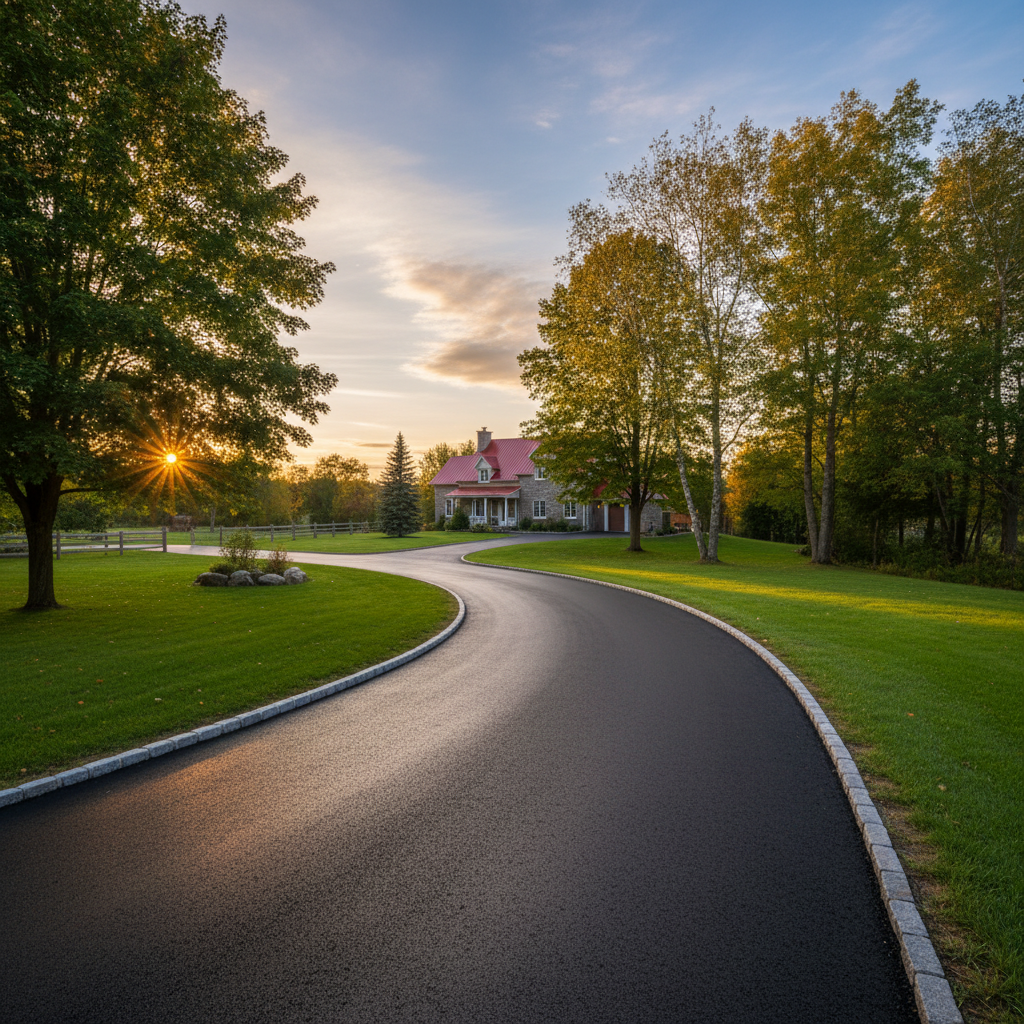
Driveway paving options and costs in Port Coquitlam
Port Coquitlam homeowners typically choose from asphalt, interlocking pavers, or concrete, and costs mostly track how much prep work your site needs—not just what surface you pick. In Port Coquitlam, there are 61,498 residents and 17,645 homeowner households (77.1% of households own), so driveways are a consistent “must-do” project as original surfaces age. About 36.7% of local dwellings are single-detached homes, which means many private driveways run through similar neighbourhood setbacks and driveway widths (often with limited access for larger equipment). That matters because tight lanes and older yard layouts can add labour time for excavation, base placement, and disposal.
Lower Mainland–Southwest paving is shaped less by extreme frost and more by intense rainfall and drainage. Frost penetration is relatively shallow compared with Interior or Northern BC, but regional practice still assumes a frost line for exposed applications, with repeated freeze–thaw near that zone. On clay-heavy spots in the Fraser Valley, drainage and granular base thickness become decisive, which is why “cheap paving” quotes can creep upward after a contractor confirms base conditions.
In Port Coquitlam, this trade is especially busy around the older housing fabric in and near Central Port Coquitlam and Glenwood areas, where many homes were built before 1981—meaning more driveways are showing settlement, soft subgrade, or failed edges. Next, you can compare the most common systems and realistic price expectations by material and maintenance level in the table below.
| Material |
Lifespan |
Maintenance |
Best For |
Price per sq ft |
Price Range |
| Asphalt (new installation, proper base) |
12–20 years |
Seal every 3–5 years; prompt crack fill |
Lowest upfront cost with good curb-to-curb look |
$5.50–$8.50 |
$3,600–$6,200 |
| Asphalt (overlay on existing gravel base) |
8–15 years |
More frequent sealing; monitor edge raveling |
When old surface is mostly sound and drainage is corrected |
$4.75–$7.50 |
$3,000–$5,200 |
| Interlocking concrete pavers |
25–35 years |
Re-leveling of minor dips; periodic joint sand refresh |
Maximum curb appeal and easy localized repairs |
$10.50–$16.00 |
$6,000–$11,500 |
| Poured concrete (broom finish) |
20–30 years |
Seal optional; maintain control joints |
Smooth, low-maintenance surface with simple detailing |
$8.50–$13.50 |
$5,500–$10,200 |
| Exposed aggregate concrete |
20–30 years |
Occasional sealing; address cracks early |
Non-slip texture and a higher-end finish |
$10.00–$16.50 |
$6,500–$12,500 |
| Gravel / crushed stone (budget option) |
5–10 years |
Top up and re-grade as needed |
Short-term or low-use driveways; best for drainage trials |
$3.00–$5.50 |
$2,000–$4,000 |
Prices are estimates only and vary by project scope, site access and material selection.
What affects the price of paving in Port Coquitlam
It’s common to see quotes for the “same size” driveway vary by 30–50% across the Lower Mainland–Southwest and even within British Columbia. The big reason is that paving is really a full earthworks-to-surface system: excavation, granular base installation, compaction, drainage corrections, and then the surface thickness. Two contractors might both quote asphalt, but one includes proper base depth and edge restraints while the other assumes existing material will perform as-is. In a market with lots of 1970s-era and pre-1981 homes (32.9% built before 1981 in Port Coquitlam), you also run into old fill, organic topsoil pockets, and driveway slopes that were never designed for today’s heavier rainfall patterns.
In coastal BC, frost penetration is not as deep as in Ontario/Alberta, but freeze–thaw around the assumed frost line still drives engineering. That means deeper, well-compacted granular base (commonly about 6" of compacted base for standard residential asphalt, and more where soils are weak or saturated) and correct drainage are where money is earned. In colder regions the paving season tightens because hot-mix asphalt requires air temperatures above 10°C; in the Lower Mainland the season is longer, but scheduling can still compress in wet shoulder months, which can affect pricing and availability.
Concrete costs can also swing based on reinforcement and jointing details. For example, a broom-finished poured concrete driveway with proper control joints may land closer to the asphalt range, while an exposed aggregate finish often pushes you toward the higher end of concrete pricing. On a $102,000 median household income (2020), many homeowners in Port Coquitlam still prefer durable systems—especially where drainage is corrected and edges are stabilized.
| Price Factor |
Why It Matters |
Cost Impact |
| Driveway area in sq ft |
Material volume and labour scale directly with area |
Often the largest driver; changes can swing total cost by thousands |
| Base depth required |
Frost line assumptions and subgrade condition determine granular thickness |
Additional excavation and gravel can add meaningful cost |
| Grading and drainage work |
Slope, runoff direction, and drainage corrections prevent soft base |
Can add labour, geotextile, and extra material |
| Tear-out of existing surface |
Breaking, hauling, and disposal of old asphalt or concrete |
Concrete tear-out typically costs more than asphalt |
| Edge restraints and curbing |
Prevents paver spread and asphalt edge failure |
Increases material and install time but protects the finish |
| Sealing requirement |
Asphalt needs sealing after cure (often 6–12 months) |
Planning for recurring maintenance affects “true” lifecycle cost |
| Site access |
Narrow lots slow equipment movement and extend labour time |
Can add hours for setup and more handwork |
| Asphalt mix specifications |
Freeze–thaw-rated mix and thickness support long-term performance |
Upgraded mix can increase unit cost |
Permits & regulations in British Columbia
In British Columbia, paving a private driveway on your own property typically does not require a building permit. However, work that affects the municipal right-of-way usually does require municipal approval. That includes new curb cuts, changes to the boulevard, altering sidewalks, and any storm drainage modifications (for example, changing how water leaves the driveway and ties into existing drainage). If your driveway project involves grading that changes how water flows toward neighbouring properties or alters ditching, you should expect additional checks under municipal lot-grading expectations.
For a Port Coquitlam homeowner, a practical way to stay compliant is to verify three things before work starts: (1) whether any portion of the driveway ties into the street/boulevard, (2) whether utility locates are needed (they always should be requested before excavation), and (3) whether there are lot-grading rules restricting hard-surface placement near property lines. Also, keep in mind that older homes often have existing under-drains or unknown backfill—confirmation up front prevents costly rework.
Step-by-step to verify your contractor: first, request their certificate of insurance naming you as the certificate holder where required, and review the coverage limits. Next, confirm they are legally operating with the correct provincial registration for the work they’re doing (and ask for documentation). Finally, ask for proof of worker coverage and clearance for payroll—then match it to the crew expected on site. Utility locates are arranged through the proper province system (BC 1 Call) before digging.
Asphalt vs pavers vs concrete for Port Coquitlam driveways
For Port Coquitlam driveways, asphalt, interlocking pavers, and concrete all work—when the base and drainage are done right. The trade-off is upfront cost versus long-term flexibility and how each system tolerates Lower Mainland–Southwest winter realities: heavy rain, wet shoulder seasons, and freeze–thaw near shallow frost zones. Asphalt is usually the lowest upfront option; when it’s installed on a well-compacted granular base and sealed after cure (often within 6–12 months, then every 3–5 years), it performs well and looks clean for years. The catch is that asphalt is one continuous layer—repairs generally mean cutting and patching, and the edges must be protected with proper restraint.
Interlocking concrete pavers cost more at the start, but they’re the best choice if you value repairability and curb appeal. If a section settles, pavers can be lifted, base corrected, and reinstalled without tearing out the entire driveway. That matters in neighbourhoods with older fill and occasional drainage soft spots. Poured concrete sits mid-range: it’s smooth and low-maintenance, but if not properly air-entrained and jointed with attention to freeze–thaw stresses, cracking can show up over time. Salt use and traction materials from winter maintenance can also affect surface appearance, especially on high-finish concrete.
On a typical 400 sq ft driveway, choosing interlocking pavers instead of asphalt can easily be a several-thousand-dollar step up; for example, asphalt might land around the $12–$20 per sq ft market band, while pavers often fall in the $20–$40 band. That price difference is justified when you want long service life, premium appearance, and the ability to fix localized failures rather than replacing the whole surface.
| Material |
Frost Resistance |
Curb Appeal |
Repair Method |
Lifespan |
Price Band |
| Asphalt (sealed regularly) |
Good when base is drained and frost-zone compaction is correct |
Moderate (clean, dark finish) |
Cut-and-patch asphalt |
12–20 years |
$12–$20 |
| Interlocking concrete pavers |
Very good with correct bedding and joint sand |
High (many colours/patterns) |
Lift units, correct base, re-lay |
25–35 years |
$20–$40 |
| Poured concrete (air-entrained) |
Good to very good with air-entrainment and proper joints |
Moderate to high (finish options) |
Drill/patch plus crack management |
20–30 years |
$18–$35 |
| Exposed aggregate concrete |
Good when sealed/managed and base is stable |
High (textured, premium look) |
Targeted patching and refinishing (as needed) |
20–30 years |
$18–$35 |
| Permeable pavers (drainage grid) |
Excellent for water handling if the sub-drain design is right |
Moderate to high (modern look) |
Remove sections, service drainage layers |
20+ years (system-dependent) |
$25–$45 |
| Chip seal / tar-and-chip |
Moderate; depends heavily on base and maintenance |
Low to moderate |
Spot repair and re-seal cycles |
7–12 years |
$10–$18 |
How to choose a paving contractor in Port Coquitlam
Choosing the right contractor matters as much as the material you choose. In British Columbia, verify licensing and insurance before anyone starts digging. Ask for the contractor’s provincial business registration details and their liability insurance certificate—this should show adequate coverage and list you as the certificate holder if required. For worker protection, request proof of worker coverage and clearance documentation for the crew that will be on site (this is typically provided by the contractor as part of compliance). If a contractor can’t produce current insurance and clearance proof quickly, treat that as a red flag.
Then get 2–3 itemised, written quotes with a labour + materials breakdown, not a single lump-sum number. The scope should clearly state excavation depth, type and thickness of granular base, geotextile use (if needed), compaction method, asphalt thickness or concrete spec, and whether edge restraints are included. Confirm what happens to the waste material—disposal should be included or clearly priced. If a permit or municipal approval is required for any boulevard/right-of-way tie-in, ask who pulls it and whether it’s included in the quote.
Use a simple payment schedule: never pay more than 10–15% upfront. Hold back the balance until the driveway is complete, cleaned, and meets the stated compaction and surface requirements. Finally, ask for a written start date and completion estimate, and ensure warranty terms are explicit—workmanship warranty length, product/manufacturer warranty coverage, and whether warranties transfer if you sell the home.
- Request proof of liability insurance and confirm coverage limits.
- Ask for proof of worker coverage/clearance for the actual crew.
- Confirm their provincial registration details relevant to the work.
- Get 2–3 itemised quotes (labour + materials), not lump sums.
- Verify excavation depth and base thickness are stated in inches.
- Confirm drainage/grading plan (slope direction, tie-ins, soft spots).
- Check whether geotextile and proper compaction are included.
- Ensure edge restraints/curbing are included for pavers and asphalt edges.
- Ask for disposal/hauling confirmation in the scope.
- Confirm sealing schedule for asphalt (after cure) and who does it.
- Ask about warranty length for workmanship and product; get it in writing.
- Use a payment schedule with a small deposit and a holdback until completion.
Red flags I see in Port Coquitlam include contractors who quote asphalt thickness without stating base depth, who skip drainage corrections after excavation, who can’t show current insurance/clearance documents, who pressure you into paying most of the job upfront, or who provide no written start date, warranty details, or disposal plan.
Frequently asked questions — paving in Port Coquitlam
How do I get the most accurate paving quote in Port Coquitlam?
To get an accurate quote in Port Coquitlam, insist on a site visit and a measured driveway layout (length, width, and any slopes). The contractor should review drainage pathways because Lower Mainland projects fail most often when water can’t get away from the base—not from “wrong pavement.” Ask for an itemised scope showing excavation depth, compacted granular base thickness, compaction method, and surface thickness (including asphalt mix spec where applicable). If you have an older driveway or built-up edges, ask whether tear-out and disposal are included. If any work touches the boulevard/right-of-way, confirm municipal approval requirements up front. Quoted totals also depend on access—tight lots around Central Port Coquitlam or Glenwood can add labour time for equipment movement and cleanup.
How much does it cost to pave a driveway in Port Coquitlam?
Pricing depends on surface area, base preparation, and whether you need tear-out and drainage fixes. As a market guide for Port Coquitlam, asphalt driveway paving commonly falls in the $12–$20 per sq ft band, while interlocking pavers often land in the $20–$40 band. Concrete is frequently in the $18–$35 band, depending on finish and reinforcement/jointing details. For a typical homeowner driveway, you might see asphalt totals in the mid-thousands when proper base is included, while pavers can be several thousand higher due to restraints, bedding, and larger quantities. If your subgrade is soft after excavation, expect the quote to adjust upward because additional granular base and grading are the fix—not a thinner surface.
Asphalt vs interlocking pavers vs concrete — which is best in Port Coquitlam?
“Best” depends on how you use your driveway and what you value most. Asphalt is usually the best balance of upfront cost and long service life when sealed regularly and built on a drained, properly compacted base—ideal for many single-detached homes where budgets are tighter. Interlocking pavers are the best choice if you want premium curb appeal and the ability to repair small problem spots without replacing the entire surface (helpful in older yards where drainage may not be perfect). Poured concrete can be a strong mid-range option, but it needs air-entrainment and correct control joints to manage freeze–thaw stress; even in coastal BC, the freeze line assumptions still matter. In short: choose asphalt for cost, pavers for repairability and appearance, and concrete for smooth, solid long-term coverage.
How long does a paved driveway last in Port Coquitlam?
With proper base and drainage, asphalt typically lasts about 12–20 years, assuming you seal after cure and handle cracks early. Interlocking pavers commonly last 25–35 years because localized failures can be corrected by lifting and re-laying pavers. Poured concrete often lands around 20–30 years when the mix is properly air-entrained and the job includes correct joints and finishing. The Lower Mainland’s intense rainfall means good runoff control is crucial—if water saturates the base, you’ll see rutting or premature cracking earlier than the typical lifespan. Also note that about 32.9% of Port Coquitlam’s homes were built before 1981, so older driveways may require deeper base correction to reach “full lifespan” performance.
When is the best time of year to pave in Port Coquitlam?
In Port Coquitlam, the workable season is longer than in colder parts of British Columbia, but rain still controls your timeline. Asphalt is typically scheduled when temperatures and weather allow proper placement and compaction—hot-mix asphalt generally requires air temperatures above about 10°C. The best results usually happen late spring through summer and into early fall, when rain events are less disruptive to excavation, base compaction, and curing. If you’re doing a full tear-out and base replacement, avoid times when the ground stays saturated for multiple days; compaction quality drops quickly in wet subgrade. Ask contractors for a start date window in writing and confirm they’ll protect the base after installation.
How deep should the base be for Port Coquitlam's frost?
Even in coastal BC where frost penetration is shallower than in the Interior, regional practice assumes a frost line for exposed applications. That means base depth is driven by the frost-zone stability and your specific subgrade condition (especially around drainage). For many residential asphalt driveways in the Lower Mainland–Southwest, the common approach is about 6" of compacted granular base plus roughly 2.5–3" of asphalt surface, with deeper excavation where soils are weak or saturated. If you have clay-heavy areas or water doesn’t drain well, contractors may increase granular depth beyond the “standard” section to prevent heaving and rutting. The right depth should be based on a site inspection after excavation, because “frost depth” alone doesn’t correct poor drainage.