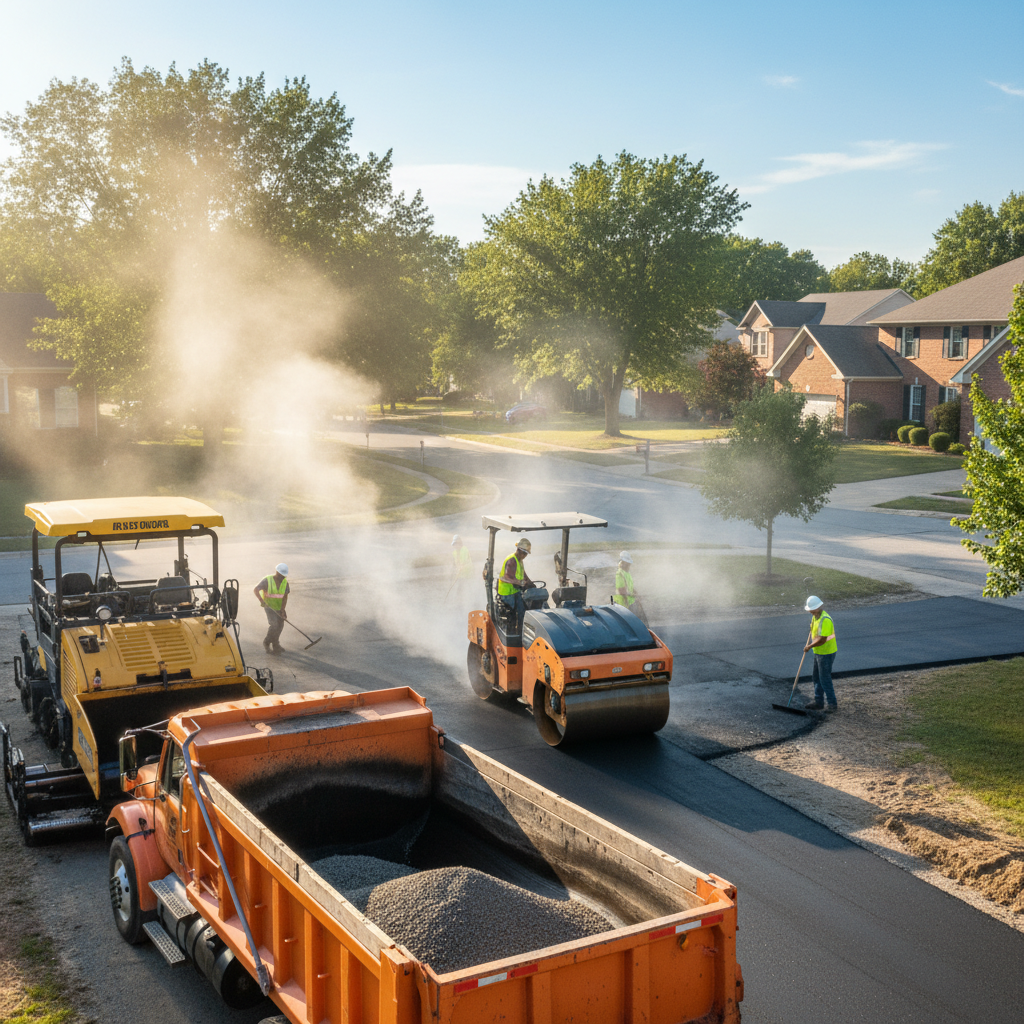
Driveway paving options and costs in Westlock
Westlock homeowners typically pave because most of the housing stock is single-detached—67.7% of dwellings—so private driveways are a huge part of everyday curb appeal. With 1,475 homeowner households in town, there’s strong demand for clean, drivable surfaces that can handle Edmonton-area winter conditions. (Statistics Canada, 2021 Census.)
In this part of Alberta, paving costs are driven less by the “surface” you see and more by what it takes underneath. Edmonton’s freeze-thaw cycle is hard on water in the base: as it freezes, it expands and can lift weak areas, then settles unevenly when it thaws. That means contractors price in deeper, well-compacted granular base, careful grading, and proper drainage to reduce frost heave, cracking, and settlement. The colder season also tightens scheduling because hot-mix asphalt needs warm weather—so mobilization can be higher during the workable months.
In Westlock, work is especially in demand around the Westlock townsite and the newer edge-of-town pockets where lots are graded but drainage and subgrade conditions vary more from property to property. If your driveway is on older fill or was built without modern frost-protection thickness, many bids end up looking like a “rebuild” rather than a simple resurfacing.
Below is a practical cost comparison for common driveway choices, assuming proper base preparation for central Alberta frost conditions. Use it to sanity-check quotes before you sign.
| Material |
Lifespan |
Maintenance |
Best For |
Price per sq ft |
| Asphalt (new installation, proper base) |
15–25 years |
Sealcoat every 3–5 years (weather-dependent) |
Most common choice in Westlock; smooth, even ride with good base design |
$7.50 – $14.00 |
| Asphalt (overlay on existing gravel base) |
10–20 years |
Sealcoat every 3–5 years; monitor low spots for rutting |
When the subgrade is sound and you have good drainage already |
$6.50 – $12.00 |
| Interlocking concrete pavers |
25–35 years |
Occasional panel re-leveling; joint sand top-ups |
High curb appeal; easy localized repairs without redoing the whole driveway |
$11.00 – $22.00 |
| Poured concrete (broom finish) |
25–40 years (with air-entrainment) |
Light cleaning; sealant optional depending on surface |
Low-maintenance, durable slab when base is engineered correctly |
$9.00 – $18.00 |
| Exposed aggregate concrete |
25–40 years |
Seal optional; keep joints/edges protected |
Slip resistance and premium appearance for longer driveways |
$14.00 – $24.00 |
| Gravel / crushed stone (budget option) |
2–7 years (varies with drainage) |
Regrade and add stone yearly; top up after spring thaw |
Lowest upfront cost; suitable while you address drainage or plan full build later |
$3.50 – $7.00 |
Prices are estimates only and vary by project scope, site access and material selection.
What affects the price of paving in Westlock
In Westlock and the wider Edmonton economic region, you can see the same driveway spec come in 30–50% apart between contractors—or even between two quotes from the same contractor—because the price often shifts to the hidden work: excavation, base thickness, drainage, and disposal. One crew may price it as resurfacing, while another correctly assumes the existing base is holding water and will need reconstruction to perform through deep frost and freeze-thaw cycling.
Frost protection is decisive here. Edmonton/central Alberta often works at about 1.5 metres or more of frost depth in local guidance, which means the granular base thickness and subgrade preparation must be built to resist heaving and cracking. In practice, that can translate into deeper excavation than what homeowners remember from earlier driveways built decades ago. The paving season is also shorter in colder regions because hot-mix asphalt requires air temperatures above about 10°C for proper placement and compaction. When crews are constrained by schedule, bids can reflect mobilization pressure and longer project timelines.
Asphalt mix design matters too: Edmonton-area freeze-thaw conditions generally require a mix that’s rated to tolerate repeated thermal stress, and that can affect the per-tonne cost. If you’re comparing bands, new asphalt installations commonly fall within the $7,000 – $15,000 range, while interlocking pavers often land in the $12,000 – $28,000 band depending on excavation and edge restraints.
Concrete examples from Westlock: (1) A driveway with poor surface drainage—water running from the lawn toward the slab—can force additional subdrain work and thicker base, raising cost quickly. (2) If the existing asphalt is brittle and breaks during tear-out, disposal and hauling time increase. (3) Lots with narrow access or long push distances can add crew hours for loading and compaction equipment—sometimes more than homeowners expect.
| Price Factor |
Why It Matters |
Cost Impact |
| Driveway area in sq ft |
Most materials and production time scale directly with area |
Major driver; can swing bids by thousands on longer driveways |
| Base depth required |
Frost line determines granular thickness and frost-protection performance |
Often the biggest variable in rebuilds; deeper base increases excavation, stone, and compaction time |
| Grading and drainage work |
Slope, ditches, and sub-drains keep water from sitting in the base |
Medium to high; can add stone, pipe, and regrading costs |
| Tear-out of existing surface |
Old asphalt or concrete must be broken, loaded, and hauled away |
Medium; difficult tear-out can raise labour and disposal charges |
| Edge restraints and curbing |
Prevents paver spread and asphalt edge breakdown |
Medium; required for clean edges and long-lasting edges in freeze-thaw |
| Sealing requirement |
Asphalt relies on sealcoat to slow oxidation and water infiltration |
Lower initial impact; adds ongoing maintenance budget and affects expected lifespan |
| Site access |
Narrow lots and long distances slow equipment movement |
Medium; can increase labour time and equipment staging costs |
| Asphalt mix specifications |
Freeze-thaw-rated mix designed for Edmonton/central Alberta conditions |
Low to medium; mix choice affects per-tonne pricing and placement requirements |
Permits & regulations in Alberta
In Alberta, paving a private driveway on your own property—like replacing asphalt or concrete within your property boundaries—often does not require a building permit. Where permits and approvals do come up is when the work affects municipal infrastructure or stormwater control. That includes work in the municipal right-of-way such as adding or changing a curb cut, altering boulevard areas, or making changes that impact storm drainage patterns (for example, redirecting runoff from the property in a way that affects the roadside system). Some municipalities also have lot-grading rules that limit how close a hard surface or drainage swale can be to property lines, which matters for older homes built before modern drainage expectations.
For Westlock homeowners, the practical step-by-step is:
- Call for utility locates before any excavation (Alberta One-Call). Confirm the markout covers the driveway footprint and any proposed trench drains.
- Ask the municipality (or through the contractor) whether a right-of-way approval is needed for your specific driveway approach.
- Confirm lot grading and drainage compliance with local requirements before base stone is placed.
- Verify the contractor’s Alberta credentials: check their business/licensing status online, request a current certificate of liability insurance, and confirm workers’ compensation coverage (WSIB/WCB) for anyone on site.
- Get documentation before work starts—especially if any part of the scope involves excavation or trenching near services.
Taking these steps early helps you avoid schedule delays, rework, and disputes later—especially in older neighbourhoods where drainage was originally built with different assumptions.
Asphalt vs pavers vs concrete for Westlock driveways
For Westlock driveways, the “best” material is usually the one that matches your base design and your winter routine—not just the cheapest surface. Asphalt is typically the lowest upfront option and can look great when properly compacted, but it does need sealing every 3–5 years to protect against oxidation and water intrusion during spring thaw. With Edmonton-area freeze-thaw cycling, an asphalt driveway that isn’t sealed and doesn’t shed water can fail prematurely even if it initially looked smooth.
Interlocking concrete pavers cost more upfront, often falling into the $12,000 – $28,000 band, but they’re highly repairable. If a section settles due to a localized drainage issue, pavers can be lifted, re-graded, and reset—without replacing the entire driveway. That’s a big advantage for homeowner-friendly fixes, particularly on properties where water management near the edge is sensitive to grades.
Poured concrete is mid-range and durable when it’s air-entrained and built on a properly frost-protected base. Still, concrete can crack from differential movement caused by freeze-thaw and thawing under the slab if drainage isn’t controlled. Exposed aggregate offers improved traction and a premium look, while permeable systems can help manage water, but they still require engineered base and correct elevation to avoid clogging or uneven settlement.
A practical pricing example: if you’re quoted asphalt in the $7,000 – $15,000 range versus pavers nearer the low end of $12,000 – $28,000, the extra paver cost can be justified when you want higher curb appeal and easier spot repairs, or when you expect future access needs (like landscaping changes) near the driveway edges.
| Material |
Frost Resistance |
Curb Appeal |
Repair Method |
Lifespan |
Price Band |
| Asphalt (sealed regularly) |
Good with correct base thickness and drainage; sensitive to unsealed water infiltration |
Moderate (clean, smooth look when fresh) |
Patch and pave locally; re-seal the full area |
15–25 years |
$7,000 – $15,000 |
| Interlocking concrete pavers |
Excellent when edge restraint and base compaction are done right |
High (widest variety of styles) |
Lift, re-grade, reset individual stones or sections |
25–35 years |
$12,000 – $28,000 |
| Poured concrete (air-entrained) |
Very good with air-entrainment and frost-protected base; can crack if drainage is off |
Moderate to high (broom finish) |
Slab repair/patching; sometimes requires localized grinding and resurfacing |
25–40 years |
$9,000 – $22,000 |
| Exposed aggregate concrete |
Very good; surface texture holds up well in winter traction |
Premium (high-end curb presence) |
Localized patching is possible; full replacement is uncommon unless base fails |
25–40 years |
$12,000 – $26,000 |
| Permeable pavers (drainage grid) |
Good for water management when designed for frost conditions |
High (engineered appearance) |
Lift-and-clean/reset components; base inspection is critical |
20–30 years (depends on maintenance) |
$14,000 – $30,000 |
| Chip seal / tar-and-chip |
Moderate; more common for longer-term rural approaches |
Low to moderate (texture-forward) |
Spot re-chip and periodic maintenance surface work |
6–12 years |
$6,000 – $13,000 |
How to choose a paving contractor in Westlock
Choosing the right paving contractor in Westlock is mostly about confirming coverage, clarity, and quality control—because in central Alberta the base build and drainage details are what determine whether your driveway survives winter. Start by verifying Alberta business credentials (where applicable), and insist on current liability insurance and workers’ compensation coverage (WSIB/WCB) for everyone working on site. Ask for a certificate of insurance and confirm the expiry date is current. If a contractor can’t produce documentation on request, that’s a major red flag.
Next, get 2–3 itemised written quotes. You want a breakdown of labour versus materials (asphalt tons, base stone quantities, drainage rock, pipe, geotextile if used, and compaction equipment time) rather than a single lump sum. Make sure each quote includes the same scope: tear-out depth, disposal, grading, edge restraints, and whether permits or right-of-way approvals are handled. Also ask what’s excluded—topsoil restoration, grass seeding, snow removal during the transition, or repairs to landscaping impacted by hauling routes.
Warranty should be explicit: workmanship warranty length (and what it covers), and any product/manufacturer warranty terms. Confirm whether warranties are transferable if you sell the property. For payment, avoid paying more than about 10–15% upfront; use milestone payments and hold back a portion until the job is complete and cleaned up.
Finally, require a start date and estimated completion in writing. In Edmonton-area conditions, weather windows affect crews, so a realistic schedule protects you from unfinished work sitting through cold nights.
- Confirm Alberta licensing/registration details (and that it matches the business name on your quote).
- Request and review a certificate of liability insurance (current expiry date and project/location coverage).
- Verify WSIB/WCB coverage for workers assigned to your site.
- Require itemised pricing: excavation, base materials, drainage, paving/lift, and compaction.
- Ask for the designed base depth and drainage plan (slope, daylighting, or subdrain details).
- Check disposal and hauling are included if tear-out is part of the scope.
- Make sure edge restraints/curbing are included for pavers and premium asphalt edges.
- Confirm asphalt placement and compaction specs (and whether temperature/weather constraints apply).
- Get warranty in writing: workmanship duration and exclusions.
- Clarify the re-seal requirement for asphalt (timing, typically after the initial curing period).
- Use a contract with a payment schedule (no large upfront deposits).
- Ask for photos of similar Edmonton/central Alberta projects and past base-build work.
Red flags I’ve seen in Westlock include: quotes that skip base thickness details, no written drainage plan, “we’ll match whatever’s there” language when freeze-thaw is involved, pressure to pay most of the balance upfront, and vague timelines that don’t account for weather windows or curing/compaction requirements.
Frequently asked questions — paving in Westlock
Why does my driveway crack and heave in winter?
In Westlock and the Edmonton region, winter cracking and heaving usually come from freeze-thaw movement in the base. If water gets into the granular layers (or if the base wasn’t built thick enough for frost protection), the water freezes, expands, and weakens the structure when it thaws. Older driveways—especially those built years ago before modern drainage and base requirements—are more prone because the subgrade can retain moisture. Cracking can also be accelerated by poor slope, clogged edge drainage, or missing sealcoat on asphalt. If you see “bumps” near the edges or low spots that hold puddles in spring, that’s a strong sign the drainage/grading plan needs attention before you re-surface.
Do I need a permit to pave my driveway in Alberta?
Often, replacing or paving within your property boundary on private land doesn’t require a building permit in Alberta. However, work in the municipal right-of-way can require municipal approval—especially if you’re changing a curb cut, altering boulevard surfaces, or impacting storm drainage patterns. Because your driveway approach may connect to municipal infrastructure near the street, it’s smart to ask before excavation, not after. For any excavation, you should also ensure utility locates are done through the Alberta One-Call process to avoid costly damage and delays. If your contractor assumes no approvals and begins work near the boulevard, that can lead to stop-work orders or rework. Always confirm lot grading and drainage rules with the municipality for your specific site.
How long before I can drive on new asphalt?
In Westlock, you can typically drive on new asphalt once it has cooled and the surface has achieved the right stability after compaction, which is usually within the same day for most residential driveway placements. If you’re building in colder shoulder conditions, contractors may adjust schedules because asphalt placement depends on workable weather (air temperature needs to be warm enough, commonly above about 10°C). Avoid turning heavy equipment or tight steering immediately after paving; sharp loads can mark soft areas before the mix fully cools. Also remember asphalt requires sealcoat later—often within the “first season window” depending on product guidance—so you’re protecting it against water infiltration during spring thaw. If your quote is in the $7,000 – $15,000 asphalt band, ask whether they include the recommended sealing timeline and curing expectations.
What causes potholes and how are they repaired?
Potholes usually form when water penetrates through cracks or weak spots, erodes the base, and then the surface can’t support the wheel loads during thaw cycles. In this climate, a small failure can expand after a wet winter because freeze-thaw cycles keep widening weakened areas. Repair is most successful when it includes base stabilization, not just “filling the hole.” A proper fix removes the damaged asphalt to a stable layer, addresses drainage or moisture pathways if needed, compacts the granular base, and then replaces asphalt with correct thickness. If the underlying issue is recurring—like standing water at a low grade—patches will keep failing. In that case, a rebuild or full overlay with proper drainage/grading is the longer-term solution.
How do I prepare for a paving project?
Preparation is a homeowner advantage. In Westlock, clear the driveway area of vehicles, portable basketball hoops, and decorative items before crews arrive. If landscaping is planned, decide whether you want removal and reinstatement included—many quotes exclude topsoil replacement or seeding beyond the paved footprint. Keep an eye on drainage paths: if you have a spot where meltwater always collects, tell your contractor—those details affect base design and slope. Confirm that access routes can handle stone delivery and equipment (especially for narrow lots). Also, make sure any utility locates are completed before excavation and that you understand the payment schedule (only small deposits upfront). For asphalt, plan your schedule around curing and the later sealcoat recommendation, since that maintenance supports the lifespan you’re paying for—typically within the $7,000 – $15,000 asphalt range depending on scope.
How do I compare paving quotes fairly?
To compare quotes fairly in Alberta, you need to compare scopes, not just totals. Ask for itemised labour and materials (excavation/base stone quantities, drainage work, disposal, paving lifts, and compaction). Ensure each quote includes the same base thickness and drainage design—because deeper frost protection and freeze-thaw control are where large differences come from. Check what’s excluded: right-of-way approvals, permit responsibility, landscaping reinstatement, or disposal. Warranty terms should also be comparable: workmanship duration, what triggers coverage, and whether product/manufacturer warranties apply to your materials. Don’t assume “cheaper asphalt” is cheaper overall if one quote includes a proper frost-protection rebuild while another treats it like resurfacing. Use price bands as a sanity check (for example, asphalt often falls around $7,000 – $15,000 and pavers often land in $12,000 – $28,000), but confirm the engineering and excavation details that drive performance through Westlock winters.