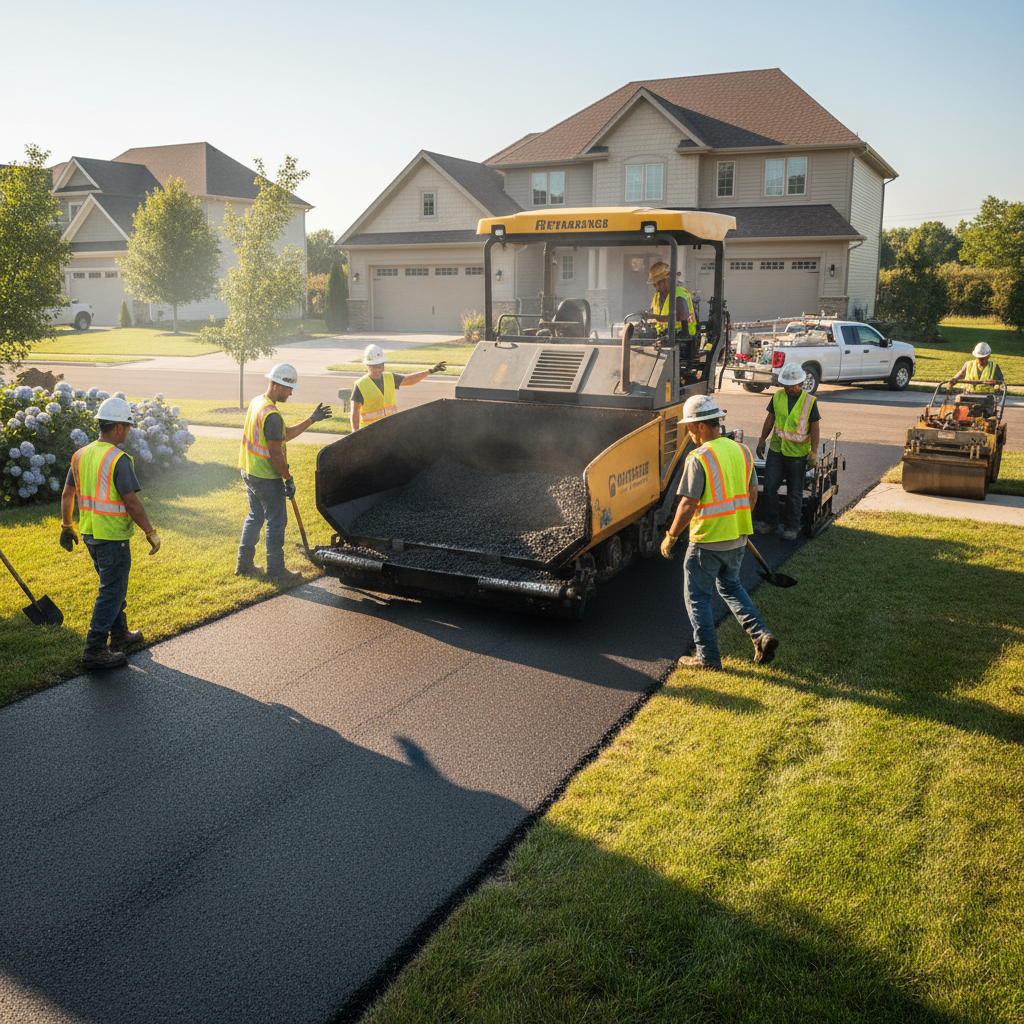
Driveway paving options and costs in Mayerthorpe
Mayerthorpe homeowners have a few solid driveway choices, but the “right” option depends on how your site handles Edmonton-area freeze-thaw cycles, drainage, and frost protection. With about 69.6% of dwellings in the area being single-detached homes (Statistics Canada, 2021 Census), most private driveway projects are tied to detached properties—meaning contractors frequently build to handle heavier vehicles, frequent plowing, and longer winters. It’s also common to see driveways on homes built before 1981, where older bases may have settled over decades (61.8% of homes built before 1981, Statistics Canada, 2021 Census).
In the Edmonton economic region, pricing is shaped less by “material only” and more by whether the existing base can perform through deep frost and repeated freeze-thaw. Local guidance often targets frost depths of about 1.5 metres or more, so a thicker, well-compacted granular base and reliable surface/subsurface drainage are frequent add-ons. Freeze-thaw cycling left water trapped in the base can lead to heaving and cracking, so bids often swing higher where excavation, hauling, or drainage corrections are needed rather than simple resurfacing.
In Mayerthorpe, this trade is especially busy around the downtown/central access corridors where snow storage, tight approaches, and turning constraints affect equipment time. For that reason, the fairest way to compare contractors is to review material options side-by-side and then match them to your site conditions.
Below are current cost bands you can expect for typical residential driveway scopes in the region.
| Material |
Lifespan |
Maintenance |
Best For |
Price per sq ft |
Price Range |
| Asphalt (new installation, proper base) |
15–25 years |
Seal 3–5 years after install, then every 3–6 years |
Lower upfront cost with good performance when base is built right |
$4.50–$7.50 |
$7,000–$15,000 |
| Asphalt (overlay on existing gravel base) |
8–16 years (depends on base) |
Seal sooner if overlay is thinner; spot-repair distressed areas |
When the base is mostly stable and drainage is adequate |
$4.00–$6.75 |
$6,500–$12,500 |
| Interlocking concrete pavers |
20–30 years |
Occasional re-leveling/replacement of small sections |
High curb appeal and repairability without full replacement |
$10.50–$16.50 |
$12,000–$28,000 |
| Poured concrete (broom finish) |
25–35 years |
Minimal, but sealant may help; monitor for freeze-thaw movement |
Durability for heavy use with straightforward upkeep |
$8.50–$13.50 |
$9,000–$22,000 |
| Exposed aggregate concrete |
25–35 years |
Reseal every 5–8 years in heavy de-icer use areas |
Non-slip surface and upgraded look |
$10.00–$15.50 |
$10,500–$24,000 |
| Gravel / crushed stone (budget option) |
3–8 years (varies with drainage) |
Regrade and top-up every 1–3 years |
Short budget window or temporary driveway |
$2.00–$4.00 |
$2,500–$7,500 |
Prices are estimates only and vary by project scope, site access and material selection.
What affects the price of paving in Mayerthorpe
You can get dramatically different quotes for what sounds like the “same” driveway in Mayerthorpe because Edmonton-area pricing depends heavily on frost protection, drainage, and how much reconstruction is required—not just the visible surface. It’s not unusual for bids across the Edmonton economic region to land 30–50% apart when one contractor can build on a stable base while another has to excavate and rebuild due to soft subgrade, poor grading, or water movement.
In this climate, frost line depth and freeze-thaw cycles are decisive cost factors. Deeper frost generally means a thicker, compacted granular base to prevent heaving and cracking; contractors in central Alberta typically plan for more granular thickness than southern or milder regions. Freeze-thaw cycling also makes water a “hidden” cost driver: if the base holds water, it expands when frozen and weakens the structure when it thaws—so you’ll see extra excavation, drainage stone, geotextile, and longer compaction time built into higher bids.
The paving season also compresses scheduling. Hot-mix asphalt generally needs air temperatures above 10°C to place properly, which concentrates demand in spring/summer and can tighten crew availability. Edmonton-area asphalt mixes are also specified for freeze-thaw performance, which can add cost versus a generic mix.
Concrete projects may look simpler, but local conditions can raise costs too: older homes (including the 61.8% built before 1981) often come with uneven subgrade, meaning tear-out and regrading can push a poured concrete job closer to the $9,000–$22,000 band. On the other hand, a driveway that’s already on a stable, properly drained base can keep asphalt closer to the $7,000–$15,000 range because the work is mostly surface and sealing.
| Price Factor |
Why It Matters |
Cost Impact |
| Driveway area in sq ft |
More square footage means more base, surface, and finishing time |
High (+20–60% across typical sizes) |
| Base depth required |
Frost protection thickness is driven by regional freeze depth and subgrade condition |
High (+10–40% where excavation is needed) |
| Grading and drainage work |
Proper slope and interception prevents water pooling that causes heave |
Medium to high (+5–30%) |
| Tear-out of existing surface |
Breaking concrete/asphalt and hauling away adds labour and disposal costs |
Medium to high (+8–35%) |
| Edge restraints and curbing |
Pavers need mechanical restraint to prevent spreading; asphalt may need form/edge control |
Medium (+3–15%) |
| Sealing requirement |
Asphalt performance depends on proper seal timing to slow oxidation and moisture intrusion |
Low to medium (often +1–6% in project total, depending on scope) |
| Site access |
Narrow approaches or soft ground increase equipment time and re-positioning |
Medium (+5–20%) |
| Asphalt mix specifications |
Freeze-thaw rated mix and proper grading improve longevity in Edmonton/central Alberta |
Medium (+2–10% versus basic mixes) |
Permits & regulations in Alberta
In Alberta, paving a private driveway within your own property typically does not require a building permit, as long as you’re staying within your parcel and not altering municipal infrastructure. The work that usually does require municipal approval is anything that affects the area between the road and your property—what’s commonly considered the municipal right-of-way. That includes new or changed curb cuts, changes to boulevard grading, storm drainage tie-ins, or any modification that could impact how surface water flows toward catch basins. Mayerthorpe homeowners should also expect lot-grading restrictions: some municipalities enforce bylaw rules about how hard surfaces can sit and how drainage must be handled near property lines.
Before any excavation, your contractor should arrange utility locates through Alberta One-Call to mark buried lines. That’s not optional in practice—hitting a buried service can turn a driveway job into a costly delay. Here’s a straightforward process to verify your contractor in Alberta: (1) check their Alberta business details/licensing information where applicable, (2) request a current certificate of insurance showing general liability coverage for the project, and (3) confirm workers’ coverage via WSIB/WCB clearance documentation (or an equivalent proof of coverage acceptable in Alberta for the specific work arrangement). A reputable contractor should provide these documents before scheduling excavation or hauling.
If drainage is being altered, ask who is pulling the municipal approval (you vs. them), and confirm what’s included in the quote for permits or engineering requirements—so surprises don’t show up halfway through construction.
Asphalt vs pavers vs concrete for Mayerthorpe driveways
For Mayerthorpe driveways, asphalt, interlocking concrete pavers, and concrete all can work well, but freeze-thaw performance and winter maintenance routine determine which is “best value.” Asphalt is usually the lowest upfront option, often landing within the $7,000–$15,000 band, but it requires sealing after installation (commonly within the first 3–5 years and then periodically). Interlocking concrete pavers tend to cost more—often within the $12,000–$28,000 band—yet they’re highly repairable: if one section settles or a drain line needs future work, you can lift and re-lay a small area instead of tearing out the entire surface. Poured concrete is mid-range on cost, typically around $9,000–$22,000, but it must be properly air-entrained and jointed for freeze-thaw movement; otherwise you can see cracking and moisture pathways that worsen over time.
Edmonton-area frost protection matters for all three systems. In practice, the base in Mayerthorpe needs to be built for deep winter: you’re looking for stable subgrade, well-graded granular layers, and drainage that prevents standing water. That’s especially important when plowing frequently pushes meltwater and salt toward low spots. Asphalt can handle winter well when the mix is freeze-thaw-rated and sealing is kept current; pavers usually tolerate localized issues because individual units can be replaced. Concrete, particularly if not properly air-entrained, is more prone to freeze-thaw surface degradation and cracking from movement if the base isn’t firm.
Where the price difference is justified: if your driveway area is large and your base is questionable (common on older properties—61.8% built before 1981), pavers can be worth paying for because future repairs are cheaper and faster. If your subgrade is already stable and drainage is proven, asphalt is often the smart value—especially when you’re comparing an asphalt install near $7,000–$15,000 against pavers that may land closer to the middle of $12,000–$28,000 once restraint, bedding sand, and edging are included.
| Material |
Frost Resistance |
Curb Appeal |
Repair Method |
Lifespan |
Price Band |
| Asphalt (sealed regularly) |
Good when base/drainage are correct and mix is freeze-thaw rated |
Moderate (clean, uniform finish) |
Mill/patch localized failures |
15–25 years |
$7,000–$15,000 |
| Interlocking concrete pavers |
Very good; movement is managed at the unit level with a stable base |
High (wide design options) |
Lift and replace affected units/bedding areas |
20–30 years |
$12,000–$28,000 |
| Poured concrete (air-entrained) |
Good to very good when air-entrained and properly jointed |
Moderate to high (broom finish or decorative) |
Patch and/or slab replacement for larger issues |
25–35 years |
$9,000–$22,000 |
| Exposed aggregate concrete |
Good to very good; same base/joint principles as concrete |
Very high (texture, slip resistance) |
Patch matching finish; sometimes localized replacement |
25–35 years |
$10,500–$24,000 |
| Permeable pavers (drainage grid) |
Very good where designed to manage water; reduces trapped moisture |
High (clean look with drainage performance) |
Lift/replace units; cleanout of drainage stone if needed |
20–30 years (design-dependent) |
$14,000–$30,000 |
| Chip seal / tar-and-chip |
Fair to good; performance varies with base and maintenance |
Low to moderate (functional surface) |
Top up/surface renewals |
5–12 years |
$6,000–$12,500 |
How to choose a paving contractor in Mayerthorpe
Choosing a paving contractor in Mayerthorpe is mostly about verifying competence and protecting yourself from “scope drift.” In Alberta, start by requesting the contractor’s insurance and coverage documents before work begins. Ask for (1) proof of general liability insurance (certificate of insurance), (2) workers’ coverage proof for the crews (WSIB/WCB clearance or an equivalent proof acceptable for the job and employer structure), and (3) business identification/licensing details you can confirm through official Alberta sources if available for their specific trade activity. A legitimate operator won’t hesitate to provide these documents—if they do, that’s a red flag.
Then get 2–3 itemised written quotes. You want a labour + materials breakdown that lists excavation, granular base thickness, geotextile (if used), drainage stone, compaction method, tack coat (for asphalt), and disposal/hauling. Avoid any quote that only shows “asphalt driveway, total price” without describing base preparation and drainage provisions. Confirm what’s excluded: permits, traffic control, cement disposal, after-hours work, and any trucking/delivery surcharges.
Warranty matters too. Ask for the workmanship warranty length (not just “best efforts”), whether product warranties apply, and if warranties are transferable to future homeowners. For payment, never pay more than 10–15% upfront; hold back a portion until the final inspection and cleanup are complete. Finally, demand a start date and completion estimate in writing—weather delays happen, but an honest schedule should still be documented.
- Verify general liability insurance certificate before excavation.
- Confirm WSIB/WCB clearance (workers’ coverage) for the paving crew.
- Request the contractor’s business details and ability to pull municipal approvals if required.
- Get an itemised quote with base thickness and drainage scope spelled out.
- Ask how they test compaction (e.g., density/field testing) and how results are documented.
- Confirm whether geotextile and drainage stone are included for wet or soft areas.
- Clarify asphalt details: tack coat, lift thickness, and freeze-thaw mix specification.
- Confirm concrete details: air entrainment, joint layout, and curing method.
- For pavers, verify edging/restraints and bedding sand thickness are included.
- Ask about disposal: is old asphalt/concrete hauled and tipped by them or by you?
- Review warranty terms in writing, including what constitutes workmanship defects.
- Set a payment schedule with a 10–15% maximum deposit and a holdback until completion.
In Mayerthorpe, red flags I’ve seen include: quotes that ignore frost protection/base reconstruction; a contractor who won’t show insurance or WSIB/WCB coverage; vague wording like “we’ll fix as needed” without unit prices or allowances; rushing you into paying large deposits; and promising “no need for drainage” when the driveway naturally sheds water toward the base.
Frequently asked questions — paving in Mayerthorpe
When is the best time of year to pave in Mayerthorpe?
In Mayerthorpe and across Alberta’s colder Prairie conditions, the best window is usually late spring through early fall, when subgrade moisture is lower and paving crews can achieve good compaction. For asphalt, installers generally need warm, stable conditions because hot-mix asphalt placement is typically done when ambient conditions support proper compaction (air temperatures often need to be above 10°C). Late-season jobs can still work, but scheduling becomes tighter and crews may be less flexible with curing times. If you’re comparing quotes now, ask how each contractor plans around freeze risk, delivery timing, and crew availability—Edmonton-area work can concentrate during the short workable period.
How deep should the base be for Mayerthorpe's frost?
Base depth isn’t “one number for every driveway” because it depends on your subgrade, soil moisture, and drainage. That said, central Alberta frost protection typically requires a thicker, well-graded granular base than milder climates to reduce heave and cracking from freeze-thaw cycling. A contractor should assess the existing soil condition (and whether water pools), then design a granular build-up with enough thickness and compaction for frost protection. If your home is older (61.8% of homes built before 1981), the existing base may have settled or become uneven, which often increases excavation and base rebuild costs. This is a major reason bids can differ by 30–50% even for similar driveway sizes.
How often should I seal my asphalt driveway?
For asphalt in Mayerthorpe, sealing is usually done after the initial surface has had time to cure and weather out—often within the first 3–5 years after installation—then repeated periodically to protect against moisture intrusion and oxidation. After that, many homeowners reseal every 3–6 years depending on traffic, plowing intensity, and how much de-icing you use. Keeping sealing on schedule is one of the practical ways to protect the lifespan you paid for in the $7,000–$15,000 asphalt range. Skipping seal periods is also a common cause of early raveling and patchy failures, especially when water migrates into small voids during thaw periods.
Why does my driveway crack and heave in winter?
The most common cause of winter cracking and heaving is water in the base. In Alberta’s freeze-thaw cycle, any moisture trapped in poorly drained granular layers freezes, expands, and weakens the structure when it thaws again. That can pull the surface out of level (heave), then later cause cracking—often along wheel paths or low spots. Another frequent contributor is inadequate or degraded base thickness, particularly on older driveways (many around homes built before 1981). If the driveway was resurfaced without addressing drainage, cracks can return even if the asphalt looks “fine” at the surface. Fixing the foundation (base + slope + drainage) is what separates longer-lasting repairs from repeat patching.
Do I need a permit to pave my driveway in Alberta?
In Alberta, paving a private driveway within your own property typically doesn’t require a building permit, but the rules change if the work affects municipal right-of-way or storm drainage. Generally, you need municipal approval for things like new or altered curb cuts, changes to boulevard grading, or modifications to storm drainage that impact public areas. Mayerthorpe homeowners should also confirm any lot-grading or drainage-related restrictions that control how close hard surfaces can be to property lines and how water must be managed. Before excavation, utility locates should be done through Alberta One-Call. When requesting a quote, ask whether permits/approvals are included or handled by the contractor, and what documentation they provide.
How long before I can drive on new asphalt?
Most asphalt driveways are ready for vehicle traffic the same day or within 24–48 hours, depending on weather, lift thickness, and how the surface was compacted. Contractors typically allow time for the surface to cool and for the asphalt binder to set properly. If you drive on it too early—especially in cold or wet conditions—you can leave wheel marks or damage the surface texture, which can shorten lifespan and increase the chance you’ll need earlier sealing or patching. In Alberta’s shorter paving season, crews manage timing carefully to avoid freeze risk. For best results, ask your contractor for a written “wait time” plan and how they’ll protect the surface from early traffic and snow in the days immediately after paving.