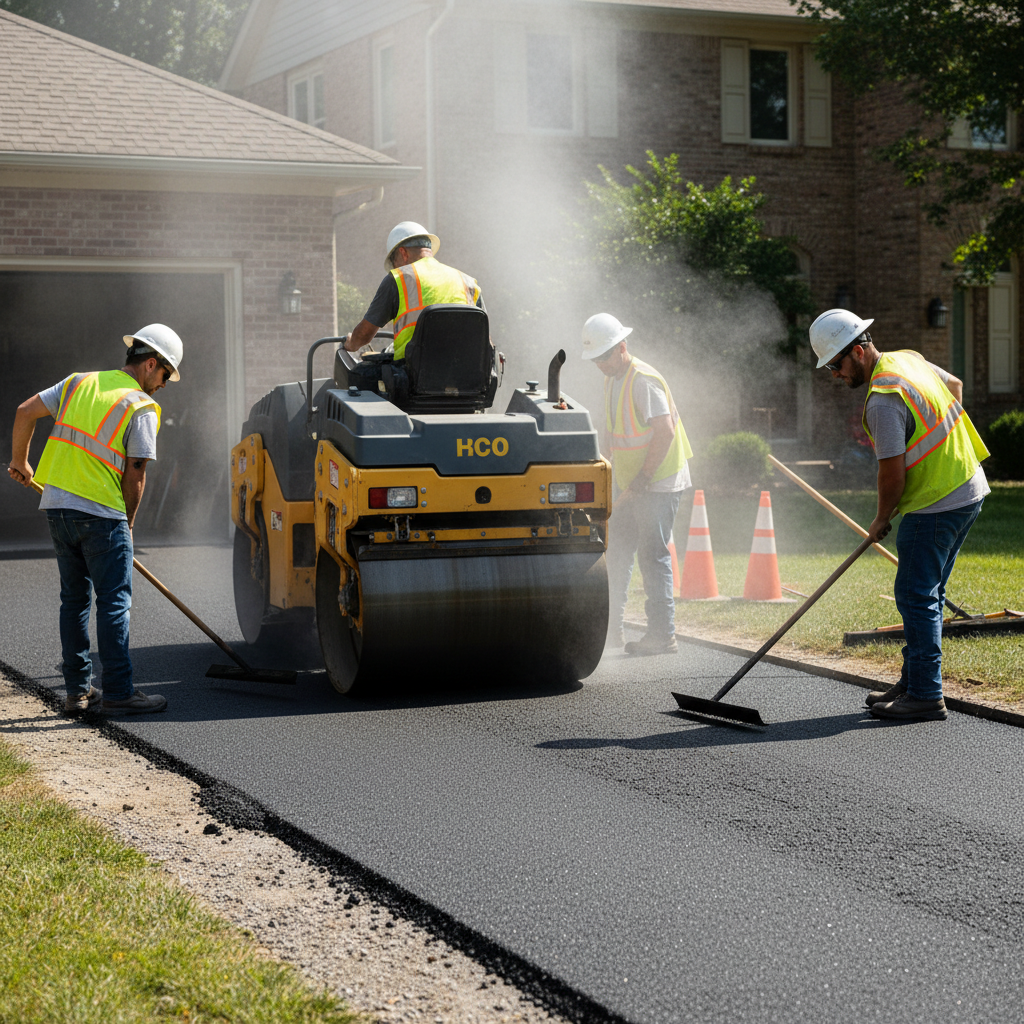
Driveway paving options and costs in Red Deer
Red Deer homeowners have a lot of driveway options, and pricing moves a lot because the city sits in a hard-winter environment where freeze-thaw doesn’t politely stay in the background—it drives the design. With 53.1% of dwellings being single-detached houses, many driveways are tied to detached homes, so asphalt and concrete installs are in constant demand. The local market also includes a meaningful amount of older housing stock: 34.1% of homes were built before 1981, which often means older bases, weaker drainage, and more frequent tear-outs when you upgrade from gravel to paved surfaces.
In Red Deer, contractors typically price by site conditions first: soil type, drainage, base depth, and access. If you’re in areas with heavier truck traffic, tight lanes, or down-slope drainage toward the driveway, the excavation and granular rework can quickly become the budget driver. Winter maintenance—plowing, plus salt/sand on some streets—also affects what holds up. Because asphalt in particular must meet freeze-thaw performance requirements, a “cheapest mix” approach can cost more over time.
Demand is especially strong around family-focused residential corridors like Clearview Estates and Normandeau, where many owners are refreshing older driveways before winter and replacing gravel before it turns into muddy ruts. Below is a practical comparison of common driveway materials and what you can typically expect for pricing, assuming proper base preparation and reasonable site access.
| Material |
Lifespan |
Maintenance |
Best For |
Price per sq ft |
Price Range |
| Asphalt (new installation, proper base) |
15–25 years |
Seal every 3–5 years (typically) |
Most cost-effective paved look |
$4.00–$6.50 |
$5,500–$12,000 |
| Asphalt (overlay on existing gravel base) |
8–15 years |
Seal every 3–5 years; monitor rutting |
When the base is stable enough to support an overlay |
$3.25–$5.75 |
$5,000–$10,500 |
| Interlocking concrete pavers |
25–35 years |
Re-sand joints as needed; occasional panel/stone reset |
Curb appeal and easy local repairs |
$9.50–$16.00 |
$9,000–$22,000 |
| Poured concrete (broom finish) |
20–30 years |
Crack monitoring; reseal only if specified |
Low-maintenance, straight edges |
$7.50–$12.50 |
$8,500–$18,000 |
| Exposed aggregate concrete |
25–30 years |
Annual inspection; reseal if chosen |
Slip resistance and decorative finish |
$10.00–$15.50 |
$10,500–$20,500 |
| Gravel / crushed stone (budget option) |
3–8 years (varies widely) |
Re-grade and top up every 1–3 years |
Short-term budget, easy reworking |
$1.50–$3.50 |
$2,000–$6,500 |
Prices are estimates only and vary by project scope, site access and material selection.
What affects the price of paving in Red Deer
In Red Deer, quotes for the “same” driveway can differ by 30–50% because asphalt and concrete pricing isn’t just material—it’s the amount of base rebuild, drainage correction, and tear-out needed to create a stable foundation for freeze-thaw. Two driveways that look identical from the street can have completely different soil moisture, subgrade strength, and how water flows across the site. When water sits under the surface, it expands as it freezes, and that leads to heaving, settlement, and edge failure.
The decisive factor in our region is frost and freeze-thaw cycling. In central Alberta, frost action is a design factor rather than a minor detail, and practical design often targets a frost-depth allowance of roughly 1.2 metres (4 feet) as a planning rule-of-thumb. That translates into thicker, well-compacted granular base and better drainage than you’d see in milder climates. Asphalt also has to meet local freeze-thaw performance requirements; that can push mix design slightly higher, even if the driveway size is the same. Paving season is also shorter with colder conditions—hot-mix asphalt generally needs air temperatures above 10°C—so scheduling pressure in spring and early summer can raise prices during peak weeks.
Local examples that change cost in Red Deer:
- Older driveways (built before 1981) often have compacted base fines or buried topsoil; upgrading can mean 6–12 inches of extra granular removal and replacement, which moves a project toward the higher end of $5,500–$12,000 for asphalt.
- If your driveway slope sends runoff toward the garage or foundation, contractors may add ditching, subdrains, or rebuild the crown—this can move interlocking pavers closer to $9,000–$22,000.
- Tight access off side streets in areas like Clearview Estates can slow equipment movement, add labour for traffic control, and increase cleanup/disposal time.
Bottom line: the “hidden” work—base depth, drainage, and tear-out—often explains the biggest portion of the difference between a budget quote and a long-lasting driveway.
| Price Factor |
Why It Matters |
Cost Impact |
| Driveway area in sq ft |
Most costs scale directly with surface area and required base replacement |
High (often 50–70% of the total) |
| Base depth required |
Frost action demands enough compacted granular thickness to prevent heaving and cracking |
High (can add thousands) |
| Grading and drainage work |
Proper slope and drainage reduce trapped water under asphalt or concrete |
Medium to high |
| Tear-out of existing surface |
Concrete/asphalt removal includes breaking, hauling, and disposal |
Medium to high |
| Edge restraints and curbing |
Pavers need restraints to prevent spread; asphalt needs proper edges for containment |
Medium |
| Sealing requirement |
Asphalt in Alberta typically needs sealing after initial cure to protect from moisture and oxidation |
Low to medium (recurring) |
| Site access |
Narrow lots slow equipment and increase labour time and staging |
Low to medium |
| Asphalt mix specifications |
Freeze-thaw-rated mix design can cost more but performs better in central Alberta cycles |
Low to medium (long-term benefit) |
Permits & regulations in Alberta
For a private driveway paving project in Alberta, a building permit is usually not required when you’re working entirely within your own property and not altering municipal infrastructure. In practice, driveway upgrades often fall under “private property maintenance/improvements,” meaning you can typically pave or replace a surface without a permit—provided you’re not changing drainage patterns that impact neighbours or the municipal right-of-way.
Where permits and approvals are commonly required is when your work involves municipal property or affects municipal drainage. Examples include: creating or changing a curb cut that ties into the boulevard, altering stormwater flow through changes near catch basins/ditches, and doing any work in the municipal right-of-way (including boulevard grading that changes how runoff is handled). In some cases, municipalities also apply lot-grading requirements that restrict hard surfaces or how close they can be to property lines and how water must be directed.
Step-by-step for Red Deer homeowners:
- First, call for utility locates (Alberta One-Call) before excavation.
- Verify the contractor’s Alberta authorization using the appropriate provincial registry for their trade/contracting category.
- Ask for a certificate of insurance (general liability) showing your property address/job name where possible.
- Confirm WSIB/WCB coverage (workers’ compensation) and request proof before work starts.
- Confirm any relevant lot-grading or right-of-way requirements with the City of Red Deer or your local municipal contact.
Asphalt vs pavers vs concrete for Red Deer driveways
For Red Deer’s hard-winter pavement conditions, the best driveway choice usually comes down to how you balance upfront cost, repairability, and winter maintenance impacts. Asphalt is typically the lowest-cost option and it’s fast to install, but it needs sealing every few years—often every 3–5 years—to protect the surface from moisture and oxidation. It also depends heavily on base preparation; if the granular base and drainage aren’t right, freeze-thaw cycling will show up as early cracking or edge failure.
Interlocking concrete pavers bring the highest curb appeal and are very practical in Alberta because individual stones or small sections can be reset after settlement. That repair flexibility matters when plowing loads repeatedly hit the same wheel paths. Poured concrete sits in the middle on cost, but freeze-thaw resistance relies on good air entrainment and finishing practices; otherwise you can see cracking sooner. Exposed aggregate adds slip resistance and aesthetics, while still requiring proper base design. Permeable pavers (drainage grid) can be useful where water management is critical, but they still require careful subgrade and drainage detailing.
In local terms, asphalt commonly lands within the $5,500–$12,000 driveway band when the base is rebuilt properly, while pavers often land within the $9,000–$22,000 band—especially if restraints and drainage corrections are included. A clear example: if a typical 600 sq ft driveway would be $7,500 in asphalt but $14,500 in pavers, paying the extra can be justified if you value long-term curb appeal and want the option to repair a small section rather than replace an entire slab or full asphalt mat.
| Material |
Frost Resistance |
Curb Appeal |
Repair Method |
Lifespan |
Price Band |
| Asphalt (sealed regularly) |
Good when base and drainage are correct; seal helps protect against water intrusion |
Medium |
Mill and patch sections; overlay if needed |
15–25 years |
$5,500–$12,000 |
| Interlocking concrete pavers |
Very good; individual unit movement is easier to manage with correct base and restraints |
High |
Replace affected units/blocks; re-sand and reset |
25–35 years |
$9,000–$22,000 |
| Poured concrete (air-entrained) |
Good with air entrainment and proper finishing; depends on jointing and base |
Medium to high |
Crack repair/seal; full replacement if movement is widespread |
20–30 years |
$8,500–$18,000 |
| Exposed aggregate concrete |
Good; surface finish doesn’t replace the need for base/drainage design |
High |
Localized patching possible but often less seamless than pavers |
25–30 years |
$10,500–$20,500 |
| Permeable pavers (drainage grid) |
Very good where water management is engineered correctly |
Medium to high (design-dependent) |
Replace units; maintain drainage layers |
20–30 years |
$11,000–$24,000 |
| Chip seal / tar-and-chip |
Moderate; can perform well but requires good prep and maintenance |
Low to medium |
Re-chipping/spot repairs |
6–12 years |
$5,000–$10,000 |
How to choose a paving contractor in Red Deer
Choosing the right contractor matters more in Red Deer than many other cities because our freeze-thaw cycles punish shortcuts. Start by confirming the contractor is properly set up to work in Alberta: ask for their Alberta business registration/authorization for the paving work, and request a current certificate of general liability insurance naming you and/or covering your address. Next, confirm WSIB/WCB coverage for their workers—ask for proof before work starts so you’re not exposed if there’s an injury on site. A reliable contractor will provide these documents without hesitation.
Then request 2–3 itemised written quotes that break down labour and materials. You want to see line items for excavation, granular base depth, compaction, drainage/grading, geotextile (if used), asphalt/paver/concrete materials, forms/finishes, disposal, and any saw cutting or jointing for concrete. Be cautious with quotes that bundle everything into a single lump sum without explaining what’s included.
Read the scope carefully: what’s excluded (for example, hauling beyond a certain distance), whether permit pull is included if you’re altering boulevard/curb access, and whether disposal and clean-up are included. Warranty should be explicit: workmanship warranty length and what product/manufacturer warranties cover. Confirm whether warranties are transferable to future owners.
For payment, keep it controlled: don’t pay more than 10–15% upfront, and hold back a portion until the finish work and close-out are complete. Finally, get a written start date and completion estimate.
- Ask for at least two project references in Red Deer or nearby areas.
- Require the quote to specify base depth and compaction method (not just the surface material).
- Confirm how drainage/slope will be corrected before paving (grade and outlets).
- Check that utilities have been located (Alberta One-Call) before excavation.
- Verify general liability insurance certificate is current and job-referenced where possible.
- Confirm WSIB/WCB coverage documentation for workers.
- Make sure the contract names disposal/hauling and whether dumpster placement is included.
- For asphalt, ask about tack coat, minimum thickness, and seal timing after cure.
- For pavers, confirm edging/restraints, bedding layer type, and joint sand specification.
- For concrete, confirm air-entrainment for freeze-thaw and jointing plan.
- Require a workmanship warranty in writing and understand what “failures” it covers.
- Use a payment schedule that holds back until final grade and cleanup are verified.
In Red Deer, common red flags include: no clear base depth in the quote, skipping drainage corrections to “save money,” refusing to provide insurance/WSIB proof, quoting the surface material but not tear-out/disposal, and starting without utility locates or without a written schedule.
Frequently asked questions — paving in Red Deer
When is the best time of year to pave in Red Deer?
The best time to pave in Red Deer is typically late spring through summer, when conditions are reliably warm and crews can get proper compaction and curing. Asphalt installations generally need consistently warm air temperatures (commonly above 10°C) to achieve proper placement and smooth mat density. That’s why many homeowners see scheduling intensity in June and early July, and why a short paving season can affect availability and pricing. For asphalt, sealing is usually planned after the surface has cured—often several months—so that the seal bonds properly rather than trapping moisture. If your driveway needs excavation and base rebuild, it’s also easier to keep subgrade dry during warm, longer daylight periods, which reduces the risk of weak, saturated material under the new surface.
How deep should the base be for Red Deer's frost?
Base depth can’t be “one size fits all,” but in Red Deer the frost-and-drainage reality matters. In central Alberta, frost action is treated as a design factor, and a practical planning rule-of-thumb used in the Edmonton-area is roughly a 1.2 metres (4 feet) frost allowance. Translating that into driveway construction means contractors typically design for enough compacted granular thickness to manage freeze-thaw movement and reduce heaving and cracking. Expect base depth to depend on your soil condition and drainage: if the subgrade is wet or unstable, or if you’re upgrading from an older gravel driveway (common in many homes built before 1981), the job often needs deeper excavation and granular replacement. This is one reason quotes vary widely, including within the asphalt band of $5,500–$12,000 for properly built bases.
How often should I seal my asphalt driveway?
In Alberta’s freeze-thaw conditions, asphalt sealing is typically scheduled after the surface has cured and then repeated every few years based on wear and exposure. A common guideline is to seal asphalt every 3–5 years, which helps protect against moisture infiltration and oxidation. If your driveway gets heavy vehicle traffic or is heavily exposed to wind-driven snow and salt/sand from nearby winter maintenance, sealing may need to happen closer to the 3-year end. Don’t skip the initial cure period—sealing too early can trap moisture and lead to premature breakdown. If you paid for new asphalt, treat sealing as part of the system: it’s one of the few homeowner actions that meaningfully extends service life and helps keep you from needing an overlay sooner (which can move you toward the higher end of the local asphalt pricing band, depending on scope).
Why does my driveway crack and heave in winter?
Cracking and heaving usually come from water and movement—especially under the driveway—during Red Deer’s freeze-thaw cycles. If drainage is poor, meltwater and surface runoff can saturate the base. When temperatures drop, freezing expands the water and pushes upward (heaving). Repeated cycles gradually break down compacted layers and cause edges to fail, which you then see as cracking, potholes, or ruts along wheel paths. Another common contributor is a base that’s too shallow or not well-compacted for the actual soil conditions. Older driveways (including many in housing built before 1981) may also have buried topsoil or organic material that compresses over time. The fix isn’t just patching the surface—successful repairs address the base and drainage first, whether you’re trying to protect an asphalt surface or planning a full replacement.
Do I need a permit to pave my driveway in Alberta?
In Alberta, paving a private driveway within your own property usually doesn’t require a building permit. However, permits or municipal approvals are commonly triggered when you work in the municipal right-of-way or affect municipal drainage—examples include new or altered curb cuts, changes to boulevard areas, or work near storm drainage that redirects runoff. Some municipalities also have lot-grading rules that restrict how water is directed and how close improvements can be to property lines. Before digging, you should always call Alberta One-Call for utility locates. For a Red Deer homeowner, the practical step is to confirm whether your scope stays entirely on your lot and whether any change touches the boulevard or storm system; if it does, ask the municipality what approval is needed before the contractor excavates.
How long before I can drive on new asphalt?
Asphalt typically needs a short cure period before light driving, and full strength develops over time as temperatures allow. In many standard driveway installs, light vehicle use is often permitted after a brief initial set (commonly within 24–48 hours, weather-dependent), while heavier loads are best avoided until the surface has fully cooled and stabilized. Hotter days speed up early curing, while cold nights and damp conditions extend the wait. Your contractor should provide a site-specific instruction sheet based on the asphalt type and ambient conditions. If you’re also planning sealing, remember that sealing too soon can harm performance—sealers usually wait until the asphalt is properly cured and dry. If you want to schedule around winter in Red Deer, it’s smart to plan the pour/pave window so your driveway can be used safely before the earliest freeze-thaw disruption.