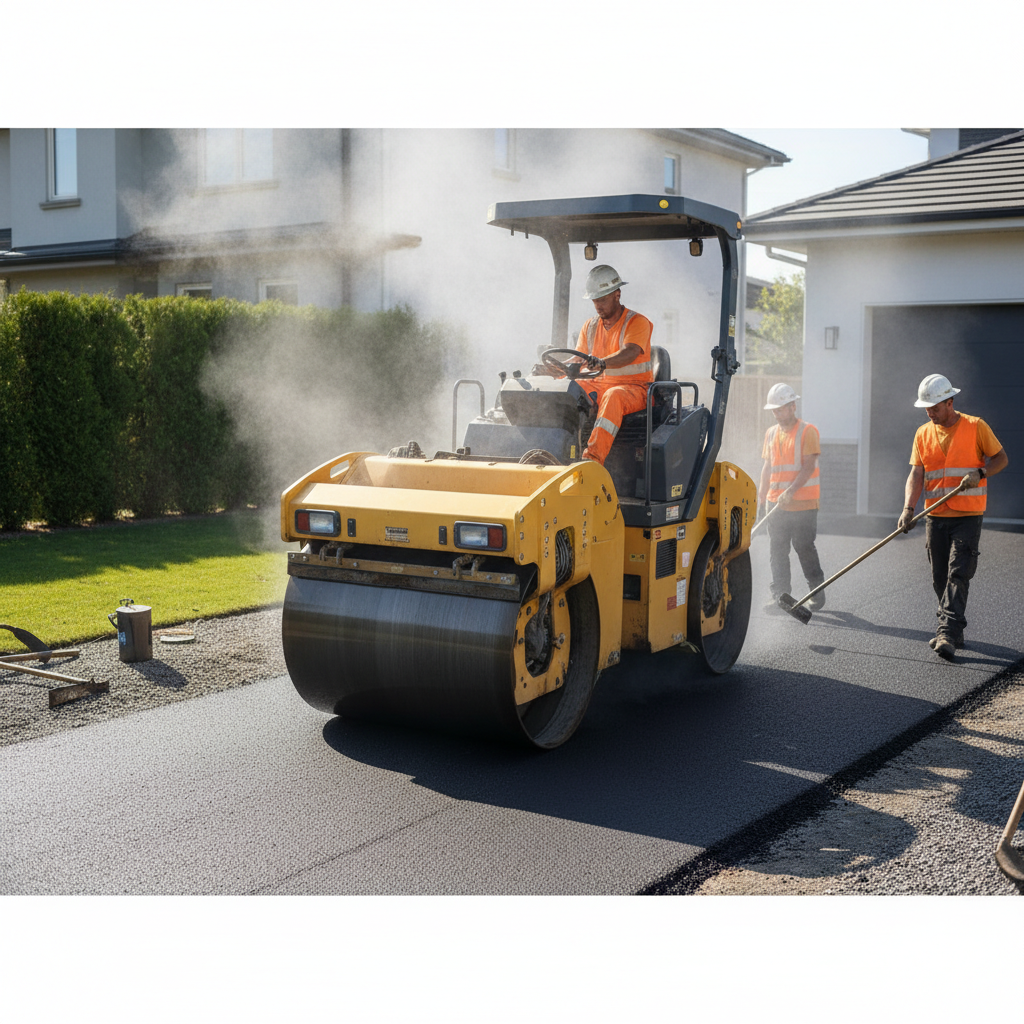
Driveway paving options and costs in Irricana
Irricana homeowners typically have a single main driveway that connects the house to the street, and with 76.3% of local dwellings being single-detached homes, there’s a steady demand for private driveway work. With 415 homeowner households in the community (89.2% of households own), many projects are planned around budgeting for upgrades that also improve curb appeal and year-round usability. In the Calgary region, contractors often see most traffic and schedule pressure in late spring and summer, because cold continental winters and the need to manage freeze–thaw cycles push asphalt and concrete crews into a shorter paving window.
In practice, frost penetration in this part of Alberta can reach about 1.2 m (4 ft). That means excavation and compaction details matter: a driveway over weak or poorly drained soil can heave, crack, or ravel sooner. The labour and material mix also changes your unit cost. For example, smaller lots in and around neighbourhoods such as the Irricana hamlet core often require more equipment repositioning and more careful edging around existing landscaping. If you’re doing work near a boulevard area, the drainage tie-in and any municipal approval steps can add time (and cost) even when the driveway footprint stays the same.
Below are realistic cost ranges you’ll commonly see for Irricana, Alberta, assuming proper subgrade prep and typical residential access. Use the table to compare materials on a per-square-foot basis, then we’ll break down what drives your quote next.
| Material |
Lifespan |
Maintenance |
Best For |
Price per sq ft |
| Asphalt (new installation, proper base) |
15–25 years |
Seal every 3–5 years; patch as needed |
Best balance of cost and smooth driving surface |
$12–$20 |
| Asphalt (overlay on existing gravel base) |
10–18 years |
Seal every 3–5 years; pothole/edge repairs sooner |
When you want asphalt but can’t fully rebuild the base |
$10–$16 |
| Interlocking concrete pavers |
20–30 years |
Re-level/cut replacement individual stones as needed |
Curb appeal and easier localized repairs |
$18–$30 |
| Poured concrete (broom finish) |
20–35 years |
Seal selectively; crack monitoring |
Low maintenance look with good long-term durability |
$15–$25 |
| Exposed aggregate concrete |
25–35 years |
Seal/maintain surface sheen as recommended |
Slips-resistant surface and decorative finish |
$18–$30 |
| Gravel / crushed stone (budget option) |
3–7 years (surface wear) |
Top up annually; grading as needed |
Temporary solution or lowest upfront cost |
$6–$10 |
Prices are estimates only and vary by project scope, site access and material selection.
What affects the price of paving in Irricana
In Irricana and across the Calgary economic region, it’s common to see the same general driveway request swing by 30–50% from one quote to the next. Most of that gap isn’t “who’s more expensive”—it’s differences in subgrade preparation, base thickness, drainage corrections, and whether the contractor is pricing for a full tear-out versus a partial patch. Even when the final asphalt or concrete mat looks similar, the work under it is where frost protection is won or lost.
Calgary-area frost considerations are a decisive cost driver. With frost routinely penetrating to about 1.2 m (4 ft), deeper frost requires a thicker compacted granular base and well-graded aggregate. In most Alberta residential work, that typically means a base build and compaction plan that costs more than you’d see in milder climates, because the contractor has to haul and place more material and verify compaction for a stable foundation. On top of that, the paving season is compressed: hot-mix asphalt requires suitable temperatures (commonly above 10°C air/placement conditions) and good ground conditions for compaction, so peak scheduling can increase labour and mobilization rates.
Local conditions in Irricana can push your price up or down. If your driveway ties into a low spot that collects meltwater, you’ll often need grading and positive drainage work before you lay asphalt or pavers—raising the quote above the typical $12,000 – $20,000 equivalent range for a standard residential install. If your soil is firm, well-drained, and the footprint is straightforward with easy equipment access, asphalt at the $12–$20 band can be achievable. Conversely, older homes built before 1981 (30.1% of dwellings) often come with mature landscaping, buried services, or driveway configurations that require more demolition and disposal, which can narrow the cost advantage of “cheaper” surfaces.
| Price Factor |
Why It Matters |
Cost Impact |
| Driveway area in sq ft |
The surface and base volume scale directly with area |
Larger footprints increase both material and labour; often the biggest driver |
| Base depth required |
Frost protection depends on granular thickness and compaction |
Deeper frost/base increases hauling, grading and equipment time |
| Grading and drainage work |
Proper slope and runoff control prevent water damage and heaving |
Can add significant labour and materials if drainage is poor |
| Tear-out of existing surface |
Removing old concrete/asphalt and hauling debris affects disposal and labour |
Breaking, load-out, and disposal can materially increase the total |
| Edge restraints and curbing |
Edges keep pavers from spreading and protect asphalt from creep |
More base prep and material/installs required |
| Sealing requirement |
Asphalt benefits from sealing to reduce water ingress |
Adds a scheduled cost (commonly 6–12 months after placement) |
| Site access |
Narrow approaches and tight lots slow equipment movement |
More time on staging and smaller-load handling |
| Asphalt mix specifications |
Freeze–thaw-rated mixes perform better under Alberta winters |
Specialty mix can increase material cost compared with basic mixes |
Permits & regulations in Alberta
In Alberta, paving a private driveway within your own property typically does not require a building permit. Most homeowners in Irricana are simply upgrading a hard surface over their own lot with proper base prep and installation that stays within property lines. Where permits and approvals often come into play is when work touches the municipal right-of-way (the area between your property and the roadway). That includes changes to a boulevard area, new or modified curb cuts, and any alterations to storm drainage that affect how water flows to the street system. If your driveway apron or grading ties directly into a ditch/boulevard swale, you should expect municipal approval steps.
Here’s a practical step-by-step way to verify your contractor in Alberta before the first scoop of aggregate arrives. First, confirm the contractor is licensed for the work they’re advertising, using the province’s public business/licensing information and any applicable trade registration details they provide. Second, request a certificate of liability insurance naming you (or showing your property address) and ensure coverage is current for the installation period. Third, verify WSIB/WCB coverage: ask for proof of workers’ coverage status or a clearance letter, and ensure it matches the dates of the job.
Finally, before excavation, always confirm utility locates through Alberta One-Call. Even a “simple” tear-out can hit buried services, and locating is especially important on older properties where driveway reworks may have involved past piping or drainage lines.
Asphalt vs pavers vs concrete for Irricana driveways
For Irricana driveways, the best material choice usually comes down to how much you value upfront cost versus repair flexibility over Alberta’s freeze–thaw winters. Asphalt typically wins on lowest upfront cost, with the familiar smooth driving surface and unit pricing often landing in the $12–$20 range per square foot when installed over a properly built base. The trade-off is that asphalt needs sealing to limit water penetration—commonly every 3–5 years—so that small cracks don’t expand under repeated freezing and thawing.
Interlocking concrete pavers cost more up front, often matching the $18–$30 band, but they’re repairable without replacing the whole surface. If a utility opening, settlement area, or localized frost issue develops, individual stones can be lifted, base corrected, and the section reset. In Calgary-area winters with snow storage and regular plowing, that “localized repair” advantage is real for homeowners who want a neat look and easy maintenance.
Poured concrete sits in the middle for cost and offers excellent long-term service when designed for cold climates—especially if it’s air-entrained and built with correct reinforcement and joints. Without proper air content and joint detailing, freeze–thaw movement can translate into surface cracking. Edge support and drainage still matter for all materials: a driveway that sheds water poorly will fail early no matter what you pour.
A concrete example of value: if your asphalt quote is at the lower $12–$20 band but includes minimal drainage correction, pavers or air-entrained concrete may be justified if your driveway is in a wetter location where water is likely to pond. In those sites, a full base and drainage approach can cost more, but it protects the surface from the very damage that drives early replacement.
| Material |
Frost Resistance |
Curb Appeal |
Repair Method |
Lifespan |
Price Band |
| Asphalt (sealed regularly) |
Good when base and drainage are correct |
Moderate (smooth, clean look) |
Patch localized areas; re-seal for restoration |
15–25 years |
$12–$20 |
| Interlocking concrete pavers |
Very good with proper edging and base |
High (design options and crisp edges) |
Replace individual pavers or reset small zones |
20–30 years |
$18–$30 |
| Poured concrete (air-entrained) |
Good with correct air entrainment and joints |
Moderate to high (finish options) |
Crack repair/patching; partial replacements if needed |
20–35 years |
$15–$25 |
| Exposed aggregate concrete |
Good with correct mix and curing |
High (decorative texture) |
Surface patching; more limited aesthetic matching |
25–35 years |
$18–$30 |
| Permeable pavers (drainage grid) |
Very good when sub-base includes drainage storage |
High (clean lines; engineered runoff) |
Lift-and-reset localized sections; inspect grid |
20–30 years |
$20–$35 |
| Chip seal / tar-and-chip |
Moderate (surface wears; depends on base) |
Low to moderate (utilitarian) |
Re-surface spots; periodic renewals |
8–15 years |
$10–$18 |
How to choose a paving contractor in Irricana
Choosing a contractor in Irricana (and the wider Calgary area) is about proving they can build for freeze–thaw, not just quoting a low price. Start with Alberta licensing: ask for their business details and confirm they’re properly set up to do the type of work they’re offering. Next, verify liability insurance—request a current certificate of insurance and ensure the coverage date spans your project timeline. For workers’ coverage, confirm WSIB/WCB status by requesting proof of coverage or a clearance letter; don’t accept “we’re covered” without documentation. A legitimate paving company will provide these items quickly.
Then request 2–3 itemised written quotes. You want a breakdown that separates labour and materials (excavation, base supply, compaction, asphalt/concrete supply, finishing, and any reinstatement). Avoid vague lump sums that don’t list thickness, base depth, or drainage/grading inclusions. Also check exclusions: is permit/municipal approval included if the driveway apron touches the right-of-way? Is disposal of old concrete/asphalt included? What about sawcutting, patching to existing asphalt, or protecting landscaping during construction?
Warranty should be in writing. Confirm the workmanship warranty length, whether it’s tied to regular sealing for asphalt, and how long the product/manufacturer warranty lasts. Ask whether the warranty is transferable if you sell the home. On payment schedule, never pay more than 10–15% upfront; use a holdback until the job is completed and cleaned up. Finally, demand a start date and completion estimate in writing, especially because Alberta’s paving season is short and crews can get booked into peak months.
- Provide licence/registration details and confirm they match the company name on the quote
- Show current liability insurance with coverage dates
- Provide WSIB/WCB proof (clearance letter or equivalent documentation)
- Ask for base depth and compaction method in writing (not just “proper base”)
- Confirm drainage/grading scope: slope, swales, and tie-ins to runoff pathways
- Request a disposal/load-out line item for tear-out debris
- Specify edge restraints: curbs, kerbs, or restraint system for asphalt/pavers
- For asphalt, confirm mix type suitable for freeze–thaw and placement temperature requirements
- Ask when sealing will be recommended (commonly 6–12 months after install)
- Verify warranty terms for workmanship and what triggers voiding conditions
- Review payment schedule and keep a holdback until final completion
- Get a written start/completion timeline that fits the short season
Red flags I see in Irricana include: contractors who won’t share base thickness or drainage details, quotes that skip tear-out scope but assume “same material reuse,” crews that pressure for a large upfront deposit, refusal to provide insurance/WSIB/WCB paperwork, and vague warranty wording that doesn’t specify what’s covered and for how long.
Frequently asked questions — paving in Irricana
How do I compare paving quotes fairly?
To compare quotes fairly in Irricana, insist on the same scope and specifications across all bids. Ask each contractor to list base depth, granular material type/grade, compaction expectations, and whether drainage/grading corrections are included. Make sure you’re comparing like-for-like thickness—especially critical here because frost can penetrate to about 1.2 m (4 ft), so insufficient base is a common reason for early cracking. Also compare allowances for tear-out and disposal: concrete breaking and hauling can swing totals a lot. Finally, check the material pricing band and schedule items like asphalt sealing—many homeowners budget around the typical asphalt install range of $12–$20 per square foot, but skip the later sealing cost at their own risk.
Can asphalt be laid in cold weather in Irricana?
Asphalt placement in Alberta is temperature-dependent, and in Irricana you should expect work to be limited to late spring through early fall. Hot-mix asphalt generally needs adequate air/ground conditions for compaction and proper curing; crews often reference placement conditions above about 10°C to reduce the risk of early raveling or poor density. If a contractor pushes to pave during colder spells, the surface can look “fine” initially but perform poorly through the first freeze–thaw cycle. The bigger issue is that in winter you also lose reliable compaction and base dryness, which are essential under Calgary-area frost movement. If a quote assumes cold-weather placement, ask how they will maintain required temperatures and density testing.
What is a driveway apron and do I need one in Irricana?
A driveway apron is the transition area from your driveway to the street/boulevard connection—often the portion that ties into curb and gutter or the municipal portion of the roadway drainage. In Irricana, whether you “need” one depends on your current configuration and whether your driveway impacts the municipal right-of-way (for example, changes to curb cuts or boulevard grading). If your work stays entirely within your property limits, many projects can be handled without additional approvals, but altering the apron or storm drainage typically requires municipal approval. Ask your contractor to clearly state what portion of the work is inside your lot versus in the right-of-way, and whether they will coordinate the approvals and inspections where needed.
How do I maintain my driveway through Irricana winters?
Winter maintenance is as important as installation quality in Irricana. Keep snow storage and plow patterns consistent—avoid stacking heavy snow right at the driveway edges where water can infiltrate and freeze. Use sand rather than aggressive de-icing salts when possible, because salt-laden runoff can accelerate surface wear and concrete deterioration over time. For asphalt, plan for sealcoating on a schedule (often every 3–5 years, depending on wear and whether it was sealed properly after installation). For concrete, fill minor cracks early to stop water from getting into the slab and freezing. If you notice localized depressions, potholes, or edge breakdown, repair promptly—small issues can expand rapidly during freeze–thaw cycles.
Is it worth sealing a new driveway right away in Irricana?
In most Calgary-area practices, you do not seal immediately as soon as asphalt is laid. Asphalt needs time to cool, cure, and properly oxidize so the sealant bonds correctly and doesn’t trap moisture. For many homeowners, the recommended timing is commonly 6–12 months after installation, then repeating roughly every 3–5 years based on traffic, snow removal habits, and surface wear. If you skip sealing, water can penetrate the mat and the freeze–thaw cycle can widen cracks, leading to more expensive patching later. A typical asphalt install might fall in the $12–$20 per square foot range, but sealing is part of the lifecycle cost—done at the right time, it helps protect the investment.
What is a chip seal driveway and is it suited to Irricana?
Chip seal (tar-and-chip) is a surface treatment where a binder is sprayed onto a prepared base and aggregate is spread and rolled in. It can be suited to Irricana for budget-focused driveways, especially where you want a functional surface at a lower upfront cost (often around the $10–$18 per square foot range, depending on scope). That said, chip seal performance depends heavily on the quality of the base and drainage—weak subgrades or water pooling will lead to premature bleeding, raveling, or texture loss. In a freeze–thaw climate like Calgary’s, the driveway still needs proper slopes and runoff control. If you expect frequent plowing and heavy turning, asphalt or pavers may hold up more predictably over the long term.