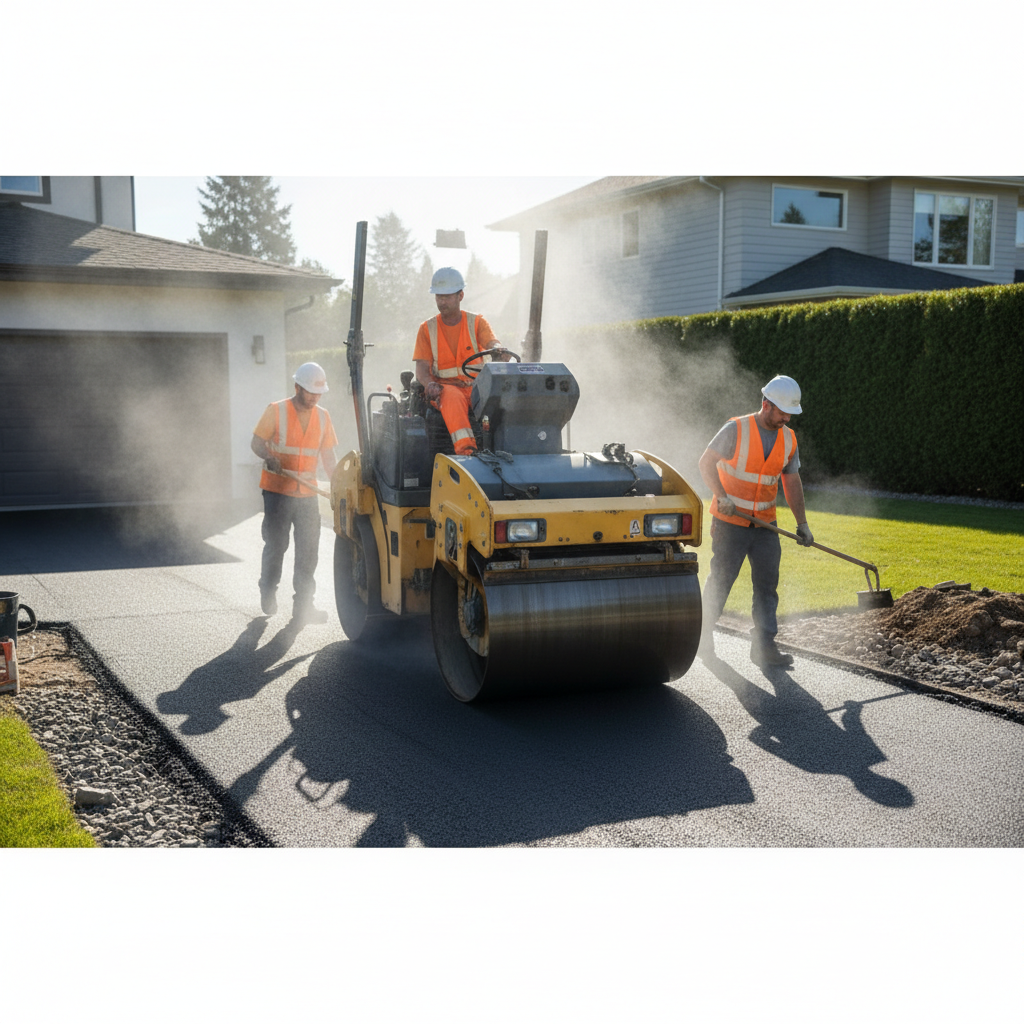
Driveway paving options and costs in Suder Greens
Suder Greens, Alberta is a great place to invest in a clean, hard-wearing driveway—but the material choice matters because Calgary’s freeze–thaw cycle puts real stress on the subgrade. With a population of 2,811 (Statistics Canada, 2021 Census), this community is small enough that scheduling can tighten quickly when the weather turns favourable. In practical terms, most private driveway builds are tied to single-family homes, so homeowners typically want a driveway that handles daily traffic, ploughing, and winter salt without creating a constant repair loop.
In the Calgary area, frost can penetrate to about 1.2 m (4 ft). That means contractors usually build deeper, better-graded granular bases and prioritize positive drainage so water doesn’t sit under the asphalt or concrete. It’s also why paving during the short working season—late spring through early fall—can drive pricing upward: crews, rollers, and hot-mix deliveries are in demand when conditions allow compaction and proper curing.
You’ll generally see asphalt come in as the lowest upfront option, while interlocking pavers and concrete typically cost more but offer different strengths. If you’re trying to compare quotes quickly, start with the surface plan size and ask whether the base is designed to resist heaving, not just to “level out” the grade—then use the table below as your quick cost baseline.
| Material |
Lifespan |
Maintenance |
Best For |
Price per sq ft |
Price Range |
| Asphalt (new installation, proper base) |
15–20 years |
Sealcoat every 3–5 years; crack fill as needed |
Best value in Suder Greens where you want a smooth, quiet drive |
$12–$20 |
$1,800–$5,500 |
| Asphalt (overlay on existing gravel base) |
12–18 years |
Sealcoat every 3–5 years; more frequent crack filling if base settles |
Shorter-scope upgrades when drainage is already good |
$10–$18 |
$1,500–$4,800 |
| Interlocking concrete pavers |
25–30 years |
Rinse/weed control; lift-and-reset failed units as needed |
High curb appeal and easier localized repairs |
$18–$30 |
$2,800–$8,500 |
| Poured concrete (broom finish) |
20–25 years |
Joint sealant and crack repairs as needed |
Low-maintenance look with clean edges |
$15–$25 |
$2,400–$7,200 |
| Exposed aggregate concrete |
20–25 years |
Reseal if specified by installer; joint maintenance |
Slip-resistant finish for icy, snowy driveways |
$16–$28 |
$2,600–$8,200 |
| Gravel / crushed stone (budget option) |
5–10 years |
Top up annually; regrade; manage mud after storms |
Interim solution or where you’re delaying a full rebuild |
$6–$12 |
$900–$3,000 |
Prices are estimates only and vary by project scope, site access and material selection.
What affects the price of paving in Suder Greens
In Suder Greens and the wider Calgary region, two quotes for the “same driveway” can differ by 30–50% because pricing isn’t just about the finish—it’s about what’s under it. The biggest swing factors are the thickness and quality of the base, how much tear-out is required, and whether drainage and edge restraint are corrected to survive Calgary’s freeze–thaw cycle. Even when materials are similar, labour and equipment time can change substantially depending on how tight the site is and how far crews must haul away old asphalt or concrete.
Frost line depth is decisive here. With frost penetrating to about 1.2 m (4 ft), contractors generally need deeper, well-compacted granular bases and stable subgrade to reduce heaving and cracking. That typically means base thickness and gradation designed for Calgary’s conditions, not a “one-size-fits-all” depth. On top of that, the paving season is compressed: hot-mix asphalt needs sufficient temperatures for proper placement and compaction, so scheduling in late spring and summer can cost more. Asphalt mix design also has to be suited for local freeze–thaw performance.
Concrete costs can rise in Suder Greens if the subgrade is variable or if you need significant grading to control water. Exposed aggregate may also add cost due to the finishing steps and reseal considerations. If your current driveway base has moisture issues, a proper rebuild can move you closer to the $12–$20 style asphalt band; skipping drainage work often leads to early failures that cost more to fix later—especially during winter when ploughing and salt continue to stress edges and joints.
| Price Factor |
Why It Matters |
Cost Impact |
| Driveway area in sq ft |
Most materials and most labour scale directly with surface area |
Typically the largest swing; often 40–70% of total cost |
| Base depth required |
Frost line conditions drive the granular thickness needed to resist movement |
Can add major material and compaction time (often +15–35%) |
| Grading and drainage work |
Positive slope and drainage reduce standing water and frost heave |
Commonly adds +10–25% depending on corrections |
| Tear-out of existing surface |
Breaking, hauling, and disposal add equipment hours and dump fees |
Can add +10–30% (higher for thick concrete) |
| Edge restraints and curbing |
Edges hold the system together against ploughing and seasonal movement |
Often +5–15% but crucial for pavers and asphalt longevity |
| Sealing requirement |
Asphalt needs sealcoating to protect from moisture and oxidation |
Adds a planned maintenance cost (commonly $400–$1,500 total per event) |
| Site access |
Narrow or distant access slows equipment and increases labour time |
Usually +5–20% |
| Asphalt mix specifications |
Freeze–thaw-rated mix can cost more but performs better in Calgary winters |
Can add +5–15% |
Permits & regulations in Alberta
In Alberta, paving a private driveway within your own property typically does not require a building permit. Most homeowners are doing work on their own land: milling/overlay, full asphalt replacement, new concrete on the driveway pad, and similar upgrades stay within standard private property maintenance/works.
Where permits and approvals can come into play is when you affect the municipal right-of-way. That includes work like creating or changing a curb cut, altering a boulevard area, or modifying storm drainage connected to the public system. Some municipalities also enforce lot-grading bylaws that limit how close surface grading or hard surfaces can come to property lines and ditches—important in Suder Greens where drainage pathways can vary lot to lot.
Before any digging, you must call for utility locates through Alberta One-Call and confirm cable, gas, and water/sewer positions. Step-by-step, here’s how a Suder Greens homeowner can verify a paving contractor: (1) confirm the contractor is properly licensed/registered per Alberta requirements using the relevant online registry; (2) ask for a current certificate of liability insurance—ensure coverage limits are appropriate for driveway-scale work; and (3) verify WSIB/WCB coverage status and obtain any clearance letter or evidence requested by your project agreement. If a contractor can’t provide these documents promptly, treat that as a major red flag and move on.
Asphalt vs pavers vs concrete for Suder Greens driveways
For Suder Greens homeowners, the “best” material is the one that performs through Calgary’s deep frost and repeated freeze–thaw cycles while still fitting your lifestyle. Asphalt usually has the lowest upfront cost and gives a smooth ride, but it must be sealed every 3–5 years to protect against moisture intrusion. In Calgary, that sealing cycle isn’t optional—water is what accelerates softening and edge failure during winter freeze–thaw.
Interlocking concrete pavers cost more upfront, but they’re forgiving when something localized shifts. If a base area settles or an edge is hit by a plough, pavers can be lifted and reset without tearing up the entire driveway. That makes pavers a strong choice when your site has variable soils or where you expect future adjustments.
Poured concrete sits in the middle for cost and can look excellent with proper joints and air-entrainment. Still, it’s susceptible to cracking if the base isn’t designed for frost and if water migrates beneath the slab. In Calgary, de-icing salt and plough impacts can also widen existing cracks over time if maintenance is deferred.
In a typical Suder Greens comparison, asphalt may land closer to the $12–$20 per-sq-ft band, while pavers often move into the $18–$30 per-sq-ft range. If your driveway includes a complex edge, tight parking area, or you anticipate drainage tweaks, paying the paver premium can be justified because repairs stay localized rather than becoming full-surface replacement.
| Material |
Frost Resistance |
Curb Appeal |
Repair Method |
Lifespan |
Price Band |
| Asphalt (sealed regularly) |
Good with deep base, proper drainage, and freeze–thaw-rated mix |
Medium (clean, uniform finish) |
Crack fill, patching, or localized resurfacing |
15–20 years |
$12–$20 |
| Interlocking concrete pavers |
Very good when edges are restrained and bedding is installed correctly |
High (custom patterns, crisp borders) |
Lift-and-reset individual units |
25–30 years |
$18–$30 |
| Poured concrete (air-entrained) |
Good with air-entrainment, joints, and frost-suitable base |
Medium to high (depending on finish) |
Patch and joint repair; major cracks may require section work |
20–25 years |
$15–$25 |
| Exposed aggregate concrete |
Good when finished and sealed per spec; base is still the key |
High (texture and traction) |
Limited patching vs pavers; usually localized repair |
20–25 years |
$16–$28 |
| Permeable pavers (drainage grid) |
Very good for water management if designed properly for subgrade |
High (modern look) |
Replace damaged units and maintain drainage layer |
20–30 years |
$22–$35 |
| Chip seal / tar-and-chip |
Variable; depends heavily on base and aggregate bonding |
Low to medium |
Spot re-chip and resurfacing |
7–12 years |
$8–$14 |
How to choose a paving contractor in Suder Greens
Choosing the right contractor matters as much as the material. For Alberta work in Suder Greens, verify licensing/registration using the provincial registry relevant to contractors, and request proof of current liability insurance. Ask for WSIB/WCB coverage evidence (often a clearance letter or documentation) before work begins—this protects you if an injury occurs on site. If the contractor won’t share these documents, that’s a serious concern.
Then request 2–3 itemised written quotes with a labour + materials breakdown rather than a single lump sum. Compare scope details: is permit coordination included if it’s needed for right-of-way impacts? Is disposal included for old asphalt or concrete? Are geotextile, granular base, and compaction testing included (where applicable), or are they omitted to make the number look lower? Warranty matters too: ask for the workmanship warranty length, whether the product/manufacturer warranty applies to you directly, and if it’s transferable if you sell your home.
For payment schedule, never pay more than about 10–15% upfront. Hold back a portion until the job is complete and graded to spec. Finally, get the timeline in writing—start date and estimated completion—because the paving season is short, and crews in Calgary can shift quickly when temperatures allow hot-mix production.
- Confirm Alberta contractor licensing/registration before you sign.
- Request certificate of liability insurance and check expiry dates.
- Verify WSIB/WCB coverage (clearance letter or evidence).
- Insist on an itemised quote: base, asphalt/concrete, labour, equipment, and disposal.
- Ask for scope of work in writing: excavation limits and replacement depth.
- Clarify drainage and slope design—what changes will be made to shed water.
- Verify edge restraints/curbing details (especially for pavers and asphalt edges).
- Confirm compaction expectations and granular material requirements.
- Ask about geotextile where subgrade stability is questionable.
- Check warranty terms: workmanship length, exclusions, and claim process.
- Agree on payment milestones (10–15% max deposit; holdback on completion).
- Get start date, weather contingency plan, and completion estimate in writing.
In Suder Greens, watch for these red flags: (1) a quote that doesn’t specify base thickness or drainage work; (2) no mention of sealcoat timing for asphalt; (3) refusing to provide insurance/WSIB/WCB documentation; (4) a vague schedule with no weather-season plan; and (5) “too low to be true” pricing that omits tear-out, disposal, or edge restraints.
Frequently asked questions — paving in Suder Greens
When is the best time of year to pave in Suder Greens?
In Suder Greens and the Calgary area, the best window is late spring through early fall, when the ground is workable and asphalt can be placed and compacted properly. Hot-mix asphalt generally needs warm air and pavement temperatures—crews typically won’t run production once conditions drop because compaction quality suffers. Scheduling is also tight because the paving season is shorter here than in milder climates, and demand rises as temperatures finally stay above workable levels. If you want predictable performance through winter, avoid paving right before a cold snap. A good contractor will also plan for initial curing, then come back for crack repair and discuss sealcoating timing so your driveway survives frost movement rather than failing early.
How deep should the base be for Suder Greens's frost?
The key point is that frost in this region can penetrate to about 1.2 m (4 ft), so base depth must be designed to resist heaving, not just to provide a “thin patch.” While exact depth depends on your subgrade condition, soil type, and drainage corrections, a properly built driveway system usually involves a thicker compacted granular base than you’d see in milder areas. Contractors in Calgary often target deeper granular layers (commonly in the broader 6–12 inch range for many residential asphalt/concrete driveway builds) when they’re addressing frost-sensitive conditions and ensuring water doesn’t stay under the slab. If someone quotes paving without discussing base depth and drainage, ask directly—this is often where quality and longevity are decided.
How often should I seal my asphalt driveway?
For Suder Greens winters, asphalt sealing is part of the lifecycle. A typical recommendation is to seal about 6–12 months after installation (after the surface has cured), then reseal roughly every 3–5 years depending on traffic, weather exposure, and how much sand/salt hits the surface. Sealcoating helps slow moisture infiltration and protects the binder from oxidation, which matters during Calgary’s freeze–thaw cycle. If you’re budgeting maintenance, sealing costs often land in the $400–$1,500 range per event for driveway-size projects. If you skip sealing, you can see raveling and cracking sooner—then you’ll spend more on patching to keep the driveway safe and draining well.
Why does my driveway crack and heave in winter?
Most winter cracking and heaving comes down to water and frost movement. When meltwater or runoff can’t drain away properly, it soaks into subgrade or base materials. During cold nights, that water freezes and expands, which can lift the surface—especially near edges where restraint and drainage are weakest. In Calgary’s deep frost conditions, inadequate base depth or poorly graded granular layers can’t “buffer” the expansion. Plough impacts and de-icing salts can also widen small cracks over time, turning hairline issues into patches. The good news: the most effective fix isn’t just patching asphalt—your contractor should confirm base thickness, aggregate gradation, and drainage slope. Otherwise, the same failure pattern can return quickly.
Do I need a permit to pave my driveway in Alberta?
Typically, in Alberta you don’t need a permit to pave a private driveway within your own property. For Suder Greens homeowners, routine asphalt replacement, concrete driveway installs, and standard resurfacing generally fall under work on private land. However, permit/approval needs can come up if you impact the municipal right-of-way—such as changing a curb cut, altering boulevard areas, or modifying storm drainage connected to the public system. Some municipalities also have lot-grading rules that affect how surfaces can be built near property lines and drainage features. Regardless, call for utility locates through Alberta One-Call before digging. If your driveway ties into a drainage swale or requires changes near the curb, confirm the requirement before excavation.
How long before I can drive on new asphalt?
With new asphalt in Suder Greens, you can usually drive on it after it cools to a point where tires won’t pick up the surface—often within 24–48 hours, depending on weather and the mix design. If the contractor places tack coat and manages lift thickness properly, the surface will be ready sooner in warm, dry conditions and slower if it’s cool or windy. The larger issue is avoiding heavy loads immediately after installation. After driving begins, keep turning movements gentle and avoid parking with a locked spot where you can repeatedly shear the mat. For performance, the bigger timeline is sealcoating: many driveways need a delay of about 6–12 months before sealcoat. That planned step is part of keeping your driveway in the $12–$20 per-sq-ft cost tier from needing expensive premature repairs.