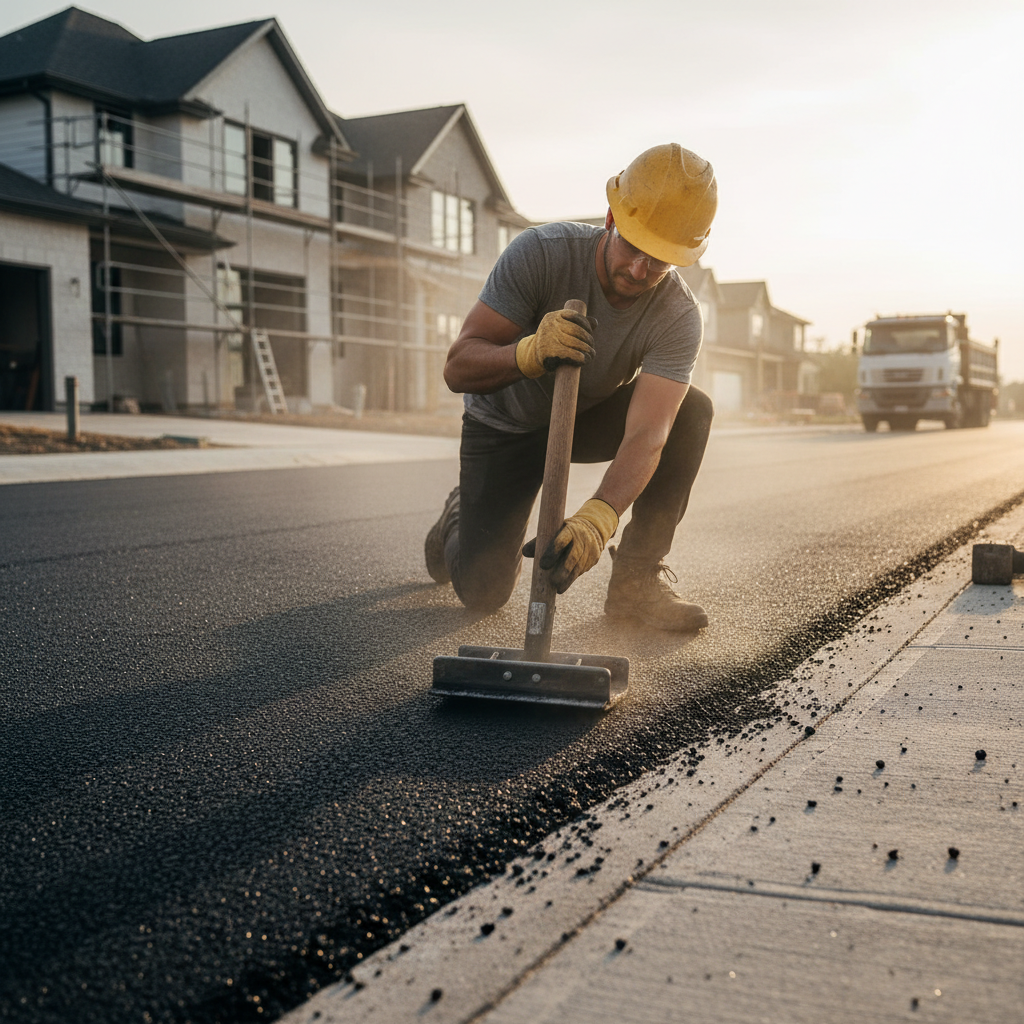
Driveway paving options and costs in Wainwright
In Wainwright, choosing a driveway surface is as much about frost performance as it is about curb appeal. With 66.4% of dwellings being single-detached homes and about 1,870 homeowner households (Statistics Canada, 2021 Census), most driveways here are privately maintained and designed around long winter freeze-thaw cycles. That matters because Camrose–Drumheller conditions push water control and subgrade stability to the front of every quote: deeper frost protection and properly compacted granular base layers help limit heave, cracking, and settlement. In practice, excavation depth, drainage corrections, and whether the crew can complete prep and paving in one mobilization all influence total cost.
Also, Wainwright’s paving season is shorter than in milder parts of Alberta. Hot-mix asphalt generally needs warmer air temperatures (often above 10°C) for good placement and compaction, so spring and early summer scheduling can get tight. That scheduling pressure can raise prices during peak weeks, especially for larger lots or properties with limited access. You’ll typically see the strongest demand around established residential areas where driveway replacements are common after years of settlement—such as the older core and neighbourhoods closer to the downtown corridor where many homes pre-date 1981 (Statistics Canada, 2021 Census).
Below is a homeowner-friendly cost comparison to help you map budgets to materials and expected service life.
| Material |
Lifespan |
Maintenance |
Best For |
Price per sq ft |
Price Range |
| Asphalt (new installation, proper base) |
15–25 years |
Seal every 3–5 years; patch as needed |
Good value with strong freeze-thaw base prep |
$6.50–$10.50 |
$6,000–$15,000 |
| Asphalt (overlay on existing gravel base) |
10–18 years |
Seal every 3–5 years; more frequent patching |
Lower-cost improvement when base is stable |
$5.50–$8.50 |
$6,000–$13,000 |
| Interlocking concrete pavers |
25–35 years |
Re-sand joints as needed; replace individual stones |
Curb appeal and easy localized repairs |
$10.00–$16.00 |
$9,000–$22,000 |
| Poured concrete (broom finish) |
20–30 years |
Minimal; seal optional every 5–10 years |
Straight, clean look with solid base |
$9.00–$14.00 |
$7,500–$18,000 |
| Exposed aggregate concrete |
20–30 years |
Seal optional; periodic cleaning |
Slip resistance and premium finish |
$10.50–$16.50 |
$9,000–$20,000 |
| Gravel / crushed stone (budget option) |
3–8 years |
Re-grade and top up yearly; add stabilizer if needed |
Temporary solution or low upfront budget |
$2.00–$5.00 |
$2,500–$6,500 |
Prices are estimates only and vary by project scope, site access and material selection.
What affects the price of paving in Wainwright
In the Camrose–Drumheller region, two quotes for the same driveway can vary by 30–50% because the real “same job” assumption often breaks down once you price excavation, frost-depth base thickness, drainage correction, and disposal. Weather also plays a role: in Wainwright, crews can hit a shorter working window in spring and fall, and mobilization costs spread differently if the job starts late or weather interrupts curing. Labour and equipment availability can tighten during peak weeks, which is one reason budget plans can drift upward if timelines compress.
Frost line depth and freeze-thaw cycling are decisive cost factors. Colder zones require a thicker, well-compacted granular base to control moisture and limit movement; that typically means deeper build-up than you’d see on lighter, coastal-style designs. In practice, frost-protection guidance in Alberta commonly places frost depth in the roughly 6 to 10+ foot range depending on latitude, elevation and soil conditions, so contractors focus on subgrade stabilization and water shedding first—not just topping it with asphalt. Asphalt mix design must also be freeze-thaw rated; using the wrong mix can mean premature raveling or cracking.
For concrete, Wainwright conditions can raise cost when additional features are needed: air entrainment, saw-cut control joints, and sometimes thicker slabs or base improvements if the soil is variable. Costs can also be lower if your existing base is already stable and drains well, which is why an “overlay” isn’t automatically the cheapest option. As a ballpark, homeowners often compare asphalt budgets in the $6,000–$15,000 band against paver projects in the $9,000–$22,000 band, and the difference is usually justified by base detail, restraints/edge work, and repairability.
| Price Factor |
Why It Matters |
Cost Impact |
| Driveway area in sq ft |
Most materials and most labour scale directly with square footage |
High: typically the biggest driver |
| Base depth required |
Frost protection and freeze-thaw stability depend on granular thickness and compaction |
High: major cost swing when subgrade is poor |
| Grading and drainage work |
Slopes and drainage corrections reduce water pooling, which causes heave and settlement |
Medium to high, depending on site conditions |
| Tear-out of existing surface |
Removing old asphalt or concrete requires saw cutting, breaking, loading and hauling |
Medium to high: can add days and disposal fees |
| Edge restraints and curbing |
Prevents paver movement and asphalt edge failure during winter plowing |
Medium: often underestimated by homeowners |
| Sealing requirement |
Asphalt needs sealing after initial cure to reduce water intrusion and oxidation |
Low to medium upfront; medium over time |
| Site access |
Narrow driveways or long pushes slow equipment and increase labour time |
Medium: affects production rate |
| Asphalt mix specifications |
Freeze-thaw-rated mix and proper compaction improves durability in Alberta winters |
Medium: small unit-cost increase, big performance benefit |
Permits & regulations in Alberta
For most homeowners in Alberta, paving work done within your property line on a private driveway typically does not require a building permit. However, you must be careful about where the work touches municipal infrastructure. Permit or approval requirements usually come up when the project affects the municipal right-of-way—such as creating or changing a curb cut, altering the boulevard area, modifying storm drainage, or changing how water is directed away from the street.
In Wainwright, driveway projects that involve any of the following are the ones you should verify with the municipality before work begins: new or revised drainage tie-ins, changes to stormwater flow patterns, adjustments to the boulevard/ditch, or work that effectively changes how water leaves your site during spring melt. Many homeowners assume “it’s just a driveway,” but drainage and right-of-way issues are the common trigger for extra approvals.
Before excavation, always arrange utility locates through Alberta One-Call so contractors can safely mark and avoid underground services. Then, verify your contractor the right way: confirm their Alberta licence status (where applicable for the work they perform), review their liability insurance certificate showing your address as job-related coverage (the COI should be specific to the contractor and project), and ensure they have appropriate workers’ compensation coverage (WSIB/WCB coverage). Ask for a clearance letter or proof document—reputable paving companies in Wainwright will provide it without pressure. Finally, confirm any lot-grading rules, including how close a hard surface can sit to property lines, since grading restrictions can affect how base and edges are built.
Asphalt vs pavers vs concrete for Wainwright driveways
For Wainwright’s freeze-thaw climate, the “best” driveway material usually depends on how you want to manage water, repairs, and winter maintenance. Asphalt is typically the lowest upfront option and performs well when the granular base is deep enough and properly compacted. The trade-off is maintenance: sealing is usually recommended every 3–5 years to keep water from entering the structure, and patching is normal after heavy plowing or when utilities are repaired in the future. Interlocking concrete pavers cost more at the start, but they’re highly repairable—if a section settles, you can lift and reset individual units instead of replacing an entire slab or full asphalt panel. They also handle freeze-thaw well because jointing and restraint control movement.
Poured concrete sits in the middle on price and can last a long time if it’s air-entrained and built on a stable base with proper joints. Still, concrete can crack from freeze-thaw movement if drainage is off, if the base is weak, or if joints aren’t laid out correctly. Exposed aggregate can add slip resistance for winter conditions, while permeable pavers can help manage drainage—though they require careful sub-base design to work reliably.
In Wainwright, crews also see wear from salt, sand, and regular plowing paths. That means base drainage and edge stability matter regardless of surface. A concrete example: if asphalt is in the $6,000–$15,000 range and interlocking pavers are in the $9,000–$22,000 range, the paver premium is most justified when you expect localized utility work, want easy future repairs, or care about a long-term curb appearance in older neighbourhoods with mature landscaping and more grade changes.
| Material |
Frost Resistance |
Curb Appeal |
Repair Method |
Lifespan |
Price Band |
| Asphalt (sealed regularly) |
Good with deep, well-compacted base and proper drainage |
Medium |
Patch and re-seal localized areas |
15–25 years |
$6,000–$15,000 |
| Interlocking concrete pavers |
Very good; flexible jointing handles movement |
High |
Lift, re-grade base locally, re-set stones |
25–35 years |
$9,000–$22,000 |
| Poured concrete (air-entrained) |
Good with air entrainment, joints and stable base |
Medium |
Crack repair or localized replacement (often limited) |
20–30 years |
$7,500–$18,000 |
| Exposed aggregate concrete |
Good if properly air-entrained and well-jointed |
High |
Localized replacement or patching of affected sections |
20–30 years |
$9,000–$20,000 |
| Permeable pavers (drainage grid) |
Excellent when designed for the site; depends on sub-base and soil |
High |
Replace localized units; maintain filter/sub-base |
20–35 years |
$10,000–$24,000 |
| Chip seal / tar-and-chip |
Variable; can be less durable than asphalt in deep freeze zones |
Low to medium |
Resurface or re-chip sections |
7–12 years |
$5,000–$10,500 |
How to choose a paving contractor in Wainwright
Choosing the right paving contractor in Wainwright starts with verification. In Alberta, confirm the contractor’s Alberta registration/licensing applicable to the work they’re doing, then check liability insurance: ask for a current certificate of insurance (COI) before work begins. The COI should list the company, show adequate coverage, and correspond to the job location. Next, verify workers’ compensation coverage (WSIB/WCB coverage). Request proof such as a clearance letter or coverage confirmation—legitimate contractors will provide it quickly and without reluctance. If they cannot show documentation, treat it as a major risk.
Then get 2–3 itemised written quotes that break down labour and materials instead of one lump sum. Ask what’s included in the scope: excavation depth, base material type and thickness, drainage corrections, compaction testing (where applicable), tack coat, sealing timing, and disposal of waste. Confirm whether permits or municipal approvals are handled by the contractor or by you, especially if the work touches the right-of-way or drainage changes. Also check warranty terms: workmanship warranty length, whether it covers base and settlement issues, and how product/manufacturer warranty is handled. Ask if the warranty is transferable if you sell the home.
On payment, never pay more than 10–15% upfront. Use a schedule that holds back a meaningful portion until completion and final cleanup. Finally, ask for a written start date and completion estimate, and ensure weather delays and curing requirements are addressed so there are no surprises mid-season.
- Request proof of Alberta registration/licence (as applicable to the scope)
- Verify liability insurance COI before any work starts
- Confirm WSIB/WCB clearance or coverage proof
- Get 2–3 itemised quotes (labour + materials, not only a total price)
- Ask for the proposed base thickness and granular materials listed by type
- Confirm drainage/grading corrections are included if water ponds
- Ask how tear-out and disposal will be handled (included or extra)
- Confirm edge restraints/curbing details (especially for pavers)
- For asphalt, confirm tack coat, lift thickness, and compaction steps
- Schedule sealing correctly (typically after proper cure, often 6–12 months)
- Clarify warranty length and what it covers (workmanship vs settlement)
- Agree to a payment schedule with a holdback until final acceptance
Common red flags in Wainwright include: vague base specs (no thickness/compaction detail), quoting only “surface asphalt” without frost-aware base work, skipping or minimizing drainage corrections, refusing to provide COI or WSIB/WCB proof, and offering a warranty that excludes normal freeze-thaw movement after documented poor base prep.
Frequently asked questions — paving in Wainwright
How much does it cost to pave a driveway in Wainwright?
In Wainwright, most asphalt driveway paving projects commonly land in the $6,000–$15,000 range depending on driveway size, excavation depth, and whether drainage correction is needed. Asphalt is often the lowest-cost option when the subgrade can be stabilized with a proper compacted granular base. If your site has frost-susceptible soils, poor drainage, or requires extensive tear-out and disposal, the job can move toward the top end of the band. For a more premium, higher-repairability surface like interlocking pavers, many homeowners see budgets in the $9,000–$22,000 range. Because Wainwright homes include a large share of older housing stock (Statistics Canada, 2021 Census), it’s also common to find settled or uneven base conditions that affect excavation and rebuild cost.
Asphalt vs interlocking pavers vs concrete — which is best in Wainwright?
For Wainwright’s Alberta freeze-thaw winters, all three can perform well when base and drainage are done correctly—so the “best” choice usually depends on how you like to handle maintenance and future repairs. Asphalt is typically best for homeowners who want the lowest upfront cost and can budget for sealing every 3–5 years; with strong base prep, it’s a durable, practical choice. Interlocking pavers are often the best fit if curb appeal matters and you want the ability to repair localized sections without replacing the whole driveway—useful if utilities or settlement issues ever occur. Air-entrained poured concrete can be a great mid-range option, but it must be properly jointed and built on stable, well-drained base to manage cracking risks from freeze-thaw and plowing impacts.
How long does a paved driveway last in Wainwright?
With correct base prep and drainage design, you can usually expect about 15–25 years from properly installed asphalt when it’s sealed regularly, and 20–30 years from air-entrained poured concrete. Interlocking concrete pavers often last 25–35 years because individual units can be lifted and reset if any area shifts. Lifespan in Wainwright depends heavily on moisture control: if water pools in spring melt or under freeze-thaw cycling, even a good surface can degrade faster. That’s why contractors in the Camrose–Drumheller area pay close attention to base thickness and compaction so frost heave and settlement are minimized. Also factor in winter maintenance habits—heavy, frequent plowing on the same edges can wear restraints and accelerate deterioration if they aren’t built for it.
When is the best time of year to pave in Wainwright?
For asphalt, the best window is typically late spring through early fall when air temperatures stay warm enough for good placement and compaction. Asphalt generally needs air temperatures above about 10°C to get reliable workmanship results; paving too late in the season can lead to weak compaction and early surface issues. Concrete can sometimes be scheduled earlier or later depending on conditions, but freeze-risk and curing requirements still matter. In Wainwright, the shorter paving season means scheduling fills quickly—so it’s smart to book early if you want your driveway finished in a specific month. If your driveway requires major base rebuild or drainage correction, plan for weather dependencies because excavation and sub-base prep often dictate the final start date.
How deep should the base be for Wainwright's frost?
Base depth isn’t one fixed number for every lot in Wainwright because it depends on subgrade condition, soil moisture, and how well water is controlled. However, Alberta’s frost-protection approach means contractors generally design for substantial frost depth protection—often guided by roughly 6 to 10+ foot frost depth ranges depending on latitude, elevation and soil conditions. Practically, that translates into needing a deeper, well-compacted granular base than you’d use in milder climates, especially if the existing subgrade is soft, pumping, or poorly drained. A reputable contractor should explain the base build-up they’re proposing (granular type, thickness, and compaction intent) and tie it to your site observations like ditch condition, slope, and any signs of historical movement.
How often should I seal my asphalt driveway?
Sealing frequency depends on how the asphalt was built, how much traffic it sees, and how the surface handles Alberta winters. In Wainwright, a common recommendation is to seal asphalt after the initial cure—often after 6–12 months—then re-seal every 3–5 years. The purpose is to limit water infiltration so freeze-thaw cycling doesn’t accelerate oxidation and cracking. If your driveway is heavily impacted by plowing paths, salt exposure, or frequent utility work in the future, you may benefit from staying on the shorter end of the interval. If you’re budgeting, it’s reasonable to plan sealing as part of ownership costs rather than treating it as optional, especially when you’ve invested in a driveway project in the $6,000–$15,000 range and want to protect that base workmanship from moisture intrusion.