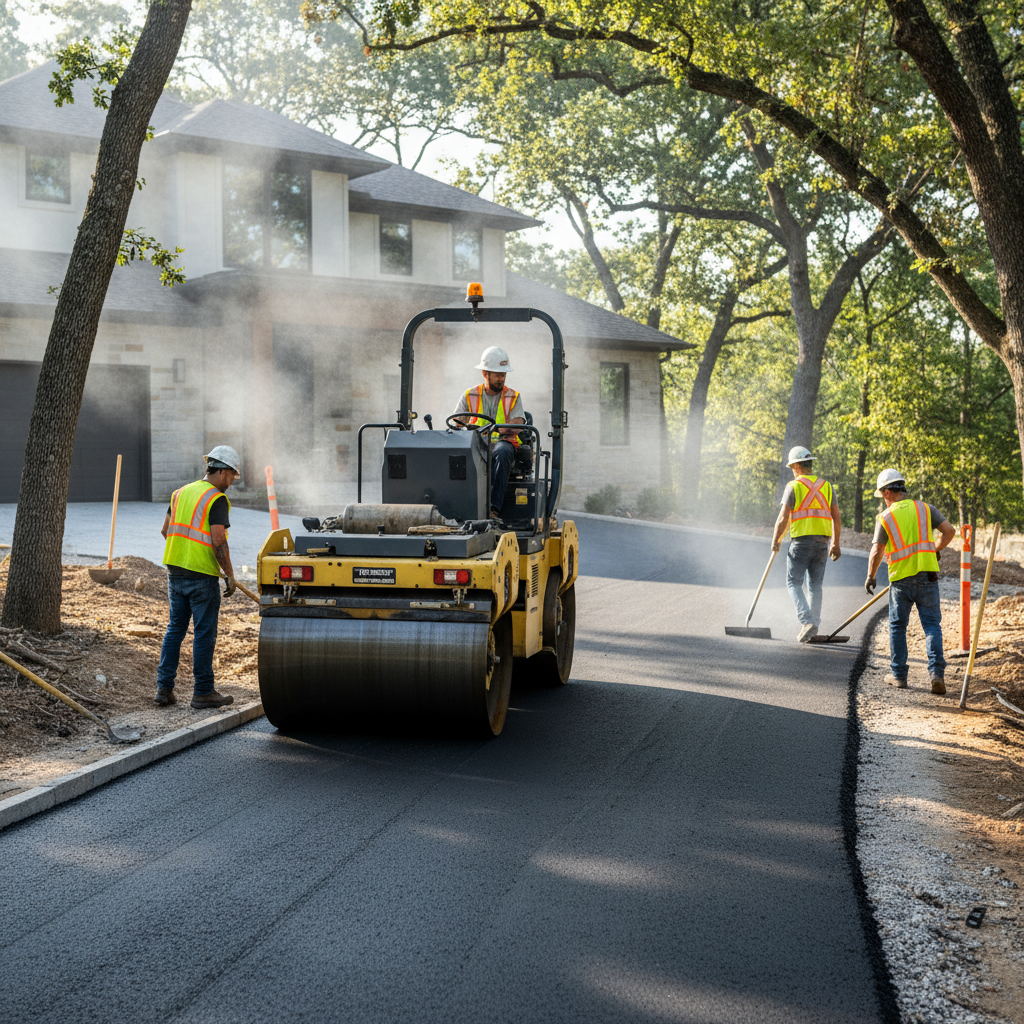
Driveway paving options and costs in St. Paul
St. Paul, Alberta homeowners typically have three strong driveway routes: asphalt, interlocking concrete pavers, and concrete. With 71.6% of dwellings in the town being single-detached homes, the demand for private driveway work is steady and wide—most lots are sized for a straightforward parking pad and vehicle lane. A big share of the housing stock is also older (56.7% of homes built before 1981), which matters because more existing driveways are already at the “repair or re-build” stage where base drainage and settlement issues show up.
In the Wood Buffalo–Cold Lake economic region, pricing is shaped by deep frost penetration (often around 1.2–1.5 m) and punishing freeze–thaw cycles. Contractors usually need a deeper, well-compacted granular base and more attention to slopes so meltwater doesn’t infiltrate edges and joints. On top of that, the paving window is shorter (often roughly May–September), which compresses schedules and increases mobilization pressure—especially for residential jobs where equipment setup is spread across fewer square metres.
If you’re in an area where driveways see heavy seasonal use—like the core residential streets near downtown St. Paul—planning earlier in the season can help you lock in a better slot. Next, use the table below to compare typical lifespans, maintenance, and budget ranges for common driveway builds in St. Paul.
| Material |
Lifespan |
Maintenance |
Best For |
Price per sq ft |
| Asphalt (new installation, proper base) |
15–25 years |
Sealcoat every 3–5 years; minor crack fill as needed |
Most cost-effective durable surface with good appearance |
$6.00–$11.50 |
| Asphalt (overlay on existing gravel base) |
10–18 years |
Sealcoat every 3–5 years; expect more patching if base settles |
When you want a faster, lower-cost improvement to a workable base |
$5.50–$9.50 |
| Interlocking concrete pavers |
20–30 years |
Re-sand joints; replace individual stones if damaged |
High curb appeal and repairability without tearing everything out |
$9.00–$16.50 |
| Poured concrete (broom finish) |
20–30 years |
Seal every 5–8 years; crack monitoring |
Low maintenance look with strong all-weather performance |
$10.00–$15.50 |
| Exposed aggregate concrete |
25–35 years |
Seal every 5–8 years; stain/efflorescence control |
Texture for traction and an upgraded finish |
$12.00–$18.50 |
| Gravel / crushed stone (budget option) |
3–7 years (varies by drainage) |
Annual raking; top-ups every 1–3 years |
Short-term budget or where paving timing is uncertain |
$2.50–$4.50 |
Prices are estimates only and vary by project scope, site access and material selection.
What affects the price of paving in St. Paul
In St. Paul and the wider Wood Buffalo–Cold Lake region, it’s common to see quotes for the “same size driveway” swing by 30–50% once you look past the surface. The main reason is that a driveway is only as good as its base and drainage—so two contractors may propose very different granular thicknesses, compaction targets, and drainage corrections even before they lay asphalt or concrete.
Frost line depth and freeze–thaw cycles are decisive cost factors here. With an approximate frost penetration in northern Alberta of 1.2–1.5 m, driveways often require a deeper, engineered granular base and more subgrade preparation than in milder climates. Practically, that means additional excavate–replace work and more material hauling, which is why northern builds can land at the higher end of the St. Paul asphalt range (commonly within $6,000 – $12,000 for driveways depending on access and base conditions) even when the asphalt thickness looks similar on paper.
The shorter paving season also concentrates demand: hot-mix asphalt production and paving require air temperatures typically above about 10°C, so crews may schedule longer days and reserve resources for weather windows. That scheduling pressure can push total pricing upward compared with southern Alberta.
Concrete can also shift in cost locally. For example, older lots (like many built before 1981) may need extra removal and regrading to address soft subgrade; that adds to both poured concrete and paver bases. Conversely, if you’re paving over a stable, well-draining gravel base and you’re not changing elevations, costs can come down toward the lower side of the concrete bands (for concrete driveway work, often $8,000 – $15,000). As a second example, if you select an aggregate finish, you may pay more but reduce surface wear and improve traction—benefits during winter plowing and snow melt.
| Price Factor |
Why It Matters |
Cost Impact |
| Driveway area in sq ft |
Material quantity and labour scale mostly with surface area |
High impact (often the biggest line item) |
| Base depth required |
Frost needs thicker, well-compacted granular layers to prevent heaving |
Medium to high; can materially shift total price |
| Grading and drainage work |
Slope and water management determine freeze–thaw longevity |
Medium impact; adds excavation and shaping time |
| Tear-out of existing surface |
Concrete breaking/haul or asphalt milling increases disposal and equipment time |
High impact on small drives (setup costs are spread less) |
| Edge restraints and curbing |
Prevents paver spread and keeps asphalt edges stable |
Medium impact; necessary for long-term neatness |
| Sealing requirement |
Asphalt performance in cold climates depends on timely sealcoat timing |
Low to medium; adds lifecycle cost |
| Site access |
Narrow lots slow equipment movement and increase placement labour |
Medium impact; sometimes forces smaller staging |
| Asphalt mix specifications |
Freeze–thaw-rated mixes cost more and perform better locally |
Medium impact; can reduce early cracking |
Permits & regulations in Alberta
For most St. Paul homeowners, paving a private driveway within your own property typically doesn’t require a building permit. However, work that touches municipal infrastructure or changes how water drains can trigger approval requirements. In Alberta, the key distinction is whether you’re altering something in the municipal right-of-way—such as new curb cuts, changes to boulevard areas, or modifications that affect storm drainage or ditch flow. If your project involves any of those, you should expect municipal approval before excavation and construction.
Also consider lot-grading bylaws. Some municipalities regulate how close a hard surface can sit to property lines and may restrict grading that could redirect runoff onto neighbouring lots. Because the Wood Buffalo–Cold Lake region is sensitive to freeze–thaw, proper drainage is not optional—contractors should design slopes and catch/ditch management to prevent water infiltration that leads to heaving and early pavement failure.
Step-by-step, verify a contractor before you sign anything:
- Confirm Alberta business registration and check their licensing/credentials through available provincial resources (where applicable) and ensure they can provide documentation on request.
- Request a certificate of insurance (liability) naming you as an additional insured if your agreement requires it.
- For worker coverage, ask for WSIB/WCB clearance documentation (the contractor should provide proof on request).
- Confirm utility locates are arranged before excavation—Alberta One-Call is the standard contact point.
- Ask the contractor whether permits are required for your specific scope and who will apply for them.
That combination—right scope, documented insurance/coverage, and correct approvals—keeps your project smooth and protects you if something changes in the field.
Asphalt vs pavers vs concrete for St. Paul driveways
For St. Paul driveways, asphalt, interlocking pavers, and concrete each match a different homeowner priority—but all three live or die by the same foundation: subgrade preparation, drainage, and base thickness suited to deep frost and repeated freeze–thaw. Asphalt is usually the lowest upfront option because it’s material-efficient and faster to place. The tradeoff is that asphalt needs sealcoat maintenance—typically every 3–5 years—to slow oxidation and keep water out of the surface. In a cold climate with winter plowing and melt cycles, that maintenance timing matters.
Interlocking concrete pavers often cost more upfront, but they shine when damage occurs. If a frost-affected area settles, you can lift and reset individual units instead of tearing out the whole driveway. That repairability can be a real advantage for older St. Paul homes where the existing base may have variable compaction.
Poured concrete sits in the middle on many projects and can be very durable when properly air-entrained and finished (broom finish and correct curing). The risk is cracking from freeze–thaw movement if control joints, finishing timing, and drainage aren’t handled correctly—especially if de-icing salts and sand are used heavily during long winters.
Base depth and drainage details are where the local climate justifies cost differences. When contractors excavate to a frost-protective granular base and restore slopes correctly, asphalt may last long enough to beat the “cheapest bid” experience. For example, a well-prepped asphalt driveway may land near $6,000 – $12,000. A comparable paver job may push toward the higher end of the local paver band (often $9,000 – $18,000) when edge restraints and a robust bedding layer are included—worth it if you want curb appeal and easier localized repairs.
| Material |
Frost Resistance |
Curb Appeal |
Repair Method |
Lifespan |
Price Band |
| Asphalt (sealed regularly) |
Good with proper base and sealcoat schedule |
Medium |
Patch-and-compact; crack fill; reseal |
15–25 years |
$6,000 – $12,000 |
| Interlocking concrete pavers |
Excellent when drainage and bedding are correct |
High |
Lift/replace individual stones; re-sand joints |
20–30 years |
$9,000 – $18,000 |
| Poured concrete (air-entrained) |
Very good if air-entrained and joints are done right |
Medium–High |
Crack repair/patch; may require section replacement over time |
20–30 years |
$8,000 – $15,000 |
| Exposed aggregate concrete |
Very good with correct mix and base |
High |
Localized patching and refinishing where feasible |
25–35 years |
$9,500 – $17,500 |
| Permeable pavers (drainage grid) |
Good; improves water handling where soils allow infiltration |
High (modern look) |
Replace paver units; maintain drainage layers |
20–30 years (system-dependent) |
$10,000 – $20,000 |
| Chip seal / tar-and-chip |
Variable; works best on well-prepared bases |
Low–Medium |
Spot re-chip; maintenance-driven |
7–12 years |
$4,500 – $9,500 |
How to choose a paving contractor in St. Paul
Choosing the right contractor matters even more in northern Alberta because deep frost and freeze–thaw cycles expose weak base work quickly. Start by verifying insurance and coverage. Ask for a current certificate of liability insurance and confirm the work vehicle/equipment coverage is active. For worker coverage, request WSIB/WCB clearance documentation—reputable paving crews can provide this without pressure.
Then get 2–3 itemised written quotes. You want the breakdown to separate labour versus materials (asphalt/pavers/concrete supply), and to list key scope items like excavation depth, granular type, base compaction expectations, drainage/culvert work if needed, and disposal costs for removed material. Avoid “lump sum only” quotes that don’t describe what’s included.
Read scope and exclusions carefully: is permit work included if the driveway apron or municipal connection requires approval? Is tear-out included? Who hauls away debris and how far? If sealing is part of the plan, confirm whether first-year sealcoat timing is included and what product is specified. For workmanship and durability, ask for warranty terms in writing—how long is the workmanship warranty, what product/manufacturer warranty applies, and is it transferable to future owners?
Payment schedule is another big one: in Alberta, a common good practice is to keep initial payment modest (often no more than 10–15% upfront) and hold back a portion until the job is fully completed and cleaned up. Finally, get the timeline in writing: a start date, estimated completion window, and what weather thresholds pause work.
- Provide insurance certificate and proof of WSIB/WCB coverage before starting.
- Show a detailed scope: base thickness, granular specs, and compaction approach.
- List disposal/hauling included (or excluded) for asphalt/concrete tear-out.
- Clarify grading and drainage responsibility (slopes, ditches, tie-ins).
- Confirm edge restraints/curbs for pavers/asphalt edge stability.
- Specify asphalt mix type suitable for freeze–thaw conditions.
- Ask how soon sealing is scheduled after asphalt placement.
- Require dust control, site cleanup, and traffic plan for the work zone.
- Request photos of similar local projects in St. Paul or nearby communities.
- Get warranty length and what triggers warranty service in writing.
- Use a written contract with start date, completion estimate, and change-order rules.
- Keep upfront payment to about 10–15% and hold back until final walkthrough.
Red flags to watch for in St. Paul: they won’t discuss base thickness and drainage; they quote without seeing the site or without a tear-out/disposal allowance; they demand a large upfront payment; they can’t provide proof of insurance/WSIB/WCB clearance; or they promise “no need for sealing” on asphalt in a freeze–thaw climate.
Frequently asked questions — paving in St. Paul
How long before I can drive on new asphalt?
In St. Paul, Alberta, the usual “ready for vehicles” window depends on air temperature, wind, and how the asphalt was placed and compacted. Typically, crews will allow light foot traffic quickly, but vehicle access is commonly staged—often the next day for standard residential driveway work if conditions are dry and warm enough. If you’re planning work right after an asphalt pour, assume you may need to keep heavy trucks, bobcats, and spinning tires off the surface for a longer period.
Contractors should also explain whether the driveway receives a temporary protection period before any later sealcoat. If your project budget is within the common asphalt driveway band of $6,000 – $12,000, you can still expect a maintenance plan: sealcoat is usually recommended after about 6–12 months (not immediately) to protect against freeze–thaw water infiltration.
What causes potholes and how are they repaired?
Potholes usually start when water enters small surface cracks or weak spots in the base. In the Wood Buffalo–Cold Lake region, freeze–thaw cycles expand that water into the pavement, loosen the aggregate, and create voids. Heavy vehicle loading from industrial activity nearby can accelerate the process, but even residential driveways can develop issues if drainage or base compaction wasn’t handled well.
Repair typically involves cutting out the failed area to sound material, cleaning the cavity, and rebuilding with asphalt layers compacted to restore density—not just “dumping” hot mix on top. For the best results in St. Paul, the contractor should also identify why the spot failed (low slope, edge breakdown, or trapped water) and correct drainage where needed; otherwise, the pothole may come back.
How do I prepare for a paving project?
Preparation is mostly about access, layout, and protecting what matters on your property in St. Paul. Clear vehicles, trailers, and stored items from the driveway footprint and give the contractor a safe path for equipment. If you have landscaping, mark sprinkler heads and protect plantings—especially where base excavation and hauling happen. Also confirm where you want the finished crown/slope to shed water so meltwater doesn’t run toward your house or into low spots.
Before work starts, review the written scope: confirm whether tear-out and disposal are included, whether any drainage repairs are included, and how edges are finished. If your driveway upgrade is targeting asphalt in the typical range of $6,000 – $12,000, ask the contractor to outline the schedule for any sealcoat so you don’t accidentally pave, then seal too early or skip it.
How do I compare paving quotes fairly?
To compare quotes fairly in St. Paul, Alberta, don’t start with the total price alone—start with scope. Ask each contractor for the same line items: excavation depth and base build-up, granular types, compaction method, drainage/grading adjustments, edge restraints, and disposal of removed material. For asphalt quotes, require details on asphalt mix specifications for freeze–thaw performance and whether a sealcoat is included or only recommended. For pavers and concrete, confirm bedding thickness, joint sand specs, and finishing and curing approach.
Also compare timelines and assumptions. A cheaper quote often hides assumptions like “no tear-out” or “minimal grading.” If one quote lands near $8,000 – $15,000 and another sits lower, the difference may be in base preparation quality, not just the surface material.
Can asphalt be laid in cold weather in St. Paul?
In St. Paul, asphalt paving is strongly weather-dependent because hot-mix asphalt needs adequate air temperature for placement and compaction. A common guideline is that asphalt paving requires air temperatures above roughly 10°C, with suitable conditions for compaction and curing. In northern Alberta’s short season (often about May–September), paving is usually planned around forecast windows to avoid poor compaction, which can lead to early cracking and rutting.
If the contractor proposes to pave in colder conditions, ask how they will maintain proper mix temperature, compaction, and curing. Good contractors will either schedule within the weather window or use compliant techniques that still meet performance requirements. In practice, paying for correct season timing is often more cost-effective than redoing a driveway—especially with deep frost in the region.
What is a driveway apron and do I need one in St. Paul?
A driveway apron is the shaped section at the transition area—often at the driveway edge where it meets a sidewalk, lane, or other paved surface. Its purpose is to create a smooth, stable grade transition and reduce settlement and break-up at the lip. Whether you need one depends on your site conditions and whether your project alters connections that affect municipal or shared surfaces. If any work touches the municipal right-of-way or storm drainage, approval requirements may apply.
In St. Paul, discuss this during your quote walkthrough. A proper apron can prevent premature edge failure, particularly on driveways serving older properties where existing elevations may be inconsistent. If your contractor is pricing an asphalt driveway in the $6,000 – $12,000 band, ask whether the apron/transition work is included and what base reinforcement is used at that change-of-grade.