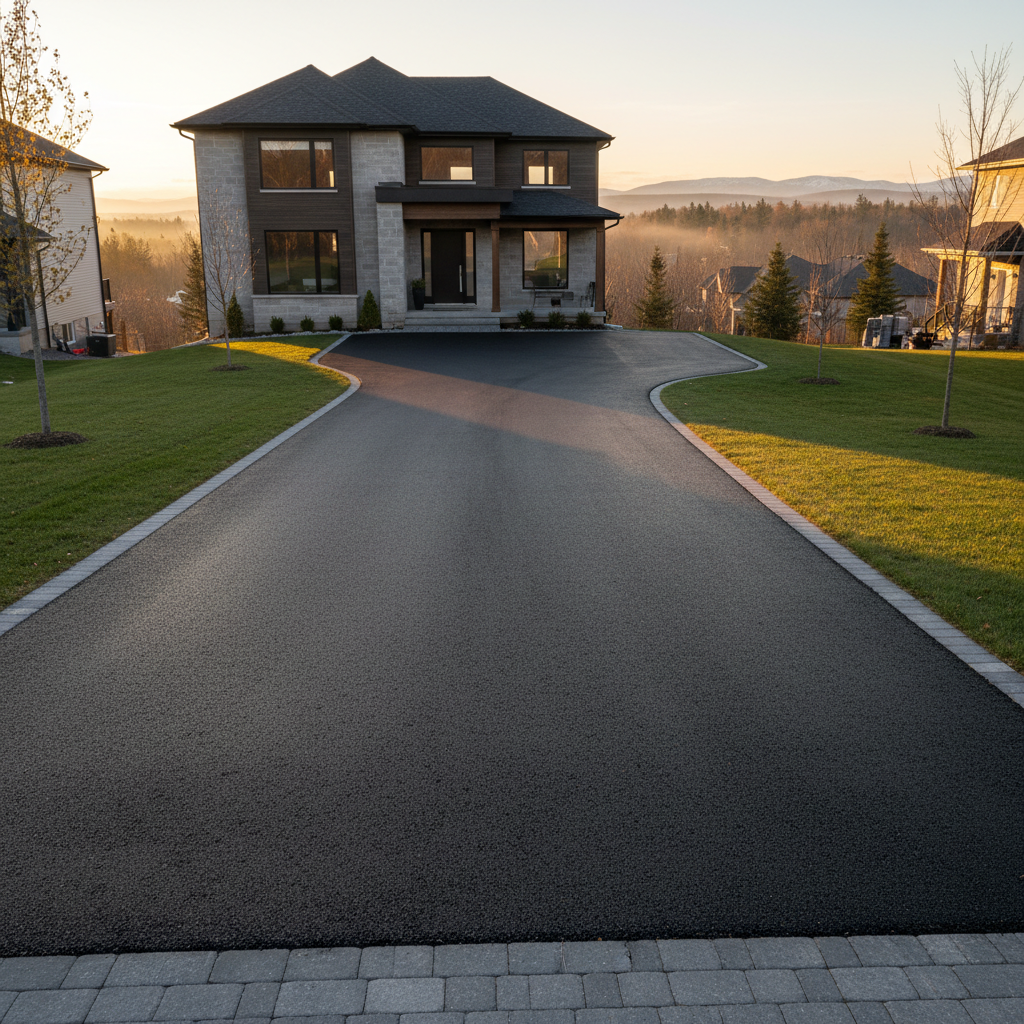
Driveway paving options and costs in Airdrie
Airdrie homeowners have three practical driveway paths—new asphalt, interlocking pavers, and concrete—yet the “right” choice usually comes down to climate performance and how much time you want to spend on maintenance. With 20,850 homeowner households in the city (Statistics Canada, 2021 Census) and 65.4% of dwellings being single-detached homes, most driveways are large enough to justify proper base work, drainage detailing, and durable edge restraint. Airdrie is also affected by Calgary-area freeze–thaw conditions: frost can penetrate to about 1.2 m (4 ft), so contractors must plan for deeper granular bases and positive runoff paths to limit heaving, cracking, and surface raveling. That’s one reason pricing can feel higher than in milder regions—both materials and labour go into resisting winter movement.
Demand is especially strong in newer growth pockets like the Windsong / Bayside area, where homeowners are often upgrading from gravel or completing the driveway as the rest of the landscaping firms up. Because the paving season is compressed (late spring through early fall), scheduling pressure in peak months can add cost, particularly on smaller jobs where crew mobilization matters.
Below is a realistic comparison of materials for an Airdrie driveway when installed with a proper granular base, compaction, and drainage-ready grading. Use it to sanity-check quotes from contractors before you dig into details like tie-ins, tear-out, and edge restraints.
| Material |
Lifespan |
Maintenance |
Best For |
Price per sq ft |
| Asphalt (new installation, proper base) |
15–25 years |
Seal coat every 3–5 years; crack fill as needed |
Lower upfront cost with good winter resilience when built on deep base |
$12 – $20 |
| Asphalt (overlay on existing gravel base) |
10–18 years |
Seal coat and patching sooner if the base is weak or wet |
Budget upgrade where subgrade is already stable and well-drained |
$14 – $22 |
| Interlocking concrete pavers |
25–40 years |
Re-seat minor areas; replace individual stones if needed |
Curb appeal, repeatable repairs, and flexible settlement handling |
$18 – $30 |
| Poured concrete (broom finish) |
25–35 years |
Crack control (sealant), occasional patch repairs |
Straightforward, low-maintenance surface with good longevity |
$15 – $25 |
| Exposed aggregate concrete |
25–35 years |
Seal every few years depending on finish exposure |
Slip resistance and an upgraded look (still requires freeze-thaw detailing) |
$18 – $30 |
| Gravel / crushed stone (budget option) |
3–10 years (varies widely with drainage) |
Top-ups and edging maintenance; washboarding control |
Lowest upfront cost while you confirm grading and drainage |
$3 – $8 |
Prices are estimates only and vary by project scope, site access and material selection.
What affects the price of paving in Airdrie
If two contractors quote “the same” driveway in Calgary’s economic region, the numbers can still differ by 30–50%. The biggest reasons are subgrade condition, base design, and the amount of drainage and tear-out work needed before asphalt or concrete can perform. In Airdrie specifically, you’ll see variation because frost depth and freeze–thaw cycles are decisive cost factors: with frost reaching roughly 1.2 m (4 ft), contractors typically increase granular base thickness and compaction to reduce water movement and soil expansion under your driveway. Asphalt mix design also needs to meet freeze–thaw expectations, which can raise material costs compared with a cheaper, poorly matched mix.
The paving season is shorter in colder regions—hot-mix asphalt generally requires air temperatures above 10°C for best placement and compaction—so spring and early summer scheduling pressure can tighten availability. That’s when smaller projects can get priced higher because mobilization costs are spread across fewer square feet.
Concrete examples in Airdrie: older properties built before 1981 may have established grading paths that collect meltwater, forcing more excavation and regrading (often adding labour and hauling). On the other hand, newer sites with straight lot grades and accessible utility routes can reduce prep time. If you’re comparing price bands, asphalt in many standard Airdrie installs lands near the $12–$20 per sq ft range, while paving treatments like interlocking pavers often sit around the $18–$30 band because of base layering, paver setting, and edge restraint labour. When the base and drainage are correctly addressed, you’re paying for longevity—not just the surface.
| Price Factor |
Why It Matters |
Cost Impact |
| Driveway area in sq ft |
Material and production time scale with square footage |
High: often the largest driver on any quote |
| Base depth required |
Frost line governs granular thickness to prevent heaving |
Medium–High: more base raises rock, hauling, and compaction time |
| Grading and drainage work |
Slope and runoff control limit water pooling under asphalt/concrete |
Medium: can add excavation, forming, and re-compaction |
| Tear-out of existing surface |
Breaking and hauling old asphalt or concrete adds disposal and labour |
Medium–High: removal can be a major add-on, especially with rebar |
| Edge restraints and curbing |
Prevents paver spread and helps asphalt/concrete hold line and slope |
Low–Medium: usually worth it for long-term performance |
| Sealing requirement |
Asphalt needs sealing after installation to protect binder against winter wear |
Medium: adds scheduled future cost (plan for it) |
| Site access |
Narrow lots, long distances, and tight turns slow equipment |
Low–Medium: can become High on small sites with poor access |
| Asphalt mix specifications |
Freeze–thaw-rated mix performs better under Alberta winters |
Low–Medium: modest unit cost, big payoff in durability |
Permits & regulations in Alberta
In Alberta, most private driveway paving work on your own property typically does not require a building permit, as you’re not altering a building structure. That said, there are important exceptions. Any work that affects the municipal right-of-way—such as changing the boulevard area, creating or altering curb cuts, or modifying storm drainage that ties into municipal infrastructure—usually requires municipal approval before you start. Some areas also enforce lot-grading requirements, meaning you may need to ensure the driveway slope and drainage do not direct water toward neighbours, sidewalks, or basements.
Before excavation in Airdrie, always request utility locates through Alberta One-Call so crews can mark buried services. This step is non-negotiable for safe excavation, especially if you’re tearing out an older driveway and rebuilding the base. Next, verify the contractor’s credentials in a practical sequence: (1) check their Alberta registration/licence through the appropriate online registry they claim to hold, (2) confirm current liability insurance by reviewing the certificate of insurance provided with your quote, and (3) confirm Workers’ Compensation coverage (WSIB/WCB) coverage—ask for the clearance letter or proof of account status.
Then confirm the scope in writing: what’s included in permit approvals (if required), who schedules locates, and how disposal/hauling is handled. If a contractor can’t clearly answer those points, that’s a planning and safety concern, not just paperwork.
Asphalt vs pavers vs concrete for Airdrie driveways
Choosing between asphalt, interlocking concrete pavers, and concrete in Airdrie comes down to how each system handles freeze–thaw, how you maintain it, and how you want repairs to work after winter. Asphalt is usually the lowest upfront option (often aligning with the $12–$20 per sq ft range), but it needs a disciplined seal plan every 3–5 years in our climate to protect the binder from winter oxidation, sand abrasion, and moisture intrusion. Interlocking pavers typically cost more at the $18–$30 band, yet they’re the most forgiving for localized settlement—any section can be lifted, corrected, and reinstalled without replacing the entire driveway. Poured concrete sits in a mid-range for many projects (often around the $15–$25 band depending on finish), but it can crack under repeated freeze–thaw if it isn’t air-entrained and properly detailed with joints, thickness, and base prep.
For Calgary-area frost conditions (frost up to about 1.2 m), all three options still rely on deeper, well-graded granular bases and positive drainage. The difference is how each surface “tells you” something is wrong: asphalt may show early raveling or cracking if water migrates upward; pavers will often shift slightly but remain repairable; concrete may exhibit cracking that’s controllable with the right mix, air entrainment, and jointing.
On winter maintenance routines—plowing, sand, and occasional de-icing—pavers and properly finished concrete generally tolerate impacts well, but asphalt benefits most from regular sealing. If you want a concrete example: for a 400 sq ft driveway, moving from asphalt near $16/sq ft to pavers near $25/sq ft can be roughly a $3,600 difference before allowances, and that premium is justified when you value easy repairs and long-term curb appeal rather than lowest-first-cost.
| Material |
Frost Resistance |
Curb Appeal |
Repair Method |
Lifespan |
Price Band |
| Asphalt (sealed regularly) |
Good with deep granular base and drainage |
Medium |
Patch and re-seal localized areas |
15–25 years |
$12 – $20 |
| Interlocking concrete pavers |
Very good; flexible over minor movement |
High |
Lift, re-level bedding/base, replace affected units |
25–40 years |
$18 – $30 |
| Poured concrete (air-entrained) |
Good when air-entrained and jointed |
Medium–High |
Patch repairs; sometimes slab replacement if widespread |
25–35 years |
$15 – $25 |
| Exposed aggregate concrete |
Good with proper base and finish curing |
High |
Patch/repair with matching finish (limited exact blending) |
25–35 years |
$18 – $30 |
| Permeable pavers (drainage grid) |
Good to very good with correct subdrain design |
High (often a premium look) |
Replace individual units; protect subdrain from clogging |
20–35 years |
$22 – $35 |
| Chip seal / tar-and-chip |
Moderate; tends to age sooner under freeze–thaw |
Low–Medium |
Spot patch and recoat later |
7–15 years |
$10 – $18 |
How to choose a paving contractor in Airdrie
For paving in Airdrie, you want a contractor who builds to our freeze–thaw reality, not just a surface-price. Start with licensing: in Alberta, confirm the contractor is properly registered for their work scope. Next, verify liability insurance—ask for a current certificate of insurance naming the right parties (as required by the contract) and confirm coverage is active for the dates of your project. Then check Workers’ Compensation coverage (WSIB/WCB): request a clearance letter or proof of account status. If they won’t provide documentation up front, treat that as a major risk.
Get 2–3 itemised written quotes. “Itemised” matters: you should see labour + materials breakdown, including base depth, aggregate type, asphalt/concrete thickness, tack coat (for asphalt), and whether disposal and tear-out are included. Pay attention to inclusions and exclusions: is permit/approval work included if the job triggers municipal right-of-way requirements? Are utility locates scheduled? Is hauling and dump fee included? Who regrades to final slope, and what’s the standard for edge restraint?
Warranty should be specific: ask for workmanship warranty length, how manufacturer warranty applies to materials, and whether it’s transferable if you sell your home. Payment schedule should protect you: never pay more than 10–15% upfront; hold back a portion until final completion and cleanup. Finally, require a timeline: a start date and an estimated completion window should be in writing, not only promised verbally.
- Ask for proof of Alberta registration/licence for the specific paving scope.
- Request a current certificate of liability insurance before any work starts.
- Confirm WCB/WSIB coverage with a clearance letter or proof of account status.
- Ensure utility locates are scheduled through Alberta One-Call (and included if you’re in tear-out mode).
- Get an itemised quote: base depth, materials, thickness, and compaction steps.
- Confirm whether tear-out includes breaking, removal, and disposal/hauling fees.
- Verify edge restraints: curbs, steel edging, or paver restraints—no “we’ll wing it” solutions.
- For asphalt, require tack coat details and a seal plan (not just “we’ll come back later”).
- For concrete, confirm air-entrainment and jointing plan appropriate for freeze–thaw.
- Ask about drainage: final grading slope, ditch/runoff tie-ins, and water management.
- Review warranty: workmanship length, exclusions, and whether it’s transferable.
- Lock the payment schedule: 10–15% max upfront; hold back until final inspection.
In Airdrie, I see common red flags: vague quotes that don’t state base thickness, promises to pave “no matter the weather” without temperature/curing requirements, missing or outdated insurance/WCB documents, no written drainage plan, and warranties that only cover materials (not workmanship). If you’re hearing any of these, keep shopping.
Frequently asked questions — paving in Airdrie
How long does a paved driveway last in Airdrie?
Airdrie driveways typically last best when they’re built on a properly compacted granular base with good drainage to resist our freeze–thaw cycles. Asphalt often performs around 15–25 years when it’s sealed on schedule and crack-jointed/filled early. Interlocking concrete pavers commonly reach 25–40 years because individual stones can be reset if minor movement happens. Poured concrete can also reach 25–35 years, especially if it’s air-entrained and properly jointed. The biggest determinant is not just the surface choice—it’s whether water is kept from migrating under the driveway. Homes in Airdrie are a mix of ages (with a smaller share built before 1981, per Statistics Canada, 2021 Census), and older grading issues can shorten life if the base/drainage isn’t corrected.
When is the best time of year to pave in Airdrie?
In Alberta, the practical paving window is late spring through early fall. Asphalt placement and compaction depend on temperatures; cold nights and damp ground can cause poor compaction and premature wear. Most reputable crews aim for consistent daytime temperatures (commonly above about 10°C for best asphalt conditions) and will avoid work right before heavy rainfall or when the subgrade is near-freezing. Concrete also needs favorable curing conditions—freezing weather can damage strength development. Scheduling can get tight in peak summer weeks because demand concentrates when the ground is workable, especially for residential driveways on shorter timelines. If you’re planning a larger upgrade (tear-out plus new base), start discussions early so the contractor can book your slot within the season.
How deep should the base be for Airdrie's frost?
Because frost can penetrate to about 1.2 m (4 ft) in the Calgary region, base depth and drainage design are crucial in Airdrie. While exact depths depend on soil conditions, subgrade strength, and whether the driveway crosses problematic fill, a good rule is that contractors should design for a deeper, well-graded granular base than you’d use in milder climates. Many residential installs end up needing approximately 6–12 inches of compacted granular base thickness in Alberta conditions, with thicker designs when subgrade is weak or moisture-prone. If you’re overlaying existing material, the base must be verified—overlaying a wet or unstable base leads to heaving and cracking. A quality quote will explain the base thickness and compaction approach, not just the surface.
How often should I seal my asphalt driveway?
For asphalt in Airdrie, sealing is an important part of lifecycle cost. In most proper asphalt builds, you apply the first seal coat after the asphalt has cured—often within about 6–12 months—then continue with resealing every 3–5 years depending on traffic, sun exposure, and how much winter sand and snow storage sits on the surface. If you wait too long, the binder can oxidize faster, and small cracks can widen as freeze–thaw forces move water in and out of the pavement. Sealing also helps slow raveling and reduces permeability. When you compare quotes, ask whether sealing is included now or planned as a future allowance; reputable contractors will talk about maintenance from day one, not after the invoice is paid. Asphalt pricing commonly lands in the $12–$20 per sq ft range, but maintenance schedule is what protects that investment.
Why does my driveway crack and heave in winter?
Cracking and heaving almost always point to water and frost interaction. In Airdrie’s freeze–thaw climate, if meltwater or groundwater can get under the driveway, it expands when temperatures drop, pushing upward and moving the surface. Poor drainage, insufficient granular base thickness, weak or moisture-laden subgrade, and missing or undersized edge support can all contribute. If the driveway slope directs runoff toward low spots, you may see more distress in winter than on the high side. Another cause is paving on uncompacted material—if the base wasn’t compacted correctly, it can settle and then react dramatically as moisture freezes. Early crack filling and keeping water from pooling helps, but if heaving is repeating, the fix is usually base and drainage correction, not just patching.
Do I need a permit to pave my driveway in Alberta?
Typically, paving a private driveway within your own property generally does not require a building permit in Alberta. However, you may need municipal approval if the work affects the municipal right-of-way—for example, a new or modified curb cut, changes to boulevard grading, or alterations that impact storm drainage connections. Some municipalities also restrict lot grading near property lines, so drainage paths and slope matter. The best approach in Airdrie is to ask the contractor to confirm whether any right-of-way or grading approvals are triggered by your specific plan before excavation. Also, regardless of permits, always ensure utility locates are completed through Alberta One-Call before any digging. A good contractor will explain what is and isn’t included in permits and approvals in the written scope.