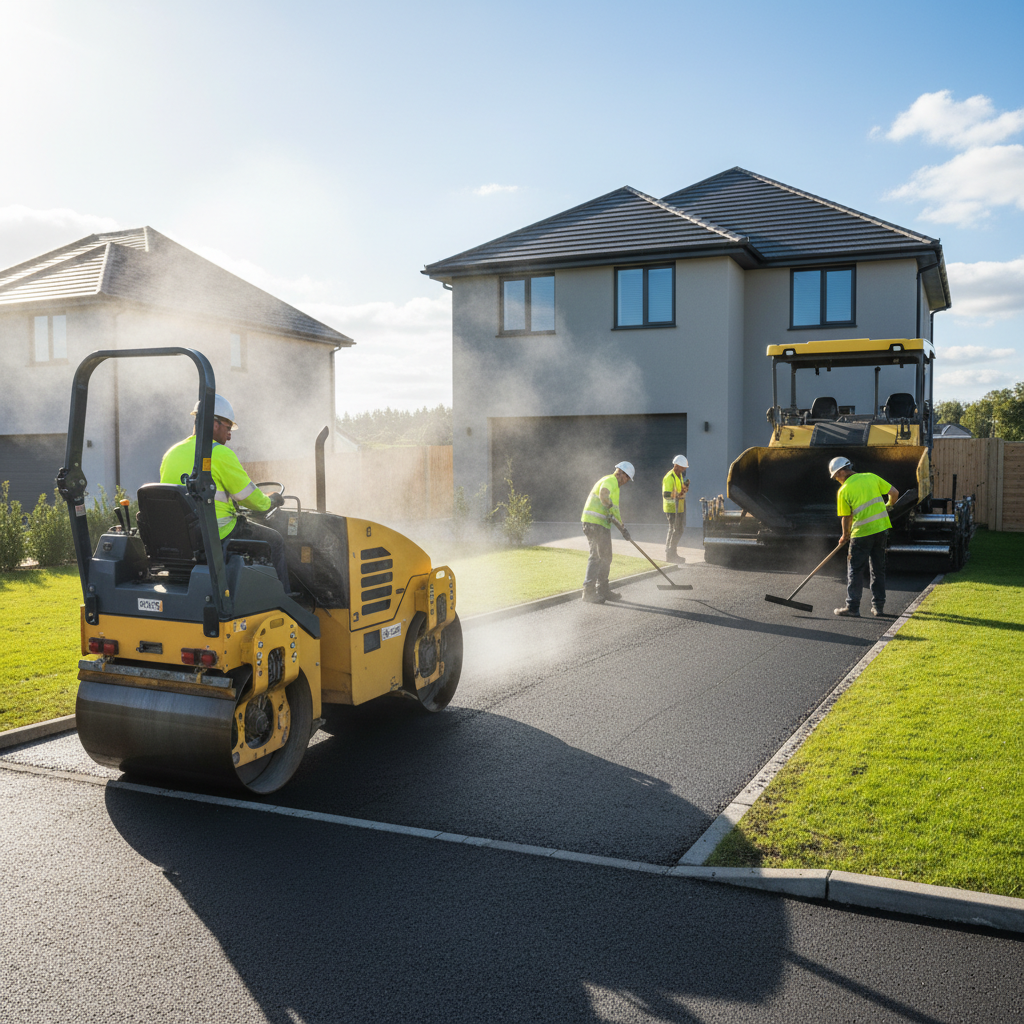
Driveway paving options and costs in Elbow Park
Elbow Park, Alberta homeowners typically choose between asphalt, interlocking pavers and concrete based on budget, appearance and how much repair work they’re willing to do after the first winter. With a population of 3,285 (Statistics Canada, 2021 Census), the neighbourhood is small, which can mean fewer crews are available during peak spring and summer weeks—especially when multiple nearby projects compete for the same equipment. Most private driveways here are tied to single-detached properties, so driveway work is a major, recurring line item for many households as they age out of older surfaces.
Calgary’s cold continental climate drives real cost differences. Frost can penetrate to about 1.2 m (4 ft), and repeated freeze–thaw cycles move water through the subgrade. To prevent heaving, cracking and raveling, contractors often need deeper, well-compacted granular bases, better edge support and strict drainage grading. That shows up in quotes, particularly when you’re paving in late spring when the ground is warming but labour schedules are tight.
In Elbow Park—especially around the busy residential stretches near 17 Ave SW—driveway resurfacing and full replacements tend to be in demand because many homes have older approach slabs and uneven gravel transitions. Next, use the comparison table to estimate typical material choices and expected maintenance, then match that to your driveway condition and winter expectations.
| Material |
Lifespan |
Maintenance |
Best For |
Price per sq ft |
| Asphalt (new installation, proper base) |
15–25 years |
Seal coat every 3–5 years; crack fill as needed |
Most cost-effective, good performance with correct base and drainage |
$12 – $20 |
| Asphalt (overlay on existing gravel base) |
10–18 years |
Seal coat; targeted repairs if base settles |
When you want a faster, lower-disruption upgrade and the base is stable |
$12 – $18 |
| Interlocking concrete pavers |
25–40 years |
Replace individual stones/blocks; re-sand joints as needed |
Curb appeal and repairability without total replacement |
$18 – $30 |
| Poured concrete (broom finish) |
20–35 years |
Resurface/joint maintenance; seal if desired |
Smoother look, snow-plow-friendly surface with proper joints |
$15 – $25 |
| Exposed aggregate concrete |
25–35 years |
Sealer recoat; joint monitoring |
Slip resistance and a more premium texture |
$18 – $28 |
| Gravel / crushed stone (budget option) |
5–12 years |
Top-up annually; grading and weed control |
Short-term solution or tight budgets; easy future upgrades |
$4 – $10 |
Prices are estimates only and vary by project scope, site access and material selection.
What affects the price of paving in Elbow Park
Even when homeowners describe the “same” driveway size, quotes in Calgary and across Alberta can swing by 30–50% because the real cost drivers are hidden: how thick the base must be, how much grading and drainage correction is needed, and how hard it is for equipment to move on site. Two contractors might both quote asphalt, but one may be building to address frost movement properly while the other is assuming the existing subgrade will behave—something the freeze–thaw cycle in this region often disproves.
In Calgary’s cold climate, frost line depth and freeze–thaw cycles are decisive. Frost routinely penetrates to about 1.2 m (4 ft), and that means water expands in winter and can lift weak sections in spring. Contractors respond by using deeper, well-graded granular bases and ensuring positive drainage. Hot-mix asphalt also has temperature requirements (air temperatures typically need to be above 10°C for reliable paving and compaction), so the compressed paving season concentrates demand. When crews are busy, mobilization and scheduling time become part of the labour rate. A freeze–thaw-rated asphalt mix design can add cost, but it helps reduce early surface cracking and raveling.
In Elbow Park, you’ll often see cost increases when an older driveway transitions poorly to the garage apron or when the soil is variable (fill, clay pockets, or spots that hold moisture). Conversely, costs can come down if your existing subbase is already uniform and drainage is already corrected. For example, moving from a basic asphalt plan toward a full proper-base install can shift you from the lower end of the $12 – $20 range toward the higher end—often a justified spend versus overlays that might start lower but need attention sooner. Concrete can also land in the $15 – $25 band, but only if jointing and base preparation are done right for Calgary winters.
| Price Factor |
Why It Matters |
Cost Impact |
| Driveway area in sq ft |
Labour and material quantities scale directly with surface area |
Major (often the biggest line item) |
| Base depth required |
Frost movement demands thicker compacted granular thickness |
Major (can change costs by thousands on small lots) |
| Grading and drainage work |
Correct slopes and manage runoff to prevent trapped water |
Medium to major, depending on current grading |
| Tear-out of existing surface |
Breaking, hauling, and disposal add labour and equipment time |
Medium |
| Edge restraints and curbing |
Prevents paver spread and asphalt edge washouts |
Medium (especially for pavers) |
| Sealing requirement |
Asphalt needs sealing after curing (commonly 6–12 months) |
Low upfront; medium lifecycle cost |
| Site access |
Narrow driveways slow equipment and increase labour time |
Low to medium |
| Asphalt mix specifications |
Freeze–thaw-rated mix resists cracking and raveling better |
Medium (can move quotes within the band) |
Permits & regulations in Alberta
In Alberta, paving a private driveway within your own property usually does not require a building permit, as long as you’re not changing how water flows off your lot in a way that affects neighbouring properties or the municipal system. Where permits and approvals can come into play is the municipal right-of-way: work such as new curb cuts, changes to boulevard conditions, or alterations to storm drainage typically require municipal approval. Some municipalities also have lot-grading bylaws that limit how close a hard surface or changed grade can be to property lines and how runoff must be managed.
Before excavation, step one is utilities: call for utility locates (Alberta One-Call) even if you “only” plan to remove asphalt or mill a surface. Step two is confirm grading rules with the municipality—particularly if you plan to change elevations or redirect runoff. Step three is hiring checks: ask for (1) the contractor’s Alberta licence number or business registration details where applicable, (2) a current certificate of liability insurance, and (3) proof of workers’ compensation coverage (WSIB/WCB coverage depending on the nature of work and employer status). For each, verify the certificate is current and covers paving/asphalt/concrete work, not just general contracting.
For Elbow Park homeowners, the practical takeaway is simple: private work on your driveway apron is usually straightforward, but anything that touches the curb/boulevard or modifies drainage paths should be approved first.
Asphalt vs pavers vs concrete for Elbow Park driveways
For Elbow Park’s freeze–thaw winters, all three options can perform—if the base and drainage are built correctly. Asphalt is the lowest upfront choice, typically sitting in the $12 – $20 per sq ft band, but it relies on regular sealing every 3–5 years to protect against oxidation and surface micro-cracking. Interlocking concrete pavers cost more—often in the $18 – $30 range—but they’re modular: if a section settles or a sub-drain issue develops, crews can lift and reset stones without tearing out the entire driveway. Poured concrete sits mid-range (commonly $15 – $25) and can be excellent when it’s air-entrained and properly jointed; otherwise, freeze–thaw movement and de-icing chemicals can contribute to cracking.
Because frost can penetrate deeply in this region, base preparation usually matters more than the surface choice. Many Calgary driveways need a stronger, properly compacted granular base (often thicker than what people expect) and positive drainage so meltwater doesn’t sit under the asphalt or concrete. Pavers can handle minor localized movement better because individual units can be repaired, while asphalt may show early edge raveling if restraint and drainage aren’t right. Concrete generally holds up well to plowing when the surface is broom-finished and joints are aligned, but salt and freeze–thaw demand good concrete mix design.
Where price differences are justified: if you’re dealing with an older, uneven driveway where future settlement is possible, pavers can cost more today but can be cheaper over time because repairs don’t require full replacement. If your base and drainage are already sound, asphalt can be the sensible value—especially when you’re planning to budget for sealing on schedule.
| Material |
Frost Resistance |
Curb Appeal |
Repair Method |
Lifespan |
Price Band |
| Asphalt (sealed regularly) |
Good (best with freeze–thaw-rated mix and correct base) |
Medium (clean, uniform look) |
Crack fill, patching; full overlay if extensive deterioration |
15–25 years |
$12 – $20 |
| Interlocking concrete pavers |
Very good (modular units tolerate minor movement) |
High (wide colour/pattern choices) |
Lift-and-relay individual units; re-sand joints |
25–40 years |
$18 – $30 |
| Poured concrete (air-entrained) |
Good (air-entrainment and joints are critical) |
Medium to high (sleek finish with options) |
Spall/Crack repair with patching; rarely lift-and-relay |
20–35 years |
$15 – $25 |
| Exposed aggregate concrete |
Good to very good (surface durability when joints are correct) |
High (textured, premium look) |
Patch and reseal; repairs are more visible than asphalt |
25–35 years |
$18 – $28 |
| Permeable pavers (drainage grid) |
Very good when engineered for local drainage |
Medium to high (clean lines; eco-focused options) |
Replace affected units; maintain drainage layers |
20–35 years |
$22 – $35 |
| Chip seal / tar-and-chip |
Fair to good (performance depends on prep and traffic) |
Low to medium (more utilitarian) |
Spot maintenance; eventually resurfaced or overlaid |
8–15 years |
$10 – $16 |
How to choose a paving contractor in Elbow Park
Start by verifying Alberta credentials before you sign anything. Ask for the contractor’s business/Alberta registration details and confirm their liability insurance with the certificate of insurance showing active coverage for paving/asphalt or concrete work. For workers, request proof of workers’ compensation coverage (WSIB/WCB) so you’re not held responsible if something happens on site. If they can’t provide certificates quickly, that’s a major warning sign. You can also confirm licensing/registration details through appropriate online registries or by requesting their licence number and insurer documentation.
Next, request 2–3 itemised, written quotes—not a lump sum. You want a breakdown that shows labour, granular base materials, asphalt/concrete quantities, disposal/tipping (if applicable) and compaction/testing steps. Read the scope carefully: is permit work included if they’re touching a right-of-way or drainage area? Is tear-out and haul-away included? Are edge restraints and proper drainage corrections included, or treated as “extras” later?
Warranty matters in Calgary winters. Ask for the workmanship warranty length (usually against defects), the manufacturer’s product warranty (if supplied), and whether any warranty transfers to you as the owner. Payment scheduling should protect you: never pay more than 10–15% upfront, and hold back a portion until completion and final grading/cleanup are verified. Finally, get a written timeline with a start date and estimated completion window, since the paving season is short and weather can shift scheduling.
- Provide an Alberta licence/business registration reference (or clear eligibility details) before work starts.
- Show a current certificate of liability insurance with adequate limits for driveway work.
- Provide proof of workers’ compensation coverage (WSIB/WCB) for the crew performing the work.
- Give 2–3 itemised quotes with labour and materials separated (not a single number).
- Include base prep details: granular type, thickness, and compaction expectations.
- Confirm drainage/grading plan (slope, swales, and runoff direction) in writing.
- Specify edge restraints/curbing or paver restraints and what’s included at both sides.
- State whether tear-out and disposal are included (or quoted as an allowance).
- List surface finish specifics: broom finish for concrete, aggregate size for exposed, and seal coat timing for asphalt.
- Clarify warranty terms: workmanship length, exclusions, and who the warranty is issued to.
- Use a payment schedule with a small deposit (10–15%) and a meaningful holdback until final acceptance.
- Get start/completion dates in writing and confirm who monitors weather/temperature thresholds.
Red flags I see in Elbow Park: contractors who refuse to itemise base depth and drainage steps, quotes that don’t mention tear-out/disposal or edge restraint, crews that want a large deposit up front, no written warranty or vague “best effort” promises, and no clear answer on whether the asphalt mix meets Calgary-area freeze–thaw expectations or whether concrete is air-entrained.
Frequently asked questions — paving in Elbow Park
What causes potholes and how are they repaired?
Potholes in Elbow Park are usually a freeze–thaw story. Water gets into small failures at the surface or along edges, freezes (expanding), then thaws (loosening). Over repeat cycles, the base can soften, and traffic breaks the asphalt loose. Common triggers include poor drainage, weak or uneven granular base, and inadequate sealing that lets moisture reach the pavement structure.
Repairs typically start with locating the failure area, removing unsound material, and compacting a proper patch base—not just “filling the hole.” For larger failures, contractors may mill and patch a wider section to restore a stable base layer. In some cases, an overlay is more cost-effective than repeated patching when there’s widespread deterioration. Local winter maintenance (plowing and salt) can accelerate surface wear, so catch small issues early.
How do I prepare for a paving project?
Preparation is mostly about making the driveway safe and reducing delays. Clear vehicles from the site and plan for access during the build—especially if equipment needs room to set forms or place aggregate. If you have landscaping, talk to the contractor about protection and removal/relocation needs. Make sure downspouts and exterior drainage are visible so they can confirm where runoff should go after grading.
For permits and right-of-way work, don’t assume it’s automatic—if any curb cut or storm drainage adjustments are planned, approvals may be needed before excavation. Finally, decide whether you’ll need a temporary parking plan during tear-out and curing. Alberta’s season is short, and air temperature affects asphalt compaction, so contractors often schedule around the weather window.
How do I compare paving quotes fairly?
To compare quotes fairly in Elbow Park (and across Calgary’s market), match the scope, not just the total price. Look for line items showing base depth, granular material and compaction, and whether drainage corrections are included. Confirm tear-out and disposal are included or listed as an allowance, because removing old asphalt or concrete can add several days of labour and equipment time.
For asphalt, ask what mix is specified for freeze–thaw performance and whether a seal coat is planned—sealing is commonly done after curing (often 6–12 months). For concrete, confirm air-entrainment and jointing details. A quote that lands in the lower end of the $12 – $20 asphalt range may be missing base and drainage work. Likewise, concrete priced within the $15 – $25 band should include proper base preparation and joints, or you’ll be paying again sooner.
Can asphalt be laid in cold weather in Elbow Park?
Asphalt paving in Elbow Park is limited by temperature. Hot-mix asphalt generally needs favourable air temperatures—commonly above about 10°C—to achieve proper placement, compaction and curing. When it’s too cold, you risk poor compaction and premature cracking because the mat can’t cool and bind properly.
Cold-weather paving is sometimes possible with planning (like heated materials or scheduling during the warmest part of the day), but it’s not something I’d treat as routine. Freeze–thaw here is severe, so contractors should build the base correctly and pave only when conditions support compaction. If you’re doing work in late fall, it may be safer to postpone to the next season rather than accept a compromised lift.
What is a driveway apron and do I need one in Elbow Park?
A driveway apron is the paved transition area where your private driveway connects to the street curb or boulevard area. In many Elbow Park situations, an apron helps provide a smooth, durable entry point and supports proper runoff direction at the edge of pavement. If the existing apron is cracked, uneven, or causing water to pond, replacing or upgrading the apron can be part of making the driveway perform through winter.
Whether you “need” one depends on your current condition and whether any right-of-way work is involved. If the work reaches into municipal boulevard or requires changes to drainage or a curb cut, approvals may be required. A contractor should assess elevation differences, slope, and drainage paths before recommending an apron so you don’t pay for paving that immediately fails at the connection.
How do I maintain my driveway through Elbow Park winters?
Winter maintenance is about preventing water and protecting the surface. For asphalt, avoid de-icing practices that grind or over-saturate the surface. Use sand as needed for traction, and use salt carefully—salt can accelerate deterioration over time. Seal coats are your best defence: plan for a seal coat every 3–5 years depending on wear, and crack-fill small lines early so moisture doesn’t infiltrate deeper layers.
Keep edges clear and don’t let plough blades damage the perimeter. If you notice low spots where meltwater sits, address drainage with your contractor—base and grading issues will show up repeatedly in Elbow Park’s freeze–thaw cycle. For budget planning, sealing and repair is often in the $400 – $1,500 range depending on extent.