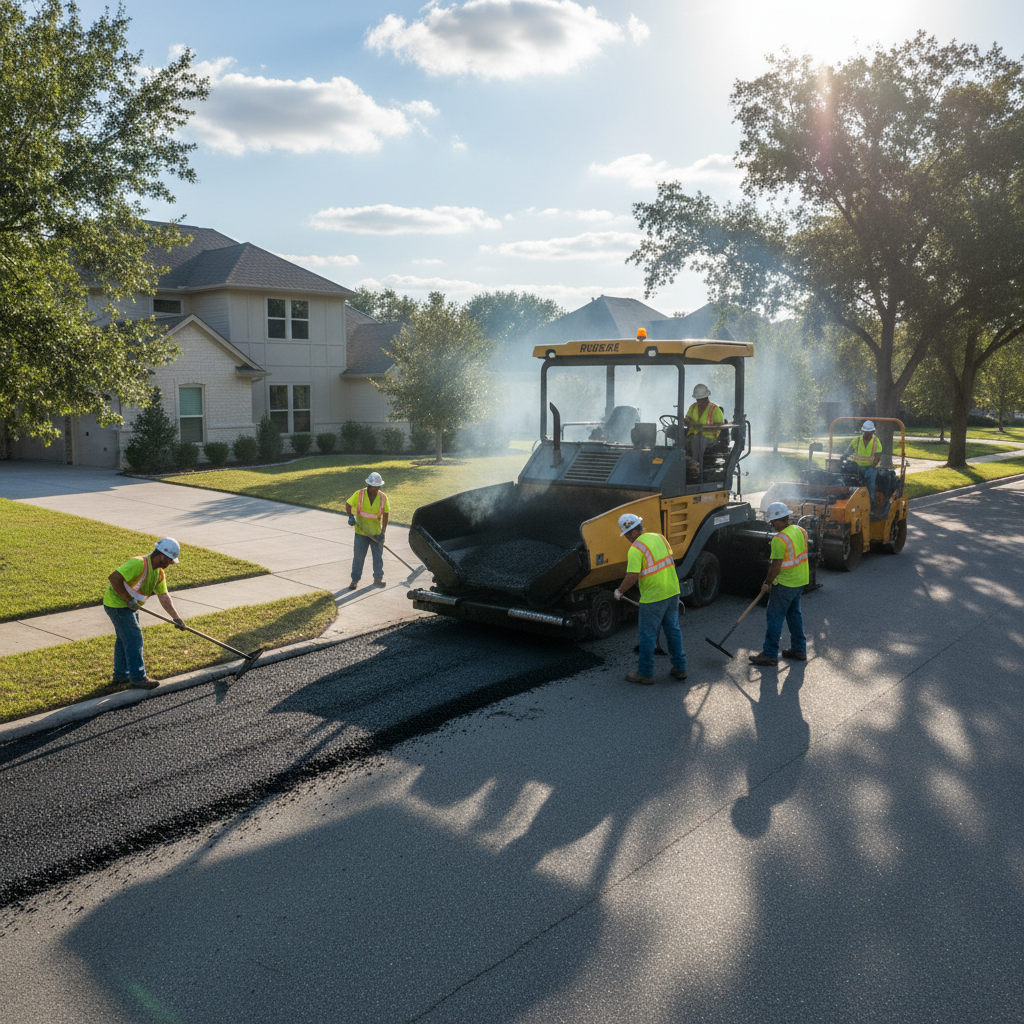
Driveway paving options and costs in Lower Mount Royal
Lower Mount Royal, Alberta sits on the Calgary market’s toughest backdrop for driveways: a cold continental climate with freeze–thaw cycles that punish weak bases and poor drainage. The community is small (2,990 people in 2021) and it’s heavily residential—most private driveways serve single-detached homes, so demand is steady for full replacements and maintenance upgrades. In practice, that means you’ll see recurring work around curb approaches and garage entrances where water runoff and tire traffic concentrate.
Because frost can routinely penetrate deep (about 1.2 m / 4 ft), contractors price for stability, not just surface materials. Expect more granular thickness and more careful compaction than in milder regions. Calgary’s paving season is also compressed: hot-mix asphalt generally requires air temperatures above 10°C, so scheduling in late spring through early fall can tighten, especially for smaller jobs. Contractors also account for mobilization to nearby areas and winter damage risk when estimating your total lifecycle cost.
In Lower Mount Royal, work is especially in demand near the older residential pockets close to the inner city where driveway geometry varies and tie-ins to existing sidewalks/approaches are common. If you’re comparing options, start with your end goal: lowest upfront cost, maximum curb appeal, or the easiest repair after a freeze–thaw event. The table below summarizes typical material choices and what they’re likely to cost per square foot in the Lower Mount Royal market.
| Material |
Lifespan |
Maintenance |
Best For |
Price per sq ft |
| Asphalt (new installation, proper base) |
15–25 years |
Sealcoat every 3–5 years; spot crack fill |
Best value where you want a smooth, quiet ride |
$12–$20 |
| Asphalt (overlay on existing gravel base) |
10–18 years |
Sealcoat every 3–5 years; stronger base prep required |
When you’re trying to upgrade without full demo |
$10–$17 |
| Interlocking concrete pavers |
25–40 years |
Re-sand joints as needed; replace individual stones |
Curb appeal and easy localized repairs |
$18–$30 |
| Poured concrete (broom finish) |
25–35 years |
Minor crack repair; occasional seal depending on exposure |
Lower visual maintenance with long-term durability |
$15–$25 |
| Exposed aggregate concrete |
25–35 years |
Periodic cleaning; seal may be recommended for staining control |
Textured grip in winter and a more upscale look |
$18–$30 |
| Gravel / crushed stone (budget option) |
3–8 years |
Top-ups every 1–3 years; regrading |
Short-term solution or sloped drainage experiments |
$6–$12 |
Prices are estimates only and vary by project scope, site access and material selection.
What affects the price of paving in Lower Mount Royal
In Lower Mount Royal and across the Calgary region, two contractors can price the same driveway 30–50% differently because the “surface” is only part of the job. The bigger drivers are base depth, drainage corrections, and how much tear-out and hauling is required. In colder Alberta markets, crews also face peak-season scheduling pressure and higher overhead in summer months—especially when multiple small driveways are booked at the same time window.
Frost line depth and freeze–thaw cycles are decisive cost factors here. With frost penetrating to about 1.2 m, water expands as it freezes and can push subgrade upward if the base isn’t thick and well-graded. That’s why contractors often plan deeper compacted granular bases than in milder climates (and why the base is frequently the single most “quote-changing” scope item). If you skip drainage or compromise compaction, you’re more likely to see heaving, cracking, and surface raveling that shortens the effective lifespan—so the upfront numbers can end up being higher later.
Concrete and asphalt also rely on temperature windows for construction. Asphalt requires air temperatures above 10°C, so spring and early fall weather swings can lead to more conservative scheduling and labour allocation. For concrete, the mix design matters; freeze–thaw-rated approaches with proper air entrainment help resist deterioration, but they add to material cost.
Concrete examples: if your driveway ties into a garage approach with limited space for forms and saw cuts, you may pay more for labour. If you need significant grading to daylight runoff away from the foundation, expect added excavation and granular placement. In many Calgary projects, a well-built asphalt driveway falls into the $12–$20 band, while paver jobs commonly price in the $18–$30 range when edge restraints and proper base layers are included from day one.
| Price Factor |
Why It Matters |
Cost Impact |
| Driveway area in sq ft |
Most materials and labour are priced per square foot |
High (primary driver) |
| Base depth required |
Frost line depth determines granular thickness to resist heaving |
High (often the biggest quote difference) |
| Grading and drainage work |
Slope correction and positive drainage prevent water pooling |
Medium to high |
| Tear-out of existing surface |
Breaking and hauling concrete or removing old asphalt adds labour and disposal |
Medium to high |
| Edge restraints and curbing |
Prevents paver spread and asphalt edge breakdown |
Medium |
| Sealing requirement |
Asphalt needs sealcoat after curing (typically 6–12 months) to slow oxidation |
Low to medium (adds maintenance cost) |
| Site access |
Narrow lots slow equipment movement and can require smaller crews/material handling |
Low to medium |
| Asphalt mix specifications |
Freeze–thaw-rated asphalt mix design can cost more but improves durability |
Low to medium |
Permits & regulations in Alberta
For paving in Alberta, the rule of thumb is: work on your private property usually doesn’t require a building permit, but modifications in the municipal right-of-way often do. In Lower Mount Royal, a typical driveway repaving (removing and replacing asphalt or concrete within your property line, with standard base and surface work) usually falls under routine private improvements. However, if your project includes new curb cuts, changes to the boulevard, or altered storm drainage that affects how water runs in the street/sidewalk area, you should expect municipal approval before work starts.
Another detail homeowners sometimes miss is lot-grading. Some municipalities have grading bylaws that restrict how close to property lines hard surfaces can be built and how runoff must be handled. If you’re improving drainage or changing slopes, ask the municipality what the requirements are for directing water away from adjacent properties and structures.
Step-by-step verification: (1) call for utility locates before any digging to confirm where gas, power, telecom, and water lines run; (2) ask the contractor whether the work stays fully within your property line or touches the boulevard; (3) confirm the contractor’s Alberta licence status via the appropriate online registry; and (4) request current proof of liability insurance and WSIB/WCB coverage. Look at the certificate of insurance for coverage limits and the effective dates, and ensure the clearance letter status aligns with your contract start date.
If you want the least risk, require a written scope stating what is and isn’t included (teardown, disposal, grading, and any municipal approval assistance).
Asphalt vs pavers vs concrete for Lower Mount Royal driveways
For Lower Mount Royal’s freeze–thaw climate, the “best” driveway material is the one that survives water and movement under load. Asphalt is usually the lowest upfront option and gives a smooth driving surface, but it needs regular sealing (typically every 3–5 years) to protect against oxidation and winter wear. Interlocking concrete pavers cost more up front, yet they handle Calgary’s winter stress well because you can lift and replace individual stones if a section heaves or if plumbing lines ever need access. Poured concrete lands in the middle for cost, and with properly air-entrained concrete and good jointing, it can perform very well; but without the right design and finishing, freeze–thaw and de-icing can contribute to cracking and scaling.
Base preparation is non-negotiable in Calgary because frost routinely penetrates to around 1.2 m. All three systems need a compacted granular base and positive drainage so water doesn’t sit beneath the pavement. Where snow and plough operations are consistent, good edge support matters: pavers are forgiving because they’re modular, while asphalt and concrete are more sensitive to edge breakdown and trapped water.
In terms of homeowner priorities, pavers generally deliver the highest curb appeal in most Lower Mount Royal streetscapes. If you’re choosing on price alone, a typical asphalt driveway may land in the $12–$20 range, while pavers often fall into the $18–$30 band once you include proper base, bedding sand, and restraints. A realistic example: on a 600 sq ft driveway, the difference between the two approaches can be several thousand dollars—worth it if you value repairability and a more premium look, but not always justified for households that plan to seal asphalt and handle minor crack repairs on schedule.
| Material |
Frost Resistance |
Curb Appeal |
Repair Method |
Lifespan |
Price Band |
| Asphalt (sealed regularly) |
Good with deep base and drainage |
Moderate |
Crack filling and localized patching |
15–25 years |
$12–$20 |
| Interlocking concrete pavers |
Very good due to modular installation |
High |
Remove and replace individual pavers |
25–40 years |
$18–$30 |
| Poured concrete (air-entrained) |
Good with air entrainment and joints |
Moderate to high |
Crack repair and patching sections |
25–35 years |
$15–$25 |
| Exposed aggregate concrete |
Good with correct mix and curing |
High |
Patch and repair with matching surface work |
25–35 years |
$18–$30 |
| Permeable pavers (drainage grid) |
Excellent if subgrade supports drainage |
High (select designs) |
Targeted replacement of grid/pavers |
20–35 years |
$20–$35 |
| Chip seal / tar-and-chip |
Fair to good; surface needs protection |
Low to moderate |
Surface reseal / re-chip as needed |
6–12 years |
$8–$14 |
How to choose a paving contractor in Lower Mount Royal
Choosing the right paving contractor in Lower Mount Royal comes down to proof and clarity. First, verify Alberta licensing (where applicable for the contractor’s work scope), then request proof of liability insurance and current WSIB/WCB coverage. To check: (1) ask for the insurance certificate and confirm limits and effective dates; (2) ask for WSIB/WCB coverage evidence and clearance status; (3) verify the contractor’s licence through the relevant online registry; and (4) confirm the company name matches the invoice and insurance documentation.
Next, get 2–3 itemised written quotes, not lump sums. Ideally, you want a breakdown for excavation, base supply and compaction, subgrade preparation, drainage/grading corrections, the surface layer, and finishing. Ask whether disposal of old asphalt/concrete is included and if permit work (when required for right-of-way changes) is included or billed separately. Make sure the quote specifies edge restraints, thickness targets, and whether there’s saw-cutting and proper joint spacing for concrete.
For warranty, distinguish workmanship from product/manufacturer warranty. Ask how long the workmanship warranty lasts, whether it transfers to future owners, and what conditions void it (for example, lack of sealing on asphalt). Payment should be conservative: never pay more than 10–15% upfront, and hold back a meaningful final portion until cleanup, final grade verification, and punch-list items are complete. Finally, request a written start date and a completion estimate—Calgary’s compressed season means delays can stack quickly.
- Confirm the Alberta licence status and business address on the quote matches the contractor’s paperwork.
- Require current liability insurance and verify the certificate is not expired.
- Verify WSIB/WCB coverage and clearance status before work begins.
- Get an itemised quote showing labour and materials separately.
- Ask for base thickness targets and compaction methodology (not just “proper base”).
- Confirm drainage/grading scope: slope, daylighting, and whether standing water will be corrected.
- Include tear-out scope (what’s removed, what’s reused, and where the waste goes).
- Make sure edge restraints/curbing details are stated for pavers and asphalt edges.
- For asphalt, specify curing and when sealcoat will be applied (typically after 6–12 months).
- Ask for concrete mix details: air-entrainment and finishing plan for freeze–thaw durability.
- Review warranty terms in writing, including exclusions and whether it’s transferable.
- Keep payment staged: small deposit (10–15%) and holdback after completion.
In Lower Mount Royal, red flags I see most often are: (1) a quote that won’t spell out base thickness or drainage corrections; (2) pressure to pay most of the amount upfront; (3) no insurance/WSIB/WCB proof provided when requested; (4) “one-size-fits-all” proposals without a site assessment; and (5) missing details on disposal, haul distance, and what happens if the schedule slips in late spring.
Frequently asked questions — paving in Lower Mount Royal
Asphalt vs interlocking pavers vs concrete — which is best in Lower Mount Royal?
There isn’t one winner for every Lower Mount Royal home; the best choice depends on how you handle winter maintenance and how you want to repair future issues. Asphalt is typically the lowest upfront option (often in the $12–$20 range) and works well when the contractor builds a deep, well-compacted granular base and installs proper drainage. Interlocking pavers usually cost more (commonly in the $18–$30 band) but shine in Calgary’s freeze–thaw climate because you can lift and replace individual sections if water or frost movement affects a spot. Poured concrete sits in the mid-range and, if air-entrained and properly jointed, can perform strongly—but poor finishing or trapped moisture can lead to cracking during winter cycles.
How long does a paved driveway last in Lower Mount Royal?
With correct base preparation and drainage in Alberta’s cold climate, you can plan on roughly 15–25 years for asphalt (with sealcoat and crack maintenance), 25–35 years for properly installed poured concrete, and 25–40 years for interlocking pavers. The key is that freeze–thaw cycles (and water expansion) can damage weak subgrades long before the surface fails. That’s why contractors focus on base depth, compaction, and positive runoff management. If you skip sealing on asphalt, you’ll usually see surface oxidation and faster raveling—so even a “new” driveway starts aging earlier. Also consider ongoing winter factors like plough impact and how de-icing chemicals are used near edges.
When is the best time of year to pave in Lower Mount Royal?
In the Lower Mount Royal / Calgary area, the practical paving window runs from late spring through early fall. Asphalt work needs warm conditions—hot-mix asphalt generally requires air temperatures above about 10°C—so early spring projects often get pushed. Concrete can be placed in a wider temperature range with proper protection, but finishing and curing still need conditions that won’t freeze too early. Scheduling is compressed in summer, so booking in advance helps you avoid waiting lists. If you’re planning a full replacement, aim for a time when the site can be excavated, drained, and compacted without rain saturating the subgrade, because wet material complicates compaction and can lead to future heaving.
How deep should the base be for Lower Mount Royal's frost?
Calgary’s frost can penetrate to around 1.2 m, which is why base design in Lower Mount Royal must resist water movement and heave, not just support weight. In practice, contractors typically specify a thick compacted granular base for residential driveways—often in the 6–12 inch range for many Alberta rebuilds, with additional depth when soils are variable, drainage is poor, or you’re correcting slopes. The exact number depends on your subgrade condition, driveway thickness targets, and whether drainage improvements are included. A good quote should state the base materials (well-graded aggregate), the targeted compacted thickness, and the compaction approach rather than leaving you with a vague “we’ll do proper base.”
How often should I seal my asphalt driveway?
For asphalt in Alberta, the general rule is to seal after the pavement has fully cured—often after 6–12 months—then re-seal every 3–5 years depending on sun exposure, tire traffic, and winter wear. In Lower Mount Royal, winters are hard on edges and snowplough pathways, so spot crack filling plus timely sealcoat matters. If you delay sealing, oxidation accelerates and you’re more likely to see raveling and interconnected cracks that eventually require more costly patching or overlay work. When you get quotes, ask whether sealcoat is included in the original scope or treated as a later phase, and confirm what product type is being used and how surface prep is handled.
Why does my driveway crack and heave in winter?
Cracking and heaving are usually symptoms of water and frost movement under the driveway. In Lower Mount Royal, freeze–thaw cycles can lift weak subgrade or expand trapped water, especially if drainage is insufficient, the slope drains toward the house, or the base wasn’t compacted to the required standard. Common causes include an underbuilt granular base, poor drainage around the driveway edges, and inadequate separation between frost-susceptible soils and the pavement structure. If you also see cracking near joints or where the driveway meets sidewalks/garage approaches, that can point to edge restraint or tie-in issues. The fix is often structural (base and drainage), not just patching the surface.