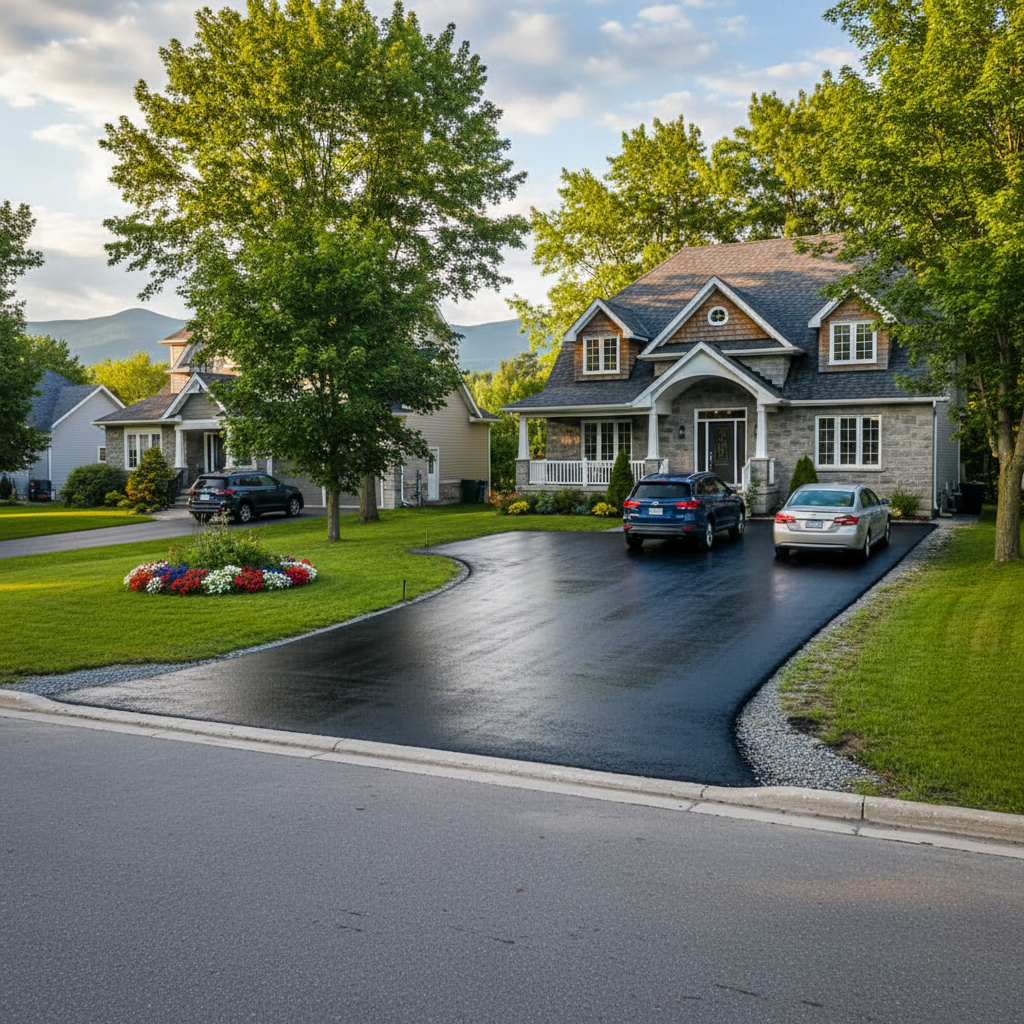
Driveway paving options and costs in Cardston
Cardston homeowners typically choose their driveway surfacing based on budget first, then on how well the surface handles Cardston winters. With single-detached houses making up about 85.3% of dwellings and about 73.8% of households owning their homes (Statistics Canada, 2021 Census), there’s a steady demand for private driveway work on the edges of town where winters are tough. In the Lethbridge–Medicine Hat economic region, pricing is driven by frost depth and frequent freeze–thaw cycles, so the lowest “sticker price” often isn’t the lowest lifetime cost. Asphalt contractors in this region plan around a narrower paving season—hot-mix asphalt generally needs warm air temperatures to place and compact properly—so spring scheduling can tighten and labour rates can stay firm.
If your driveway is in an area with heavier clay or you’ve noticed pumping/soft spots after thaw, you’ll usually see higher excavation and granular base costs. Basements, buried services and driveway subgrades also tend to be built on older lots; since about 58.3% of homes were built before 1981 (Statistics Canada, 2021 Census), many driveways in mature neighbourhoods around the downtown core and older residential blocks have legacy drainage issues that must be corrected before a new surface goes on. That “prep-first” approach is what keeps asphalt from heaving and cracking early.
Below is a realistic installed pricing comparison for standard residential driveway sizes. Use it to sanity-check quotes before you compare details like base depth, disposal, and edge restraints.
| Material |
Lifespan |
Maintenance |
Best For |
Price per sq ft |
Price Range |
| Asphalt (new installation, proper base) |
15–25 years |
Seal every 3–5 years |
Cost-effective, smooth ride with good longevity when base and drainage are done right |
$3.50–$6.00 |
$6,000–$12,000 |
| Asphalt (overlay on existing gravel base) |
10–18 years |
Seal every 3–5 years; monitor edges for moisture |
When existing base is stable and only needs improvement, not full reconstruction |
$3.00–$5.50 |
$5,500–$10,500 |
| Interlocking concrete pavers |
25–35 years |
Occasional re-sanding; replace individual stones if needed |
Curb appeal and easy spot repairs (especially where future driveway access changes may occur) |
$7.00–$12.00 |
$9,000–$18,000 |
| Poured concrete (broom finish) |
20–30 years (with air-entrainment and correct base) |
Light cleaning; seal if you want stain/ice-buildup resistance |
Low-maintenance, firm surface with a clean look |
$6.00–$11.00 |
$8,000–$16,000 |
| Exposed aggregate concrete |
20–30 years |
Seal as recommended by installer; re-seal every few years in winter |
Higher traction and a decorative finish |
$7.00–$13.00 |
$9,000–$17,500 |
| Gravel / crushed stone (budget option) |
3–8 years (depends on drainage and grading) |
Re-grade annually; top up each season |
Short-term solution or where budgets are tight before a full paving project |
$2.00–$3.50 |
$3,000–$6,500 |
Prices are estimates only and vary by project scope, site access and material selection.
What affects the price of paving in Cardston
In Cardston and the wider Lethbridge–Medicine Hat area, you can see quotes for the “same” driveway swing by 30–50% because the expensive part is usually what you can’t easily see: subgrade condition, frost protection depth, drainage correction and how much old material must be hauled away. In Alberta’s colder zone, frost depth in the 6 ft range means contractors design the granular base and underdrain approach to resist frost heave and water migration. If your contractor assumes a shallow base on a wet or clayey lot, you’ll pay later through cracking, raveling and patchwork.
Another pricing driver is the paving season. Hot-mix asphalt typically requires air temperatures above 10°C for proper placement and compaction, so late-spring and early-fall scheduling concentrates demand. That’s why an asphalt job in Cardston that can only be scheduled around a narrow weather window may price closer to the top end of the region’s asphalt band (for example, the installed range commonly lands in the $6,000–$12,000 neighbourhood depending on prep). On the concrete side, air-entrainment and correct base build-up also matter—concrete that isn’t designed for freeze–thaw costs less upfront but often fails earlier.
Two concrete examples from Cardston that commonly move costs up: (1) driveways with poor drainage or standing water often need undercut and re-fill plus a corrected slope, which adds excavation and haul; (2) driveways on older lots built before 1981 frequently have settlement or buried service conflicts, requiring additional base reconstruction. Costs can also come down when your existing base is already well-drained and stable, allowing an asphalt overlay rather than full reconstruction—sometimes putting you closer to the lower end of the asphalt range.
| Price Factor |
Why It Matters |
Cost Impact |
| Driveway area in sq ft |
Most materials and paving time scale directly with square footage |
High (often the largest portion of the total) |
| Base depth required |
Frost line drives granular thickness and compaction needs to prevent heaving |
Medium–High (can add substantial excavation/aggregate) |
| Grading and drainage work |
Correct slope and manage runoff to keep water from migrating into the base |
Medium (more if underdrains or re-grading are needed) |
| Tear-out of existing surface |
Breaking/hauling old asphalt or concrete increases labour and disposal costs |
Medium–High (especially for concrete tear-out) |
| Edge restraints and curbing |
Prevents paver spread and asphalt edge raveling under freeze–thaw |
Medium (often required for longevity) |
| Sealing requirement |
Asphalt performs better when sealed after cure (commonly 6–12 months) and then periodically |
Low–Medium (small line item that protects the main investment) |
| Site access |
Narrow lots slow equipment movement and can increase time for stockpiling |
Low–Medium (higher on constrained sites) |
| Asphalt mix specifications |
Freeze–thaw-rated mix costs more and supports longer service life in cold winters |
Medium (material upcharge) |
Permits & regulations in Alberta
For most Cardston homeowners, paving a driveway within your own property typically does not require a building permit. The usual “no-permit” work includes removing and replacing asphalt or concrete on your driveway surface, rebuilding your granular base on private land, and adding standard base and surface layers—provided you are not changing how stormwater is conveyed across property or interfering with municipal infrastructure.
Permit and approvals typically are required when you work within the municipal right-of-way. That can include creating or modifying a curb cut/apron where it connects to the street, changing boulevard grading, or altering storm drainage patterns tied to the public system (for example, work that changes flow paths or directs runoff differently than existing drainage provisions). Also, some areas have lot-grading rules that restrict how close a hard surface can be to certain property features or drainage swales, so it’s smart to confirm local lot-grading bylaws before excavation.
Step-by-step, Cardston homeowners should:
- Call for utility locates before any digging (Alberta One-Call) and ensure the contractor coordinates with the locate marks.
- Ask for the contractor’s current Alberta business/contractor registration info (if applicable), then verify their licence details through the relevant online registry.
- Request a certificate of liability insurance naming you as a certificate holder, and confirm coverage remains active through completion.
- Confirm workers’ compensation coverage (WSIB/WCB as applicable) with a clearance letter or proof of registration.
- If any work touches the curb/boulevard/drainage, ask whether the municipality requires an approval before starting.
Asphalt vs pavers vs concrete for Cardston driveways
For Cardston driveways, the right material depends on how you trade upfront cost against winter performance and repair flexibility. Asphalt is usually the lowest upfront option and often lands within the asphalt band of $6,000–$12,000 when the base and drainage are done properly. The trade-off is that asphalt should be sealed after the initial cure (commonly after 6–12 months) and then resealed every 3–5 years to protect against surface oxidation from freeze–thaw and moisture. Interlocking concrete pavers are typically the highest upfront, but they offer the best curb appeal and the advantage of replacing individual stones if a localized frost-heave or settlement issue shows up later. Poured concrete sits in the middle on price, but it can crack in Alberta winters if the base isn’t built for frost and if the concrete isn’t properly air-entrained and finished.
Because frost penetration in this region is commonly designed around the 6 ft range, all three options must start with a robust granular base and good drainage so water doesn’t sit under the surface. If you get winter maintenance like snowplowing and sand/ice control, pavers usually tolerate routine impacts well because the surface is modular. Asphalt can be smooth and durable, but edges and joints need restraint to prevent raveling, and sealing matters for traction and crack resistance. Concrete can perform very well when air-entrained and built to specification, but in poor drainage conditions it may develop freeze–thaw cracking sooner than asphalt that’s been sealed and maintained.
A practical pricing example: if an asphalt driveway quote comes in near $7,500–$9,500, moving to pavers might add several thousand dollars (often trending toward $9,000–$18,000 total). That difference is justified when you care about curb appeal, want repairable sections, and expect your area to experience moisture/settlement near the driveway edge.
| Material |
Frost Resistance |
Curb Appeal |
Repair Method |
Lifespan |
Price Band |
| Asphalt (sealed regularly) |
Good with deep, well-compacted base and drainage; requires sealing |
Moderate (clean, uniform finish) |
Patch locally and mill/overlay when needed |
15–25 years |
$6,000–$12,000 |
| Interlocking concrete pavers |
Very good when set over correct base and restrained |
High (pattern and colour options) |
Replace individual pavers; re-sand joints |
25–35 years |
$9,000–$18,000 |
| Poured concrete (air-entrained) |
Good with air-entrainment and correct base drainage |
Moderate to High (clean broom finish) |
Slab repairs and patching; full replacement if heavily cracked |
20–30 years |
$8,000–$16,000 |
| Exposed aggregate concrete |
Good with correct base and curing |
High (decorative finish) |
Patch and replace sections; matching finish matters |
20–30 years |
$9,000–$17,500 |
| Permeable pavers (drainage grid) |
Very good where designed for site drainage; performance depends on soil/underdrain design |
High (modern look) |
Replace blocks and maintain drainage components |
20–30 years (site-dependent) |
$10,000–$20,000 |
| Chip seal / tar-and-chip |
Moderate; needs correct base and may wear with heavy turning traffic |
Low to Moderate |
Spot patch and re-chip/refresh |
7–12 years |
$5,000–$10,000 |
How to choose a paving contractor in Cardston
Choosing a contractor in Cardston is mostly about verifying documentation and then matching the quote to the actual site conditions. Start by confirming the contractor is properly set up in Alberta: ask for proof of liability insurance (certificate of insurance should be current) and workers’ compensation coverage (WSIB/WCB proof or clearance letter, as applicable). Next, verify their registration/licensing details through the appropriate Alberta online registry and request an “active” status screen or documentation you can keep for your records.
Then get 2–3 itemised written quotes, ideally with a labour-and-materials breakdown rather than one lump-sum number. Make sure the scope includes base preparation (excavation depth, granular material type, compaction method), drainage/grading corrections, and disposal of removed material. Clarify what’s excluded: does the price include saw cuts for concrete, removal/replace of edge restraints, utility relocation coordination, and any permit or municipal approval work if curb/boulevard impacts occur?
Warranty also matters. Look for a workmanship warranty length in writing, and ask whether the manufacturer warranty on asphalt mix, paver materials, or concrete products is included and whether it’s transferable to you. Finally, protect your cashflow: don’t pay more than about 10–15% upfront, and use a holdback until the job is complete and any final cleanup/deficiencies are corrected. For timelines, ask for a written start date and completion estimate—weather-driven delays are common in Alberta, but the contractor should still give a schedule and contingency plan.
- Confirm liability insurance and that the certificate includes your address as certificate holder (where offered).
- Verify workers’ compensation coverage and request the clearance letter/proof.
- Check Alberta registration/licence details before signing anything.
- Get 2–3 itemised quotes with base depth, materials and disposal listed.
- Ask how they’ll test/confirm compaction and base thickness.
- Ensure drainage/grading changes are explicitly included (not “allowance”).
- Confirm edge restraints/curbing are included for pavers/asphalt edges.
- For asphalt, confirm the plan for sealing: timing and who supplies the sealant.
- For concrete, confirm air-entrainment and finishing method (broom vs exposed aggregate).
- Ask whether crack control joints (for concrete) are included and where they’ll be placed.
- Review the warranty: workmanship duration, exclusions, and claim steps.
- Use a payment schedule with a holdback until you approve final grade and cleanup.
Red flags to watch for in Cardston: contractors who won’t provide itemised scope; no proof of insurance or workers’ compensation; vague base specs (no depth, no compaction description); starting excavation before utility locates are marked; and quotes that don’t clearly address drainage corrections or tear-out/disposal costs.
Frequently asked questions — paving in Cardston
Can asphalt be laid in cold weather in Cardston?
In Cardston and across southern Alberta, asphalt paving is generally limited by temperature and moisture conditions because hot-mix asphalt needs workable air temperatures to be placed and compacted. If it’s too cold or windy such that the mat cools quickly, you risk poor compaction and weak asphalt, which can show up as premature cracking during the region’s freeze–thaw cycles. A contractor should also account for frost risk in the subgrade and granular base—if the base is frozen or saturated, you’ll get instability regardless of the mix. That’s why many jobs that start too early in spring get postponed, even if materials are on hand. For homeowners, plan for weather windows rather than fixed calendar dates, and expect the best results when crews can keep consistent temperatures during paving and rolling.
What is a driveway apron and do I need one in Cardston?
A driveway apron is the section that transitions from your driveway surface to the street edge—often involving a connection at the curb line or where the driveway meets municipal frontage. In Cardston, whether you “need” an apron depends on what exists today and whether you’re changing the approach to the road. If you’re widening, regrading, or altering how runoff flows near the curb cut, that work can require municipal approval since it affects the street/right-of-way connection and storm drainage behaviour. If your contractor proposes a full surface replacement but ignores the apron/transition area, it can lead to edge breakdown or water pooling at the weakest point. When you request a quote, ask specifically what they’re doing at the street connection and confirm whether approvals are needed before excavation.
How do I maintain my driveway through Cardston winters?
Winter maintenance is mostly about preventing trapped moisture and reducing surface stress from plowing and de-icing. In Cardston’s freeze–thaw environment, avoid piling snow directly on asphalt or concrete edges for long periods; water from melting snow can wick downward, especially if your base has any weak drainage. For asphalt, sealing is one of the most practical protections: you typically seal after the driveway cures (often after 6–12 months) and then re-seal every 3–5 years, which helps slow oxidation and reduces water penetration. Use sand/traction products rather than high-salt applications when possible, since excess salt and brine can accelerate concrete surface deterioration. For pavers, keep joints from washing out and re-sand if you notice gaps. The biggest “do this yearly” step is watching drainage—if water sits, address grading or improve run-off paths early.
Is it worth sealing a new driveway right away in Cardston?
For asphalt, sealing “right away” in Cardston depends on when the asphalt is fully cured. Most reputable crews wait until the mat has cooled and the surface has stabilized so you don’t trap moisture or interfere with proper oxidation. A common approach is to plan sealcoat after about 6–12 months, then maintain with reseals every few years based on traffic and winter conditions. If you’re budgeting, sealing is typically a much cheaper protective step compared to full repairs later—and it can help your driveway stay in the “top end” of its expected lifespan. As a pricing reference, many installed asphalt driveways in this region fall around $6,000–$12,000, and sealing is a small fraction of that cost. If your contractor recommends immediate sealing, ask for the curing timeframe and what product system they’re using.
What is a chip seal driveway and is it suited to Cardston?
Chip seal (also called tar-and-chip) is a sprayed asphalt binder topped with aggregate. It’s designed to provide a durable surface at a lower cost than full asphalt paving, but it’s generally not as smooth or as long-lived as thicker asphalt or concrete when traffic and turning stresses are higher. In Cardston, chip seal can be suited to low-to-moderate traffic driveways, especially where you can maintain the surface during the early seasons and you have a solid base and drainage underneath. If your property has clay or tends to hold water, the base preparation becomes even more important—otherwise freeze–thaw can loosen aggregate and lead to raveling. If you’re looking at a budget path, compare the total expected service time against asphalt. For instance, asphalt installations commonly land in $6,000–$12,000, while chip seal is often cheaper upfront but may need refresh sooner.
How much does driveway crack repair cost in Cardston?
Crack repair pricing in Cardston depends on crack width, length, and whether the base has movement (which is common to check in freeze–thaw climates). Small, isolated cracks can be cleaned and sealed, while wider or “working” cracks may need routing and patching so the repair lasts through Alberta winters rather than breaking again right away. Sealing and repair is commonly a modest line item compared to resurfacing—typical ranges in this market are around $300–$2,500 depending on scope. If the driveway is older and cracking is widespread, a patch-only approach may not be cost-effective; a contractor might recommend localized asphalt patching or an overlay instead. When you get a quote, ask whether they’re sealing only the surface crack or also checking for moisture and base issues, since drainage-related cracking will come back if the underlying cause isn’t addressed.