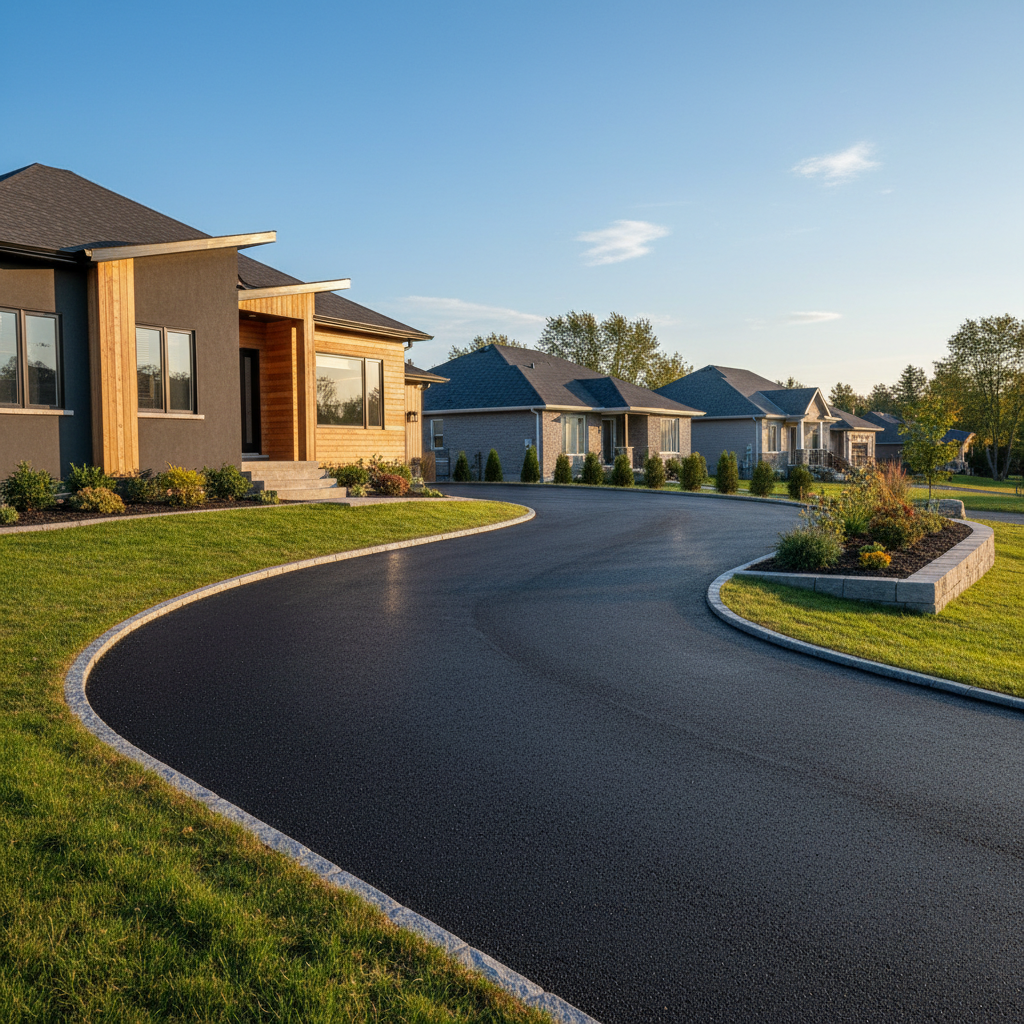
Driveway paving options and costs in Ballantrae
Ballantrae homeowners usually choose between asphalt, interlocking pavers, and concrete based on upfront budget, winter performance, and curb appeal. With Ballantrae’s population at 3,223 (Statistics Canada, 2021 Census), the market is smaller than Toronto proper, so contractors often prioritize established neighbourhood routes—but a busy summer still brings schedule pressure. In practice, many private driveways here are tied to single-family homes, so driveway sizing and base conditions can swing a job’s cost more than the surface finish alone.
In the Toronto economic region, frost depth and freeze–thaw cycles are the main cost drivers. Ground freezing to roughly 3–4 feet means driveways need a deeper, well-compacted granular base and reliable drainage so water can’t sit under the pavement and cause heaving and cracking. The paving season is effectively late spring through early fall, because hot-mix asphalt placement depends on suitable air/soil temperatures. That shorter workable window can push pricing toward the higher end of the asphalt band, especially for spring starts and quick turnarounds.
Because Ballantrae sits within the same broader demand zone as Markham/Vaughan-type rush periods, jobs in the heart of the community—like the residential stretches closer to the Ballantrae Village area—tend to book earlier. The good news is you can control much of your final cost by locking in scope details (base depth, drainage corrections, and haul-away) up front. Use the comparison table below to line up materials and typical price ranges, then match the option to your winter routine and maintenance comfort.
| Material |
Lifespan |
Maintenance |
Best For |
Price per sq ft |
Price Range |
| Asphalt (new installation, proper base) |
15–25 years |
Seal every 3–5 years; patch as needed |
Best balance of cost and performance with the right base |
$6.50–$12.50 |
$3,500–$8,000 |
| Asphalt (overlay on existing gravel base) |
10–18 years |
Seal every 3–5 years; more frequent patching if base is weak |
When you want a faster upgrade without full tear-out |
$7.00–$13.50 |
$4,200–$7,800 |
| Interlocking concrete pavers |
25–40 years |
Regular sweeping; occasional joint sand top-up |
Maximum curb appeal; repairs can be localized |
$14.00–$22.00 |
$9,000–$20,000 |
| Poured concrete (broom finish) |
25–35 years |
Minor patching; seal if desired for stains/salt protection |
Clean look; good winter durability with proper design |
$10.50–$18.00 |
$6,000–$15,000 |
| Exposed aggregate concrete |
20–35 years |
Sealer optional; periodic cleaning |
Non-slip finish and upgraded aesthetics |
$12.50–$20.00 |
$7,500–$16,500 |
| Gravel / crushed stone (budget option) |
3–10 years |
Top up and re-grade; weed control |
Lowest initial cost; temporary or low-use driveways |
$3.00–$6.50 |
$1,500–$5,000 |
Prices are estimates only and vary by project scope, site access and material selection.
What affects the price of paving in Ballantrae
In Ballantrae and across the Toronto region, it’s common to see quotes for the same driveway swing by 30–50%. The difference usually isn’t the surface material—it’s what happens underneath: excavation quantities, base depth, drainage corrections, haul-away, and whether the contractor is properly engineering for frost. Two driveways can look identical from the road, yet one may need additional granular thickness and subgrade stabilization to handle 3–4 feet of seasonal freezing, while the other stays near the minimum.
Frost line depth and freeze–thaw cycles are decisive cost factors in this area. Deeper frost requires a thicker compacted granular base (in Ontario we’re typically talking about deeper engineered granular thickness to resist heaving), plus better drainage so water doesn’t migrate under the asphalt or concrete. If water sits under the slab or pavement, it expands when it freezes and can translate into cracking, pumping fines, and early failures—especially after winter de-icing and repeated plowing.
The paving season also concentrates demand. Hot-mix asphalt is best placed when temperatures are reliably suitable, so late spring and summer schedules get tight and labour rates rise. That’s one reason good asphalt installs often land from the mid to upper end of the $3,500–$8,000 band, while rush or tight-access jobs can creep upward. Concrete can also vary: an air-entrained design and proper jointing help manage movement, but more prep work (like raising low spots, improving slope, or correcting drainage) can add significant labour. For pavers, curb restraint and edge detailing often determine whether the interlock stays tight through winter; skipping restraint is a common source of costly rework later. A typical budget shift might look like moving from a basic asphalt install toward a properly engineered job that justifies the higher end of the asphalt band, or choosing pavers in the $9,000–$20,000 range when you want easy, localized repairs.
| Price Factor |
Why It Matters |
Cost Impact |
| Driveway area in sq ft |
Most materials and machine time scale directly with square footage |
High (often the biggest single driver) |
| Base depth required |
Frost protection depends on engineered granular thickness and compaction |
High (extra excavation + hauled-in stone) |
| Grading and drainage work |
Proper slope and drainage prevent water migration under the pavement |
Medium to High |
| Tear-out of existing surface |
Breaking, hauling and disposal of old asphalt or concrete add labour |
Medium to High |
| Edge restraints and curbing |
Prevents paver spread and keeps asphalt/concrete from shifting |
Medium |
| Sealing requirement |
Asphalt should be sealed after curing to slow moisture and oxidation |
Low to Medium (adds a future line item) |
| Site access |
Narrow driveways slow equipment movement and can increase labour time |
Low to Medium |
| Asphalt mix specifications |
Freeze–thaw-rated mixes and correct binder help performance in Ontario winters |
Low to Medium (but can prevent premature failures) |
Permits & regulations in Ontario
In Ontario, paving a private driveway within your own property typically does not require a building permit. Where homeowners must be more careful is when work touches the municipal right-of-way or affects drainage and grading beyond your lot lines. New curb cuts, changes to boulevard paving/approaches, or alterations to storm drainage (such as adjusting catch basins or directing runoff in a way that impacts municipal systems) usually require municipal approval. Some municipalities also have lot-grading rules that restrict how close a hard surface can be to property lines and how drainage must be managed—so it’s worth confirming local lot-grading bylaws before work starts.
Step 1: Call utility locates before any excavation. In Ontario, use Ontario One Call so underground services are marked—especially important for driveways that may intersect service lines. Step 2: Ask your contractor to provide their insurance documentation and proof they are eligible to work in the scope proposed. Step 3: Confirm whether a permit or municipal approval is needed for your exact location (for example, anything affecting curb/sidewalk/boulevard or storm drainage). If your quote references only “private driveway paving,” ask them to clarify whether curb cuts or drainage adjustments are included.
To verify Ontario compliance, check three things: (1) licence/registration—ask for the relevant Ontario contractor details and confirm eligibility through appropriate public business listings or registries available to homeowners; (2) liability insurance—request a certificate of insurance naming you and the project (where applicable) as additional parties if your contract allows; and (3) WSIB/WCB coverage—request proof of clearance or current account status before work begins. A reputable contractor can provide these without hesitation.
Asphalt vs pavers vs concrete for Ballantrae driveways
For Ballantrae’s freeze–thaw climate, asphalt, interlocking concrete pavers, and concrete can all perform well—but they do it differently, and the maintenance routine matters. Asphalt usually has the lowest upfront cost, but it relies on ongoing care: proper curing and sealing every 3–5 years to slow moisture intrusion and oxidation. Interlocking concrete pavers cost more upfront, yet they’re typically the easiest to repair locally—if you have a driveway section that heaves slightly, you can remove and relay just that area instead of replacing an entire slab. Poured concrete often lands in the mid-range and can look great, but it needs the right air-entrainment and jointing strategy to manage movement and reduce freeze-thaw and salt-related surface scaling.
In the Toronto region, base preparation is non-negotiable because frost can reach roughly 3–4 feet. Every option needs reliable drainage: adequate slope away from the foundation, clean edges, and a granular base that’s properly compacted so water doesn’t sit under the surface. Asphalt and concrete are more sensitive to trapped water; pavers are more forgiving because joints allow a bit of movement, but they still need correct bedding and restrained edges.
Winter maintenance also plays a role. If you plow regularly and use de-icing, choose systems designed to handle it. Concrete without proper air-entrainment or poorly jointed slabs can crack sooner, while asphalt that isn’t sealed can oxidize and ravel. A realistic way to justify the difference: if you’re comparing an asphalt driveway near the middle of the $3,500–$8,000 band versus pavers in the $9,000–$20,000 range, pavers are worth it when curb appeal and “repair without full replacement” are priorities—especially on driveways that may need utility access or where localized fixes are likely over time.
| Material |
Frost Resistance |
Curb Appeal |
Repair Method |
Lifespan |
Price Band |
| Asphalt (sealed regularly) |
Good with engineered base and drainage |
Good (clean, uniform finish) |
Mill/patch localized areas |
15–25 years |
$3,500–$8,000 |
| Interlocking concrete pavers |
Very good when bed + restraints are engineered |
Excellent (varied colours/patterns) |
Remove and re-lay the affected zone |
25–40 years |
$9,000–$20,000 |
| Poured concrete (air-entrained) |
Good with proper mix + joints |
Good (clean, monolithic look) |
Patch or slab replacement if severely cracked |
25–35 years |
$6,000–$15,000 |
| Exposed aggregate concrete |
Good with air-entrained mix and sealing |
Excellent (texture + slip resistance) |
Localized repair limited; often patch blends |
20–35 years |
$7,500–$16,500 |
| Permeable pavers (drainage grid) |
Very good for water management when engineered |
Very good (modern look) |
Lift/re-lay sections; clean-out as needed |
20–35 years |
$10,000–$22,000 |
| Chip seal / tar-and-chip |
Moderate (depends heavily on prep) |
Fair (more utilitarian) |
Spot re-chip or re-surface |
7–12 years |
$3,000–$6,500 |
How to choose a paving contractor in Ballantrae
Choosing a paving contractor in Ballantrae starts with verifying credentials in Ontario. First, confirm liability insurance: ask for a current certificate of insurance and ensure it covers the kind of work being quoted (excavation, asphalt/paver installs, concrete work if applicable). Next, verify WSIB/WCB coverage—request proof of clearance or current status before scheduling begins. Third, validate their Ontario eligibility to do the work: ask for the business registration details and confirm they’re in good standing through the appropriate public listings available to homeowners.
Then, get 2–3 itemised written quotes, not just a lump sum. A proper quote breaks out labour and materials (excavation, granular base, geotextile if used, asphalt thickness/grade, paver bedding/sand, curb restraints, and concrete finishing). Ask what’s included in disposal and haul-away—especially if tear-out is required. Also check whether permits (if your project triggers municipal approval) are included or excluded.
Warranty matters in Ontario’s freeze–thaw environment. Ask for a workmanship warranty length and what it covers (settlement, base failure symptoms, edge restraint issues). Clarify whether the warranty is tied to the property or transferable to future owners. In payment terms, don’t allow large deposits: keep upfront payment typically to 10–15% and use a holdback until completion and final cleanup are done. Finally, get an agreed start date and a realistic completion estimate in writing, since spring scheduling delays are common when weather tightens the paving window.
- Confirm liability insurance with valid coverage dates.
- Provide WSIB/WCB proof (clearance or current status) before work starts.
- Ask for a written scope that states exact surface thickness and base build-up.
- Verify drainage details: slope, edge drains (if needed), and where water goes.
- Make sure excavation depth and compaction expectations are stated.
- Confirm whether geotextile is included (or why it’s not needed).
- Check edge restraints/curb details are included for pavers and asphalt transitions.
- For asphalt, confirm when sealing is scheduled (after curing, often 6–12 months later).
- Confirm disposal/haul-away is included for tear-out debris.
- Ask who will protect landscaping, garage doors, and adjacent surfaces.
- Insist on a start date and completion timeline in the contract.
- Use a payment schedule with a holdback until final grade, cleanup, and punch-list items are done.
In Ballantrae, common red flags include: quoting asphalt or concrete without specifying base depth and compaction, refusing to provide insurance/WSIB proof, bundling “site prep” as an unclear lump without drainage details, offering a very low price that assumes no tear-out or no haul-away, and asking for a large upfront payment with no holdback until completion.
Frequently asked questions — paving in Ballantrae
Do I need a permit to pave my driveway in Ontario?
Usually, paving a private driveway within your own property in Ontario does not require a building permit. Where permits/approvals often come into play is when the work affects the municipal right-of-way—think new curb cuts, changes to the boulevard/approach, or any alteration to storm drainage that impacts municipal systems. Some areas also have lot-grading rules, which can restrict how grading and hard surfaces are placed near property lines and how water must flow. In Ballantrae, the most practical step is to confirm with your contractor whether the scope stays entirely within your property limits, and to ask if any municipal approval is required based on your driveway location. If excavation is happening, make sure Ontario One Call utility locates are completed before anyone digs.
How long before I can drive on new asphalt?
After asphalt placement, you’ll typically be able to drive on the driveway once the surface has cooled enough to prevent rutting and tracking—often the same day or within about 24 hours, depending on temperature, thickness, and weather conditions. In Ballantrae, late spring and early fall can swing quickly with overnight chills, so contractors usually plan roller passes and cooling time to keep compaction correct. Even if you can drive soon, treat the surface more carefully for the first days: avoid sharp turns, heavy loads, and parking in one spot while it’s still tender. Sealing is a separate step; for asphalt, most homeowners should plan for sealing after curing—often in the 6–12 month window. Budget-wise, asphalt driveway installs commonly fall within the $3,500–$8,000 band depending on size and base work.
What causes potholes and how are they repaired?
Potholes in Ontario are usually caused by water. When freeze–thaw cycles repeatedly infiltrate weak spots—whether from poor drainage, insufficient base, or cracks that let water in—the pavement can loosen and break down. In Ballantrae’s climate, winter de-icing and frequent temperature swings accelerate the process if the subgrade isn’t well-prepared. Repairs generally start with inspection: the crew should remove failed asphalt down to stable material, clean out the base, and then re-compact granular layers before placing asphalt in lifts. “Skin patching” over weak material is a common failure. A proper repair targets the underlying void and restores thickness, not just the surface crater. If your driveway shows widespread cracking or base problems, an overlay or full re-install may be more cost-effective than repeated patching.
How do I prepare for a paving project?
Preparation reduces delays and helps your final price match the estimate. First, clear the driveway and gate access so equipment can reach the work area safely. Identify any items that must move—cars, basketball hoops, planters, or storage bins. Next, mark any sprinkler heads, buried lights, or landscaping you want protected. Make sure you coordinate with the contractor for utility locates if excavation is required (Ontario One Call). Before work starts, confirm the scope in writing: base depth, grading/slope corrections, tear-out and disposal, and edge restraints. If your quote includes sealing for asphalt, ask when that sealing is scheduled and what the conditions are. Finally, plan for spring schedule constraints in the Toronto region: crews often book limited prime dates because the asphalt paving window is shorter in colder weather.
How do I compare paving quotes fairly?
Compare quotes by apples-to-apples scope, not just total price. Ask each contractor for itemised breakdowns: excavation quantity/footage, granular base thickness and compaction approach, asphalt mix specifications (freeze–thaw-rated), concrete air-entrainment and jointing notes, and paver bedding/sand and restraint details. Confirm tear-out is included if you need to remove existing asphalt or concrete, and verify haul-away/disposal is part of the price. Pay attention to drainage—if one quote ignores slope corrections or underestimates grading, it can look cheaper but fail early in freeze–thaw conditions. Also compare warranty terms and workmanship coverage. If you’re choosing asphalt, look at where bids land within the typical $3,500–$8,000 band; if quotes are dramatically below, ask what they’re excluding. In Ballantrae, tight summer scheduling can also affect pricing, so prime-date timing should be consistent across bids.
Can asphalt be laid in cold weather in Ballantrae?
Asphalt can’t be installed the same way in deep cold, because hot-mix placement requires suitable air and surface temperatures for proper compaction and bond. In Ballantrae and the broader Toronto area, late fall, winter, and early spring are typically not ideal for new asphalt, because freeze–thaw cycles intensify and the material can cool too quickly to achieve proper density. That’s why the paving season effectively runs from late spring through early fall. If a contractor claims they can place asphalt during cold snaps, ask for specific temperature conditions and placement/compaction controls in their process. For winter-timing work, some companies suggest repairs or temporary solutions, but new asphalt should follow the seasonal guidelines to avoid early cracking and water damage. If you’re budgeting, asphalt installs commonly fall into the $3,500–$8,000 range when scheduled within the workable season.