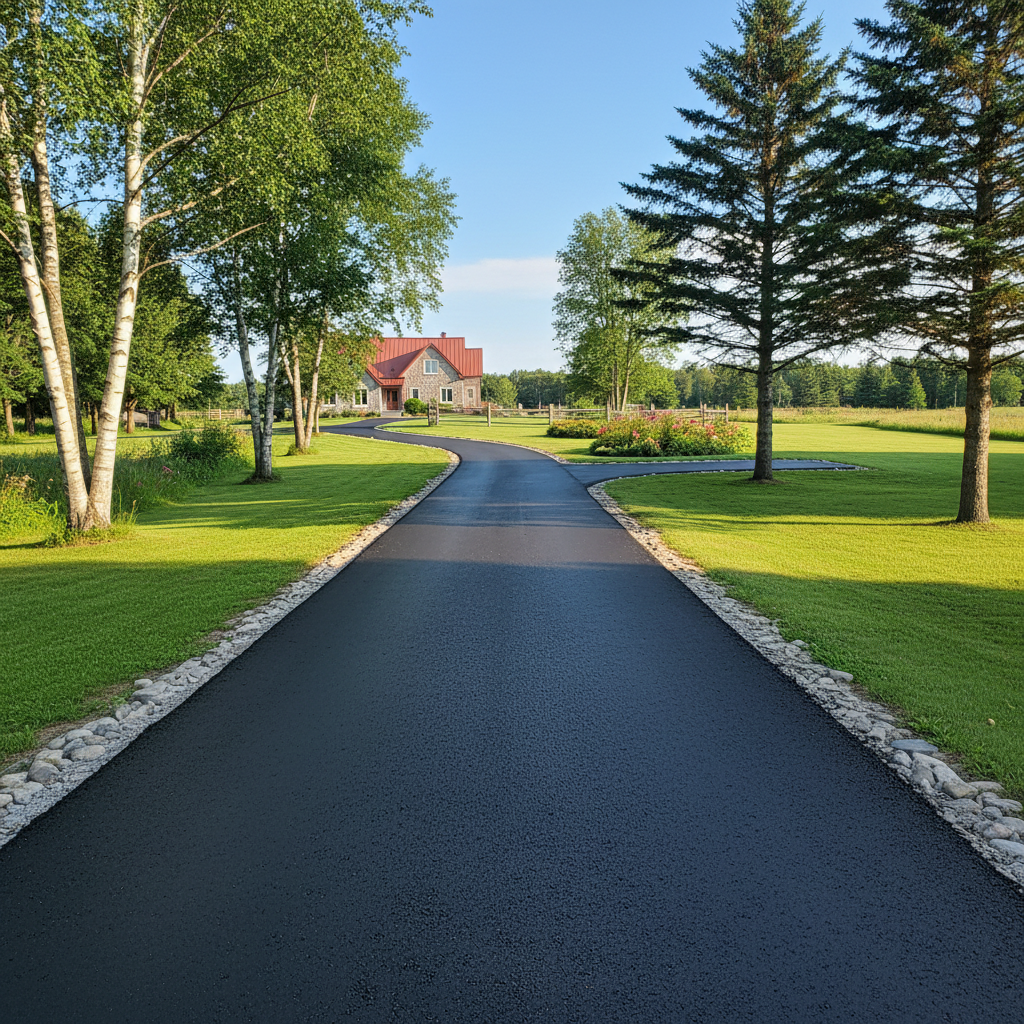
Driveway paving options and costs in Nelson
Nelson is a classic Kootenay community—about 11,106 residents (Statistics Canada, 2021 Census)—and driveways here are typically tied to single-detached homes, since 50.6% of dwellings in the area are that type. That matters because most of the paving work we see is for private driveway surfaces feeding garages and access lanes, not just small residential paths.
In the Kootenay region, frost depth and repeated freeze–thaw cycles are a major cost driver for paved surfaces. Locally, frost penetration is commonly in the 45–60 inch range depending on elevation and micro-climate, so contractors must build a deeper, well-drained granular base. It’s not unusual to need more excavation and import base material than you’d budget for milder parts of BC. Also, Nelson’s paving season runs later in spring and through early fall; shorter weather windows tighten scheduling, which can put upward pressure on pricing even for “standard” jobs.
We also see demand concentrate around older neighbourhoods where many homes were built before 1981 (68.4%): driveways often have aged gravel or failing asphalt that needs a proper rebuild rather than a quick patch. Areas like the downtown core and the hills above it (including parts of Lakeside Drive and the broader Central Nelson area) tend to have lots of driveways with drainage issues—those conditions can increase the amount of grading and base correction required.
Below are realistic cost bands for common Nelson driveway choices, assuming proper base prep and typical residential site access.
| Material |
Lifespan |
Maintenance |
Best For |
Price per sq ft |
Price Range |
| Asphalt (new installation, proper base) |
15–25 years |
Seal every 3–5 years; crack fill as needed |
Lower upfront cost with smooth ride and strong plow tolerance |
$6.50–$10.50 |
$7,000–$13,000 |
| Asphalt (overlay on existing gravel base) |
10–18 years (depends on base) |
Seal and more frequent crack maintenance |
When existing base is sound and only needs topping |
$5.50–$9.50 |
$6,000–$11,500 |
| Interlocking concrete pavers |
25–35 years |
Replace individual pavers; joint sand top-ups |
Curb appeal and easy, localized repairs |
$10.50–$15.50 |
$9,000–$16,000 |
| Poured concrete (broom finish) |
25–30 years (air-entrained) |
Seal periodically; manage surface cracking with good base |
Durability for heavy traffic and clean winter maintenance |
$11.00–$16.00 |
$11,000–$18,000 |
| Exposed aggregate concrete |
20–30 years |
Seal if required by finish; keep joints/edges maintained |
Texture for traction and a premium look |
$13.00–$18.50 |
$12,500–$19,500 |
| Gravel / crushed stone (budget option) |
5–10 years (varies by drainage and maintenance) |
Re-grade and top up; weed control |
Lowest cost access where paving can be deferred |
$4.00–$6.50 |
$3,000–$6,500 |
Prices are estimates only and vary by project scope, site access and material selection.
What affects the price of paving in Nelson
In Nelson (and across the Kootenay region), it’s common to see quotes for the same driveway swing by 30–50% once you break them into excavation, base engineering, drainage corrections, and disposal. Two contractors may both offer “asphalt,” but one may be pricing a true frost-ready rebuild while the other is assuming the existing base and drainage will perform for years—often the difference is what’s happening under the surface.
Frost depth and freeze–thaw cycles are decisive cost factors in the interior. With frost penetration commonly in the 45–60 inch range, Nelson driveways typically need a thicker compacted granular base and consistent compaction in thin lifts to resist heave and cracking. Asphalt and concrete both rely on the base to stay dry; if water migrates into the base during melt, you pay for it in premature failures. Kootenays also face a shorter paving season: hot-mix asphalt generally needs air temperatures above 10°C to place reliably, so demand concentrates into late spring through early fall and schedules tighten—labour and mobilization costs rise.
Concrete pricing can move too. For example, an air-entrained mix and proper curing help reduce freeze-thaw damage; that may add material cost but can prevent the kind of early cracking you see on poorly built slabs. Meanwhile, jobs with significant grading and drainage corrections (a common issue in older neighbourhoods built up over time) can increase total cost even when the surface material is the same. Asphalt projects that need sealing and crack management early are often still competitive; for many homeowners, the difference between a driveway that lands in the $7,000–$13,000 asphalt range versus $11,000–$18,000 concrete reflects the level of base work, edge restraints, and whether the existing structure can be used.
| Price Factor |
Why It Matters |
Cost Impact |
| Driveway area in sq ft |
Material and paving crew time scale directly with surface area |
High (often the biggest driver) |
| Base depth required |
Frost determines granular thickness to prevent heave and cracking |
High; deeper base adds excavation and imported road base |
| Grading and drainage work |
Slope and drainage corrections keep base dry through melt cycles |
Medium to high (adds labour and sometimes extra drainage rock/pipe) |
| Tear-out of existing surface |
Breaking/hauling asphalt or concrete and managing disposal costs |
Medium; can become high on thick slabs or full removals |
| Edge restraints and curbing |
Restraints prevent paver spread and asphalt edge raveling |
Low to medium; crucial for long-term performance |
| Sealing requirement |
Asphalt needs sealing after installation (often within 6–12 months) |
Low to medium (adds future, planned cost) |
| Site access |
Narrow lots and steep grades slow equipment movement and extend setup time |
Low to medium; can raise labour costs |
| Asphalt mix specifications |
Freeze-thaw-rated mixes cost more but perform better in winter cycling |
Medium (material premium) |
Permits & regulations in British Columbia
In British Columbia, most paving on private property can be completed without a building permit—especially when you’re keeping the work within your lot limits and not changing storm drainage patterns. Typically, a new driveway surface, re-surfacing, or replacing an existing driveway on your own property does not require a permit.
Where you need municipal approval is work in the municipal right-of-way (boulevard) or any change that affects municipal infrastructure. That usually includes creating or changing a curb cut, altering boulevard drainage, or connecting or modifying storm drainage features that discharge into the municipal system. Some municipalities also enforce lot-grading bylaws that restrict how close hard surfaces (or fill/grading changes) can come to property lines or how water must be routed off-site.
Step-by-step, here’s how a Nelson homeowner can verify a contractor’s credentials in BC: (1) confirm the contractor’s business listing and licensing/registration information through the appropriate provincial online sources for trades; (2) request a Certificate of Insurance naming you as an additional insured for liability—verify the coverage limits and that it’s current; (3) ask for proof of coverage for workers through the applicable workers’ compensation system (often referred to as WCB in BC) and ensure it’s active; and (4) keep copies of any clearance letters or documentation provided. Before excavation, require utility locates through BC One Call so crews can avoid underground services.
Asphalt vs pavers vs concrete for Nelson driveways
For Nelson driveways, asphalt, interlocking concrete pavers, and concrete can all work—what changes is upfront cost, repair approach, and how well the surface tolerates freeze–thaw cycling and winter maintenance. Asphalt is usually the lowest upfront option, with a smooth ride, but it depends on sealing to protect binder aging. In Nelson winters, when freeze–thaw cycles keep moisture active under the surface, sealing every 3–5 years helps slow raveling and oxidation.
Interlocking concrete pavers typically cost more at the start, but they’re the most flexible when something changes—like a settled utility trench or a localized drainage issue. Individual stones can be lifted and reset without replacing the whole driveway. That’s a strong fit for older Nelson properties where subgrade conditions vary driveway-to-driveway.
Poured concrete (and exposed aggregate) usually lands in a mid-to-higher price bracket and performs well when it’s air-entrained and built on a proper granular base. The base and drainage still matter: if water gets into the subgrade during melt, concrete can crack and heave. With snow plowing and salt/sand combinations common around town, concrete should be properly cured and finished for durability and traction.
In most Nelson projects, the “best” option is the one with the right base and drainage. For example, if you’re comparing a typical asphalt budget that lands in the $7,000–$13,000 range to pavers in the $9,000–$16,000 range, the extra cost can be justified when curb appeal matters or when you want easy spot repairs rather than full-surface replacement later.
| Material |
Frost Resistance |
Curb Appeal |
Repair Method |
Lifespan |
Price Band |
| Asphalt (sealed regularly) |
Good with deep, drained base and freeze-thaw mix |
Medium (clean, dark finish) |
Patch/replacement of sections + sealing |
15–25 years |
$7,000–$13,000 |
| Interlocking concrete pavers |
Very good; resilient when base is compacted and edges restrained |
High (variety of colours/patterns) |
Lift-and-reset individual units; re-sand joints |
25–35 years |
$9,000–$16,000 |
| Poured concrete (air-entrained) |
Good to very good when air-entrained and properly built |
Medium (broom finish) to high (exposed finishes) |
Localized patching; full replacement if widespread |
25–30 years |
$11,000–$18,000 |
| Exposed aggregate concrete |
Good; texture can help traction through winter |
High (premium look) |
Patch with matching surface or grind/pour sections |
20–30 years |
$12,500–$19,500 |
| Permeable pavers (drainage grid) |
Very good for drainage; reduces water pressure in base |
Medium to high (system look) |
Reset units; maintain stone reservoir as needed |
20–30 years |
$10,500–$17,500 |
| Chip seal / tar-and-chip |
Variable; relies heavily on base quality and maintenance |
Low to medium (texture/aggregate appearance) |
Re-aggregate and reseal; patching limited |
7–12 years |
$5,500–$9,500 |
How to choose a paving contractor in Nelson
Choosing the right contractor in Nelson is mostly about verification and clarity before you sign anything. First, confirm British Columbia coverage and documentation. Ask for a current Certificate of Insurance for liability (and confirm it remains active for the entire project). For workers’ protection, request proof of workers’ compensation coverage (WCB) and ensure it matches the company doing the work. Also check that the contractor is set up to operate legally for the scope you need and that they can provide relevant registration details if applicable.
Next, get 2–3 itemised written quotes, not a single lump sum. The best quotes separate labour, base/sub-base materials, haul and disposal, edge restraints, geotextile (if used), and the surface course. Make sure the scope states whether permit work is included (when required), and whether disposal/recycling of the removed asphalt or concrete is included. A good contract also spells out the base thickness expectations—important in Kootenay freeze–thaw conditions.
For warranty, ask: what is the workmanship warranty length, does it include settlement/cracking related to prep, and is it specific to the installation? Product/manufacturer warranties should be clearly differentiated from workmanship. Payment schedule matters too: never pay more than about 10–15% upfront; hold back a portion until the final surface is complete and any punch-list items are addressed. Finally, insist on a written timeline with a start date, weather contingencies, and estimated completion.
- Ask for base design details (typical granular depth and compaction method) matched to frost conditions.
- Require utility locates evidence (BC One Call) before excavation.
- Confirm liability insurance is current; request the certificate and read the limits.
- Verify workers’ compensation (WCB) coverage for the installing crew.
- Get at least 2–3 itemised quotes with line-by-line labour and materials.
- Check what’s included in tear-out and disposal (haul, tipping, recycling).
- Confirm edge restraints/curbing details, especially for pavers to prevent spreading.
- For asphalt, require sealing plan and timing (often after 6–12 months).
- Ask how drainage will be corrected (slope, outlets, and separation from foundations).
- Request a written warranty covering workmanship and specify exclusions.
- Avoid large deposits; keep 10–15% upfront max and hold back until completion.
- Ensure the quote includes cleanup and final grade checks at the end.
Red flags we see in Nelson include: contractors refusing to provide insurance proof, quotes that don’t include base thickness or drainage corrections, “asphalt only” bids when the existing base is clearly failing, very short warranties on workmanship, and wording that leaves tear-out/disposal as “extra” with no unit prices.
Frequently asked questions — paving in Nelson
Asphalt vs interlocking pavers vs concrete — which is best in Nelson?
In Nelson, the “best” choice usually depends on your tolerance for maintenance and how often you want to repair localized areas. Asphalt is the most cost-effective upfront option and can perform very well in our interior freeze–thaw conditions when it’s built on a proper, well-drained base and the contractor uses a freeze-thaw-rated approach. Interlocking pavers typically cost more (often within the $9,000–$16,000 band) but they’re easy to fix if something settles—common on older Nelson properties built up over time. Poured concrete (often $11,000–$18,000) can be very durable when air-entrained and correctly founded. If you plow frequently and want minimum hassle, well-built concrete or asphalt with regular sealing generally fits best; if curb appeal and repairability matter most, pavers usually win.
How long does a paved driveway last in Nelson?
With proper base preparation and drainage in the Kootenays, asphalt driveways commonly last around 15–25 years, while interlocking pavers can reach 25–35 years. Poured concrete typically lasts about 25–30 years when it’s air-entrained and installed with good subgrade support. The local climate plays a big role: repeated freeze–thaw cycles (and seasonal melt water) can shorten lifespan if water isn’t routed away from the base. Nelson also has an older housing stock—68.4% of homes were built before 1981 (Statistics Canada, 2021 Census)—which means some driveways start with inconsistent base conditions. That’s why two “same-size” quotes can differ: longevity is mostly won below the surface.
When is the best time of year to pave in Nelson?
The best time for asphalt and concrete is late spring through early fall, when temperatures are reliably warm enough for proper placement and compaction. Hot-mix asphalt generally needs air temperatures above about 10°C to place correctly, so crews often can’t work effectively in cool shoulder periods. In Nelson, spring melt can also bring saturated ground; rushing base compaction in wet conditions increases the risk of settlement and winter cracking. Scheduling is tighter because the Kootenay paving window is shorter than coastal BC, so it’s smart to book early once you know you want resurfacing or a full rebuild. A good contractor will include weather-based contingencies in writing.
How deep should the base be for Nelson's frost?
Because Nelson sits in a colder interior zone, base depth is driven by frost penetration and the ability to keep the base dry. In many Kootenay driveway rebuilds, contractors target roughly 6–10 inches of compacted granular base for typical residential work, and they may increase thickness where soils are weaker or where drainage corrections require more removal and replacement. Locally, frost penetration is commonly in the 45–60 inch range depending on elevation and micro-climate, but the takeaway for homeowners is simpler: the driveway can’t rely on a shallow “coast-style” base. The right answer also depends on whether you’re going over existing asphalt, existing gravel, or removing an old slab.
How often should I seal my asphalt driveway?
For asphalt installed in Nelson, plan to seal after it has cured—often within a 6–12 month window—then re-seal every 3–5 years depending on traffic, sun exposure, and how harsh the winter season is on your surface. Frequent plowing with sand/salt and the wetting cycle from spring melt can accelerate binder aging if the seal coat isn’t maintained. Sealing doesn’t replace good base prep, but it can significantly slow oxidation and surface deterioration. If your driveway is in the asphalt range of $7,000–$13,000, homeowners often find sealing is a relatively small, predictable addition compared with the cost of a full resurfacing after the asphalt begins raveling. Ask your contractor about the product and timing they recommend for your specific mix.
Why does my driveway crack and heave in winter?
Cracking and heaving in Nelson are usually a moisture and support problem made worse by freeze–thaw cycles. When water migrates into the base or subgrade during melt, it expands as temperatures drop, pushing pavement upward (heave). Repeated cycles then create fatigue cracking, especially near edges where drainage is weaker. In older driveways common around pre-1981 neighbourhoods, the base may have been built shallow or without proper grading, and the drainage path may have shifted over time. Poor edge restraint or insufficient granular thickness can also let the surface move. If you’re seeing heaving, the fix is typically not just patching—it’s correcting drainage and rebuilding the base to frost-ready depth.