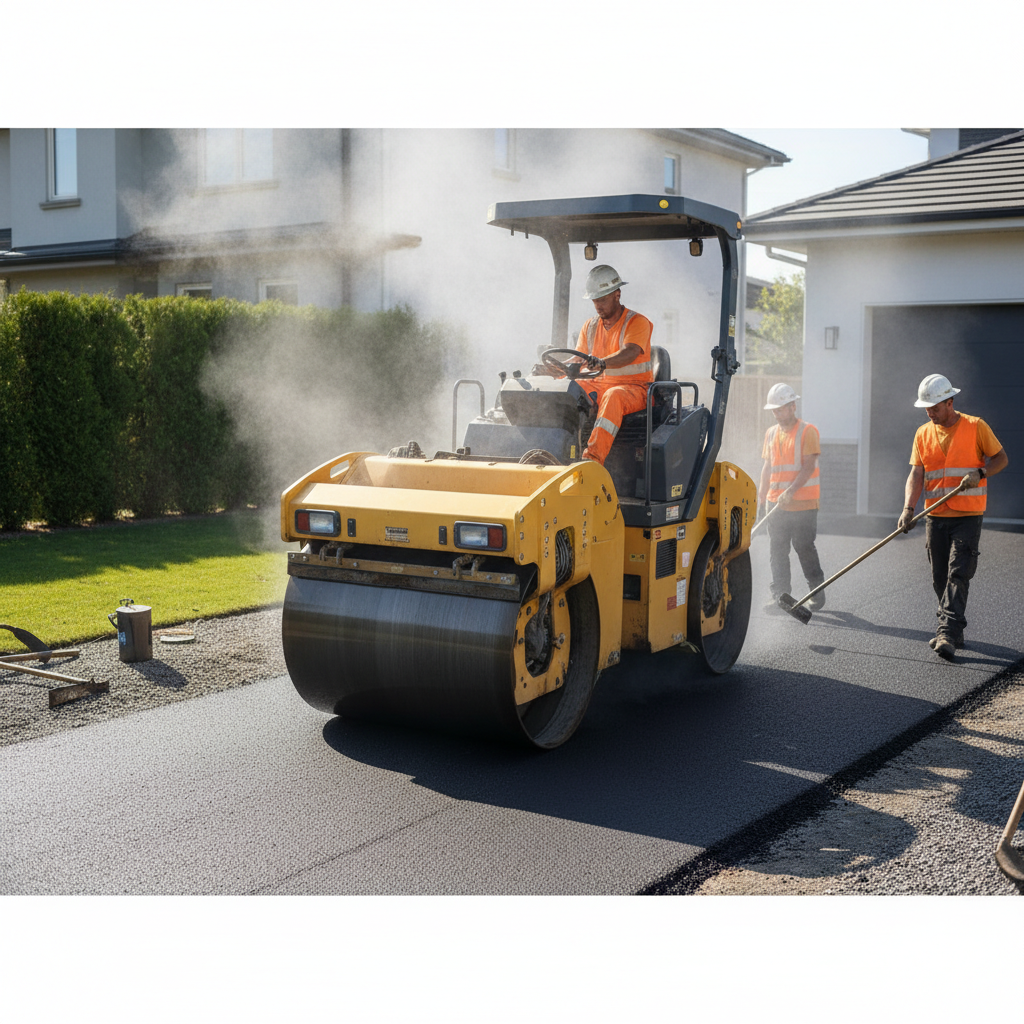
Driveway paving options and costs in Popkum
Popkum homeowners typically choose from asphalt, interlocking pavers, or concrete, and the “right” option usually comes down to how your driveway is built (especially the granular base and drainage) and how much maintenance you’re comfortable with. Popkum is a small community—about 1,710 residents (Statistics Canada, 2021 Census)—so driveways are often tied to owner-occupied housing, where workmanship and longevity matter more than quick cosmetic fixes. In the Lower Mainland–Southwest, where intense rainfall and wet shoulder-season conditions are common, paving costs are driven less by deep frost and more by preventing water from getting into the base. Even though coastal frost penetration is relatively shallow, local practice and sensitive infrastructure assumptions still treat freeze depth as a factor for exposed applications, so we build bases to handle freeze–thaw around that frost line. If your lot has clay-heavy soil or poor surface drainage, you’ll typically see higher prep costs because excavation and proper granular thickness must be increased to control rutting and cracking.
In Popkum, interlocking pavers and asphalt are especially in demand in the areas around the Fraser Valley rural roads where driveways experience heavier yard-to-lane runoff and frequent spring storms. Expect your contractor availability and scheduling to be strong in the milder months, but winter rain and early spring ground saturation can tighten timelines. With that in mind, the table below compares the most common driveway options, typical lifespans, maintenance expectations, and realistic per-square-foot price ranges for Popkum.
| Material |
Lifespan |
Maintenance |
Best For |
Price per sq ft |
Price Range |
| Asphalt (new installation, proper base) |
15–25 years |
Seal every 3–5 years; patching as needed |
Best value where drainage and base prep are done right |
~$12–$20 |
$4,500–$10,000 |
| Asphalt (overlay on existing gravel base) |
10–18 years |
Seal and more frequent spot repairs |
When the existing base is sound and excavation is limited |
~$13–$22 |
$4,000–$9,500 |
| Interlocking concrete pavers |
25–35 years |
Re-leveling/spot replacement; joint sand top-up |
Premium curb appeal and easy localized repairs |
~$20–$40 |
$7,000–$18,000 |
| Poured concrete (broom finish) |
20–30 years |
Crack monitoring; occasional patching |
Low maintenance, straight-line driveway layouts |
~$18–$35 |
$6,500–$15,500 |
| Exposed aggregate concrete |
20–30 years |
Sealer often required for stain control |
Better slip resistance and upscale finish |
~$22–$40 |
$8,000–$18,500 |
| Gravel / crushed stone (budget option) |
3–8 years (depends on drainage) |
Re-top and re-grade yearly in wet seasons |
Short-term/lowest upfront cost |
~$6–$12 |
$2,000–$6,000 |
Prices are estimates only and vary by project scope, site access and material selection.
What affects the price of paving in Popkum
In the Lower Mainland–Southwest, it’s common to see paving quotes for the “same-looking” driveway swing by 30–50% once the scope gets detailed. That’s because the visible surface (asphalt, pavers, or concrete) is only part of the cost—most of the real expense is in what you can’t see: excavation to the right depth, granular base thickness, compaction testing, and drainage corrections. A contractor who allows for proper base build-up and water management will cost more, but you usually avoid the early failures that show up as soft spots, rutting, or cracking after a wet winter. In British Columbia, winter rain and saturated soils can also shorten workable windows, pushing crews to work efficiently and sometimes earlier/late in the season, which affects overhead and scheduling.
Frost line depth and freeze–thaw cycles are decisive cost factors in Popkum, even if we’re not dealing with deep Interior-type freeze. When deeper frost assumptions apply for exposed areas, bases need thicker compacted granular layers (often around 4–6 inches in coastal BC practice for typical driveways, but more if soils are weak or saturated). Repeated freeze–thaw around that shallow frost line, combined with clay-heavy soils in parts of the Fraser Valley, makes drainage and proper granular thickness critical to prevent heaving and cracking. Asphalt mix design must also be freeze–thaw rated; those mixes can increase material cost versus basic mixes.
Concrete can come in lower when your driveway is straightforward (simple rectangular pour), but it rises if you need reinforcement, saw cuts for control joints, and extra subgrade prep. Interlocking pavers can be surprisingly expensive when edge restraints, geotextile, or drainage corrections are required. If you’re comparing price bands, moving from gravel to asphalt usually puts you in the $4,500–$10,000 type range for many residential sites, while pavers can push closer to $7,000–$18,000 depending on excavation and the amount of regrading needed.
| Price Factor |
Why It Matters |
Cost Impact |
| Driveway area in sq ft |
Most line items (base, asphalt/pavers/concrete, labour) scale with surface area |
High—commonly 50–70% of total cost |
| Base depth required |
Freeze-related movement control depends on compacted granular thickness and correct subgrade |
Medium to high—extra inches add up quickly on tight lots |
| Grading and drainage work |
Proper slope and keeping water away from the base reduce rutting and long-term cracking |
Medium—can add major excavation and drainage components |
| Tear-out of existing surface |
Breaking, hauling, disposal, and sometimes subgrade replacement increase labour and equipment time |
Medium to high—especially for old concrete |
| Edge restraints and curbing |
Prevents paver spread and controls asphalt/concrete edges during freeze–thaw cycles |
Low to medium—often a “must do” for lasting results |
| Sealing requirement |
Asphalt performs better when sealed after the proper cure window |
Low—but it affects year-to-year budget |
| Site access |
Slow equipment movement and extra handling of materials increases labour hours |
Low to medium—can become high on narrow lanes |
| Asphalt mix specifications |
Freeze–thaw rated mixes and correct binder content cost more but improve durability |
Low to medium—material premium offsets early failure risk |
Permits & regulations in British Columbia
In British Columbia, paving a private driveway within your own property typically does not need a building permit. However, if your project touches the municipal right-of-way—such as creating or changing a curb cut, altering the boulevard, modifying drainage to connect into municipal infrastructure, or adjusting stormwater flow that impacts the road—municipal approval is often required. Also, some municipalities enforce lot-grading and surface drainage bylaws, which can restrict how close hard surfaces can be to property lines and how runoff must be managed. In Popkum, the key practical step is to confirm your driveway tie-in points (where it meets the lane/road) and whether any grading or drainage changes cross beyond your lot line.
Before excavation, call for utility locates (BC 1 Call) so you don’t hit buried services. Then verify contractor credentials in writing. For British Columbia, check three things: (1) licensing/registration status through the relevant online provincial resources used by contractors for trade credentials, (2) liability insurance with the correct project value listed on the certificate of insurance, and (3) workers’ compensation coverage (WSIB equivalent for BC) so you’re protected if a worker is injured. Ask the contractor for a current clearance letter or proof of coverage and match the insured name to the company doing the work. Finally, request a simple project sketch showing proposed grades and drainage points, which helps you catch permit-relevant scope early.
Asphalt vs pavers vs concrete for Popkum driveways
For Popkum’s Lower Mainland–Southwest conditions—regular heavy rainfall, wet shoulder seasons, and freeze–thaw movement around a shallow frost line—the “best” driveway material is the one that you can build on a stable, well-draining base. Asphalt is usually the lowest upfront option and it’s flexible enough to handle minor movement, but it depends on sealing and good drainage. Interlocking concrete pavers cost more at the start, yet they’re highly repairable: if a section fails due to a localized base problem, you can lift, correct, and reinstall without replacing the whole driveway. Poured concrete is mid-range in many cases, but it’s more prone to cracking if the subgrade prep or jointing isn’t done correctly; in winter, de-icing salt and freeze–thaw cycles can widen cracks over time if the concrete isn’t properly air-entrained.
Base preparation matters across all three. In coastal BC practice, typical residential driveway builds often rely on a compacted granular base (commonly about 6 inches) with a properly drained subgrade. If your site has clay-heavy soil or water stands after storms, the excavation and granular thickness often need to increase, regardless of material. For winter maintenance routines like plowing, light sanding, and occasional salt, asphalt generally holds up well with sealing, while pavers resist surface damage and can be spot-repaired after settling. Concrete longevity improves significantly when control joints and air-entrainment are specified and the driveway has appropriate drainage slopes away from structures.
Here’s where the price difference is justified: if an asphalt driveway runs roughly in the $4,500–$10,000 range, pavers often push to about $7,000–$18,000. Many homeowners accept that premium because pavers keep their appearance longer and let them address future base issues surgically. If your budget is tight and drainage is excellent, asphalt can be the smarter long-term value because you’ll spend less upfront and manage sealing over time (often costing only a few dollars per square foot equivalent depending on total size, plus contractor labour).
| Material |
Frost Resistance |
Curb Appeal |
Repair Method |
Lifespan |
Price Band |
| Asphalt (sealed regularly) |
Good with correct base and sealing; movement is manageable |
Medium—clean and dark when freshly done |
Mill/patch or overlay affected sections |
15–25 years |
$4,500–$10,000 |
| Interlocking concrete pavers |
Very good; flexible surface over a properly built base |
Highest—varied patterns and colours |
Lift-and-replace individual units and re-level sand |
25–35 years |
$7,000–$18,000 |
| Poured concrete (air-entrained) |
Good when air-entrained and joints are done correctly |
Medium—more uniform and modern look |
Patch cracks and, if needed, section repairs |
20–30 years |
$6,500–$15,500 |
| Exposed aggregate concrete |
Good with air-entrainment and proper curing |
High—texture hides minor surface wear |
Patch with matching aggregate mix (limited spot aesthetic changes) |
20–30 years |
$8,000–$18,500 |
| Permeable pavers (drainage grid) |
High—helps manage stormwater under the driveway |
High niche appeal |
Spot replacement plus maintenance of drainage outlets |
20–30 years |
$9,000–$22,000 |
| Chip seal / tar-and-chip |
Moderate—surface can wear faster in heavy vehicle turning |
Lower—more utilitarian finish |
Reseal/recoat as chips wear; patching |
8–15 years |
$3,500–$8,500 |
How to choose a paving contractor in Popkum
Choosing a paving contractor in Popkum is mostly about verifying that the company can do the job to spec and that you’re protected if something goes wrong. In British Columbia, confirm licensing/registration for the work they’re claiming to do (especially any subcontracted trades), and ask for proof of liability insurance. You should also require workers’ compensation coverage for their crew—request a current clearance letter or proof of coverage and ensure it matches the legal name on the quote. If a contractor can’t provide these quickly, that’s a red flag.
Next, get 2–3 itemised written quotes. You want labour and material breakdowns, not just one lump sum. Look for line items that cover excavation depth, granular base thickness, compaction, drainage adjustments, tack coat (for asphalt), joint sand and edge restraints (for pavers), and disposal of old material. Clarify what’s excluded: permit fees, utility locates, saw cutting, concrete forms, tree root removal, and whether reinforcement or geotextile is included. Ask for confirmation on disposal and haul-off—this is often where low quotes become expensive later.
Warranty should be in writing with a workmanship period (for example, typical driveway workmanship coverage can be a limited term) and clarity on whether it’s transferable to future owners. Keep payment reasonable: never pay more than 10–15% upfront, and hold back a portion until you’ve completed the punch list and you’ve received final documentation. Finally, ask for a written start date and completion estimate; in Popkum, heavy rain and saturated subgrade can affect schedules, so timelines should include weather allowances.
- Verify BC coverage: liability insurance certificate, workers’ compensation clearance/proof, and correct company name on documents.
- Ask for at least 3 recent driveway references in the Lower Mainland–Southwest (photos plus addresses where possible).
- Demand an itemised quote with excavation depth, base thickness, and compaction steps.
- Confirm whether utility locates (BC 1 Call) are arranged before digging.
- Check drainage and grading scope: who sets slope, and where does runoff go?
- Require edge restraints/curbing (pavers) or edge stabilization (asphalt/concrete) in the scope.
- For asphalt, confirm tack coat and freeze–thaw rated mix design language.
- For concrete, confirm air-entrainment and joint/control cut plan.
- Clarify disposal/haul-off: include or excluded?
- Ask about base testing/compaction verification (even simple proof photos can help).
- Understand warranty terms: workmanship duration, exclusions, and how repairs are handled.
- Set payment milestones: small deposit, then progress draws; hold back until final acceptance.
In Popkum, common contractor red flags include quotes that skip base thickness details, no written drainage plan, refusing to provide proof of workers’ compensation and liability insurance, vague warranties that only cover “materials,” and a schedule that ignores wet-soil risk (no contingency for rain delays).
Frequently asked questions — paving in Popkum
How long before I can drive on new asphalt?
In Popkum and across the Lower Mainland–Southwest, curing time depends on temperature and rainfall risk. As a practical guideline, light foot traffic can be fine sooner, but cars usually need longer than homeowners expect because the surface can still be susceptible to rutting while the asphalt binder fully sets. Many contractors plan for vehicle access after the initial cool-down period (often same day), but a “full strength” timeframe is more realistic over the next several days—especially if evenings are cool or the weather turns wet. Ask your contractor to state the exact curfew and what “drive-on” means for turning and tire loads. This matters even though frost penetration is relatively shallow; freeze–thaw movement is still active around that shallow frost line in exposed areas.
What causes potholes and how are they repaired?
Potholes in Popkum usually start from water intrusion—rainwater or meltwater gets into voids at the surface, then repeated loading and freeze–thaw action enlarges the damaged area. Poor drainage, weak or under-compacted base, and a missing/failed seal can all contribute, particularly along driveway edges where water concentrates. Repairs are typically patching: the contractor saw-cuts or breaks out loose asphalt to reach firm material, cleans the area, then rebuilds with proper base material and compacts before placing asphalt patch hot-mix. If the base is unstable across a larger section, an overlay approach may be more cost-effective than repeated patches.
How do I prepare for a paving project?
Preparation is mostly about making the site workable for excavation and compaction. In Popkum, clear the driveway area of vehicles, garden furniture, and loose items at least a few days before the scheduled start. Identify any sprinklers, downspouts, or drainage swales so the contractor can incorporate grading changes where needed. Confirm where you want topsoil/landscaping material stored or hauled away. Also, don’t forget utility locates: your contractor should arrange BC 1 Call before digging. Finally, plan around the weather—wet shoulder-season conditions can delay base prep. If you’ve had standing water during heavy rains, mention it upfront so drainage corrections are included in the scope.
How do I compare paving quotes fairly?
To compare quotes fairly in British Columbia (including Popkum), you need the same scope on every estimate. Watch for missing line items like granular base depth, compaction, drainage grading, edge restraints, tack coat for asphalt, or jointing plans for concrete. Compare total square footage and how each contractor calculates excavation and haul-off. If one quote is significantly lower, ask what they’re excluding—often disposal, base thickness, or repair of soft subgrade. A well-prepped asphalt driveway is usually priced in the $4,500–$10,000 band for many residential projects, while interlocking pavers can land nearer $7,000–$18,000 depending on excavation and drainage work. Equal surfaces don’t guarantee equal performance.
Can asphalt be laid in cold weather in Popkum?
Cold weather paving is possible, but it’s limited by asphalt temperature, air temperature, and moisture on the subgrade. In Popkum, winter rain and cool nights can reduce workable window and increase risk of poor bonding or surface defects if the base is too cold or wet. Many crews won’t pave unless conditions meet hot-mix requirements—commonly air temperatures above about 10°C for proper asphalt production and placement. Even if a contractor claims they can pave “any time,” ask how they handle moisture, wind chill, and whether they’ll protect the mat during curing. The goal is to meet the local freeze–thaw performance expectations, not just to pour asphalt on schedule.
What is a driveway apron and do I need one in Popkum?
A driveway apron is the transition surface at the edge where your driveway meets the lane or road—often shaped to reduce the “lip” effect created by curb cut grades, settle-out, and vehicle turning. In Popkum, whether you “need” one depends on how your driveway ties into the right-of-way, the slope, and drainage control. If water tends to pool at the transition or the grade is steep, an apron or properly built approach can reduce damage to the first few metres of asphalt or pavers. If your project changes the curb cut or affects storm drainage near the right-of-way, municipal approval is typically required. Ask your contractor to include the apron/approach work in writing so you’re not left with a weak transition section.