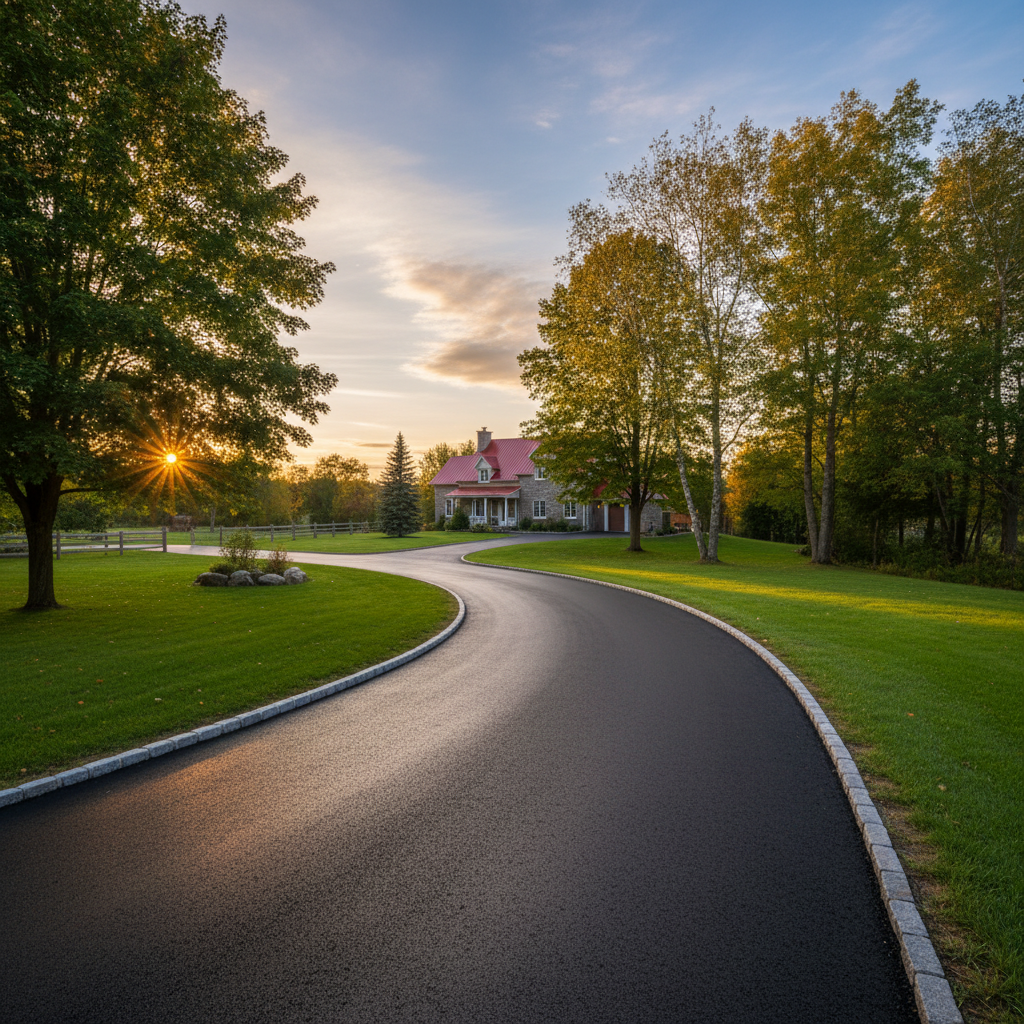
Driveway paving options and costs in Penticton
Penticton homeowners have a few solid paving choices, and the “right” one usually comes down to how much you want to spend upfront versus how much effort you’re willing to put into maintenance. With 36,885 residents and 10,985 homeowner households in the area (63.3% of households own), driveways tied to single-detached homes make up a large portion of the work we see year after year—especially in older neighbourhoods where the original base has settled or softened. (Statistics Canada, 2021 Census)
In the Thompson–Okanagan, our pricing is shaped by repeated freeze–thaw cycles and the need for moisture control. Even though structure frost depth can be around 18" in much of the interior, paved surfaces and slabs experience higher moisture and traffic loading, so we typically design driveways with substantially more compacted granular base than minimums. That added excavation, base material, and sub-grade stabilization is a big reason asphalt at the low end still needs a proper section. It also helps explain why concrete and pavers are often priced with stronger emphasis on drainage, edges, and crack-control detailing.
Demand is especially steady around the Okanagan Lake corridor and older residential pockets near downtown (where access is tight and drainage fixes are commonly needed). Once you account for those site realities, the price bands for Penticton become easier to compare—see the table below for typical per-style ranges.
| Material |
Lifespan |
Maintenance |
Best For |
Price per sq ft |
Price Range |
| Asphalt (new installation, proper base) |
15–25 years |
Seal every 3–5 years; patch as needed |
Lowest upfront cost with a durable, frost-resistant build |
$6.50–$12.00 |
$4,500–$9,000 |
| Asphalt (overlay on existing gravel base) |
10–18 years (depends on existing base) |
Seal and monitor for settlement; spot patch |
When the old base is sound and excavation can be minimized |
$5.75–$10.50 |
$4,000–$8,500 |
| Interlocking concrete pavers |
25–35 years |
Resand joints; occasional panel-level repairs |
Maximum curb appeal and easier local repairs |
$10.00–$20.00 |
$6,500–$14,000 |
| Poured concrete (broom finish) |
20–30 years |
Keep joints sealed; occasional patching |
Clean look and straightforward long-term maintenance |
$9.00–$17.00 |
$7,000–$15,000 |
| Exposed aggregate concrete |
25–35 years |
Periodic sealing; patch spalls quickly |
Higher slip resistance and premium appearance |
$12.00–$22.00 |
$8,000–$16,500 |
| Gravel / crushed stone (budget option) |
5–12 years |
Re-grade and top up; manage washouts |
Temporary solution or low-traffic lots |
$3.00–$6.50 |
$3,000–$6,500 |
Prices are estimates only and vary by project scope, site access and material selection.
What affects the price of paving in Penticton
In Penticton and the broader Thompson–Okanagan, two quotes for what looks like the “same” driveway can vary by 30–50% because the foundation design changes with soil, moisture, slope, and how many hours of labour it takes to get to solid sub-grade. In British Columbia (especially in interior communities), contractors also factor in a tighter paving window—hot-mix asphalt generally needs air temperatures above 10°C—so crews price in weather risk and the cost of mobilizing equipment when schedules open up.
Freeze–thaw is the decisive cost driver. When we expect deeper frost penetration and the driveway sits closer to a wet area, we typically build thicker compacted granular base—often in the 8.5–9" total structure range for residential asphalt systems—with about 6" of compacted base in many standard designs. If the soil is clayey, saturated, or the slope pushes water toward the driveway, the base can need to increase, and drainage corrections can become mandatory rather than optional.
Concrete and pavers can be “cheaper” only when the sub-base is already well-draining and the excavation is minimal. In older Penticton properties (and homes built before 1981, which account for 45.5% of the housing stock), settled fill and aging drainage lead to more tear-out and base replacement. That’s when prices move toward the higher end of asphalt’s $4,500–$9,000 and pavers’ $6,500–$14,000 bands. Conversely, a straightforward replacement on stable granular base can keep asphalt closer to the mid-range—sometimes making sealing and patching the main ongoing cost rather than major reconstruction.
| Price Factor |
Why It Matters |
Cost Impact |
| Driveway area in sq ft |
Most costs (materials, base, labour) scale directly with square footage |
Often determines 50–70% of the total |
| Base depth required |
Freeze–thaw control depends on thick, compacted granular layers |
Can add 10–30% if extra base/excavation is needed |
| Grading and drainage work |
Proper slope and keeping water out prevents heaving and edge failure |
Typically +$500 to +$3,000 depending on complexity |
| Tear-out of existing surface |
Concrete/asphalt removal plus hauling disposal adds labour and equipment time |
Often +$700 to +$4,000 |
| Edge restraints and curbing |
Without restraints, pavers spread; asphalt edges break down faster |
Usually +$300 to +$2,000 |
| Sealing requirement |
Asphalt needs sealing after placement (commonly after 6–12 months) to slow oxidation and water infiltration |
About +$500 to +$1,500 over the first few years |
| Site access |
Narrow lanes, steep driveways, or long carry distances slow equipment movement |
Often +5–15% for labour and logistics |
| Asphalt mix specifications |
Freeze-thaw-rated mixes cost more but perform better through interior winters |
Can move pricing toward the upper end of the asphalt band |
Permits & regulations in British Columbia
For Penticton homeowners, most driveway paving on your own property typically does not require a building permit in British Columbia—especially when you’re replacing an existing paved surface within the lot line and not altering utilities. The main permit trigger is work that touches the municipal right-of-way. That includes new or modified curb cuts, changes to boulevard areas, and any adjustments that affect storm drainage routing or municipal infrastructure.
Some municipalities also enforce lot-grading rules that limit how close a hard surface can be to property lines or how water must be directed away from neighbouring lots and foundations. Because driveway work is often tied to how drainage is handled, it’s smart to confirm lot-grading requirements with the City of Penticton before excavation.
Step-by-step, here’s how to verify a contractor in BC:
- Ask for a copy of their BC business licence (and confirm the legal business name matches the quote).
- Request a Certificate of Insurance showing general liability coverage and the effective dates.
- Verify workplace coverage: request proof of WSBC/WCB coverage for workers (when applicable to their operation) or appropriate exemption documentation.
- Check licensing/credentials online using the contractor registry available in BC, then cross-match the details with the insurance certificate.
- Ensure they confirm utility locates before digging (BC 1 Call / utility locator service). This is critical for hydro, gas, and telecom lines.
- Ask who pulls any municipal approvals if your scope includes boulevard or drainage changes.
Asphalt vs pavers vs concrete for Penticton driveways
In Penticton’s interior freeze–thaw climate, asphalt, interlocking pavers, and concrete can all work well—when the base and drainage are built correctly. The difference is how each material behaves through winter maintenance and how you manage repairs over time.
Asphalt is usually the lowest upfront option and is popular where budgets are tight: typical driveway asphalt pricing falls in the $4,500–$9,000 range. It’s also the most maintenance-dependent in the long run. You generally plan on sealing every 3–5 years to slow water infiltration and oxidation, especially where meltwater or spring runoff gets into cracks. If you get that maintenance timing wrong, freeze–thaw will magnify small flaws.
Interlocking concrete pavers cost more initially (often $6,500–$14,000), but they’re highly repairable. If a section settles or a utility trench is later opened, pavers can be lifted and reset without tearing out the entire driveway—an advantage in older neighbourhoods where underground servicing changes are more likely.
Poured concrete sits in the middle to higher band (commonly $7,000–$15,000) and can look great for decades. The key is air-entrainment and proper joint spacing, because freeze–thaw can crack concrete if the mix and detailing aren’t right. De-icing salt and sanding can also accelerate surface wear, so surface and maintenance habits matter.
In many Penticton driveways, a “$2,000–$4,000” difference between asphalt and pavers is justified when you want long-term cosmetic control and easier local repairs. If you mainly want the best value and don’t mind a sealing plan, asphalt is often the smarter call.
| Material |
Frost Resistance |
Curb Appeal |
Repair Method |
Lifespan |
Price Band |
| Asphalt (sealed regularly) |
Good when built on thick, compacted base and drained well |
Moderate (clean, uniform finish) |
Mill & patch localized areas |
15–25 years |
$4,500–$9,000 |
| Interlocking concrete pavers |
Excellent with proper base and joint sand |
High (style choices and crisp edges) |
Lift/replace individual pavers or sections |
25–35 years |
$6,500–$14,000 |
| Poured concrete (air-entrained) |
Good with air-entrainment and correctly spaced joints |
Moderate to high |
Patch spalls/cracks; joint maintenance |
20–30 years |
$7,000–$15,000 |
| Exposed aggregate concrete |
Good with correct base and curing |
High (textured, premium appearance) |
Patch and blend spots; keep sealed |
25–35 years |
$8,000–$16,500 |
| Permeable pavers (drainage grid) |
Very good where designed to manage water infiltration |
High (modern drainage look) |
Section-level replacement; periodic maintenance of voids |
20–30+ years |
$7,500–$16,000 |
| Chip seal / tar-and-chip |
Moderate (best for appropriate base and low traffic sections) |
Low to moderate |
Spot re-chip or resurface |
6–12 years |
$3,500–$7,000 |
How to choose a paving contractor in Penticton
Choosing a paving contractor in Penticton is mostly about verifying capacity and protecting yourself from workmanship problems—especially because interior freeze–thaw exposes weak base work. Start with British Columbia compliance: request their business details, their Certificate of Insurance (general liability) and proof of workplace coverage for workers (WSBC/WCB coverage, where applicable). Then confirm they’re active and properly registered by checking the appropriate online registry and matching the names on the quote to the insurance paperwork.
Next, insist on 2–3 itemised written quotes. You want labour and materials broken out (excavation, base supply, compaction, asphalt or concrete, forms/edges, disposal), not just a lump sum. Ask what’s excluded: permit pulling for any right-of-way or drainage work, disposal of removed material, and whether drainage/grading corrections are included. Make sure the quote specifies the expected structure (base thickness, number of lifts for asphalt, compaction method) rather than just the finish surface.
Warranty matters. Ask for workmanship warranty length, what it covers (cracks, settlement, premature failures), whether it’s prorated, and whether it’s transferable to future owners. For payment, a safe schedule is never more than 10–15% upfront; keep a holdback until the full job is complete and cleaned up. Finally, get the start date and completion estimate in writing—weather delays happen in the Thompson–Okanagan, but your contractor should spell out how they’ll communicate schedule changes.
- Confirm BC registration/licence details match the quote and invoices.
- Request a current Certificate of Insurance and verify the effective dates.
- Verify WSBC/WCB coverage for workers (or obtain written confirmation if subcontracting is used).
- Ask for at least 3 recent Penticton driveway references with similar site conditions.
- Require an itemised estimate including base, excavation, drainage/grading, and disposal.
- Make sure the quote states compaction requirements and equipment used (not just “we’ll compact”).
- Clarify what happens if temperatures drop below acceptable paving limits (asphalt air-temp needs matter).
- Confirm whether crack control joints are included (for concrete) and where they’ll be placed.
- Ask for edge restraint details (paver edging, concrete returns, or asphalt saw cuts).
- Review warranty terms in writing, including start date and what constitutes failure.
- Agree on a payment schedule with a holdback (10–15% of the total) until completion.
- Confirm cleanup standards and final grading so water doesn’t pond at the driveway edge.
Red flags in Penticton: vague quotes that don’t list base thickness or excavation scope; contractors who won’t discuss drainage and grading; insurance documents that are outdated or don’t match the quoted company name; pressure to take full payment upfront; and crews that schedule around “any time we can get it done” without addressing freeze–thaw and seasonal temperature limits.
Frequently asked questions — paving in Penticton
How much does driveway crack repair cost in Penticton?
Crack repair pricing in Penticton depends on whether it’s a “hairline” surface crack that’s primarily letting water in, or a structural crack with minor settlement. For asphalt, small repairs (routing/sealing of narrow cracks) often fall in the hundreds of dollars, and larger crack segments can move toward the low-thousands once milling, patching, and edge prep are included. If the driveway section is already failing due to poor base drainage, a simple seal won’t stop the problem—then the repair becomes a localized patch or even a partial overlay. As a rule of thumb in the Thompson–Okanagan, minor work might align with the lower end of the $500–$4,000 repair/sealing band, while more extensive patching can exceed it.
What base thickness do I need for pavers in Penticton?
For Penticton pavers, the “right” base thickness is driven by soil moisture and drainage, not only the frost line. In typical residential conditions where drainage is good, paver systems often land in the total structure range that pairs well with asphalt designs—commonly around 8.5–9" total, with roughly 6" compacted granular base plus bedding sand and paver thickness. If your sub-grade is clayey, waterlogged, or the driveway has slope/drainage challenges, expect deeper excavation and additional base to reduce heaving and edge movement during repeated freeze–thaw cycles.
How do I get the most accurate paving quote in Penticton?
To get an accurate quote in Penticton, treat it like a site-design job rather than a “price per sq ft” guess. Provide driveway measurements (length/width), confirm whether there’s soft spots or ponding, and share any known drainage issues. Ask the contractor to inspect for sub-grade condition, then specify the base thickness and drainage/grading scope in writing. Request an itemised breakdown: excavation, base materials, compaction, asphalt/concrete/pavers, restraints, and disposal. Also confirm whether the quote includes saw cuts/edge work, and whether sealing is included for asphalt (often after 6–12 months). A detailed, site-aware scope is what keeps bids from diverging by 30–50% across the Thompson–Okanagan.
How much does it cost to pave a driveway in Penticton?
Driveway paving costs in Penticton commonly fall within the regional price bands based on material and how much reconstruction is needed. For asphalt driveway paving on a properly prepared base, many homeowners land around $4,500–$9,000. Interlocking concrete pavers typically range from $6,500–$14,000 depending on excavation, edging, and pattern complexity. Poured concrete is often $7,000–$15,000, with exposed aggregate at the higher end. Your exact number depends on driveway size in sq ft, how much tear-out is needed, and whether drainage/grading corrections are required for freeze–thaw durability.
Asphalt vs interlocking pavers vs concrete — which is best in Penticton?
There isn’t one “best” option for all Penticton homes—each trades upfront cost, appearance, and repair approach. Asphalt is usually best for value and speed, with the expectation of regular sealing every 3–5 years; it typically fits $4,500–$9,000 when the base is done properly. Interlocking pavers are best if curb appeal and repairability matter most; they can be lifted and reset without replacing the whole driveway, and they usually sit in the $6,500–$14,000 band. Concrete (including air-entrained poured concrete) is a solid mid-range choice (often $7,000–$15,000) when joints and mix design are right for freeze–thaw. In all cases, drainage and base thickness are what determine whether you’ll see rutting, heaving, or cracking after a few winters.
How long does a paved driveway last in Penticton?
With correct design and maintenance, asphalt driveways often last 15–25 years, while interlocking concrete pavers commonly reach 25–35 years. Poured concrete typically lasts around 20–30 years when joints are detailed and the mix is air-entrained for freeze–thaw. Longevity in British Columbia’s interior comes down to water management: if meltwater or runoff keeps getting into the base, freeze–thaw will accelerate failure regardless of the topcoat. Asphalt also has a maintenance component—sealing after placement (often after 6–12 months) and then every 3–5 years helps protect against oxidation and water intrusion. If your driveway was built on uncertain fill in older areas, lifespans can be shorter until drainage and base are corrected.