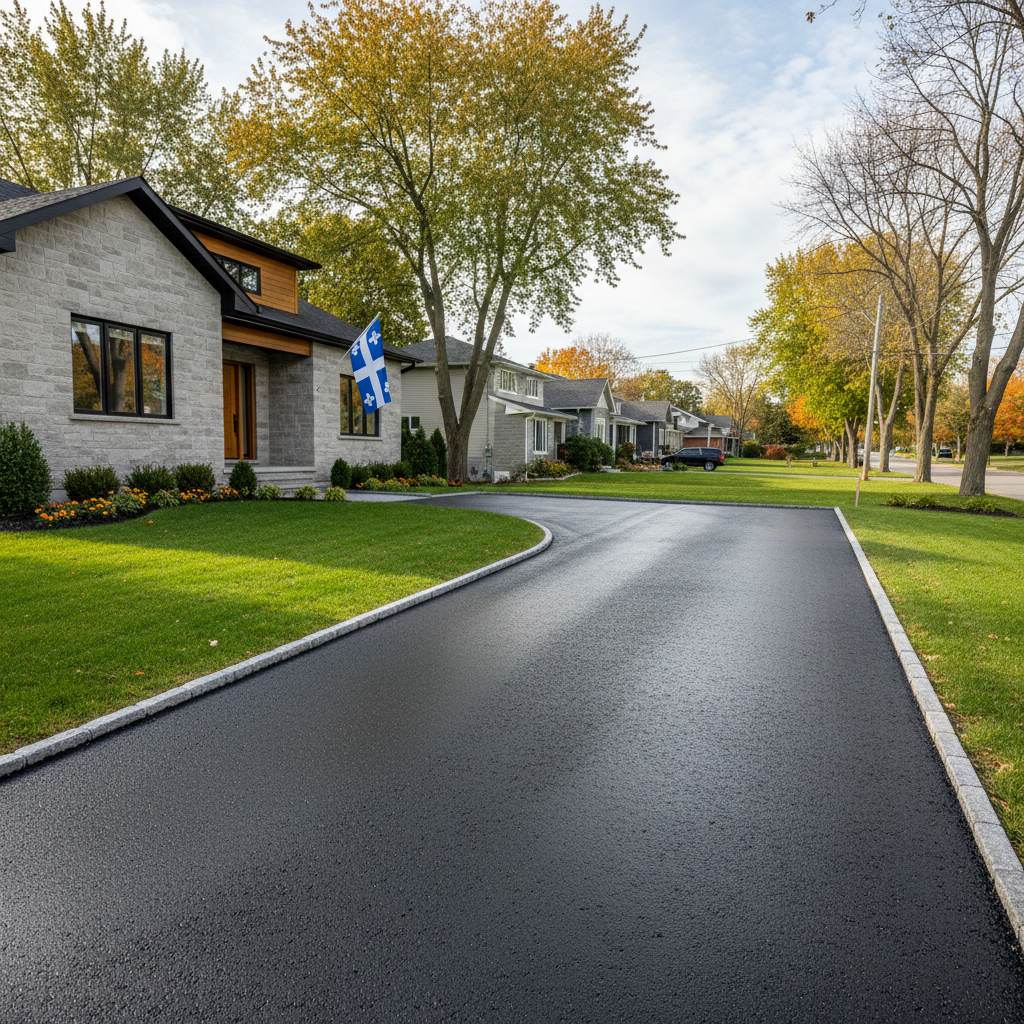
Driveway paving options and costs in Burnaby
In Burnaby, you’ll usually see three driveway materials competing for your attention: asphalt, interlocking concrete pavers, and concrete (poured or exposed aggregate). With Burnaby’s housing stock anchored by detached homes—single-detached dwellings make up 18.9% of homes—many homeowners have private driveways that are high-traffic, high-visibility, and exposed to heavy Lower Mainland rainfall. At the same time, 60.5% of households are owner households (Statistics Canada, 2021 Census), which means long-term value and maintenance planning matter when you’re choosing a surface.
Pricing here is shaped more by drainage and freeze–thaw around a relatively shallow coastal frost depth than by deep winter frost. In the Lower Mainland–Southwest, intense rain can saturate clay-heavy pockets of the Fraser Valley side of the region, and that water is what accelerates base failure and surface pumping if the granular base and slopes aren’t right. The good news is that workable paving windows can be longer than in Northern BC, so contractors can sometimes schedule through shoulder seasons—however, heavy storm weeks still compress crews and can tighten availability.
On the ground, we commonly see especially strong demand in areas like Metrotown and along Brentwood, where older driveways (and homes built before 1981, at 35.5% of the stock) are due for renewal. The table below compares typical lifespan, maintenance, and realistic price ranges for common driveway scopes, assuming proper excavation, compacted base, and drainage-focused installation.
| Material |
Lifespan |
Maintenance |
Best For |
Price per sq ft |
| Asphalt (new installation, proper base) |
15–25 years |
Seal after 6–12 months, then every 3–5 years |
Best value, smooth ride, quick turnaround |
$12 – $20 |
| Asphalt (overlay on existing gravel base) |
10–18 years |
Seal as needed; monitor for base movement |
Budget renewal when excavation is limited |
$10 – $17 |
| Interlocking concrete pavers |
25–35 years |
Re-level as needed; periodic joint sand refresh |
Repairability and curb appeal |
$20 – $40 |
| Poured concrete (broom finish) |
20–30 years |
Crack sealing as required; occasional re-seal |
Low-maintenance flat surface |
$18 – $35 |
| Exposed aggregate concrete |
20–30 years |
Sealer/maintain surface finish; crack monitoring |
Texture and slip resistance |
$22 – $38 |
| Gravel / crushed stone (budget option) |
5–10 years |
Re-grade and top up yearly; weed control |
Temporary or low-budget access |
$6 – $12 |
Prices are estimates only and vary by project scope, site access and material selection.
What affects the price of paving in Burnaby
In Burnaby and the wider Lower Mainland–Southwest, it’s common to see quotes for what looks like the “same” driveway range by 30–50%. The spread usually comes down to whether the contractor is pricing for true drainage and base reconstruction (the long-term fix) or for surface-only work. Another reason: excavation and compaction are labour-heavy, and disposal, saw-cutting, and hauling can add up quickly in older neighbourhoods where driveways sit close to fences, trees, and existing landscaping.
Frost line depth and freeze–thaw cycles are decisive cost factors in this region. While coastal BC typically has a milder frost profile than Interior provinces, practice still assumes a frost line on the order of 18" for sensitive infrastructure, so exposed applications still need compacted granular base thickness and proper subdrainage. As a rule of thumb, coastal BC projects often work with about 4–6 inches of compacted base in stable, well-drained situations, but the moment soils are saturated or clay-heavy, crews commonly excavate deeper and increase granular thickness to prevent heaving, rutting, and cracking. Asphalt mix design and air-void targets also matter for freeze–thaw durability, and “cheap” mixes can fail sooner in coastal winter conditions.
Two concrete examples: if your driveway is on fill or soft spots near the garage approach, contractors may need additional base and possibly membrane/drainage correction, which pushes you toward the higher end of the asphalt band (often closer to the $12–$20 range rather than the low end). Conversely, if you’re replacing a gravel apron with good drainage and a straightforward rectangle layout, you may land nearer the mid-range. When concrete is chosen, prices typically land within the $18–$35 band, but complex forms, tied-in steps, or thicker flatwork can push it higher.
| Price Factor |
Why It Matters |
Cost Impact |
| Driveway area in sq ft |
Most charges scale directly with surface quantity and base volume |
High (largest variable) |
| Base depth required |
Frost-related movement control depends on compacted granular thickness |
High (more excavation and material) |
| Grading and drainage work |
Correct slope and storm run-off routing reduce saturation and freeze–thaw stress |
Medium–High |
| Tear-out of existing surface |
Breaking, removal, and hauling concrete or old asphalt takes time and equipment |
Medium–High |
| Edge restraints and curbing |
Prevents paver spread and asphalt edge raveling |
Medium |
| Sealing requirement |
Asphalt performance in coastal rain improves with seal timing |
Low–Medium (schedule dependent) |
| Site access |
Narrow driveways or complex staging slow equipment and increase labour |
Low–Medium |
| Asphalt mix specifications |
Freeze–thaw rated mixes and proper binder content cost more |
Low–Medium |
Permits & regulations in British Columbia
In British Columbia, paving work on your own property usually falls under normal property maintenance and often does not require a building permit when you’re replacing an existing driveway surface within the property limits (for example: asphalt resurfacing within your lot line, or new pavers and concrete inside your driveway footprint). However, you do need municipal approval when the work affects the public realm—especially the municipal right-of-way. That includes new or modified curb cuts, changes to boulevard paving, altering storm drainage patterns, and any work that ties into municipal infrastructure.
For a Burnaby homeowner, the practical approach is: (1) confirm what portion of your driveway apron is boulevard/right-of-way versus private property; (2) ask the contractor to identify whether permits or municipal inspections are required for your scope; and (3) confirm any lot-grading rules that restrict how close a hard surface can sit to property lines or how drainage must be handled.
Before excavation, always arrange utility locates through BC 1 Call. Then, to verify a contractor’s compliance: (1) check their BC business licence or contractor registration where applicable (many firms also publish details on their website), (2) request a certificate of insurance showing liability coverage (and verify it matches the project dates), and (3) confirm workers’ compensation coverage (WSIB/WCB equivalent coverage in BC is required). Your contractor should also provide documentation such as clearance letters or proof of coverage upon request.
Asphalt vs pavers vs concrete for Burnaby driveways
Choosing the right driveway surface in Burnaby comes down to balancing upfront cost, maintenance rhythm, and how each material handles Lower Mainland–Southwest rain and freeze–thaw. Asphalt typically offers the lowest upfront cost and a smooth driving feel, but it performs best when sealed after installation (usually after the surface has cured, often within 6–12 months) and then resealed every 3–5 years. Interlocking concrete pavers cost more initially, yet they’re the most repair-friendly option: if a section settles or a drain area needs attention, individual pavers can be lifted, corrected, and reset. Poured concrete sits in the middle on price, but it can crack over time—freeze–thaw movement, poor drainage, and de-icing practices matter. Using air-entrained concrete and proper joints helps, but drainage remains the deciding factor in wet coastal winters.
For base preparation, Lower Mainland practice still targets frost-related stability rather than “minimum” excavation. As a typical residential benchmark, asphalt driveways often use about 6" of compacted granular base plus 2.5–3" of asphalt, while pavers commonly need 6" of base gravel and bedding sand with 2.5–3.5" pavers. In saturated clay-prone spots, contractors may excavate deeper and increase base thickness to reduce water retention—this is where quotes diverge.
Where the price difference is justified: if your driveway is small and simple, asphalt might land in the $12–$20 per sq ft range and be the most economical. But if you want maximum longevity and easier local repairs—especially around sloped approaches or drainage fixes—pavers in the $20–$40 per sq ft range can pay off by avoiding full-surface replacement.
| Material |
Frost Resistance |
Curb Appeal |
Repair Method |
Lifespan |
Price Band |
| Asphalt (sealed regularly) |
Good with proper base and sealing |
Medium (clean, uniform finish) |
Patch & tack; re-seal blends |
15–25 years |
$12 – $20 |
| Interlocking concrete pavers |
Very good (flexible surface over granular base) |
High (variety of patterns/colours) |
Remove and replace affected units |
25–35 years |
$20 – $40 |
| Poured concrete (air-entrained) |
Good when air-entrained and well-drained |
Medium (solid, modern look) |
Crack repair + targeted patching |
20–30 years |
$18 – $35 |
| Exposed aggregate concrete |
Good with proper mix and finishing |
High (textured, premium appearance) |
Localized patch/colour-match repair |
20–30 years |
$22 – $38 |
| Permeable pavers (drainage grid) |
Very good (reduced surface runoff when designed right) |
High (engineered look) |
Replace sections; maintain infill as required |
20–35 years (design-dependent) |
$25 – $45 |
| Chip seal / tar-and-chip |
Moderate (maintenance and wear varies) |
Low–Medium (utility finish) |
Re-chipping and surface refresh |
7–12 years |
$10 – $18 |
How to choose a paving contractor in Burnaby
Start by confirming a contractor is properly set up to work in British Columbia. Ask for their certificate of liability insurance (verify limits are adequate for residential paving and that coverage is active during your work dates). Then ask about workers’ compensation coverage (in BC, this is handled through the workers’ compensation system). A reputable paving company should be willing to provide documentation without pushback. You can also ask for their business registration details and, if they participate in trade organizations or publish compliance information, use that as additional support—but always rely on the insurance certificate and proof of coverage.
Get 2–3 itemised written quotes (not lump sums). The quote should break out excavation/take-off, base gravel and compaction, asphalt/paver/concrete supply, forms and base thickness, drainage corrections, and disposal. Check what’s excluded: permit pull, utility locates, saw-cutting, tree root management, and disposal—these are common scope differences that drive price swings. If you’re overlaying existing pavement, ask for the condition assessment method (cracking, pumping, soft base indicators).
Warranty matters. Look for a workmanship warranty length (often 1–5 years depending on the material and region), plus any product/manufacturer warranty for paving materials. Confirm whether the warranty transfers to future owners.
For payment, don’t pay more than 10–15% upfront. Use a holdback until the job is complete and the final walk-through is done. Request a start date and a completion estimate in writing, especially since Burnaby’s rainy stretches can affect crew scheduling.
- Quote includes base thickness and compaction specifications, not just the surface material.
- Itemized line for tear-out/disposal if there’s existing asphalt or concrete.
- Drainage/slope plan described (how water will be directed away from the garage approach).
- Edge restraint details listed (especially for pavers and asphalt terminations).
- Clear start and finish timeline tied to weather windows.
- Written warranty for workmanship and what triggers exclusions.
- Certificate of liability insurance provided before work begins.
- Proof of workers’ compensation coverage provided (and active for your dates).
- Payment schedule with small deposit only; holdback until completion.
- Permit/right-of-way scope explained if any boulevard curb cut is involved.
- Sealing plan included for asphalt (timing and responsibility for the early seal).
- Photos of similar recent Burnaby projects or references you can contact.
Red flags: vague “all-in” pricing without base/grading details; pressure to accept a large deposit early; no written warranty or warranty limited to “material only”; refusal to provide insurance/proof of workers’ compensation; and a contractor who won’t discuss drainage or base preparation because “the asphalt will cover it.”
Frequently asked questions — paving in Burnaby
What is a driveway apron and do I need one in Burnaby?
A driveway apron is the section where your driveway transitions from the sidewalk/road area to your private property—often the paved (or reconstructed) approach area that connects to the curb/boulevard. In Burnaby, whether you need an “apron” depends on whether you’re creating a new access point, expanding width, changing the curb cut, or modifying how stormwater is handled at the road edge. If your work stays entirely within your property line and is simply replacing worn asphalt or pavers on the driveway itself, it often doesn’t trigger extra municipal steps. However, if you’re changing the curb cut or altering drainage in the municipal right-of-way, you’ll typically need municipal approval.
How do I maintain my driveway through Burnaby winters?
For Burnaby winters, the goal is to manage moisture and limit stresses on the base. Start with good drainage: keep the driveway sloped correctly and don’t allow roof runoff to dump onto the slab or asphalt. During freeze–thaw periods, avoid over-salting—salt and harsh de-icing can accelerate deterioration on both asphalt and concrete surfaces. Use sand for traction if needed, and shovel promptly to reduce mechanical damage. For asphalt, plan on sealing after installation (often after 6–12 months) and then resealing every 3–5 years, because sealed asphalt resists water penetration during coastal rain events. For concrete, repair hairline cracks early with a proper concrete crack sealant so water doesn’t migrate into the base.
Is it worth sealing a new driveway right away in Burnaby?
In Burnaby, sealing is usually worth it, but timing is everything. Asphalt needs time to cure and “set” so you don’t trap moisture under the seal coat. Most contractors plan the first seal after installation within a window that aligns with temperature and curing—commonly after 6–12 months rather than immediately. Sealing helps reduce water intrusion from winter rain, which is critical on Lower Mainland driveways where drainage failures can lead to base pumping and early cracking. If your driveway is brand new asphalt, sealing on schedule can extend performance; without it, you often see surface oxidation sooner, pushing maintenance earlier than you planned. If you’re budgeting, sealing is typically a smaller line item compared to full paving—sealing & repair often runs about $2 – $6 per sq ft depending on scope.
What is a chip seal driveway and is it suited to Burnaby?
Chip seal (tar-and-chip) is a surface treatment where asphalt binder is sprayed and covered with aggregate chips. It’s sometimes used where you want a lower upfront cost or a more utilitarian finish. In Burnaby, it can be suited for certain applications—especially where the driveway is not expected to have premium curb appeal, and the base/drainage is designed correctly. That said, chip seal generally has a shorter service life than new asphalt paving when exposed to traffic and frequent wet weather; it typically needs periodic refreshing. If you compare price bands, chip seal may fall around the lower end (often near $10 – $18 per sq ft), while proper asphalt paving is commonly $12 – $20 per sq ft because it includes a thicker, more durable asphalt structure. If you want a smoother ride and longer lifespan, new asphalt or pavers are usually the better match.
How much does driveway crack repair cost in Burnaby?
Crack repair cost in Burnaby varies mainly by crack width, the number of locations, and whether the repair is just sealing (for stable cracks) or includes cutting out and patching (for active movement). As a rule of thumb, sealing & repair projects often fall into the $2 – $6 range per sq ft depending on how much surface area needs attention and whether the contractor is doing targeted crack cleaning and sealant placement versus broader patching. Timing also matters: fixing cracks early reduces water infiltration, which helps protect the granular base from freeze–thaw strain. If you’re seeing edge deterioration, standing water, or “pumping” near the garage approach after rain, crack sealing alone may not be enough—you may need base/drainage correction.
What base thickness do I need for pavers in Burnaby?
For pavers in Burnaby, the typical residential build is about 6" of compacted granular base, then bedding sand, and pavers at roughly 2.5–3.5" thick. That said, base thickness is not one-size-fits-all because Lower Mainland–Southwest projects are driven by drainage performance and soil condition. If soils are saturated, clay-heavy, or the site has poor runoff control, a contractor should excavate deeper and increase the granular base (and possibly add drainage measures) so you don’t get settlement and heaving from repeated moisture cycles. The “right” thickness also depends on load and subgrade strength. Ask your contractor how they assess subgrade—if they can’t explain their excavation depth and compaction plan for your driveway, it’s a reason to get a second quote.