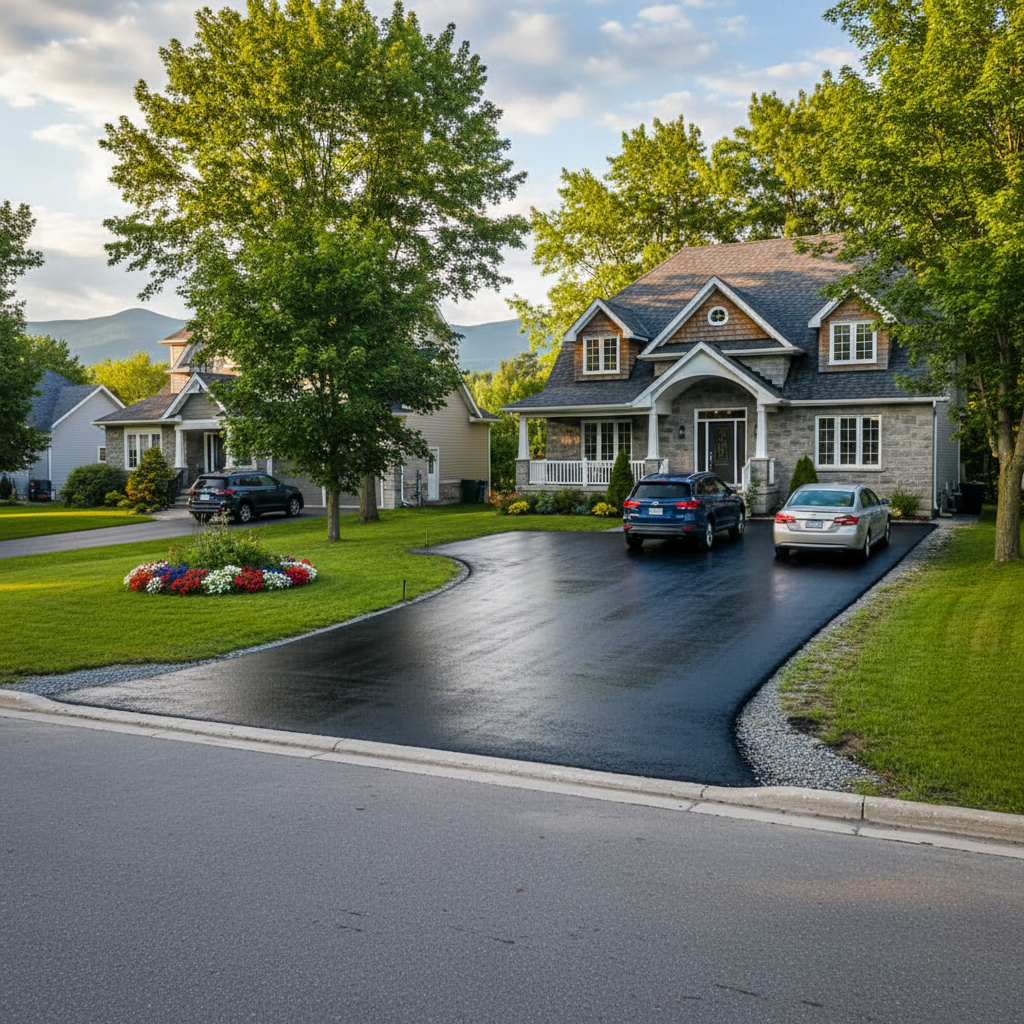
Driveway paving options and costs in Cumberland
Cumberland, British Columbia, has a lot of driveways to pave—especially because most homes here are in neighbourhoods of single-detached houses, and 64.9% of dwellings are that type (Statistics Canada, 2021 Census). That matters because driveway work often ties directly into home access, sidewalk/curb transitions, and how your site sheds water after rain. With 72.0% of households owning their home, homeowners are typically planning paving with a long-term view rather than treating it as a quick facelift (Statistics Canada, 2021 Census).
On Vancouver Island and the Coast, our climate is “mild” compared to the Interior, but we still deal with frost pockets and repeated freeze-thaw cycles. Those cycles around Cumberland and nearby valleys can heave weak spots if the excavation and drainage aren’t engineered. The mild coastal conditions also influence scheduling: paving tends to happen in longer dry stretches, and when shoulder-season weather turns wet, contractor availability can tighten. Materials and trucking to Island markets can add cost versus some mainland areas, and asphalt crews need air temperature and surface conditions that meet mix requirements.
In Cumberland, driveways around areas like the downtown core and adjacent residential streets see strong demand because lots are often practical to service but require careful vehicle access planning. If you’re comparing options, the best next step is to look at the typical material choices side by side—then match the material to the base, drainage, and how you want your driveway to age.
| Material |
Lifespan |
Maintenance |
Best For |
Price per sq ft |
| Asphalt (new installation, proper base) |
15–25 years |
Seal every 3–5 years; minor patching as needed |
Value-focused driveways with good drainage |
$10 – $20 |
| Asphalt (overlay on existing gravel base) |
10–18 years |
Seal every 3–5 years; more frequent patching if base settles |
When you need improvement without full tear-out |
$12 – $22 |
| Interlocking concrete pavers |
25–40 years |
Weed control; re-setting individual stones; re-polymeric joint sand as needed |
Curb appeal and repairability |
$25 – $45 |
| Poured concrete (broom finish) |
20–30 years |
Periodic cleaning; crack monitoring and localized patching |
Low-detail maintenance and a clean look |
$18 – $35 |
| Exposed aggregate concrete |
20–30 years |
Sealer as recommended by finish system; crack monitoring |
Slip-resistant texture and premium appearance |
$22 – $40 |
| Gravel / crushed stone (budget option) |
3–10 years |
Re-grade and top up every season or two |
Short-term or drainage-first solutions |
$6 – $12 |
Prices are estimates only and vary by project scope, site access and material selection.
What affects the price of paving in Cumberland
In Cumberland, you’ll often see the same “square footage” driveway price differ by 30–50% when quotes are apples-to-apples on paper but not on scope. Across Vancouver Island and Coast markets (and comparisons to other parts of British Columbia), that gap usually comes down to excavation depth, base engineering, disposal costs, equipment access, and how much drainage correction is required before asphalt or concrete goes down. Labour availability can also tighten during dry windows, and that can raise the effective cost of getting on the schedule.
Frost line depth and freeze-thaw cycles are decisive cost factors on the Coast. While our coastal BC frost line is relatively shallow compared to colder provinces, we still see localized freezing and repeated freeze-thaw cycles that can heave weak subgrades. When deeper granular thickness is needed for stability, contractors may need an engineered base in the 4–6 inch range (coastal BC typical) rather than minimal gravel “make do” bases. For context, contractors in colder provinces often plan thicker granular layers (6–12 inches) to resist heaving. That base thickness difference is a direct driver of material and labour costs.
Concrete costs in Cumberland can rise if air-entrainment and proper crack control aren’t included, because freeze-thaw can widen shrinkage or construction joints over time. Asphalt overlay costs may look lower initially, but if your existing gravel base is soft, settling can force more patching—pushing effective lifetime costs closer to full new installation. With median household income around $86,000 (Statistics Canada, 2021 Census), many homeowners choose asphalt or interlocking based on balancing upfront spend with the reality that sealing and repairs are climate-driven.
| Price Factor |
Why It Matters |
Cost Impact |
| Driveway area in sq ft |
Most material and paving time scales with surface area |
High (primary driver) |
| Base depth required |
Frost pockets and freeze-thaw need stable granular thickness |
High |
| Grading and drainage work |
Slope correction and water control prevent future heaving |
Medium to high |
| Tear-out of existing surface |
Breaking concrete or removing old asphalt adds labour and disposal |
Medium to high |
| Edge restraints and curbing |
Controls paver spread and protects edges from water infiltration |
Medium |
| Sealing requirement |
Asphalt benefits from sealing after installation (often 6–12 months) to protect binder |
Low to medium (ongoing) |
| Site access |
Narrow lots slow equipment movement and may increase labour time |
Medium |
| Asphalt mix specifications |
Freeze-thaw-rated mixes help performance in coastal conditions |
Low to medium |
Permits & regulations in British Columbia
In British Columbia, paving a private driveway within your own property typically does not require a building permit. For Cumberland homeowners, the situation changes when work affects the municipal right-of-way—think curb cuts, changes to the boulevard area, modifications near the roadway surface, or any alteration to storm drainage that connects to municipal systems. Those items generally require municipal approval before construction.
Some municipalities also have lot-grading or drainage bylaws that restrict how close a hard surface can be to property lines and how water must be handled (for example, to prevent directing runoff onto adjacent properties). The best practice is to confirm your exact boundary conditions with the municipality before excavation, especially where your driveway meets the street or where there are ditch lines.
Before anyone digs, ensure utility locates are completed using BC 1 Call. That locate requirement applies because excavation for base—plus saw-cutting and tear-out—can hit buried services even when the driveway footprint seems straightforward.
When hiring a contractor, verify three things in writing:
- Licence: confirm the contractor’s BC business registration status and trade authorization where applicable, and check publicly available registry information for the firm.
- Liability insurance: request a certificate of insurance showing limits and that it covers driveway/land improvements.
- Coverage for workers: verify workers’ compensation coverage (commonly discussed as WCB coverage) and obtain clearance documentation when offered.
Ask for copies before work starts so you’re covered if schedules slip due to site issues or if any damage occurs during excavation.
Asphalt vs pavers vs concrete for Cumberland driveways
For Cumberland driveways, asphalt, interlocking concrete pavers, and concrete all can work well—if the base and drainage are engineered for our Vancouver Island and Coast freeze-thaw realities. Asphalt is the lowest upfront option, and it’s popular because it’s usually within the asphalt driveway paving band (often cited as $10–$20 per sq ft). The trade-off is maintenance: asphalt typically needs sealing every 3–5 years to protect the binder from wet weather and to slow surface oxidation.
Interlocking pavers cost more upfront (often $25–$45 per sq ft), but they’re highly repairable. If a utility line is serviced later or if a localized settlement point develops, you can lift and reset stones without tearing up the whole driveway. In our climate, that repair flexibility matters because freeze-thaw can reveal weak spots over time.
Poured concrete sits in the middle cost range (often $18–$35 per sq ft). It can be durable when properly air-entrained and finished, but freeze-thaw can cause cracking—especially if the base is not stable or if de-icing practices introduce stress. Most Cumberland driveways see sand and routine maintenance rather than heavy chemical salt loads, but moisture still drives freeze-thaw. A well-drained, well-graded base helps whichever material you choose.
As a practical example: if you have a 500 sq ft driveway, asphalt might pencil out around $10–$20 per sq ft, while pavers may land around $25–$45 per sq ft. The difference can be thousands, but it’s usually justified when you value curb appeal, want easy localized repairs, or have concerns about future driveway adjustments. If your goal is the best value per year and your drainage plan is solid, asphalt is often the strongest fit.
| Material |
Frost Resistance |
Curb Appeal |
Repair Method |
Lifespan |
Price Band |
| Asphalt (sealed regularly) |
Good with proper base and drainage; needs protection from freeze-thaw |
Medium |
Patch and re-surface locally; seal to restore |
15–25 years |
$10 – $20 |
| Interlocking concrete pavers |
Very good; units tolerate movement better when base is compacted |
High |
Lift/re-set individual pavers; re-polymeric sand |
25–40 years |
$25 – $45 |
| Poured concrete (air-entrained) |
Good when air-entrained and on stable base; cracks can occur |
Medium |
Crack repair and patching; joint maintenance |
20–30 years |
$18 – $35 |
| Exposed aggregate concrete |
Good; finish is durable but still depends on base stability |
High |
Localized patching; sealer system upkeep |
20–30 years |
$22 – $40 |
| Permeable pavers (drainage grid) |
Very good for water management when design drains correctly |
High |
Replace individual units and maintain drainage layer |
20–35 years |
$30 – $55 |
| Chip seal / tar-and-chip |
Moderate; performance depends on subgrade and traffic loads |
Low to medium |
Spot re-chips and reseal |
8–15 years |
$8 – $15 |
How to choose a paving contractor in Cumberland
Choosing the right paving contractor in Cumberland comes down to verifying coverage, comparing itemized quotes, and matching scope to your local freeze-thaw conditions. First, verify British Columbia compliance and safety coverage. Ask for:
- Licence / eligibility: check the contractor’s standing via available BC contractor/builder registration info and ensure the company is properly authorized for the type of work.
- Liability insurance: request a current certificate of insurance (COI) with coverage limits appropriate for driveway/land improvement work.
- Workers’ compensation coverage: verify their WCB/WCB clearance documentation (or equivalent proof) so you’re not exposed if someone is injured on your property.
Next, request 2–3 itemised written quotes. Don’t accept a “lump sum” with vague inclusions. A fair comparison should break down excavation, base supply and compaction, forms/edge restraints (for pavers/concrete), asphalt or concrete materials, reinforcement or air entrainment notes (for concrete), and disposal.
Read the scope carefully. Confirm whether the quote includes permit pulls (if any are required for right-of-way or drainage connections), utility locate compliance, demolition/tare-out disposal, and traffic control/temporary reinstatement if the driveway ties into sidewalks or street edges. For warranty, look for a workmanship warranty stated in writing (length and what it covers), plus any manufacturer warranty terms for product components—and whether it’s transferable to you as the homeowner.
Finally, keep payment terms responsible. Never pay more than 10–15% upfront. Use a progress payment structure with holdback until substantial completion and cleanup are verified. Get the start date and completion estimate in writing so weather-related scheduling expectations are clear for coastal shoulder seasons.
- Ask what base depth they are designing for your driveway, not just the material surface.
- Confirm compaction approach and how they verify density (or at least describe testing procedures).
- Ensure drainage corrections are included if the driveway has ponding or runoff problems.
- Check whether they include edge restraints/curbing for pavers and proper forms for concrete.
- For asphalt, confirm when sealing is recommended (often after 6–12 months) and whether it’s quoted or separate.
- Verify utility locate responsibility and excavation safety procedures.
- Look for explicit disposal and hauling scope—especially for concrete tear-out.
- Confirm cleanup standards (vacuuming/hosing paver dust, removing excess base material).
- Request dates for start and completion, not just a “spring/summer” window.
- Ask how they handle weather stoppages and whether work is paused/covered appropriately.
- Get proof of insurance and coverage before any equipment enters your driveway.
- Make sure the quote includes all elevations/transitions at the apron/curb line if applicable.
In Cumberland, common red flags include quotes that skip or downplay drainage and base prep, vague specs like “standard base” with no depth or compaction details, refusal to provide insurance/certificates, pressure for large upfront deposits, and lack of a written warranty or unclear scope exclusions (like disposal or saw-cutting).
Frequently asked questions — paving in Cumberland
How long before I can drive on new asphalt?
In Cumberland and across coastal BC, typical asphalt “ready to drive” timing depends on weather, thickness, and whether any ramps or transitions are involved. Many driveways are safe for light vehicle traffic after the asphalt cools enough to prevent tracking; crews often target “next day” access for standard new installations when temperatures are favourable. If it’s wet or cooler during curing, that window can stretch—especially in shoulder seasons when freeze-thaw is still a risk for the underlying base. If your project includes a full new base and proper drainage corrections, curing is usually more consistent than overlays on unstable gravel. A good planning benchmark is that sealing (when recommended) is often done after 6–12 months, but drive-on timing is separate from long-term maintenance. Budgeting based on the asphalt driveway paving band of $10–$20 per sq ft helps many homeowners, but exact access timing should be stated in your written work plan.
What causes potholes and how are they repaired?
Potholes in Cumberland are usually the end result of water finding a weak spot: a soft subgrade, insufficient base depth, or drainage that directs runoff under the surface. Even in a mild coastal climate, localized freezing and freeze-thaw cycles expand moisture and widen small failures into voids. Potholes are typically repaired by cutting out the distressed asphalt, removing the unstable material, re-compacting the base, and then placing hot-mix asphalt in lifts. If the base issue is not corrected, the repair may fail again around the same area, which is why good drainage design is part of a proper driveway quote. On an asphalt driveway, patching is common, but repeated patches can lead to needing a larger re-surface or overlay. That’s also why homeowners who plan sealing every 3–5 years often see fewer pothole-style failures compared to driveways left unsealed.
How do I prepare for a paving project?
For a driveway in Cumberland, preparation starts by clearing access and planning for temporary parking during excavation and curing. Move vehicles, basketball hoops, and loose items off the driveway and allow room for equipment to stage. If you have landscaping that needs protection, discuss preservation with your contractor before work begins—especially around single-detached homes where planting beds often sit close to the driveway edge. Also confirm sprinkler lines and any low-voltage lighting; utility locates (BC 1 Call) are normally required before digging, but you can still help by identifying known lines and boundaries. Be ready for a walkthrough: contractors should confirm grades, drainage direction, and transitions to sidewalks or street edges. If you’re choosing asphalt versus pavers or concrete, preparation may include deciding whether edge restraints will align with your apron/curb transitions. Good preparation reduces change orders and keeps the project on schedule during the coastal paving window.
How do I compare paving quotes fairly?
Compare quotes using the same scope, not just the bottom-line price. Ask each contractor to provide an itemized breakdown: excavation depth, base material and compaction, drainage corrections, tear-out and disposal, and the finished surface specification. For asphalt, clarify whether they’re placing new installation or overlay, what mix quality they’re using for freeze-thaw conditions, and whether sealing is included or recommended as a separate step. For pavers or concrete, make sure edge restraints, base layers, and joint details are included, because those details affect long-term performance in Cumberland’s coastal freeze-thaw conditions. Prices should align with typical local bands—such as asphalt at about $10–$20 per sq ft or pavers at roughly $25–$45 per sq ft—only if scope matches. If one quote is far lower, it may be skipping drainage work or reducing base prep. Don’t pay more than a small deposit upfront until you see clear written terms.
Can asphalt be laid in cold weather in Cumberland?
Asphalt can be laid in cool conditions, but “cold weather paving” isn’t simply about air temperature—it’s about workable asphalt temperature, surface conditions, and whether the base is dry and stable. On Vancouver Island and the Coast, Cumberland projects are often limited by wet periods and the practical need for adequate drying time before compaction. Hot-mix asphalt generally requires air/surface conditions that support proper laydown and compaction; many crews target conditions well above typical freezing points to maintain quality. If you pave too early and the base holds moisture, freeze-thaw later can lead to premature cracking or settlement-related failures. That’s why reputable contractors will postpone when it’s damp, windy, or near-freezing rather than forcing production. If scheduling is tight, discuss the plan: base dryness verification, weather monitoring, and what happens if temperatures drop mid-day.
What is a driveway apron and do I need one in Cumberland?
A driveway apron is the transition section between your driveway surface and the adjoining sidewalk/curb/roadway edge—often where the driveway meets the street or municipal portion near the curb. Whether you “need” one depends on your existing frontage and the condition of the transition. In many Cumberland situations, the apron area is where drainage and settlement issues show up first, because water concentrates at the edge and freeze-thaw cycles can exploit any weak base or improper slope. If you’re doing major work and the driveway ties into municipal right-of-way elements, the apron/transition may require municipal approval or specific construction details. If the driveway is staying entirely within your private property with no curb cut or drainage changes, a permit is often not needed, but the apron detail still needs engineering for long-term performance. A good contractor will show you the planned transition in writing, including grades and how water will exit the apron area safely.