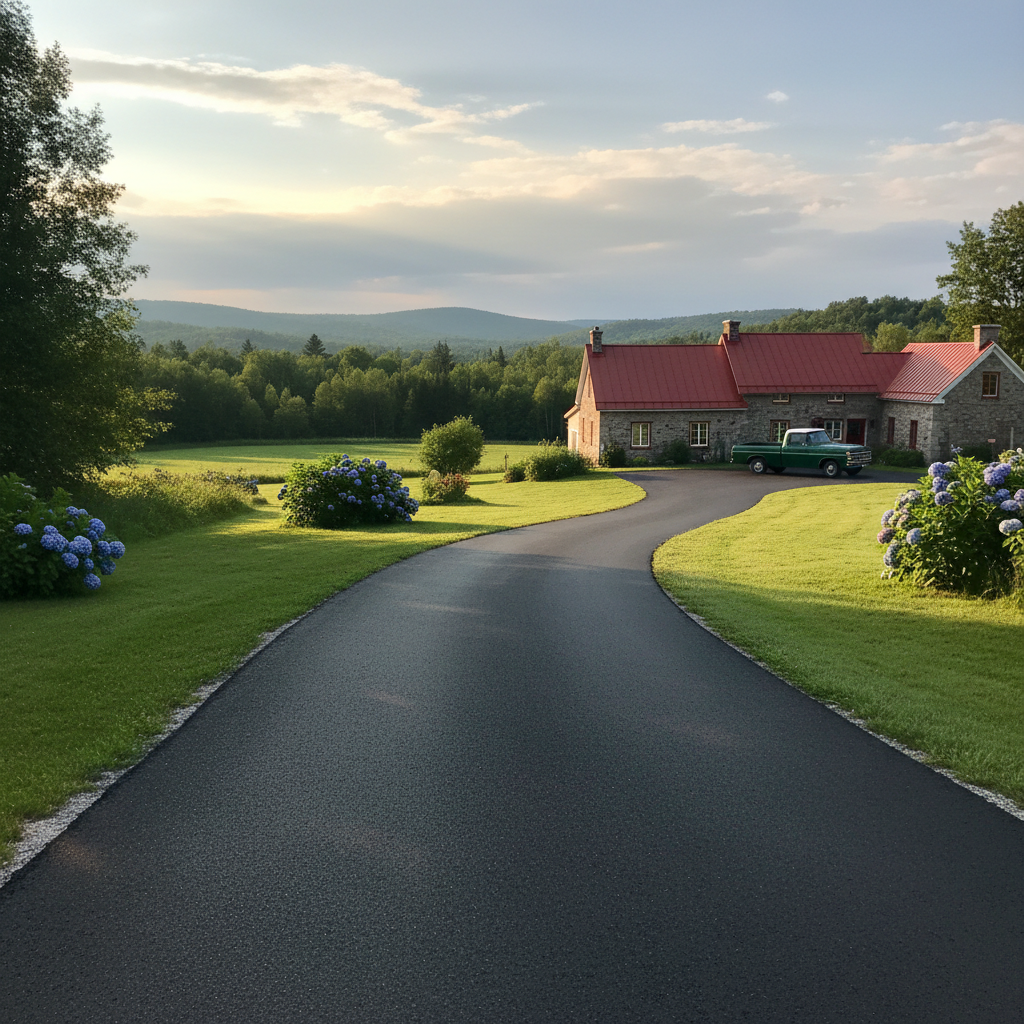
Driveway paving options and costs in Creston
Creston homeowners typically have a lot of influence on driveway paving decisions because most homes here are single-detached—about 74.0% of dwellings—so private driveways are a major part of what we do. With 2,035 homeowner households (76.2% of all households, Statistics Canada, 2021 Census), many projects are planned around accessibility, curb appeal, and spring melt performance rather than lowest first cost alone. That said, Creston’s Kootenay location in a colder interior climate is a real cost driver: frost penetration and repeated freeze–thaw cycles can move water and expand soils under thin pavements if drainage and base thickness aren’t right.
In practice, contractors usually build driveways with a deeper, compacted granular base and careful grading to shed water away from the surface. Local frost depth is commonly in the 45–60 inch range depending on elevation and micro-climate, so we treat driveways as frost-sensitive slabs—not just a surface layer. The other big factor is scheduling: the paving season is shorter (late spring through early fall), which tightens availability and can push prices toward the higher end of BC’s range when crews are booked.
If you’re seeing more paving demand in town, one of the most common areas we hear about is the downtown-access and near-rail corridor properties where access is tight and drainage details matter for longevity. If you want a clear comparison, use the cost bands below as a starting point for planning your driveway and base scope—then we can refine it with your measurements, soil conditions, and any needed tear-out.
| Material |
Lifespan |
Maintenance |
Best For |
Price per sq ft |
| Asphalt (new installation, proper base) |
15–25 years |
Seal coat every 3–5 years |
Best value for a smooth, durable surface when base and drainage are correct |
$4.50–$7.50 |
| Asphalt (overlay on existing gravel base) |
10–18 years |
Seal coat every 3–5 years; monitor rutting |
Situations where you’re keeping a mostly stable base and want lower excavation |
$3.75–$6.50 |
| Interlocking concrete pavers |
25–40 years |
Weeding/spot cleaning; occasional panel replacements |
Repairable surface and stronger curb appeal |
$6.00–$10.00 |
| Poured concrete (broom finish) |
25–35 years |
Light seal as recommended; patch crack if needed |
Low-maintenance look with a solid, monolithic surface |
$7.00–$12.00 |
| Exposed aggregate concrete |
25–35 years |
Periodic cleaning; optional seal |
Slip-resistant texture and a premium appearance |
$8.50–$13.50 |
| Gravel / crushed stone (budget option) |
3–8 years (varies by traffic and drainage) |
Re-grade and top-up annually |
Quick, budget-friendly turnaround when frost concerns are managed |
$1.50–$3.25 |
Prices are estimates only and vary by project scope, site access and material selection.
What affects the price of paving in Creston
In Kootenay, it’s common to see driveway quotes for the “same” surface come back 30–50% apart, even when homeowners choose similar-looking finishes. The difference usually isn’t the top layer—it’s the work required below grade to control water and resist frost heave. In Creston and the wider Kootenays, deeper frost depth and more freeze–thaw cycles are decisive cost factors. Where you might be able to get by with thinner granular build-up on milder coastal sites, interior zones often need additional compacted granular thickness (commonly 6–10 inches of compacted granular base for driveways in the region, adjusted upward where soils are weaker or clayey). That means more excavation, more imported base, and more time for proper compaction in thin lifts.
The paving season is shorter too. Hot-mix asphalt typically requires air temperatures above about 10°C to install properly, so crews stage work into a limited window. That concentrates demand and tightens schedules. Concrete has its own constraints: air entrainment and proper curing matter to reduce freeze-thaw damage, and weather staging can affect manpower days.
Two practical Creston examples that swing costs: (1) older homes built before 1981—57.5% of dwellings in the area—often have older subgrades, basement/roof-runoff drainage issues, or prior repairs that require additional tear-out and regrading; (2) driveways that route water toward the roadway or toward foundation edges can require more granular undercut and drainage correction. For homeowners, that’s why an asphalt driveway can land in the lower end of BC’s band (for example around the $7,000–$13,000 range), while a paver or properly reinforced concrete job often pushes higher within $9,000–$16,000 or $11,000–$18,000 respectively depending on excavation and base.
| Price Factor |
Why It Matters |
Cost Impact |
| Driveway area in sq ft |
Surface area drives material quantities and installation labour |
$2.00–$9.00 per sq ft equivalent, depending on scope |
| Base depth required |
Frost line conditions dictate granular thickness to prevent heave and cracking |
Often adds $1,000–$4,000 when extra excavation/base is required |
| Grading and drainage work |
Slope, swales, and runoff control keep water out of the base |
May add $500–$3,500 based on site corrections |
| Tear-out of existing surface |
Breaking up, hauling, and disposal of old asphalt or concrete is labour-heavy |
Typically $800–$3,000 depending on thickness/access |
| Edge restraints and curbing |
Pavers and some asphalt edges need restraint to prevent movement and spreading |
Often $600–$2,000 for proper containment |
| Sealing requirement |
Asphalt needs seal timing to protect from UV and moisture intrusion |
Generally $600–$1,500 as a future maintenance allowance |
| Site access |
Narrow lots slow equipment, increase staging and manual handling |
Can add $300–$1,200 for added labour and time |
| Asphalt mix specifications |
Freeze-thaw-rated mix design supports better longevity in interior BC cycles |
Often adds $250–$1,000 versus basic mixes |
Permits & regulations in British Columbia
In British Columbia, paving a private driveway within your own property typically does not require a building permit—especially when you’re replacing the existing hard surface and staying within your property boundaries. However, if the work affects the municipal right-of-way, you should expect municipal approval. Examples that usually DO require permits/approvals include creating or changing a curb cut/apron where it meets the roadway, altering boulevard areas, or making modifications that affect storm drainage (such as changing catch basins, culverts, or drainage flow paths). Some municipalities also have lot-grading bylaws that restrict how close a hard surface can be to property lines and how water must be directed; this matters a lot in Creston where water management helps protect base integrity in winter freeze–thaw.
Before excavation, confirm utility locates. In BC this is commonly handled through BC 1 Call. Then, verify your contractor’s coverage and ability to work locally: (1) Licensing—check the appropriate online registry for your contractor’s status (trade requirements vary by scope). (2) Liability insurance—request a current certificate of insurance naming you as additional insured if offered. (3) WCB/coverage—ask for proof of clear status where applicable and match it to the crew performing the work. Step-by-step, you can: request documentation before signing, verify the dates are current, and keep copies with your contract. If any work touches drainage or the boulevard edge, ask the contractor whether they are handling approvals or whether you must.
Asphalt vs pavers vs concrete for Creston driveways
For Creston’s freeze–thaw climate, the best driveway choice often comes down to how much you value upfront cost versus long-term repair flexibility. Asphalt is usually the lowest upfront option, and a properly built asphalt driveway can perform well when it’s installed over a correctly compacted granular base and graded to shed water. The trade-off is ongoing maintenance: in Kootenay conditions, sealing is commonly needed every 3–5 years to protect the surface and slow moisture penetration during wet shoulder seasons and spring melt.
Interlocking concrete pavers cost more up front, but they’re highly repairable. If one area settles from drainage issues or a frost-impacted subgrade pocket, pavers can be lifted, corrected, and reset without replacing the whole driveway. That’s a big advantage for older properties (57.5% built before 1981) where underground drainage or past repairs may be unpredictable. Poured concrete sits mid-to-higher on cost, and when it’s air-entrained and correctly cured it can last a long time; however, freeze–thaw cracking and surface scaling are real risks if workmanship and air entrainment aren’t right. Also, de-icing salts and repeated snow-plough impacts can accelerate surface wear if the finish isn’t suited and joints aren’t handled properly.
For Kootenay’s winters, drainage and base prep are what make all three materials perform. We typically design around deeper granular build-ups (commonly 6–10 inches compacted granular base for these driveways, increased for weaker/clayey soils) and reliable cross-slope or swales. If you want a concrete dollar example: homeowners sometimes start with asphalt in the $7,000–$13,000 band, then choose pavers near the $9,000–$16,000 band when they want curb appeal plus the ability to repair localized failures. In that scenario, the extra cost is justified when you expect heavier plough contact, mixed soil, or want an upgrade without committing to a full replacement later.
| Material |
Frost Resistance |
Curb Appeal |
Repair Method |
Lifespan |
Price Band |
| Asphalt (sealed regularly) |
Good with proper base + drainage |
Moderate (clean, smooth look) |
Patch and re-tape/seal local areas |
15–25 years |
$7,000–$13,000 |
| Interlocking concrete pavers |
Very good with correct restraint/base |
High (variety of colours/patterns) |
Lift, re-level base, replace units |
25–40 years |
$9,000–$16,000 |
| Poured concrete (air-entrained) |
Good when air-entrained and properly cured |
Moderate to high (clean slab look) |
Crack patching; slab replacement if severe |
25–35 years |
$11,000–$18,000 |
| Exposed aggregate concrete |
Good with correct mix + placement |
High (textured premium finish) |
Patch/overlay options; selective repair where feasible |
25–35 years |
$12,000–$20,000 |
| Permeable pavers (drainage grid) |
Very good where water control is critical |
Moderate to high (functional design) |
Lift-and-repair localized areas |
20–35 years |
$10,000–$17,000 |
| Chip seal / tar-and-chip |
Moderate; depends on base and maintenance |
Low to moderate |
Re-chip/seal as wear appears |
7–15 years |
$6,000–$11,000 |
How to choose a paving contractor in Creston
Choosing the right paving contractor in Creston comes down to verifying coverage and matching the quote to the real scope of work. In British Columbia, you should ask each contractor for proof of valid licensing status (where applicable to the work they’re doing), current liability insurance, and WCB coverage information (commonly WCB/Workers’ Compensation coverage depending on the type of work and employer structure). How to check: (1) look up the contractor through the appropriate provincial online registry; (2) request a certificate of insurance and confirm it’s current (not expired) and that the job address is covered; and (3) ask for proof of clear standing/coverage documentation for the crew assigned to your project.
Get 2–3 itemised written quotes—not just a lump sum. You want labour and materials broken out: excavation/hauling, granular base depth, compaction, asphalt or concrete supply, edge restraints, forms, disposal, and reinstatement. Read exclusions line-by-line: is permit work included if the job affects boulevard/drainage? Who pays for disposal? Is existing base removal included, and what happens if unexpected unsuitable soil is discovered? Ask about warranty too: workmanship warranty length, and whether product/manufacturer warranty applies and is transferable to you.
Payment matters in winter-town projects. Never pay more than 10–15% upfront. Use a holdback until the job is complete and final grading/surface tolerances are confirmed. Also request a written timeline: the start date, weather contingency, and an estimated completion window so you understand what happens if a late cold snap delays asphalt placement.
- Request itemised quotes with base depth, excavation volume assumptions, and compaction method.
- Confirm whether tear-out and disposal are included or quoted separately.
- Ask who supplies and places granular base (and what specification) for frost resistance.
- Check that edge restraints/curbing are in the scope (especially for pavers).
- Verify concrete air-entrainment and asphalt freeze-thaw-rated mix selection where applicable.
- Ensure the quote includes grading to shed water away from the foundation/edges.
- Ask about drainage corrections (swales, outlet direction, tie-in to existing systems).
- Look for documented workmanship warranty and a clear start/end date.
- Confirm manufacturer warranty coverage and whether it transfers to the homeowner.
- Use a payment schedule with 10–15% maximum deposit and holdback to completion.
- Get start date and completion estimate in writing, with weather-related contingencies.
- Ask for references from Creston/Kootenay jobs and photos of similar frost-season builds.
Red flags we see too often in Creston: contractors who won’t provide insurance documentation, “all-inclusive” lump-sum quotes with no base depth stated, missing compaction details (thin-lift requirements), deposits beyond 20%, and no written timeline or warranty language.
Frequently asked questions — paving in Creston
What causes potholes and how are they repaired?
Potholes in Creston usually start with water. During freeze–thaw cycles, water gets into small cracks or weak seams, expands as it freezes, and loosens the asphalt. In a colder interior climate like the Kootenays, this happens more often when drainage is off (low spots, poor slope, or water draining toward the driveway instead of away). Traffic then breaks the loosened edges, turning them into potholes.
Repair typically involves cutting out to sound material, removing any saturated/failed base, and rebuilding with compacted granular base before placing hot-mix asphalt. If the surrounding surface is badly deteriorated, an overlay may be more cost-effective than multiple patch jobs. For budget planning, homeowners sometimes compare sealing/repair options in the same season; sealing and repair work is often priced in the $600–$3,000 band depending on size and prep needs.
How do I prepare for a paving project?
Start by measuring the driveway area and marking any utilities, sprinklers, or landscaping that could be affected. In Creston, make sure downspouts and yard drainage aren’t directing runoff onto the future pavement—if they are, ask your contractor to include drainage/grading corrections in the scope. Confirm utility locates through BC 1 Call before excavation; even if you’re only replacing the surface, equipment may disturb shallow services.
Next, plan for access. If your lot is narrow or has tight turns, let the contractor stage equipment accordingly—this reduces risk to lawns and helps crews work faster in the limited late-spring-to-early-fall paving window. Finally, gather your quote documents and ask what’s included: tear-out, disposal, permits (if any municipal right-of-way/drainage changes are involved), and clean-up. Clear prep helps avoid change orders that can affect the final cost.
How do I compare paving quotes fairly?
Don’t compare quotes by total price alone. Instead, compare scope and build-up: base depth, compaction expectations, tear-out and disposal, edge restraints, and drainage/grading corrections. For frost protection in the Kootenays, quotes should specify adequate compacted granular base (commonly 6–10 inches, increased for weaker soils) and confirm how the contractor will shed water away from the driveway and house.
Ask for an itemised breakdown rather than a lump sum, and confirm the material selection. Asphalt quotes should state mix design intent for freeze–thaw durability, while concrete quotes should confirm air-entrainment and finish type. As a rough planning reference, an asphalt driveway in Creston often lands in the $7,000–$13,000 band, while pavers commonly fall in the $9,000–$16,000 band and concrete in the $11,000–$18,000 band—so if a number is wildly outside those ranges, ask why (or what’s missing).
Can asphalt be laid in cold weather in Creston?
Asphalt placement in Creston is weather-dependent. Hot-mix asphalt typically requires air temperatures above about 10°C to place and compact correctly; colder conditions can prevent proper compaction, which increases the risk of early rutting, cracking, and moisture intrusion. Because Creston’s paving season is usually late spring through early fall, most contractors plan around this window and staging to reduce downtime after cold snaps.
If a cold night threatens, your contractor should explain mitigation—cold-weather staging, additives where appropriate, and limits on production/placement. Still, the safest approach for long-term performance is to schedule during workable temperatures and ensure the underlying base is dry enough for paving. If you’re comparing quotes, ask what the contractor does when temperatures drop, and whether the schedule assumes “best-case” weather.
What is a driveway apron and do I need one in Creston?
A driveway apron is the transition area at the point where your driveway meets the roadway—typically the reinforced section that helps the driveway “connect” and handle vehicles turning or plowing over the change in grade. In some cases, a municipal right-of-way apron or curb cut treatment is required when you’re altering the boulevard or changing the approach. If your driveway is staying within the same footprint, you may not need major changes, but if there’s a bump, failing edge, or drainage issue at the roadway connection, an apron treatment can be the difference between a driveway that lasts and one that breaks repeatedly at the entrance.
Because rules can depend on how the work touches municipal property, ask your contractor to confirm whether any municipal approvals are needed for the apron/boulevard section. Your quote should clarify whether transition work is included.
How do I maintain my driveway through Creston winters?
Winter maintenance in Creston is mostly about preventing water damage and minimizing surface gouging. Start with plow technique: avoid scraping down to bare material, especially on asphalt edges and paver joints. Snow should be moved with care so you don’t repeatedly hit restraints/edges, which can loosen paving or chip the asphalt edge. Keep an eye on drainage—if water ponds after storms or spring melt, it will accelerate freeze–thaw breakdown.
For asphalt, sealing timing matters. A seal coat is typically done every 3–5 years in Kootenay conditions, depending on wear; catching it early is often cheaper than replacing worn top course. If you notice small cracks, address them promptly with repairs so water can’t migrate downward. For repairs/sealing planning, many homeowners budget in the $600–$3,000 range for targeted maintenance work.