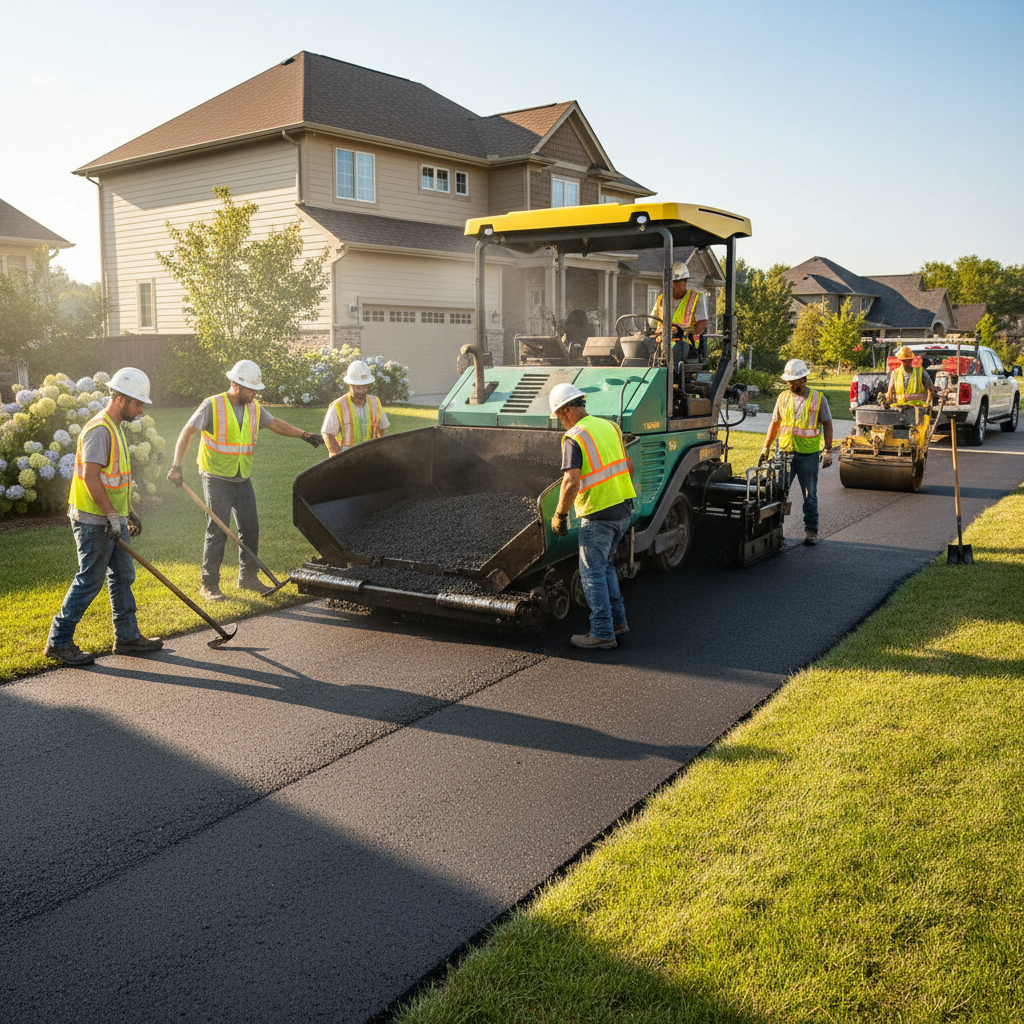
Driveway paving options and costs in Edson
Edson, Alberta sees driveway work year-round in planning, but only in-season in reality. With 60.6% of local dwellings being single-detached houses (Statistics Canada, 2021 Census), most of the demand is for private driveway paving that can handle heavy freeze–thaw cycles. In the Banff–Jasper–Rocky Mountain House corridor, that climate reality drives the biggest cost difference between “cheap pavement” and “built to last.” Frost penetration in this region is typically deep, and the structure has to be protected with a well-graded granular base, tight compaction, and positive drainage. If water gets trapped under the surface, you’ll get heaving, cracking, and rutting as the subgrade repeatedly cycles above and below freezing.
Contractors also price higher because the paving season is shorter—hot-mix asphalt needs warm air temps (often above 10°C), and cold nights arrive early at elevation. That compresses scheduling into late spring through early fall, which increases mobilization pressure. In practice, you’ll see the most attention on paving near the busy residential pockets along 50 Avenue and the broader south Edson growth areas, where driveways get widened for parking and accessibility.
Below are the realistic material options Edson homeowners usually compare, and the typical lifespan and maintenance expectations in this freeze-friendly—but tough on pavement—region. Use the table to align budgets before you request a detailed quote.
| Material |
Lifespan |
Maintenance |
Best For |
Price per sq ft |
| Asphalt (new installation, proper base) |
15–25 years |
Sealcoat every 3–5 years; patch small areas as needed |
Most cost-effective full driveway rebuilds |
$9–$18 |
| Asphalt (overlay on existing gravel base) |
10–18 years |
More frequent patching early; seal after first season |
When subgrade is stable and base quality is adequate |
$7–$14 |
| Interlocking concrete pavers |
25–40 years |
Re-level or replace individual units; periodic joint sand top-up |
High curb appeal and repairable surfaces |
$18–$45 |
| Poured concrete (broom finish) |
20–30 years |
Seal optional; fill hairline cracks if they open |
Simple, long-term parking pads |
$15–$30 |
| Exposed aggregate concrete |
20–30 years |
Seal as recommended; patch matching sections if needed |
Slip-resistant texture and premium look |
$18–$34 |
| Gravel / crushed stone (budget option) |
3–8 years (varies by traffic) |
Regrade and top up every 1–3 years |
Temporary solution or low-traffic lots |
$4–$10 |
Prices are estimates only and vary by project scope, site access and material selection.
What affects the price of paving in Edson
In Edson, two driveways that look similar from the street can price out very differently—often by 30–50% across the Banff–Jasper–Rocky Mountain House corridor—because the cost is driven less by “surface choice” and more by what needs to happen under the pavement. Frost depth and aggressive freeze–thaw cycles are decisive cost factors here: deeper frost typically requires a thicker, well-compacted granular base to prevent heaving and cracking. That base is not just “more gravel”—it’s more excavation, more supply, and more time on compaction and drainage corrections. In milder coastal conditions, contractors can sometimes get away with thinner granular layers, but in colder inland regions like Alberta, you plan for a structure that stays stable through seasonal expansion and contraction.
The paving season is also shorter. Hot-mix asphalt typically needs air temperatures above about 10°C to place and compact properly, so spring weather delays can shift crews into overtime and tighten the schedule. That’s one reason asphalt and concrete pricing in this corridor can feel higher than national averages even for small civil jobs. Asphalt mix design matters too: a freeze–thaw-rated mix costs more than “basic blacktop,” but it performs better where winters are hard.
Concrete examples: (1) a driveway with poor slope or downspout discharge redirected toward the pavement often needs additional grading and subdrain work—this can move a job from the lower bands ($15–$30 for concrete or $9–$18 for asphalt) toward the higher end. (2) In older neighbourhoods with homes built before 1981—49.6% locally (Statistics Canada, 2021 Census)—it’s more common to find buried utilities, undocumented culverts, or irregular subgrades, which adds tear-out and rebuild time. Those are the hidden drivers behind what looks like a simple “patch and pave” request.
| Price Factor |
Why It Matters |
Cost Impact |
| Driveway area in sq ft |
More area means more base, asphalt/concrete, saw cuts, and finishing time |
Largest swing; can change totals by hundreds to thousands |
| Base depth required |
Frost penetration determines granular thickness to resist heaving/cracking |
Major cost increase when thicker engineered base is needed |
| Grading and drainage work |
Slope and drainage prevent trapped water under the surface |
Often adds excavation, re-compaction, and sometimes subdrain |
| Tear-out of existing surface |
Breaking and hauling old asphalt or concrete adds equipment and disposal costs |
Can move a mid-range job into the upper band |
| Edge restraints and curbing |
Prevents pavers/asphalt from spreading and migrating under traffic |
Moderate to high; improves longevity |
| Sealing requirement |
Asphalt in freeze–thaw climates benefits from sealing after placement (and later) |
Low per-year cost; delays deterioration |
| Site access |
Narrow/tight lots slow equipment movement and increase labour time |
Small area projects can get disproportionately expensive |
| Asphalt mix specifications |
Freeze–thaw-rated mix improves performance but costs more |
Usually adds to the upper end of the $9–$18 band |
Permits & regulations in Alberta
For most homeowners in Edson, paving a private driveway within your own property typically does not trigger a building permit. In Alberta, the work usually falls under property improvements—especially when you’re replacing an existing surface in roughly the same location and maintaining established drainage. Where permits and municipal approvals often come into play is when you work in the municipal right-of-way or change how water leaves the lot.
Examples of work that does commonly require municipal approval include: a new or modified curb cut/driveway crossing into the boulevard; changes to storm drainage patterns (such as adding or altering catch basins, culverts, or directing runoff toward the road); and major grading that affects how runoff flows offsite. Also, some municipalities have lot-grading or drainage bylaws that restrict how close hard surfaces can be to property lines and how slopes are handled. Always confirm specifics with the Town/County before you schedule excavation.
Step-by-step contractor verification (smart in Edson because utilities and older lots can complicate base work): (1) Call for utility locates before any digging. In Alberta, use Alberta One-Call so buried services are marked. (2) Ask for the contractor’s Alberta licence number (when applicable for the work they’re doing) and verify it through the appropriate online registry. (3) Request a certificate of insurance showing general liability with sufficient limits for paving/civil work. (4) Confirm WSIB/WCB coverage status through the contractor’s documentation—your quote should reflect that coverage is in place. (5) Ask for a current clearance letter (or equivalent proof) if they provide it as part of compliance.
Asphalt vs pavers vs concrete for Edson driveways
When you’re choosing driveway material in Edson, asphalt, interlocking pavers, and concrete all can work—provided the base and drainage are built correctly for the Banff–Jasper–Rocky Mountain House freeze–thaw climate. Asphalt is typically the lowest upfront option, but it performs best when homeowners plan for sealing every 3–5 years and timely patching. Interlocking concrete pavers cost more up front, yet they’re the most homeowner-friendly for repairs: a contractor can lift and replace only the damaged section instead of demolishing the whole surface. Poured concrete is often a middle ground for cost and durability, but it needs proper air-entrainment and good jointing to manage freeze–thaw movement; otherwise, you’ll see cracking sooner, especially where de-icing practices and plowing are aggressive.
Base preparation is the make-or-break step in this region. For deeper frost conditions, contractors generally build a thicker, engineered granular base and ensure positive drainage so water doesn’t sit beneath the surface. Asphalt and pavers still rely on the same principle: dry, well-compacted layers under the driveway. In practical terms, areas with consistent plow patterns and salted winters tend to age surfaces faster at edges and transitions.
Where does the price difference make sense? If you’re comparing asphalt (in the $9–$18 per sq ft band) to pavers (often $18–$45), the extra cost can be justified if you want long-term curb appeal and easy spot repairs after heaving or utility access. If you’re on a tighter budget and can commit to sealing, asphalt can deliver strong value; if you expect the driveway to be modified later (widening, drainage tweaks), pavers may be worth it because the surface can be reworked.
| Material |
Frost Resistance |
Curb Appeal |
Repair Method |
Lifespan |
Price Band |
| Asphalt (sealed regularly) |
Good with proper base and seal maintenance |
Moderate |
Cut and patch localized areas |
15–25 years |
$9–$18 |
| Interlocking concrete pavers |
Very good due to flexible repair and jointing |
High |
Remove and replace individual pavers |
25–40 years |
$18–$45 |
| Poured concrete (air-entrained) |
Good to very good if properly air-entrained and jointed |
Moderate to high |
Slab patching and crack/segment repair |
20–30 years |
$15–$30 |
| Exposed aggregate concrete |
Good if curing and base are correct |
Very high |
Localized patching with matched finish |
20–30 years |
$18–$34 |
| Permeable pavers (drainage grid) |
Excellent when designed with correct subdrain system |
High (architectural look) |
Replace affected units; maintain drainage system |
20–35 years |
$25–$55 |
| Chip seal / tar-and-chip |
Fair (surface wears faster under heavy plowing) |
Low to moderate |
Ongoing patching and periodic resurfacing |
5–10 years |
$6–$14 |
How to choose a paving contractor in Edson
Choosing the right paving contractor in Edson is mostly about verifying compliance and comparing apples-to-apples scope. In Alberta, confirm the contractor’s licence status (when applicable for the work type), and make sure their general liability insurance is current and actually covers paving/civil construction risk. Then check WSIB/WCB coverage documentation. If a contractor can’t show proof, treat it as a serious warning—paving involves excavation, heavy equipment, and jobsite hazards.
Next, request 2–3 itemised written quotes. You want a breakdown that clearly separates labour and materials, including excavation, base supply, grading, compacted thickness, surface course, and any edge restraints. Avoid “all-in” pricing that doesn’t show what’s included—especially when you’re dealing with freeze–thaw conditions that often require extra base depth and drainage correction. Also confirm whether disposal/hauling of removed material is included, whether permit or municipal approval fees are your responsibility, and whether utility locates are arranged before digging.
Warranty matters too: ask for a workmanship warranty length (for example, surface performance after placement and patching responsibility) and understand the difference between workmanship and product/manufacturer warranty. A good workmanship warranty should address issues like segregation, improper compaction, and premature failures linked to installation. Clarify if warranties are transferable to future owners if you sell your home.
On payment schedule, never pay more than about 10–15% upfront. Hold back a portion until the job is complete and the final surface meets grade and finish requirements. Get a written start date and an estimated completion window aligned with typical Edson weather and asphalt curing timing.
- Provide Alberta proof of coverage: general liability and WSIB/WCB documentation.
- Share their licence/registry details and request a clearance letter if offered.
- Itemise quotes (base depth, thicknesses, compaction requirements, materials).
- Confirm excavation limits, haul-away/disposal, and re-use of topsoil.
- Specify drainage and slope targets (water must drain away from structures).
- Require utility locates before digging.
- Ask for edge restraints/curb details so materials don’t migrate.
- For asphalt, include sealcoat timing guidance (often after the first season).
- Ask what happens if weather shifts (rain/cold nights) and how curing is protected.
- Confirm saw-cut/joint plan for concrete, and air-entrainment specification where applicable.
- Detail cleanup and final grading around sidewalks, steps, and garage entries.
- Get a written timeline and a clear warranty contact process.
Red flags I see in Edson: crews showing up without clear proof of WSIB/WCB or insurance; quotes that don’t specify base thickness/compaction; “we’ll pour it and figure out drainage later” language; using the same mix/spec every season regardless of freeze–thaw demands; and avoiding written scopes while pushing large upfront deposits.
Frequently asked questions — paving in Edson
How deep should the base be for Edson's frost?
In Edson and the Banff–Jasper–Rocky Mountain House corridor, base depth is driven by frost penetration and freeze–thaw cycling, not by “standard driveway thickness.” As a rule of thumb, Alberta inland installations commonly require a thicker, engineered granular base than milder regions—often on the order of several inches of compacted granular layers plus additional thickness to reach the frost-resistant structure. The exact number depends on subgrade condition (how stable and well-drained it is), the expected traffic load (single vehicle vs. heavier equipment), and how much excavation is needed to remove topsoil/poor material. The most reliable approach is for the contractor to excavate to proper subgrade, confirm drainage/slope, and build up the granular structure accordingly so water doesn’t sit beneath the pavement. If the quote doesn’t mention granular thickness and compaction, ask for those details.
How often should I seal my asphalt driveway?
For asphalt in Edson, plan on a sealcoat after the pavement has properly cured—commonly after the first full season—then re-seal every 3–5 years depending on how busy the driveway is and how harsh winter wear is from plowing and traffic. The goal is to slow oxidation and reduce water infiltration at the surface. In this climate, freeze–thaw can magnify small surface issues; sealing is one of the cheapest ways to prevent water from getting into minor cracks before they grow. Your contractor may suggest staying closer to the 3-year end if you get frequent tire wear, regular sand use, or early surface raveling. If you’re budgeting, sealing and repair work can still be a relatively modest line item compared with complete replacement; regional sealing costs are often in the $300–$1,200 range for typical residential driveway touch-ups and seal jobs.
Why does my driveway crack and heave in winter?
Cracking and heaving usually come down to two things: water and weak support. In Edson’s freeze–thaw conditions, any water that gets under the asphalt or into the granular base can expand as it freezes, pushing the surface up (heave) and stressing it through repeated cycles. If the driveway base wasn’t deep or well-graded enough, or if compaction wasn’t tight, the subgrade can move during thaw periods and settle again during freeze. Also, drainage issues—such as a driveway slope that sends water toward the house or clogged edge drains—accelerate failure. Homes built in older eras (many in Edson are pre-1981) can have irregular subgrades or buried drainage changes that weren’t accounted for originally (Statistics Canada, 2021 Census). The fix is typically not just crack filling; it often requires addressing drainage and base integrity.
Do I need a permit to pave my driveway in Alberta?
In Alberta, paving a private driveway within your own property is commonly done without a building permit, particularly when you’re replacing an existing surface in roughly the same footprint and keeping drainage patterns similar. However, approvals are often needed when the work affects the municipal right-of-way—think new or changed curb cuts, boulevard work, or alterations to storm drainage that change how runoff reaches offsite infrastructure. Some municipalities also enforce lot-grading expectations that limit how close or how steep a hard surface can be near property lines. In Edson, the practical step is to confirm with the municipality whether your project touches boulevard/culverts or changes runoff. Regardless, call for utility locates before any excavation. If your contractor says “no permit ever,” ask them to list exactly what work they’re doing and whether it crosses into right-of-way or drainage changes.
How long before I can drive on new asphalt?
After asphalt placement in Edson, driving timing is mainly about curing and compaction readiness. Many residential driveways can be lightly trafficked relatively soon after installation, but it’s not always the same day depending on weather, lift thickness, and how the contractor manages rolling and cooling. Asphalt placed during cooler or late-day conditions may need more time to set. The contractor should provide a clear written “open to traffic” instruction and explain if any restrictions apply to heavy vehicles. In a short season climate, crews also manage weather windows carefully so the pavement cools and sets properly. If you’re comparing contractors, the best ones explain the curing plan instead of giving vague timelines. For example, asphalt projects priced in the $9–$18 per sq ft band should still come with a workmanship plan that considers placement temperature, rolling, and schedule constraints unique to Edson winters.
What causes potholes and how are they repaired?
Potholes typically form when water infiltrates a weak spot under the pavement. In Edson’s freeze–thaw cycle, trapped moisture expands during freezing and breaks down the base/support, then traffic (and plowing) enlarges the void into a pothole. Common causes include missed patching of small cracks, inadequate base compaction, poor drainage, or inadequate sealcoat maintenance that lets water get under the surface. Repairs usually start with cutting out the failing area, removing any saturated or unstable base material, and replacing it with properly compacted granular and/or asphalt layers. A competent repair should re-establish proper slope and edge support so the patch doesn’t “break out” again. For homeowners, the key is speed: filling small failures early costs far less than waiting until the base has been washed out. Depending on the job size, sealing & repair work can be budgeted broadly within the $300–$1,200 range for many driveway touch-ups and localized fixes.