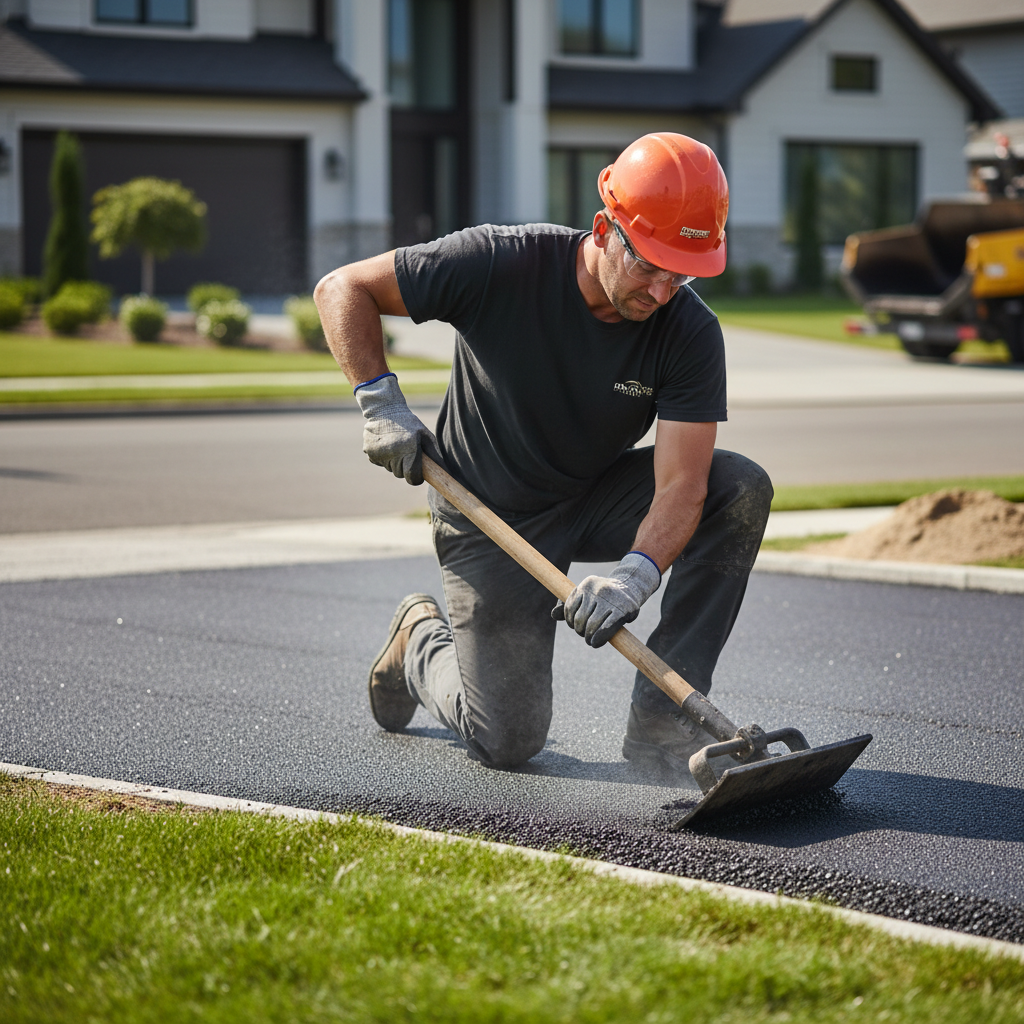
Driveway paving options and costs in Barrhead
Barrhead homeowners have a few proven driveway paving routes, and the right one usually depends on budget, how often you want repairs, and how the driveway is built for our Central Alberta freeze-thaw cycles. In Barrhead, most private driveways serve single-detached homes—around 68.9% of dwellings—so surface performance matters because driveways see heavy use from parking, ploughing, and winter traction. With a population of about 4,320 and roughly 1,195 homeowner households (Statistics Canada, 2021 Census), you’ll also find consistent seasonal demand when contractors are booking spring and early summer.
In the Edmonton economic region, frost protection and drainage design often matter as much as the wearing surface. Edmonton-area guidance commonly reaches deeper frost depths (often around 1.5 metres or more), which means a driveway needs stable subgrade, a properly graded granular base, and surface plus subsurface drainage to limit frost heave, cracking, and settlement. Freeze-thaw cycling is a major cost driver: water left in the base expands when frozen and weakens layers when thawed. On top of that, the paving season is tighter in colder Prairie markets—hot-mix asphalt generally requires air temperatures above about 10°C—so bids can be higher during peak months when crews are busier.
For Barrhead, demand is especially noticeable around the older residential pockets where homes built before 1981 are common (53.4% of dwellings), because more existing driveways need reconstruction rather than simple resurfacing. Below is a practical comparison of common materials and where their costs typically land; your final quote depends on removal, grading, base depth, and drainage.
| Material |
Lifespan |
Maintenance |
Best For |
Price per sq ft |
| Asphalt (new installation, proper base) |
15–25 years |
Sealcoat every 3–5 years |
Clean, consistent look with the lowest upfront cost of pavement |
$3.50–$6.50 |
| Asphalt (overlay on existing gravel base) |
10–18 years |
Sealcoat every 3–5 years; monitor edge raveling |
When the base is sound and only needs partial prep |
$4.50–$7.50 |
| Interlocking concrete pavers |
25–40 years (good base) |
Weed control; occasional stone-joint topping |
Repairable surface and strong curb appeal |
$7.50–$13.00 |
| Poured concrete (broom finish) |
25–35 years |
Minimal; watch for surface scaling and seal if specified |
Low-maintenance monolithic driveway |
$6.00–$10.00 |
| Exposed aggregate concrete |
25–35 years |
Occasional cleaning; seal depending on finish |
Slip resistance and premium appearance |
$7.50–$12.00 |
| Gravel / crushed stone (budget option) |
3–10 years (varies widely) |
Regrade and top up every 2–4 years |
Fast, lowest cost before upgrading |
$2.00–$4.00 |
Prices are estimates only and vary by project scope, site access and material selection.
What affects the price of paving in Barrhead
In Barrhead, you can see the same “driveway size” quote range by 30–50% across the Edmonton area because paving is priced around what’s under the surface—especially frost protection and drainage—not just the top finish. Two driveways can both be “about the same square footage,” but one may require full base rebuild and proper drainage corrections while the other only needs trimming and a surface course. That’s why asphalt bids can swing within the wider local band of about $7,000–$15,000 for typical asphalt driveway projects, and paver or concrete jobs can shift toward the higher end when excavation depth increases.
Frost line depth and freeze-thaw cycles are decisive in the Edmonton region. Deeper frost means thicker, well-compacted granular base layers to reduce heave and cracking; if contractors estimate too shallow a base, you often pay later through settlement, potholes, or “edge breakdown.” Asphalt also depends on freeze-thaw-rated mix design and proper compaction. Asphalt production and placement are seasonal: hot-mix asphalt typically needs air temperatures above 10°C, and the shorter workable season can concentrate labour and equipment demand, pushing mobilization costs up during spring/summer peaks.
Concrete and pavers can also change price in local conditions. For example, older existing driveways (common in homes built before 1981) often have weak material that must be ripped out and hauled, which adds breaking costs and dump fees—sometimes pushing a concrete or paver job upward into the mid-to-high end of its band. On the other hand, if your subgrade is firm and your driveway already slopes correctly to carry meltwater away from the base, you can often keep the project closer to the lower end—particularly for asphalt resurfacing rather than full reconstruction. Your driveway’s age, drainage plan, and base condition are the difference between “$X to fix” and “$X to rebuild.”
| Price Factor |
Why It Matters |
Cost Impact |
| Driveway area in sq ft |
Most costs scale directly with square footage of paving and base |
High—primary driver |
| Base depth required |
Frost line determines granular thickness and compaction effort |
High—major excavation/haul cost |
| Grading and drainage work |
Slope, swales, and drainage corrections prevent water pooling |
Medium to high—more stone and labour |
| Tear-out of existing surface |
Breaking and hauling concrete or old asphalt; disposing properly |
Medium to high—depends on thickness |
| Edge restraints and curbing |
Prevents paver spread and asphalt edge failure under freeze-thaw |
Medium—often underestimated |
| Sealing requirement |
Asphalt needs sealcoat after curing (typically 6–12 months) |
Low to medium—adds scheduled future cost |
| Site access |
Narrow lots slow equipment movement and can increase labour hours |
Medium—mobilization premium |
| Asphalt mix specifications |
Freeze-thaw-rated mix and correct binder improve durability |
Medium—costs more per ton |
Permits & regulations in Alberta
For most Barrhead homeowners, the paving work itself is straightforward from a approvals standpoint. Typically, paving a private driveway within your own property does not require a building permit. Where things change is when your project touches municipal infrastructure—especially anything in the municipal right-of-way or that affects drainage. In Alberta municipalities around Edmonton (including areas like Barrhead’s service connections), contractors and homeowners generally need municipal approval if you’re doing things like a new curb cut, altering a boulevard area, changing the driveway’s connection where it crosses municipal land, or modifying storm drainage that routes water through ditches and culverts. If the driveway grade is adjusted close to the road or if drainage patterns change, expect review and conditions.
Regardless of permit requirements, you should always call for utility locates before excavation. In Alberta, use Alberta One-Call to mark buried services on your lot so the base rebuild doesn’t hit power, telecom, or gas lines.
To verify your contractor is properly set up, follow a simple checklist: (1) confirm the contractor’s Alberta licence/standing using the applicable trade registry information they provide and any online listings they reference; (2) request a current certificate of insurance naming you as the affected party where appropriate, and confirm liability coverage limits; (3) ask for proof of WSIB/WCB coverage (workers’ compensation) for their crews. Clear, recent documents should be supplied before scheduling. Also ask whether disposal/hauling is included and who manages any excess materials.
Asphalt vs pavers vs concrete for Barrhead driveways
Choosing between asphalt, interlocking pavers, and concrete in Barrhead usually comes down to three things: upfront budget, repair strategy, and how your driveway will tolerate Edmonton-region freeze-thaw and winter maintenance. Asphalt typically has the lowest upfront cost, but it relies on a maintenance rhythm—sealcoat every 3–5 years—to slow oxidation and protect the surface from salt and moisture. Interlocking concrete pavers cost more to install, yet they’re the most flexible when you need localized repairs: individual stones and bedding can be lifted and reset without replacing the whole driveway. Poured concrete sits in the middle on cost and is durable when properly air-entrained and finished, but it can develop cracking if the base isn’t built right for frost movement or if water gets under the slabs.
In the Edmonton economic region, base preparation and drainage are non-negotiable across all three materials. If frost depth is commonly deeper (often around 1.5 metres or more in local guidance), the granular base and subgrade need correct thickness, compaction, and grading so water doesn’t stay in contact with the base. In Barrhead winters, meltwater and ploughing forces add stress, and de-icing salt can accelerate scaling on poorly finished concrete surfaces.
Where the price difference is justified: if you expect future utility work, prefer the ability to patch one area, or want a crisp, premium curb look, pavers can make sense—even if they’re higher than asphalt. For example, a typical asphalt driveway estimate might land around $7,000–$15,000, while pavers commonly run into roughly $12,000–$28,000. If your priority is “repairable in sections” and long-term appearance, that extra upfront cost can pay back by avoiding full replacement later.
| Material |
Frost Resistance |
Curb Appeal |
Repair Method |
Lifespan |
Price Band |
| Asphalt (sealed regularly) |
Good with proper base and drainage; relies on sealcoat |
Medium |
Mill/patch asphalt at the affected area |
15–25 years |
$7,000–$15,000 |
| Interlocking concrete pavers |
Very good when bedding and base are designed for frost |
High |
Lift pavers, recompact base/bedding, reinstall |
25–40 years |
$12,000–$28,000 |
| Poured concrete (air-entrained) |
Good if air-entrained and base is frost-protected |
Medium |
Section patching or concrete repair for small areas |
25–35 years |
$9,000–$22,000 |
| Exposed aggregate concrete |
Good; similar requirements to concrete |
High |
Surface repair/patching is less seamless than pavers |
25–35 years |
$10,000–$24,000 |
| Permeable pavers (drainage grid) |
Good; helps manage water at the surface |
High (modern look) |
Replace affected units/grids as needed |
20–35 years |
$14,000–$30,000 |
| Chip seal / tar-and-chip |
Fair to good; depends heavily on base and maintenance |
Low to medium |
Spot patching; periodic refresh coats |
7–12 years |
$5,500–$12,000 |
How to choose a paving contractor in Barrhead
Picking the right paving contractor is one of the biggest levers you have for protecting your driveway from frost damage in Barrhead. Start with credentials. In Alberta, ask for proof of liability insurance (so you’re covered if something gets damaged) and proof of WSIB/WCB coverage for their workers. Request a certificate of insurance and confirm it’s current. If you don’t receive clear paperwork, treat that as a warning sign. Next, verify they’re set up to do the scope you’re hiring for—excavation, base supply, compaction testing practices (when applicable), and the asphalt or concrete work itself.
Then get 2–3 itemised written quotes. You want labour and materials broken down—base, granular supply, removal/disposal, saw-cutting (if concrete), curb/edge restraints, paving material, and cleanup. Avoid “lump sum only” quotes where exclusions are vague. Read the scope for what’s not included: permit pull (if required), disposal/hauling fees, structural repairs to subgrade, geotextile (when specified), and any drainage additions. Ask how they handle areas that fail during compaction or where the existing base is weaker than expected.
Warranty matters too: confirm the workmanship warranty length and whether it includes base settlement issues tied to their construction (not just surface cracking). Separate product/manufacturer warranties from workmanship. Also ask whether warranties are transferable to future owners.
For payment schedule, never let the contract require more than about 10–15% upfront. Hold back a portion until the job is completed and surfaces are properly cured/finished, especially for asphalt and concrete. Finally, insist on a start date and completion estimate in writing so seasonal delays are accounted for.
- Ask for insurance and WSIB/WCB documentation before signing.
- Confirm the quoted scope includes excavation depth and base thickness.
- Require the drainage plan in writing (slope, outlet, and where water goes).
- Ensure tear-out and disposal are itemised (old asphalt/concrete).
- Check whether edging/curbs are included (pavers especially).
- Ask about compaction approach and equipment for granular base.
- Request the asphalt mix type/spec for freeze-thaw conditions.
- Confirm concrete is air-entrained where applicable.
- Clarify jointing/saw-cut plan for concrete (if included).
- Verify sealcoat timing for asphalt and who supplies/installs it.
- Read exclusions for settlement, drainage issues, or unforeseen utilities.
- Use a payment schedule with a holdback until the final walkthrough.
Common red flags in Barrhead: quotes with no base thickness described, missing disposal/haul details, “we’ll fix it later” warranty language, reluctance to provide insurance/WSIB paperwork, and schedules that can’t give a written start/completion window for the season.
Frequently asked questions — paving in Barrhead
How much does driveway crack repair cost in Barrhead?
In Barrhead, crack repair pricing depends on whether you’re dealing with a narrow asphalt hairline crack, a failed joint near the edge, or a wider crack that needs base stabilization. For typical asphalt sealing and repair, many homeowners see work in the range of $600–$3,500, with the lower end often applying to minor cleaning, crack routing, and a reseal. Wider cracks or areas that have started to break up usually require more preparation, sometimes a patch to re-stabilize the surrounding surface so water doesn’t keep migrating in during thaw cycles. Because freeze-thaw cycling is a big factor in the Edmonton region, “just seal it” sometimes fails if the base is already compromised—your contractor should explain what they see in the field before quoting.
What base thickness do I need for pavers in Barrhead?
Paver base thickness in Barrhead hinges on frost protection and drainage. In the Edmonton economic region, deeper frost and freeze-thaw cycles often mean you need a more substantial, well-compacted granular base so water doesn’t stay trapped and expand under freezing. While the exact depth is best confirmed after the contractor evaluates your subgrade and removes a small test area, the typical approach is to use a stable subgrade plus layered compacted granular base, then a bedding sand layer for pavers. If your existing base is weak (common on older driveways—Barrhead has a large share of homes built before 1981 at 53.4% per Statistics Canada, 2021 Census), plan for more excavation and haul. A proper slope to daylight drainage is also critical; without it, even “thick enough” base can still heave if meltwater sits.
How do I get the most accurate paving quote in Barrhead?
To get the best-accuracy quote in Barrhead, ask for a site visit where the contractor can assess the existing base, not just measure your driveway footprint. Request an itemised breakdown that includes excavation depth, base thickness, drainage corrections, tear-out and disposal, and the paving material and application method. Quotes should explain assumptions: whether the job is overlay vs full rebuild, what happens if they uncover soft subgrade, and whether edge restraints/curbing are included. Also confirm whether any municipal right-of-way work is involved (new curb cuts or drainage changes can require approvals). For utilities, make sure locates are called before excavation. Finally, ask for a written start date and completion estimate—seasonal scheduling matters because hot-mix asphalt placement depends on warm conditions.
How much does it cost to pave a driveway in Barrhead?
For Barrhead homeowners, asphalt and concrete projects usually fall into the local driveway pricing bands. Asphalt driveway paving is commonly estimated in the range of $7,000–$15,000 depending on square footage, base rebuild needs, and access. Interlocking concrete pavers are typically higher, often landing around $12,000–$28,000 because of excavation, base preparation, and the labour-intensive installation. Concrete driveways generally fall around $9,000–$22,000 with variations driven by thickness, finishing, and whether the base must be rebuilt. If your existing driveway has weak material or drainage issues, expect pricing toward the upper end because frost protection work becomes the main cost driver.
Asphalt vs interlocking pavers vs concrete — which is best in Barrhead?
There isn’t a single “best” option for every Barrhead home, but asphalt, pavers, and concrete each fit different priorities under Edmonton-region freeze-thaw conditions. Asphalt is usually the best value if you’re willing to plan for sealcoat every 3–5 years and you have a properly designed granular base and drainage. Interlocking concrete pavers tend to be best if curb appeal matters and you want a surface that can be repaired section-by-section without replacing the whole driveway. Concrete is a strong choice when it’s air-entrained and correctly base-supported, but it can crack if drainage or base preparation is off. If you can compare bids, the “best” option is often the one where the contractor clearly explains base thickness, slope/drainage, and the local freeze-thaw-rated mix or concrete spec—not just the material type.
How long does a paved driveway last in Barrhead?
Typical service life in Barrhead depends on the driveway structure (subgrade, base thickness, drainage), plus how winter maintenance is handled. When a contractor builds the base properly for freeze-thaw conditions, asphalt driveways often last about 15–25 years, especially with regular sealcoat. Interlocking pavers can commonly last 25–40 years because localized areas can be lifted and reset if settlement happens. Poured concrete often targets about 25–35 years with the right air-entrainment and finishing practices. Exposed aggregate is similar to concrete in longevity. If you skip sealing on asphalt or ignore drainage corrections, the driveway may fail sooner—because water trapped in the base is what drives frost heave and cracking through Alberta winters.