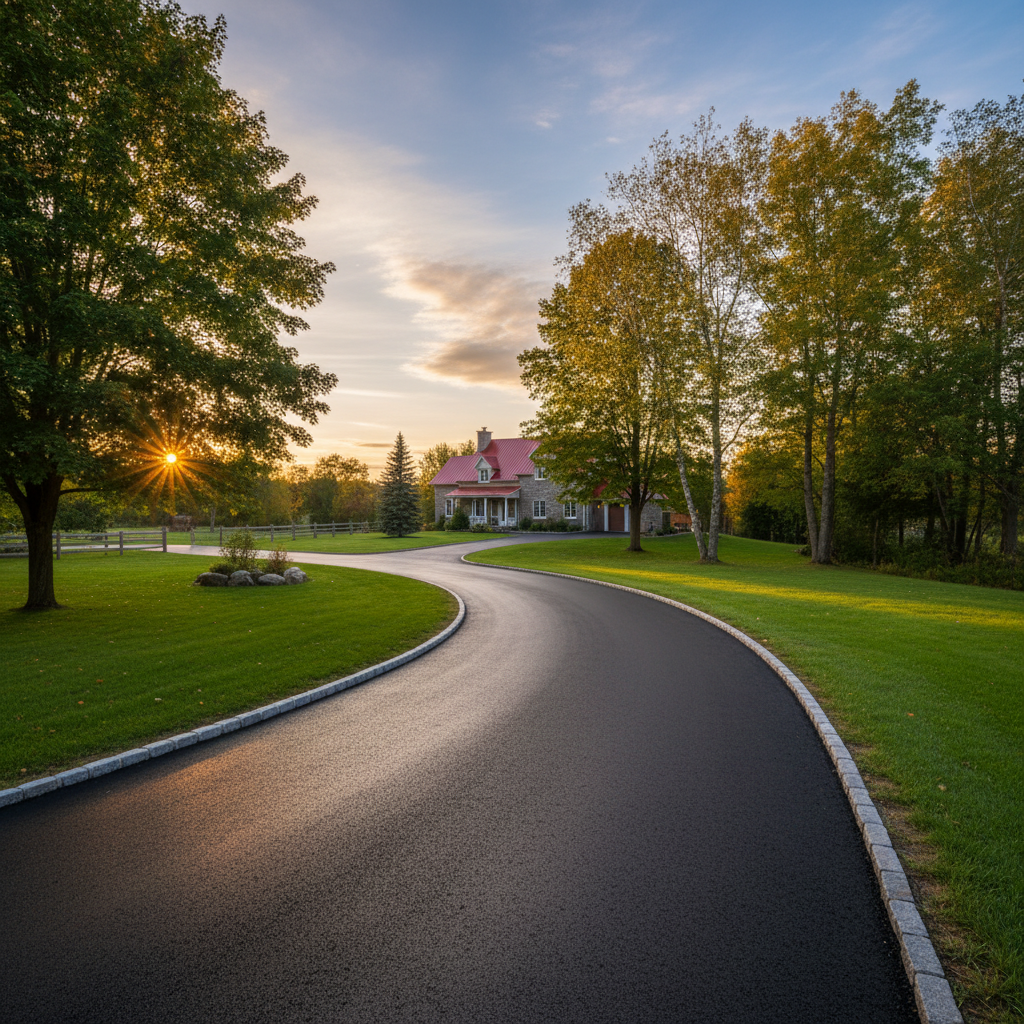
Driveway paving options and costs in Chinatown
In Chinatown, Alberta, driveway paving is one of the most visible upgrades you can make—especially on streets where older homes sit close to curbs and the driveway edge is constantly exposed to salt, plough splash, and spring thaw. With Chinatown’s population sitting at 2,250 people (Statistics Canada, 2021 Census), demand is concentrated in a smaller customer base, so scheduling can tighten during peak paving months.
Most private driveways in the area serve single-detached properties, so quotes often depend on whether your driveway is tied to a garage approach (shorter run, more curb interaction) or a longer, residential-use access strip (more area, more base). In Calgary’s cold continental climate, frost routinely penetrates to about 1.2 m (4 ft), and repeated freeze–thaw cycles force contractors to build deeper, well-graded granular bases and ensure positive drainage. That’s why even “standard” installs can land at different ends of the range: a drainage correction or thicker base moves your total more than the choice of asphalt vs. concrete alone.
Contractors also plan around Alberta’s compressed paving season (late spring through early fall). Hot-mix asphalt typically needs air temperatures above 10°C to place and compact properly, so spring and early fall weather swings can affect both availability and per-square-foot pricing. In and around the central Chinatown blocks near downtown Calgary, driveways that need curb-area work and edge support are especially in demand.
Below are realistic cost expectations so you can compare options side-by-side and talk to contractors with clearer assumptions.
| Material |
Lifespan |
Maintenance |
Best For |
Price per sq ft |
Price Range |
| Asphalt (new installation, proper base) |
15–25 years |
Seal every 3–5 years; crack fill as needed |
Strong value, smooth ride, typical residential access |
$3.50–$6.00 |
$12,000–$20,000 |
| Asphalt (overlay on existing gravel base) |
10–18 years |
More frequent crack filling; seal every 3–5 years |
Budget installs where the base is already mostly stable |
$3.00–$5.20 |
$9,500–$15,000 |
| Interlocking concrete pavers |
25–35+ years |
Joint sand top-ups; replace individual stones when damaged |
Curb appeal and repairs without tearing up the whole drive |
$6.50–$10.50 |
$14,500–$24,500 |
| Poured concrete (broom finish) |
20–30 years |
Seal as recommended; maintain expansion joint sealant |
Low-profile maintenance and solid all-season performance |
$5.00–$8.50 |
$13,000–$22,000 |
| Exposed aggregate concrete |
20–30 years |
Seal/maintain finish; address joint sealant |
Slip resistance and a more decorative look |
$6.00–$10.00 |
$16,000–$26,000 |
| Gravel / crushed stone (budget option) |
5–12 years |
Top up annually; regrade and weed control |
Short-term solution or where drain paths are needed |
$2.00–$4.00 |
$4,000–$9,000 |
Prices are estimates only and vary by project scope, site access and material selection.
What affects the price of paving in Chinatown
In Chinatown, you can see quotes swing by 30–50% for what looks like the “same” driveway because contractors are pricing the risks and the hidden work: base build-up, drainage fixes, haul/disposal, and how much production time your site allows. In a smaller local market with a compressed paving window, labour and equipment availability can also influence the final number—especially for smaller jobs scheduled between larger installs.
Calgary’s frost depth and freeze–thaw cycles are a decisive cost factor. With frost penetrating roughly 1.2 m (4 ft), you typically need a thicker compacted granular base to prevent heaving, settlement, and cracking. The goal is a well-graded base with stable support, plus positive drainage so meltwater doesn’t sit under the asphalt or undercut concrete. When contractors can’t rely on the existing subgrade, you pay more for excavation and granular placement (and that’s where costs move quickly toward the upper end of the $12,000–$20,000 asphalt expectations).
Also, Alberta’s paving season is shorter. Hot-mix asphalt placement generally requires warm air temperatures (often above 10°C). That concentrates demand and increases scheduling pressure in late spring and early fall, which can push per-square-foot pricing toward the top of the band (for example, asphalt projects that land closer to $3.50–$6.00/sq ft versus the lower end).
Concrete pricing can rise when you need air-entrained concrete and robust edge detailing to manage freeze–thaw and salt exposure; it can also drop when your base is already uniform and only requires minimal grading. For a typical Chinatown driveway that’s tight-access near curbs, additional base work and disposal can justify moving from “budget gravel” toward a paved solution—where the spend is often the difference between reworking annually and installing once for a longer lifecycle.
| Price Factor |
Why It Matters |
Cost Impact |
| Driveway area in sq ft |
Most material and labour scale with square footage |
High (primary driver) |
| Base depth required |
Frost line determines granular thickness to prevent heaving/cracking |
High (more excavation and aggregate) |
| Grading and drainage work |
Slope corrections and directing meltwater prevent failures |
Medium to high |
| Tear-out of existing surface |
Breaking, loading, and hauling concrete or old asphalt |
Medium to high |
| Edge restraints and curbing |
Prevents paver spread and supports asphalt/concrete edges |
Medium |
| Sealing requirement |
Asphalt needs sealing after curing (often within 6–12 months) for longevity |
Low to medium (lifecycle cost) |
| Site access |
Narrow lots slow equipment movement and increase labour time |
Medium |
| Asphalt mix specifications |
Freeze–thaw-rated mix and proper binder selection cost more |
Low to medium |
Permits & regulations in Alberta
In Alberta, paving a private driveway within your own property usually doesn’t require a building permit. Where approvals typically come into play is work that touches the municipal right-of-way—especially anything involving curb cuts, changes to the boulevard, or altered storm drainage. In practice, that can mean you’ll need municipal approval if you’re expanding or relocating the driveway access points, modifying roadside drainage, or changing the way water is directed at the street edge. Some municipalities also enforce lot-grading expectations that affect how close a hard surface can be to property lines and how runoff must be managed.
Before digging in Chinatown, always call for utility locates (Alberta One-Call) so contractors can verify the location of buried services. Then, verify the driveway’s “edge plan”: ensure drainage flows away from foundations and doesn’t send meltwater toward neighbouring properties. Step-by-step for a homeowner:
- Ask the contractor for their Alberta licence documentation and confirm it on the provincial registry for your trades category.
- Request a current certificate of insurance showing liability coverage for paving-related work.
- Confirm WSIB/WCB coverage (workers’ compensation) and ensure it’s active for the crew on your site.
- Get a written scope that clearly states whether boulevard work or drainage tie-ins are included (and who obtains any required approvals).
- Keep copies of all certificates and correspondence in your project folder.
Asphalt vs pavers vs concrete for Chinatown driveways
For Chinatown driveways in Calgary’s freeze–thaw environment, the “best” material depends on your priorities: lowest upfront cost, maximum curb appeal, or ease of repair. Asphalt is usually the lowest-cost option to install, but it needs routine sealing every 3–5 years to protect against salt abrasion and winter moisture. Interlocking concrete pavers typically cost more upfront, yet they’re very repairable—if a small section settles or is damaged, stones can be lifted and reset rather than replacing an entire surface. Poured concrete often sits mid-range on cost, and with proper air-entrainment and jointing, it can perform well; however, if the base or drainage isn’t right, freeze–thaw can still lead to cracking and surface deterioration.
Because frost penetrates deeply in this region (about 1.2 m), base preparation is not optional. In Calgary, contractors often build thicker granular bases and focus heavily on drainage to prevent water from expanding under the slab or asphalt. In a Chinatown setting, where ploughing and street meltwater can run across the driveway approach, that drainage detail often matters as much as whether you choose asphalt or concrete.
Here’s a practical example: for a driveway similar to many residential Chinatown installs, moving from a basic asphalt install toward pavers can add roughly several thousand dollars—often in the direction of the interlocking $14,500–$24,500 band versus asphalt $12,000–$20,000. That price difference is justified if you value curb appeal, expect future utility access, or want targeted repairs instead of full resurfacing later.
| Material |
Frost Resistance |
Curb Appeal |
Repair Method |
Lifespan |
Price Band |
| Asphalt (sealed regularly) |
Good with proper base and drainage |
Medium |
Crack fill; patch areas; resurfacing later |
15–25 years |
$12–$20/sq ft installed (typical band reference) |
| Interlocking concrete pavers |
Excellent (modular, forgiving if base is built right) |
High |
Lift/replace individual pavers and reset bedding sand |
25–35+ years |
$18–$30/sq ft installed (typical band reference) |
| Poured concrete (air-entrained) |
Good with air-entrainment and sound base |
Medium |
Patch small spalls; larger cracks may require section repair |
20–30 years |
$15–$25/sq ft installed (typical band reference) |
| Exposed aggregate concrete |
Good to excellent with sealed joints and correct base |
Very high |
Targeted patching; finish-specific repairs required |
20–30 years |
$16–$28/sq ft installed (typical band reference) |
| Permeable pavers (drainage grid) |
Variable (depends on soil drainage and base design) |
Medium to high |
Replace sections; maintain infiltration performance |
20–30 years+ |
Often premium over standard pavers |
| Chip seal / tar-and-chip |
Moderate (surface wear expected sooner) |
Low to medium |
Spot repair and re-chipping/overlay over time |
7–12 years |
Typically budget-to-mid |
How to choose a paving contractor in Chinatown
Choosing the right paving contractor in Chinatown is less about catchy ads and more about proof: Alberta licence status, insurance, and workers’ compensation coverage, plus a scope that matches the climate realities here. Start by verifying the contractor’s Alberta licence for the paving trade category, then ask for a certificate of insurance with liability coverage that covers paving-related work on your property. Confirm WSIB/WCB coverage is active—this matters for both your risk and theirs. When the crew shows up, you want the work to be covered, not “figured out later.”
Next, get 2–3 itemised written quotes. You want a labour + materials breakdown and clear line items for excavation, base granular placement, geotextile (if used), compaction, edge restraints, and surface course. Avoid lump-sum estimates that don’t explain what’s included in tear-out, haul-away/disposal, or disposal fees. Ask directly: Is permit pulling required and included (if any boulevard/right-of-way work is triggered)? What’s the cleanup standard at the end of each day?
Warranty details should be in writing: separate workmanship coverage from product/manufacturer warranty, plus whether the warranty is transferable if you sell the home. For payment, never pay more than 10–15% upfront; hold back a portion until the finish meets the agreed scope and curing/verification steps are done. Finally, insist on a written timeline—start date, major milestones, and an estimated completion date—so you can plan around Calgary’s shorter paving season.
- Check Alberta licence status before signing anything.
- Confirm liability insurance certificate is current and project-relevant.
- Verify WSIB/WCB coverage is active for the crews working your site.
- Request 2–3 quotes with itemised labour and material lines (no “mystery totals”).
- Ensure base thickness and compaction requirements are explicitly stated.
- Ask whether geotextile is included for weak soils or separation needs.
- Confirm grading/slope plan: where meltwater goes and how it avoids pooling.
- Clarify tear-out scope and disposal/haul-away inclusions.
- Verify edge restraint type and height (especially for pavers and asphalt edges).
- For asphalt, confirm sealing timing expectations (often after 6–12 months) and who advises on it.
- Get warranty terms in writing (workmanship length, exclusions, and transferability).
- Set a payment schedule with a holdback until final acceptance.
Red flags to watch for in Chinatown: vague scopes (“supply and install asphalt” without base specs), refusal to provide proof of licence/insurance/WSIB/WCB, quotes that don’t address drainage or edge support, large upfront payments beyond 10–15%, and a schedule that promises winter work or quick turnarounds despite cure/compaction needs.
Frequently asked questions — paving in Chinatown
How do I maintain my driveway through Chinatown winters?
For driveways in Chinatown, Alberta, winter performance comes down to controlling water, salt impact, and mechanical damage. Start with snow removal: avoid aggressive scraping that can gouge asphalt or lift paver edges, and keep plough passes consistent so you don’t create repeated ruts at the same spot. Use sand or a balanced de-icer approach; while de-icing is unavoidable, heavy salt application can accelerate surface wear on asphalt. If you have asphalt, keep up with crack filling in the first warm season after installation, and plan sealing as recommended (often after the driveway has cured—commonly within 6–12 months). For concrete, monitor expansion joints and reseal where required. Finally, watch for pooling near the garage approach—if meltwater sits, the base/drainage may need correction during the next service season.
Is it worth sealing a new driveway right away in Chinatown?
In Chinatown and across Calgary’s freeze–thaw conditions, “right away” usually isn’t the best timing. Asphalt needs to cure so the surface can seal properly without trapping moisture. Many contractors recommend sealing after the asphalt has had time to cure—often within a window like 6–12 months, depending on weather and product. If you seal too early, you can risk reduced adhesion and a shorter effective service life. The value comes from maintenance timing: sealing extends the asphalt’s usable life and helps protect against winter moisture and salt abrasion, which is critical when frost penetrates deeply (about 1.2 m) and cycles repeatedly. If you’re comparing options, remember that sealing is part of lifecycle cost—so even a driveway that starts around asphalt install pricing in the $12,000–$20,000 band will look “cheap” only if sealing is deferred until problems accelerate.
What is a chip seal driveway and is it suited to Chinatown?
A chip seal (tar-and-chip) driveway is a surface treatment where a binder is applied and small aggregate chips are embedded to create texture and drainage. It can be a budget-friendly option for some properties, but in Chinatown’s Alberta winters, it’s typically not the “set it and forget it” choice. The freeze–thaw cycle and winter maintenance routine can lead to more frequent surface wear compared with asphalt paving, especially if the base isn’t engineered for frost movement. Chip seal may make sense on low-traffic drives or where you want a temporary-to-mid-term solution while you plan a full rebuild later. If your driveway sees heavy daily traffic, tight turns that scrape, or regular plough contact, you’ll likely spend more over time on re-chipping/spot repairs. For most homeowners seeking a durable finish, standard asphalt in the typical $12,000–$20,000 band or pavers/concrete may hold up better in the long run.
How much does driveway crack repair cost in Chinatown?
Crack repair pricing in Chinatown depends on crack width, whether there’s active movement from the base, and how much prep is required (cleaning, routing, and sealing). Small, stable hairline cracks are usually handled with crack filling at a lower cost, while cracks that have widened—often from freeze–thaw and water infiltration—may need more involved patching. If you’re budgeting for maintenance, homeowners often fall into the general repair and sealing range of $400–$1,500 for localized work, assuming the damage is limited and the base is otherwise sound. If the contractor finds base issues or drainage problems, the “repair” scope can expand into partial removal and rework, which raises costs. The best way to keep crack repair affordable is to catch it early in the warm season before water has a chance to expand and break down the pavement layers.
What base thickness do I need for pavers in Chinatown?
For pavers in Chinatown, base thickness is driven by frost exposure and whether your existing subgrade is stable. With Calgary’s cold continental conditions (frost reaching roughly 1.2 m) and repeated freeze–thaw, a properly compacted granular base is critical to stop movement and prevent paver settlement. In practice, many driveways require a thicker, well-graded base and tight compaction than you’d expect from a “landscaping” mindset. Exact thickness varies based on soil condition and design, but contractors typically plan for substantial granular depth plus a bedding layer for pavers. If drainage is poor or the subgrade is soft, the required base depth increases because contractors must reduce the chances of water accumulation and frost-related heave. Ask for the written base build-up (materials and compacted thickness) rather than a generic “we’ll do a good base,” so the quote aligns with how paving actually survives winters here.
How do I get the most accurate paving quote in Chinatown?
To get an accurate paving quote in Chinatown, start by giving contractors enough site information and insist on itemised pricing. Provide driveway dimensions and access constraints, then request a site visit so they can evaluate subgrade condition, existing base material (if overlay), and drainage patterns. A strong quote should break down excavation/tear-out, base/granular quantities, compaction steps, edge restraints/curbs (where needed), and disposal/haul-away if applicable. Ask whether any boulevard or storm drainage changes would require municipal approval—then clarify whether permit-related work is included or excluded. Compare bids apples-to-apples: labour + materials, not a single lump sum. Finally, confirm they address frost and freeze–thaw in their design (base depth and asphalt/concrete specs). If you want a realistic expectation, make sure your scope aligns with the typical asphalt or paver bands—many homeowners see asphalt budgets around $12,000–$20,000, while pavers commonly land higher, often within a $14,500–$24,500-type range depending on excavation and edge detailing.