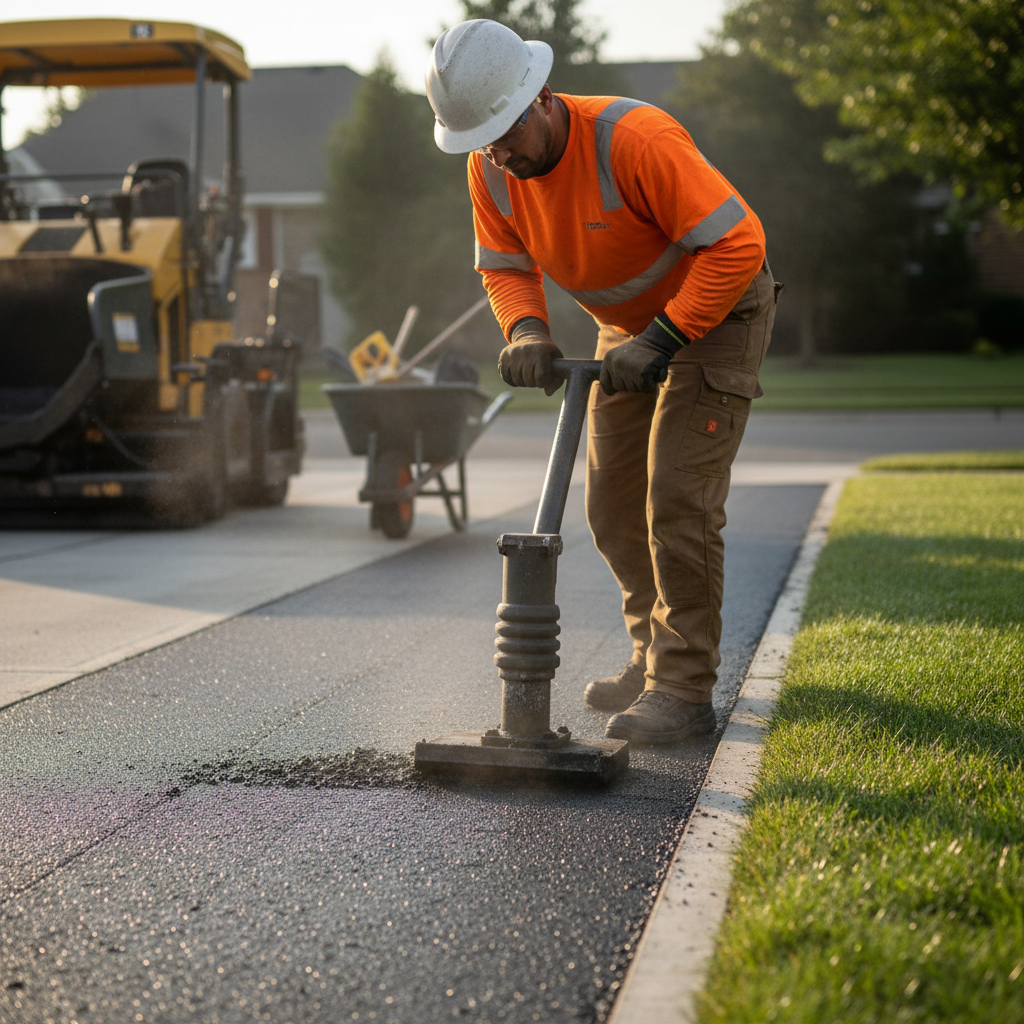
Driveway paving options and costs in Saddle Ridge
Saddle Ridge, Alberta is a great place for a long-lasting driveway—but pricing depends heavily on how your site handles Calgary’s freeze–thaw cycles. With a population of 24,365 people (Statistics Canada, 2021 Census), and a neighbourhood built around family homes, most private driveways are tied to single-detached properties—so the local paving workload is steady when the weather window opens. In practice, that means contractors plan for a limited season late spring through early fall, and demand spikes can show up in spring quotes. In Calgary’s cold continental climate, frost can penetrate to about 1.2 m, so the “base” (granular thickness, compaction, and drainage) often determines whether your surface performs well or cracks prematurely.
Homeowners in Saddle Ridge tend to focus on two things: curb appeal and winter durability. If you’re looking at the area near Cooper’s Crossing and surrounding streets with heavier residential demand, you’ll usually see faster scheduling for small repairs and overlays—but larger rebuilds can book out during peak months. That’s also why two bids for a similar-looking driveway can differ materially: one crew might be pricing a deeper, well-graded base with proper edge restraint, while another may be assuming lighter prep.
Below is a practical comparison of common materials for Saddle Ridge driveways, using typical price bands for the city tier. Use it to frame your budget, then we can dial in the numbers once we confirm your measurements, base condition, and site access.
| Material |
Lifespan |
Maintenance |
Best For |
Price per sq ft |
| Asphalt (new installation, proper base) |
15–25 years |
Sealcoat every 3–5 years; patch as needed |
Lowest upfront cost with good performance |
$12 – $20 |
| Asphalt (overlay on existing gravel base) |
12–20 years (depends on base) |
Sealcoat every 3–5 years; monitor cracks/settlement |
Speed and cost savings when base is sound |
$10 – $16 |
| Interlocking concrete pavers |
25–40 years |
Occasional joint sand top-up; replace pavers if needed |
Curb appeal and easier local repairs |
$18 – $30 |
| Poured concrete (broom finish) |
25–35 years |
Crack control; sealant optional; joint maintenance |
Straightforward, durable surface |
$15 – $25 |
| Exposed aggregate concrete |
25–35 years |
Seal as recommended; clean debris from joints |
Slip resistance and upscale look |
$18 – $28 |
| Gravel / crushed stone (budget option) |
1–5 years (varies with grade and washboarding) |
Re-grade and top up 1–3 times/year |
Short-term solution before paving |
$5 – $10 |
Prices are estimates only and vary by project scope, site access and material selection.
What affects the price of paving in Saddle Ridge
If you get quotes for the “same” driveway in Calgary, Alberta, it’s common to see 30–50% differences. The big reason isn’t the surface—it’s what’s underneath and what it takes to make the drainage work. A deeper, well-compacted base and proper edge restraint are what control frost-related movement; crews that price only the top layer can leave you exposed to heaving, raveling, and cracking after the first hard winter. In a cold continental region like Calgary, frost routinely penetrates to about 1.2 m, and repeated freeze–thaw cycles expand water in the subgrade. That means your granular base has to be sized for local conditions, and the mix design and compaction matter as much as the paving thickness.
The compressed paving season also changes labour math. Asphalt requires suitable air temperatures (often above 10°C) for placement and compaction, so spring and early summer demand concentrates, equipment schedules tighten, and smaller jobs can cost more per square foot. That’s why asphalt might land nearer the $12 – $20 range when crews have to mobilize quickly for a tight timeline.
Two concrete examples from Saddle Ridge often swing price up or down: (1) if your driveway is on a weak or variable soil and needs an engineered drainage correction, you’ll pay more than a straightforward rebuild; (2) if you already have stable granular base and good slope, an asphalt overlay can keep costs closer to the lower end of the asphalt band. Concrete pricing also shifts based on crack control and whether joints and dowels are properly planned for the slab size and winter loading.
When you compare pavers, remember that the labour is higher, but repairs can be localized—often avoiding a full resurfacing. If you’re budget-sensitive, it helps to view paving as a lifecycle plan, not just an install invoice.
| Price Factor |
Why It Matters |
Cost Impact |
| Driveway area in sq ft |
Most materials and production time scale directly with area |
Major driver—small driveways often cost more per sq ft due to mobilization |
| Base depth required |
Frost line and subgrade strength determine granular thickness needed to prevent heaving |
Can change costs by tens of percent where deeper base and more aggregate are required |
| Grading and drainage work |
Proper slope and positive drainage prevent water trapping and freeze expansion |
Often adds labour + extra base; higher if re-contouring is needed |
| Tear-out of existing surface |
Breaking, hauling, and disposal add time and equipment costs |
Can significantly increase total price, especially with old concrete |
| Edge restraints and curbing |
Edges hold the pavement geometry during snowmelt and freeze–thaw movement |
More cost, but reduces spreading and surface distortion |
| Sealing requirement |
Asphalt benefits from sealcoat to slow oxidation and moisture damage |
Typically an added lifecycle cost; recommended after 6–12 months |
| Site access |
Narrow lots and tight turns affect equipment productivity |
Can increase labour and require extra handling |
| Asphalt mix specifications |
Freeze–thaw-rated mix and correct aggregate gradation reduce cracking and raveling |
Quality mix can raise unit material costs but improves winter performance |
Permits & regulations in Alberta
In Alberta, most paving of a private driveway on your own property typically does not require a building permit. However, you need municipal approval when your work affects the space or infrastructure the municipality controls. That usually includes work in the municipal right-of-way, such as creating or changing a curb cut, modifying boulevard areas, altering storm drainage patterns, or making changes that impact municipal services. Some municipalities also have lot-grading or surface drainage expectations that restrict how close hard surfaces can be to property lines and where runoff must be directed.
Even when no permit is required, you should start with safety and compliance. Before excavation, always arrange utility locates through the Alberta One-Call system. That step helps prevent costly utility strikes and delays.
Here’s a homeowner-friendly checklist to verify your contractor in Saddle Ridge:
- Confirm the contractor’s Alberta licensing (verify they’re registered/authorized for the work they’re pricing).
- Request liability insurance certificate (COI) naming you appropriately and covering paving operations.
- Verify WSIB/WCB coverage as applicable—ask for the current clearance/coverage letter or account status proof.
- Ask for a written scope showing what happens at the curb/sidewalk interface and how drainage is handled.
- Keep everything in writing: quote, warranty, start/completion dates.
If your project touches the right-of-way or drainage, ask the contractor whether they will coordinate the municipal approval steps and confirm any permit requirements before work begins.
Asphalt vs pavers vs concrete for Saddle Ridge driveways
For Saddle Ridge winters, the “best” driveway material comes down to how well it handles moisture, movement, and the realities of snow clearing. Asphalt usually wins on upfront cost and simplicity. When installed over a properly compacted granular base and built with drainage in mind, asphalt performs well for many homeowners—especially when you plan for sealcoating every 3–5 years. Pavers cost more up front, but they shine in freeze–thaw climates because damaged sections can often be removed and reset without ripping up the entire driveway. Concrete sits in the middle: it’s durable and maintenance-friendly, but it’s also more prone to cracking if the base or jointing strategy doesn’t account for Calgary’s frost and the repeated expansion of water during freeze–thaw cycles.
Because frost penetration can reach roughly 1.2 m, base preparation is non-negotiable. Your granular base should be designed for the subgrade and drainage conditions, and the driveway needs a slope that sheds water away from the slab or asphalt surface. In a typical residential setup, asphalt can be a strong choice if you want predictable timing and cost—often landing near the $12 – $20 per sq ft range. If you’re choosing pavers, you’re usually investing toward the $18 – $30 per sq ft band for long-term curb appeal and replaceability. Concrete pricing often falls between those bands, but cost rises if the job requires deeper base, heavier reinforcement, or extensive tear-out.
A simple dollar example: if a 400 sq ft driveway is quoted at $13 per sq ft for asphalt versus $22 per sq ft for pavers, that’s about a $3,600 difference in material and labour. That extra cost is justified when you value future repairs, the look of a finished interlock pattern, and you expect localized settlement risks from variable soils.
| Material |
Frost Resistance |
Curb Appeal |
Repair Method |
Lifespan |
Price Band |
| Asphalt (sealed regularly) |
Good with deep base, drainage, and freeze–thaw-rated mix |
Moderate |
Mill and patch; localized crack repair |
15–25 years |
$12 – $20 |
| Interlocking concrete pavers |
Very good; segmented surface accommodates movement better |
High (pattern and colour options) |
Lift and replace affected pavers; re-sand joints |
25–40 years |
$18 – $30 |
| Poured concrete (air-entrained) |
Good with air-entrainment, joints, and correct base |
Moderate to high |
Crack sealing or patching; slab repairs as needed |
25–35 years |
$15 – $25 |
| Exposed aggregate concrete |
Good; slip resistance helps in snowmelt |
High |
Patch replacement of sections where needed |
25–35 years |
$18 – $28 |
| Permeable pavers (drainage grid) |
Excellent where designed to manage water infiltration |
High (modern look) |
Reset pavers; clean/replace drainage layer if clogged |
20–35 years |
$20 – $35 |
| Chip seal / tar-and-chip |
Variable; depends on base and aggregate selection |
Low to moderate |
Spot re-chip and maintenance top-ups |
8–15 years |
$8 – $14 |
How to choose a paving contractor in Saddle Ridge
Choosing the right paving contractor in Saddle Ridge is mostly about verifying three things: competence, insurance coverage, and clarity in the quote. Start with Alberta licensing—ask for proof that the contractor is properly authorized for the scope they’re proposing. Next, request a current liability insurance certificate (COI) before work begins. Finally, confirm WSIB/WCB coverage for workers: ask for a clearance letter or account confirmation. A legitimate crew can usually provide these documents quickly; if they can’t, that’s a red flag.
For pricing, don’t accept “lump sum” quotes without a breakdown. Get 2–3 itemised written quotes that show labour and materials components (base preparation, granular quantities, asphalt/concrete thickness, saw cutting/jointing where needed, and edge restraints). Confirm what’s excluded: is disposal included for concrete/asphalt tear-out? Is permit coordination included if your work affects the right-of-way? Will they handle utility protection and locates?
Warranty matters in a cold climate. Ask for both a workmanship warranty length and whether there’s a manufacturer/product warranty for the materials used—and whether it transfers if you sell the home. For payment, avoid large deposits: never pay more than 10–15% upfront. Use a holdback until the job is complete and you’ve confirmed final grade, drainage, and cleanup. Also request a start date and estimated completion timeline in writing, because the paving season is short and crews can get booked quickly.
- Ask for their Alberta licensing details and verify it before signing.
- Request liability insurance COI and confirm limits are reasonable for paving.
- Verify WSIB/WCB clearance for the period you’ll be hiring them.
- Get 2–3 itemised quotes with thicknesses and quantities stated.
- Confirm base depth and aggregate specification, not just “compacted base.”
- Make sure drainage and grading changes are included if needed.
- Ask what happens if you find unsuitable subgrade during excavation.
- Confirm edge restraints/curbing are included for pavers and asphalt.
- Specify tear-out scope and disposal/hauling responsibility.
- Check warranty terms: workmanship coverage length and exclusions.
- Agree on payment schedule: keep deposits to 10–15% max and use holdback.
- Get start date, curing/working windows, and completion estimate in writing.
Common red flags in Saddle Ridge: a contractor who won’t provide COI or WSIB/WCB proof, quotes that don’t specify base depth or compaction, vague warranty language (“materials only”), heavy upfront deposits, and crews that promise year-round completion despite the short paving season.
Frequently asked questions — paving in Saddle Ridge
How much does driveway crack repair cost in Saddle Ridge?
In Saddle Ridge and the wider Calgary area, crack repair pricing depends on crack type (surface vs. structural), width, and whether there’s active water intrusion. Small asphalt cracks are often repaired with cleaning and crack sealing or a patch system, while wider or settled areas may need localized cutting, base spot correction, and asphalt re-lift. As a budget reference, basic sealing/patch repairs commonly fall in the low hundreds, while repairs that require tear-out and reinstatement can climb into the higher range once excavation and hauling are included. If you’re seeing multiple cracks, it may be more economical to plan for a sealcoat (often recommended after 6–12 months) or even an overlay instead of repeated patching. For a new asphalt install, homeowners typically plan lifecycle sealing costs in the broader $400 – $1,500 range depending on driveway size and condition.
What base thickness do I need for pavers in Saddle Ridge?
Paver base thickness in Saddle Ridge needs to be designed around frost and drainage realities—because freeze–thaw cycles can move water and soils. While exact thickness varies with your subgrade, a common approach in Calgary is to build a compacted granular base strong enough to prevent heaving, then add a bedding layer for paver setting. If your soil is weaker or drainage is poor, base and re-grading requirements increase, which affects cost more than people expect. The most accurate estimate comes from a site inspection and sometimes removal to evaluate subgrade conditions. A good contractor will explain how they’re addressing positive drainage away from the slab/pavers and where the driveway slope is going, not just quoting a “standard” base. In quotes, make sure they specify the base layers (not just “compacted gravel”) and the compaction method.
How do I get the most accurate paving quote in Saddle Ridge?
To get an accurate paving quote in Alberta, the best move is to have a contractor measure your driveway area, review existing base conditions, and confirm access constraints. Ask for an itemised, written scope that includes demolition (if required), disposal, granular base preparation (depth and material), and the surface thickness/type. Weather and schedule also matter locally: asphalt work depends on suitable temperatures (typically above 10°C), and crews may plan differently during peak season. Provide photos and any known issues—settlement spots, water pooling, or recurring patch areas. If you have an overlay in mind, request they assess whether your existing gravel/asphalt is stable or if undercutting is needed. Finally, verify licensing, liability insurance, and WSIB/WCB coverage before work starts, so the quote reflects a real, insured scope and not assumptions.
How much does it cost to pave a driveway in Saddle Ridge?
Driveway paving costs in Saddle Ridge typically follow the Calgary area price bands, but your total depends on square footage, base work, and tear-out needs. For new asphalt installations built with proper base and drainage, homeowners often see pricing around $12 – $20 per sq ft. Interlocking concrete pavers commonly price higher, around $18 – $30 per sq ft due to labour and materials. Poured concrete usually falls in a mid-range band around $15 – $25 per sq ft, with exposed aggregate tending toward the higher end. If you’re comparing quotes, watch for differences in base depth, edge restraints, and drainage corrections—those are the usual reasons the total can vary by 30–50% even when the driveway dimensions look similar.
Asphalt vs interlocking pavers vs concrete — which is best in Saddle Ridge?
In Saddle Ridge’s freeze–thaw climate, asphalt is often the best choice when you want a lower upfront cost and are willing to maintain it with sealcoating every 3–5 years. Asphalt can perform extremely well if the base is built for frost and water drains correctly. Interlocking pavers usually offer the strongest curb appeal and the most flexible repairs: if a section fails due to localized settlement, the crew can lift and replace the affected pavers instead of replacing the entire driveway. Poured concrete is durable and can be a good value, especially when it’s air-entrained and jointing is properly planned, but cracking can occur if base preparation and drainage are insufficient. If your site has variable soils or you anticipate future spot repairs, pavers can justify their higher cost (often near the $18 – $30 band) versus asphalt at $12 – $20.
How long does a paved driveway last in Saddle Ridge?
With correct base preparation, drainage, and maintenance, paved driveways in Saddle Ridge can last well beyond the first few winters. Asphalt typically lasts about 15–25 years when installed over a suitable, compacted granular base and sealed regularly, because Calgary’s freeze–thaw cycles can otherwise accelerate oxidation and allow moisture movement. Interlocking pavers can often deliver 25–40 years due to their segmented structure and replaceable surface units. Concrete commonly lasts 25–35 years when air-entrainment and proper jointing strategies are used. The key is that cold winters and snow clearing don’t “forgive” poor drainage: standing water under edges or inadequate slope can reduce lifespan regardless of the surface you choose. If you’re budgeting, treat maintenance as part of the lifespan plan—especially for asphalt sealcoating, where lifecycle costs commonly fall within the $400 – $1,500 range depending on driveway size and condition.