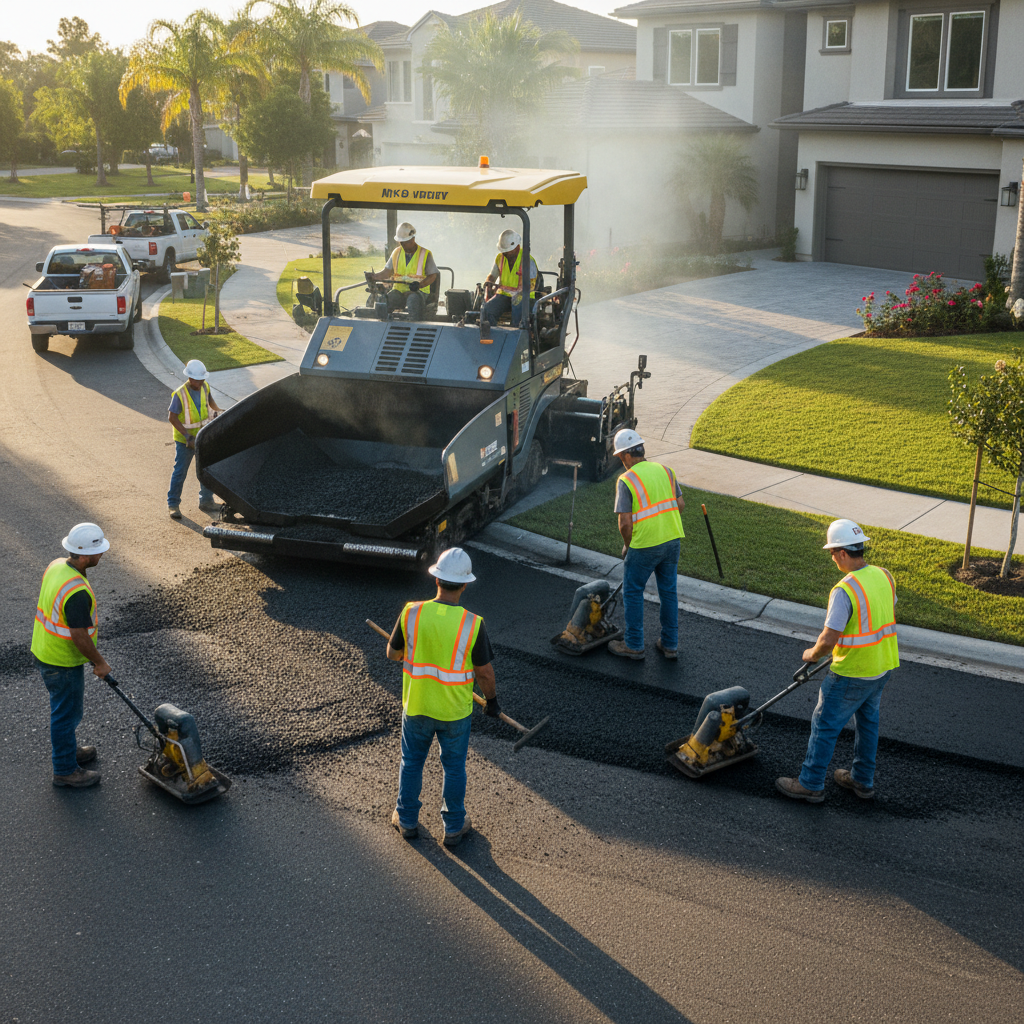
Driveway paving options and costs in Pineridge
Pineridge, Alberta is a great place to live—but it’s also a place where driveways get tested. With a total population of 9,850 (Statistics Canada, 2021 Census), you may have noticed the steady rhythm of driveway refreshes around new infills and the natural wear from winter freeze–thaw cycles. In this part of the Calgary region, most private driveways are tied to detached-home lots, so paving contractors regularly see both straightforward replacements and full base rebuilds after older gravel fails. The good news is you have options: asphalt for the lowest upfront cost, interlocking pavers for curb appeal and easy repairs, and concrete for a longer-lived, heavier surface.
Pricing in Pineridge is shaped by Calgary-area conditions: frost can penetrate deep (about 1.2 m / 4 ft), and repeated freezing and thawing expands water in the subgrade. That means contractors typically need deeper, well-compacted granular bases and positive drainage to reduce heaving, cracking, and surface raveling. On top of that, the paving season is compressed—most asphalt and concrete work has to be completed in a late spring to early fall window when temperatures and ground conditions support proper compaction and curing. Demand spikes in summer can affect availability and drive per-square-foot pricing, especially for smaller jobs and tight-access properties near Springbank-area road links and semi-rural edges.
Below is a practical comparison of material choices and typical costs to help you line up quotes before you choose a contractor.
| Material |
Lifespan |
Maintenance |
Best For |
Price per sq ft |
| Asphalt (new installation, proper base) |
15–25 years |
Sealcoat every 3–5 years; crack repair as needed |
Cost-effective driveway surface with good winter performance when built on a strong base |
$12 – $20 |
| Asphalt (overlay on existing gravel base) |
8–15 years |
Sealcoat and targeted repairs; monitor settlement |
When you have a relatively stable existing base and want a faster, lower-cost upgrade |
$9 – $16 |
| Interlocking concrete pavers |
25–40+ years |
Occasional joint sand refresh; re-leveling of limited areas |
High curb appeal and repairs without replacing the whole driveway |
$18 – $30 |
| Poured concrete (broom finish) |
20–30 years |
Seal if desired; patch spalls early |
Clean, uniform look with solid durability when properly air-entrained and reinforced |
$15 – $25 |
| Exposed aggregate concrete |
25–35 years |
Seal periodically; spot patching for minor surface damage |
Slip-resistant texture and premium finish |
$17 – $28 |
| Gravel / crushed stone (budget option) |
5–10 years |
Ongoing raking/top-ups; edging improvements |
Temporary solution or low-budget access with manageable maintenance |
$6 – $10 |
Prices are estimates only and vary by project scope, site access and material selection.
What affects the price of paving in Pineridge
You can see 30–50% differences in quotes for what looks like the same driveway in Calgary and Alberta, and it usually comes down to what’s happening below the surface. Two contractors may both say “new asphalt,” but one quote may include a full tear-out and granular base rebuild, while the other assumes the existing base is stable. With Calgary’s frost conditions—frost penetration around 1.2 m (4 ft)—freeze–thaw cycles are decisive cost factors. Deeper, well-graded granular bases help prevent water expansion that leads to heaving, cracking and raveling. In cold regions like Pineridge, contractors commonly need thicker, properly compacted base layers (often more than you’d see in milder climates), plus careful drainage grading to keep water moving away from the subgrade.
The paving season is also compressed. Hot-mix asphalt generally needs air temperatures above about 10°C for reliable placement and compaction, and crews often rush in late spring and summer. That compressed schedule concentrates demand, so mobilization and labour costs rise—especially for smaller driveways where the crew still has the same truck and roller time. Concrete and pavers are less sensitive to same-day temperature than asphalt, but they still require correct curing windows and base prep to handle freeze–thaw.
Concrete examples: a broom-finished slab with correct air-entrainment and planned joints can fit many budgets, often aligning with the $15 – $25 band, while an exposed aggregate finish and tighter finish tolerances push higher. Asphalt can stay closer to the $12 – $20 band when the base is sound; if the contractor finds pumping or weak material and needs a deeper rebuild, pricing moves toward the top of the range or beyond once drainage and disposal are included. If you’re upgrading a driveway on an older lot in Pineridge, budget extra if the existing subgrade has poor drainage—settlement after freeze–thaw can trigger repair now, or full replacement later.
| Price Factor |
Why It Matters |
Cost Impact |
| Driveway area in sq ft |
Materials and machine time scale directly with square footage |
Often the biggest variable; small driveways can cost more per sq ft |
| Base depth required |
Frost line depth and local freeze–thaw demand thicker compacted granular layers |
Extra excavation/aggregate can add a major share to the quote |
| Grading and drainage work |
Positive drainage prevents water pooling that accelerates heaving/cracking |
Higher if ditching, re-profiling, or tie-ins are needed |
| Tear-out of existing surface |
Old asphalt or concrete must be broken and hauled; subgrade may need correction |
Concrete tear-outs typically add labour and disposal costs |
| Edge restraints and curbing |
Prevents paver spread and asphalt edge failure |
Can increase cost but protects the surface long-term |
| Sealing requirement |
Asphalt must be sealed after installation to slow aging and keep water out |
Usually increases lifecycle cost but reduces premature cracking |
| Site access |
Narrow/tight lots slow equipment movement and increase labour time |
Can add a noticeable per-day premium during peak season |
| Asphalt mix specifications |
Freeze–thaw-rated mix design helps resist cracking under Alberta winters |
Better mixes can cost more but reduce early failure |
Permits & regulations in Alberta
In Alberta, most homeowners can pave a private driveway within their own property without a building permit. Typically, a driveway resurfacing or replacement on your own lot (new asphalt, concrete, or pavers) does not require a permit as long as you’re not changing the public interface of the property. The situation changes when you touch the municipal right-of-way. Work that often requires municipal approval includes creating or changing a curb cut, modifying the boulevard, changing driveway approach elevations that affect municipal drainage, or altering storm drainage connected to the road allowance.
Step-by-step for Pineridge homeowners: start by confirming your property lines and where the driveway meets municipal space (your contractor can usually help with a site plan, but you should still verify). Next, call for Alberta One-Call (locates) before any excavation, even if you’re replacing an existing surface—utilities, irrigation lines, and service leads can be buried where you least expect them. Then confirm lot-grading rules with the local municipality, because some areas restrict how close hard surfaces can sit to property lines and how drainage must be handled to avoid water flow onto neighbours.
Before signing, verify the contractor’s Alberta licence status (where applicable), and review insurance documentation. Ask for a certificate of insurance showing liability coverage and request proof of workers’ compensation coverage (WSIB/WCB). You can also look for clearance information through the insurer or regulator-facing documentation the contractor provides. Finally, keep the written scope and warranty details in your file so you can confirm what was included if any questions come up after winter.
Asphalt vs pavers vs concrete for Pineridge driveways
For Pineridge driveways, the “best” material depends on your tolerance for maintenance, your look preference, and how willing you are to invest in base prep. Asphalt is usually the lowest upfront choice and, when built correctly on a strong granular base, performs well through Alberta winters. The trade-off is lifecycle: asphalt needs sealing every 3–5 years to slow aging and water penetration, and you’ll want crack repairs done early. Interlocking concrete pavers cost more at the start, but they are highly repairable—if a section heaves or settles, it can be lifted, rebuilt, and re-set without replacing the whole driveway. That matters in freeze–thaw climates like Calgary where localized base issues can show up after several winters. Poured concrete sits in the middle on price, but it must be properly air-entrained and finished with a plan for joints to manage expansion/contraction.
Because frost can move water deep into the ground, the “real decision” is often the same for all three: base depth, gradation, compaction, and drainage. A properly designed crossfall and edge support protect the surface from runoff and edge failure during plowing and thaw periods. In real winter maintenance, salt and sand can accelerate surface scaling on poorly designed concrete and can worsen fine cracking in asphalt if water gets under the surface.
Where does the price difference make sense? If your driveway replacement lands around 400 sq ft, moving from asphalt ($12 – $20) to pavers ($18 – $30) may be justified when you want premium curb appeal and long-term flexibility. But if your primary goal is a durable, cost-controlled upgrade and your contractor will rebuild the base, asphalt is often the best value—especially when the quote clearly includes drainage corrections.
| Material |
Frost Resistance |
Curb Appeal |
Repair Method |
Lifespan |
Price Band |
| Asphalt (sealed regularly) |
Good when placed on a properly compacted granular base and sealed to block water |
Medium (clean, modern look but less “designer” than pavers) |
Patching with milling and resurfacing of affected areas |
15–25 years |
$12 – $20 |
| Interlocking concrete pavers |
Very good; tolerates localized movement better with flexible base and modular repairs |
High (strong visual curb impact) |
Lift, re-level, re-install limited sections |
25–40+ years |
$18 – $30 |
| Poured concrete (air-entrained) |
Good to very good with air-entrainment, correct thickness, and joint plan |
Medium to high (clean, finished lines) |
Spall/patch repairs; larger failures may require partial or full replacement |
20–30 years |
$15 – $25 |
| Exposed aggregate concrete |
Good with correct mix and finishing; slip-resistant texture helps in snowy seasons |
Very high (premium finish) |
Patch and blend; typically spot repairs for localized areas |
25–35 years |
$17 – $28 |
| Permeable pavers (drainage grid) |
Very good for managing water; helps reduce pooling when designed correctly |
High (often looks upscale and “clean-lined”) |
Modular repair similar to interlocking pavers |
25+ years with proper base |
$22 – $35 |
| Chip seal / tar-and-chip |
Moderate; can wear faster in heavy freeze–thaw and where plows scrape |
Low to medium (more utilitarian look) |
Spot re-chip and resurfacing over time |
6–12 years |
$10 – $16 |
How to choose a paving contractor in Pineridge
Choosing a contractor in Pineridge is less about flashy ads and more about verifying three things: Alberta coverage, a detailed scope, and proof they understand freeze–thaw construction. Start with licensing or registration status (as applicable) and confirm liability insurance. Ask for a certificate of insurance naming you as an additional insured if your contract allows it. For workers’ coverage, request proof of WCB/WSIB coverage—contractors should be able to provide clearance information or documentation on request.
Next, get 2–3 itemised written quotes. You want the breakdown to include labour and materials, not a single lump-sum number that hides whether base depth, drainage work, and tear-out are included. Read exclusions carefully: is permit/municipal approval included (if required for curb cuts or right-of-way work), is disposal included, and are locates included in the price? Scope clarity matters in Calgary-area projects where a “small” change in excavation can add hours of hauling.
Warranty should be in writing. Ask: how long is the workmanship warranty, is it transferable if you sell, and what does the manufacturer warranty cover (material defects) versus installer coverage (base prep, paving workmanship)? Also confirm the payment schedule—never pay more than 10–15% upfront, and hold back a portion until the job is complete and cleaned up. Finally, demand a timeline with a start date window and completion estimate, since the season is tight and scheduling around curing matters.
- Verify Alberta business details and licence/registration status (as applicable) before work starts.
- Request a current certificate of liability insurance and confirm coverage limits.
- Confirm workers’ compensation coverage (WCB/WSIB) and obtain clearance documentation.
- Ask for references from similar Pineridge-area driveways built for freeze–thaw conditions.
- Get 2–3 itemised quotes with labour + material lines and unit pricing where possible.
- Confirm base depth, aggregate gradation/type, and compaction requirements are stated.
- Ensure grading and drainage corrections are explicitly included (not “as needed”).
- Check whether tear-out and disposal are included, including hauling of old concrete/asphalt.
- Confirm edge restraints/curbs or restraint methods for pavers/asphalt are included.
- Ask when sealing is scheduled for asphalt and whether it’s included or separate.
- Review warranty length, what it covers, and whether it’s transferable on sale.
- Lock payment terms to keep upfront payment at 10–15%, with a completion holdback.
In Pineridge, common red flags include: quotes that skip or minimize base rebuild details after a site visit; refusing to provide insurance/WCB documentation; vague scopes that don’t specify tear-out and disposal; starting excavation before utility locates are confirmed; and warranties that are only verbal or don’t distinguish workmanship from material coverage.
Frequently asked questions — paving in Pineridge
Why does my driveway crack and heave in winter?
In Pineridge and across the Calgary region, freeze–thaw cycles are a major reason driveways crack and heave. When water soaks into the subgrade or an insufficient base, it expands as temperatures drop. Frost penetration (around 1.2 m / 4 ft) can push upward if the base is too thin, poorly graded, or not properly compacted. Heaving is also common where drainage is off—if the driveway doesn’t shed water, meltwater and rain keep re-wetting the material each cycle. Another contributor is edge failure: if restraints are missing or the asphalt/pavers migrate, water can enter the joint or edge and worsen the movement. The fix is usually not just “patching”—it may require correcting base depth and drainage, then resurfacing. If you’re seeing widespread cracking, ask whether your contractor will address the cause rather than just applying a surface treatment.
Do I need a permit to pave my driveway in Alberta?
Most driveway paving done entirely on your private property (replacement/resurfacing on your lot) typically doesn’t require a building permit in Alberta. However, in Pineridge, you may need municipal approval if the job affects the municipal right-of-way—for example, changing a curb cut, altering the boulevard, or modifying storm drainage tied into municipal infrastructure. It’s also important to check lot-grading rules, because some restrictions can affect how close hard surfaces can be to property lines and how runoff must be managed. Before excavation, your contractor should arrange utility locates through Alberta One-Call. When you get quotes, ask directly whether any permit or municipal approval process is included if the scope reaches the road allowance. If a contractor avoids the question, that’s a sign the scope may not be fully planned.
How long before I can drive on new asphalt?
For new asphalt in Pineridge, contractors commonly allow light vehicle traffic soon after paving depending on mix temperature and weather conditions, but you should expect a short curing period before heavier loads. In general, the safest approach is to follow the contractor’s written instructions and avoid turning, parking, or driving on fresh asphalt too soon, especially during cool or damp weather in the shoulder months. The compressed paving season in the Calgary area also means crews work within a narrower temperature window—hot-mix placement needs suitable air temperatures (often above 10°C) for proper compaction and performance. If you choose asphalt in the $12 – $20 band, ask whether sealing is included and when it will be scheduled (typically months later, not immediately after install). This is part of lifecycle protection: sealing too early or too late can affect how well the surface resists winter water damage.
What causes potholes and how are they repaired?
Potholes usually form when water enters a weakness in the asphalt—often from cracks, failed patch areas, or spots with poor drainage. In Alberta winters, the freeze–thaw process enlarges voids and breaks the pavement structure farther each cycle. In spring, you’ll often see the worst damage after thaw. Repairs are typically done by removing the failed asphalt down to sound material, then compacting a new base layer (if needed) and placing asphalt to the correct depth and temperature. Contractors should feather edges and compact properly; a “top patch” without correcting the underlying base problem tends to return. If the driveway is older and failures are frequent, an overlay or a full rebuild with granular base correction may be more cost-effective than repeated patching. When comparing quotes, ask whether they’ll do full-depth patching or just surface asphalt—this is a major driver of differences between estimates.
How do I prepare for a paving project?
Preparation makes the job smoother and helps protect quality in Pineridge. Start by clearing the driveway path: move vehicles, bikes, trailers, and anything near edges so equipment can get close without damaging lawns or fences. If you have landscaping, consider marking sprinkler heads and identifying any areas that must stay protected. Schedule utility locates through your contractor (Alberta One-Call) before excavation—don’t rely on “we’ve never hit anything before.” Review drainage: if water currently ponds or runs toward a neighbour’s property, mention it so the contractor can plan grading corrections. If your quote includes tear-out, confirm how disposal and hauling are handled. Finally, plan for a short curing window—depending on whether you’re doing asphalt, concrete, or pavers, you may need to avoid traffic and keep the area clear. Asking these questions upfront helps ensure your final driveway matches the scope you paid for, not a shortened version due to site surprises.
How do I compare paving quotes fairly?
To compare paving quotes fairly in Pineridge, focus on scope details, not just the total price. Ask for itemised quotes showing labour, materials, and what’s included in base prep, grading, drainage corrections, and tear-out/disposal. A quote that lands in the $12 – $20 asphalt band can still be more expensive in the real world if it assumes the existing base is stable when it isn’t. Similarly, if one option includes deeper granular base and edge restraints while another skips them, the lower number isn’t apples-to-apples. Confirm timing: is sealing included (for asphalt) and what month will it happen? Check warranty terms for workmanship and whether product coverage is separate. Verify contractor coverage: liability insurance and workers’ compensation (WCB/WSIB) documentation. Finally, ensure payment terms match best practice—avoid large upfront payments and keep a holdback until the job is complete and cleaned up.