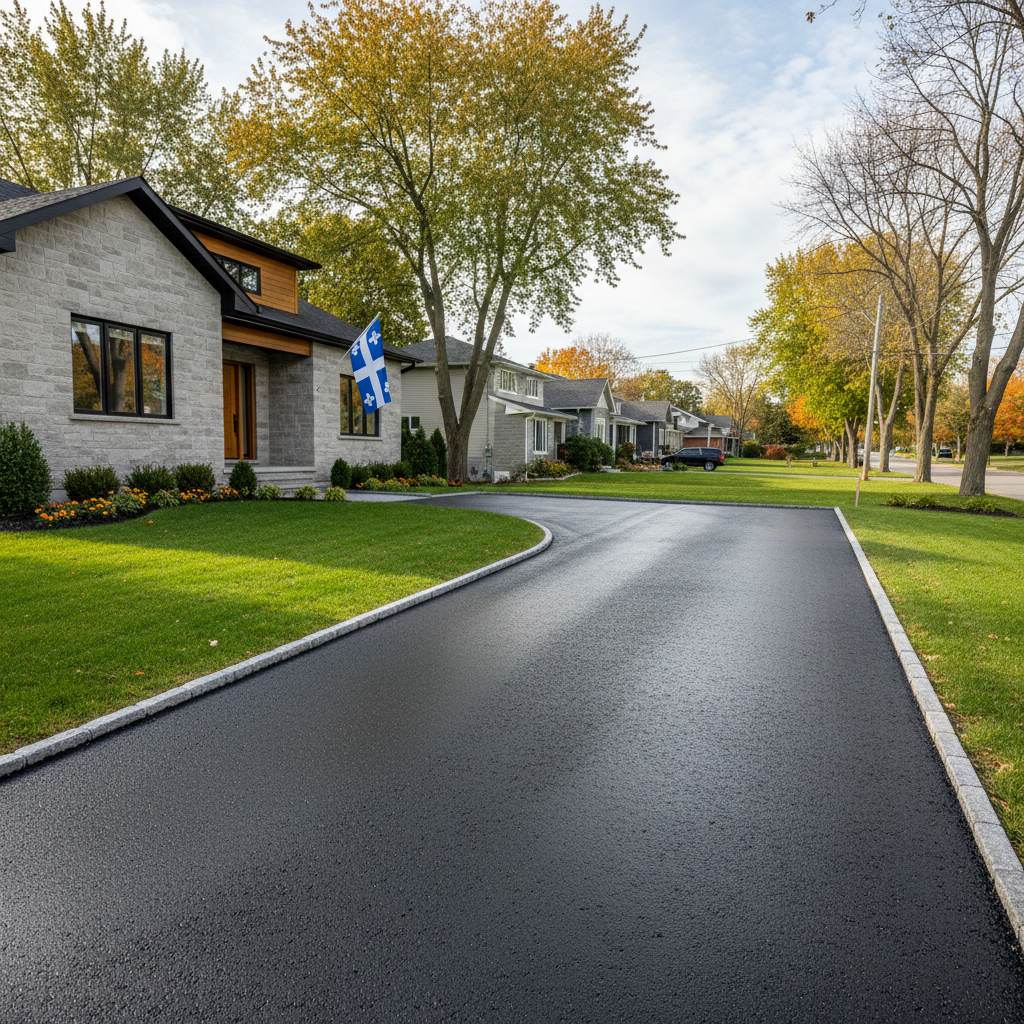
Driveway paving options and costs in New Brighton
New Brighton, Alberta, is a growing Calgary-area neighbourhood where homeowners increasingly want a driveway that looks finished and survives our freeze–thaw winters. With a population of 12,885 (Statistics Canada, 2021 Census), there’s steady demand for hard-surface driveways—especially in detached-home pockets where the majority of properties typically park daily-use vehicles. That means the “baseline” competition for contractor availability is real in spring and early fall.
In Calgary’s cold continental climate, frost can penetrate to around 1.2 m (4 ft), so costs are driven by how well the contractor builds the granular base and manages drainage. If water sits in the subgrade, repeated expansion and contraction can lift the surface, leading to cracking, raveling, and edge breakdown. As a result, paving quotes here often land higher than in milder regions, and crews may be booked tightly because the paving season is compressed—hot-mix asphalt generally needs air temperatures above about 10°C to place and compact correctly.
In New Brighton, demand is especially common near established residential corridors and busy access points where driveways see frequent turning, plowing, and winter sanding. If you’re comparing options, the upfront differences matter—but so does how each surface performs during freeze-thaw and how often it needs maintenance. Below is a practical comparison of common driveway choices and typical per-square-foot ranges, so you can evaluate apples-to-apples when you get bids.
| Material |
Lifespan |
Maintenance |
Best For |
Price per sq ft |
| Asphalt (new installation, proper base) |
15–25 years |
Sealcoat every 3–5 years; patching as needed |
Cost-controlled driveways with a smooth finish |
$12–$20 |
| Asphalt (overlay on existing gravel base) |
12–20 years |
Sealcoat every 3–5 years; more frequent patching if base is weak |
Upgrading an unpaved drive where a full tear-out isn’t ideal |
$14–$22 |
| Interlocking concrete pavers |
25–35 years |
Re-leveling of limited sections; sealant for colour protection (optional) |
High curb appeal and easier spot repairs |
$18–$30 |
| Poured concrete (broom finish) |
20–30 years |
Crack repair; occasional patching; reseal if desired |
Durability and a clean, modern look |
$15–$25 |
| Exposed aggregate concrete |
20–30 years |
Sealer refresh every few years; crack repairs as required |
Slip resistance and strong visual finish |
$18–$28 |
| Gravel / crushed stone (budget option) |
3–8 years |
Top-ups; grading; weed control |
Lowest entry cost while you plan future upgrades |
$6–$12 |
Prices are estimates only and vary by project scope, site access and material selection.
What affects the price of paving in New Brighton
In New Brighton and the wider Calgary market, it’s common to see quotes for the “same driveway size” differ by 30–50%. The reason is usually not the asphalt or concrete itself—it’s what gets done underneath and around it: base depth, drainage corrections, grading, and the amount of tear-out and disposal. When crews are booked in peak weeks, mobilization and labour rates also rise, especially for smaller jobs that still require full equipment movement.
Frost line depth and freeze–thaw cycles are decisive cost factors in this region. With frost penetrating to roughly 1.2 m (4 ft), contractors plan for deeper, well-compacted granular base and well-graded aggregates to reduce subgrade movement. Practically, that means many Calgary-area driveways need stronger base build-ups (often in the 6–12 inch compacted range for asphalt or concrete placements, depending on soil conditions and design), plus positive drainage so water can’t sit under the slab. Asphalt mix design also matters: you’ll typically want a freeze–thaw-rated hot-mix asphalt that can better tolerate Calgary’s winter cycling.
Two concrete examples from New Brighton show how conditions move the price. First, if you have poor drainage (low spot near the garage, downspout discharge onto the driveway, or a shallow crown), contractors often need extra grading and underdrain work, pushing jobs above a typical $12–$20/sq ft asphalt range. Second, a straightforward site with firm soils and good slope can keep asphalt closer to the lower end, while a full tear-out of old concrete (breaking, hauling, and replacing granular base) can add significant labour and disposal costs. If you’re moving to pavers, tight lot access and edge restraints can increase cost, but repairs may be cheaper later than with a single poured slab when only a small area is damaged.
| Price Factor |
Why It Matters |
Cost Impact |
| Driveway area in sq ft |
Most material and paving labour scale directly with surface area. |
High—can change the total by thousands. |
| Base depth required |
Frost drives the need for thicker, compacted granular layers to prevent heaving and cracking. |
Medium to high—more base means more hauling and compaction time. |
| Grading and drainage work |
Proper slope and water management reduce freeze–thaw damage. |
Medium—can become high if underdrain/soils are problematic. |
| Tear-out of existing surface |
Concrete/asphalt removal includes breaking, loading, hauling, and disposal. |
Medium to high—often a major add-on. |
| Edge restraints and curbing |
Edges keep pavers from spreading and keep asphalt from migrating. |
Medium—especially for pavers and long runs. |
| Sealing requirement |
Asphalt performance depends on timely sealcoat to protect from water and oxidation. |
Low upfront, medium lifecycle (budget for year 1 to 2 sealcoat). |
| Site access |
Narrow driveways or tight turns slow equipment placement and increase labour hours. |
Low to medium—can be high for difficult access. |
| Asphalt mix specifications |
Freeze–thaw-rated mixes can cost more but improve winter durability. |
Low to medium—often worth it on residential driveways. |
Permits & regulations in Alberta
For most homeowners in New Brighton, paving a driveway within your own property typically does not require a building permit. The usual exception is if you’re doing work that affects the municipal right-of-way, such as a new curb cut, changes to the boulevard, or modifications to storm drainage—those items generally require municipal approval. Some areas also enforce lot-grading expectations, which can restrict how close and how you surface across certain transitions to prevent runoff problems.
Here’s a practical way to think about what usually does require a permit/approval versus what typically does not: paving and replacing the driveway surface on your private lot usually does not trigger a building permit. However, anything that changes drainage patterns into the street, involves a boulevard crossing, or creates/adjusts a curb opening usually needs municipal sign-off first.
Before excavation, always call for utility locates using Alberta One-Call. Then verify your contractor’s credentials step-by-step: (1) check the contractor’s Alberta business licence/registration using the appropriate provincial registry or the contractor’s public listing; (2) ask for a current certificate of liability insurance with your address noted (and confirm it covers paving-related work); (3) confirm workers’ coverage—commonly WSIB/WCB coverage documentation—by requesting clearance paperwork or coverage confirmation from the contractor. A credible contractor will provide these without pushing you to “skip paperwork.”
Asphalt vs pavers vs concrete for New Brighton driveways
Choosing between asphalt, interlocking concrete pavers, and concrete in New Brighton comes down to a trade-off between upfront cost, winter durability, and how you want repairs handled. Asphalt is usually the lowest upfront option and can produce a smooth, uniform surface, but it depends on sealing—typically every 3–5 years—to reduce water intrusion that fuels freeze–thaw failure. In Calgary-area winters with deep frost (about 1.2 m/4 ft), that sealing and base preparation both matter; a thin base or poor drainage can lead to cracking and surface raveling sooner.
Interlocking concrete pavers cost more initially, but they’re often the best choice for homeowners who want curb appeal and flexibility. If a small section settles due to localized soil moisture or a plumbing repair, pavers can be lifted, corrected, and reset without replacing the entire driveway. That repairability is valuable in semi-rural and variable-soil pockets around the Calgary region.
Poured concrete sits in the middle on price and looks clean, but it needs good air-entrainment and proper jointing to resist freeze–thaw stresses. Concrete also responds to winter maintenance: regular plowing and sand/ice melt can expose weak spots if curing and mix design aren’t right. Exposed aggregate can improve traction, but it follows the same freeze–thaw principles as concrete.
Budget example: if an asphalt driveway is quoted around $12–$20/sq ft and pavers are quoted near $18–$30/sq ft, the premium is often justified when you value long-term aesthetics, want the ability to repair localized areas, or expect future access needs. If your priority is lowest upfront cost and you’re comfortable budgeting for sealing, asphalt can still be the right call.
| Material |
Frost Resistance |
Curb Appeal |
Repair Method |
Lifespan |
Price Band |
| Asphalt (sealed regularly) |
Good with proper base, drainage, and freeze–thaw-rated mix |
Low to moderate |
Patch and re-seal localized failures |
15–25 years |
$12–$20 |
| Interlocking concrete pavers |
Very good when edged and bedded correctly |
High |
Remove and re-set only affected units/areas |
25–35 years |
$18–$30 |
| Poured concrete (air-entrained) |
Good with correct air-entrainment and jointing |
Moderate to high |
Crack repair/patching; full replacement only if widespread |
20–30 years |
$15–$25 |
| Exposed aggregate concrete |
Good with correct mix, air entrainment, and drainage |
High |
Patch and reseal; aesthetic matching required |
20–30 years |
$18–$28 |
| Permeable pavers (drainage grid) |
Good when installed to move water correctly |
High (modern look) |
Spot repairs similar to standard pavers |
20–30 years |
$22–$34 |
| Chip seal / tar-and-chip |
Moderate; performance depends heavily on base and spring maintenance |
Low to moderate |
Chip/aggregate rework; localized patching |
8–15 years |
$10–$16 |
How to choose a paving contractor in New Brighton
When you’re hiring in New Brighton, start with verification. In Alberta, confirm the contractor has the right business registration and can provide a certificate of liability insurance (covering paving and any subcontractors they use). Then verify workers’ compensation coverage (commonly WSIB/WCB) by asking for clearance letters or coverage confirmation directly from the contractor. If they can’t supply these documents or they provide old certificates, that’s a major risk—especially when winter work delays can extend time on site.
Next, get 2–3 itemised written quotes. You want a breakdown for labour, materials, base/granular thickness, compaction, excavation/take-out, disposal, and any drainage or grading corrections. Avoid bids that lump everything into one number without stating whether the base is being rebuilt to the required depth for frost protection. Ask whether permits/approvals are included if the job touches the municipal right-of-way. Confirm what’s excluded (existing drainage repairs, soft spot removal, replacement of damaged turf, or landscaping restoration).
Warranty matters too: ask for the workmanship warranty length and whether the product/manufacturer warranty applies to you as the homeowner (and if it’s transferable). For payment, don’t accept a schedule that asks for more than about 10–15% upfront. Use a holdback until the job is complete and site clean-up is done.
Finally, request a written timeline with a start date and estimated completion—peak season scheduling is tight here, and you want to know what happens if weather extends the window.
- Provide Alberta licence/registration details and proof they’re operating as a legitimate business.
- Show current liability insurance certificate (request it be address-specific if possible).
- Confirm workers’ compensation coverage (clearance letter or coverage confirmation).
- Ask for an itemised scope: excavation, base depth, compaction method, and surfacing layers.
- Require a written drainage plan (slope, outlets, and how water will be managed).
- Confirm frost-related base design for your soil condition and driveway thickness.
- Specify edge restraints/curb options (especially for pavers) and include them in the quote.
- Ask what tear-out and disposal includes (old asphalt/concrete, hauling distance assumptions).
- Clarify exclusions: soft spots, utility locates, sod/landscape reinstatement, and backfill.
- Request warranty terms in writing for labour/workmanship and product if applicable.
- Set payment schedule with a small upfront deposit and holdback until completion.
- Get a start date and completion estimate in writing, with how weather impacts scheduling.
Red flags in New Brighton include: quotes with no base thickness or compaction details, refusal to show insurance/coverage documents, “we’ll see later” language about drainage corrections, unclear warranty terms, and bids that are significantly lower while omitting tear-out, hauling, or edge restraints—those shortcuts usually show up the next winter.
Frequently asked questions — paving in New Brighton
What is a chip seal driveway and is it suited to New Brighton?
Chip seal is a surface treatment that uses asphalt binder followed by a layer of stone chips, then compacted so the chips lock in. In New Brighton and the broader Calgary area, it can be suitable for some residential driveways—especially when the base is well-built and drainage is correct—but it’s not the best fit if you’re after a highly uniform, “finished” look like asphalt or pavers. The freeze–thaw cycle can loosen chips if the subgrade is waterlogged, so contractors need a strong granular base and proper slope. Budget-wise, it’s often below typical asphalt pricing (for example, chip seal may land closer to $10–$16/sq ft), but lifecycle expectations are shorter than sealed asphalt or pavers.
How much does driveway crack repair cost in New Brighton?
Crack repair typically costs based on crack length, whether it’s just sealing hairline cracks or dealing with wider splits caused by base movement. In New Brighton, contractors usually assess whether water is getting underneath; otherwise, sealing alone may only be a temporary fix. For many residential driveways, basic crack sealing and surface prep can be relatively modest, while repairs that require saw-cutting, removing affected material, and patching can increase the price quickly. As a homeowner budgeting anchor, sealing and repair as a category often runs roughly $400–$1,500 depending on access, quantity, and how much base correction is needed. A good quote will specify the crack size, cleaning method, and whether a targeted patch is included.
What base thickness do I need for pavers in New Brighton?
For paver driveways in New Brighton, the right base thickness depends on your soils, subgrade firmness, and how water is managed—because frost expansion and movement are what you’re trying to prevent. In Calgary’s cold continental conditions (frost about 1.2 m/4 ft), contractors generally build a deeper, properly compacted granular base rather than relying on thin layers. A typical design approach is: a compacted base layer (often in the 6–12 inch compacted range for many residential applications) plus a bedding layer for pavers, with edge restraints to lock everything in. If you have soft spots, high groundwater, or drainage issues, the effective base thickness and undercut/excavation requirements increase, and your quote should reflect that.
How do I get the most accurate paving quote in New Brighton?
To get an accurate quote in New Brighton, start by providing measurements (approximate width/length) but ask the contractor to verify on site. The most reliable bids are itemised: they specify excavation/take-out, granular base depth, compaction approach, drainage/grading, and the specific surface type. Ask whether the contractor is including disposal, and whether utility locates are handled or verified beforehand. Also request clarity on frost-related design—what base thickness they’re proposing and how they prevent water from sitting under the driveway. Finally, compare like-for-like: asphalt bids should specify mix type and sealcoat plan, and paver bids should specify edge restraints and bedding.
How much does it cost to pave a driveway in New Brighton?
Driveway paving cost in New Brighton usually lands within the regional price bands, but the final total depends on size (sq ft), base work, tear-out, and access. For asphalt, typical driveway paving often falls around $12–$20/sq ft when the contractor designs the base properly for freeze–thaw conditions and includes necessary prep. Concrete is commonly in the $15–$25/sq ft range depending on finish type and whether there’s significant drainage or demolition work. For pavers, homeowners often see $18–$30/sq ft due to base layers, restraints, and labour-intensive installation. If you’re upgrading from gravel, the difference between a full rebuild and an overlay approach is one of the biggest drivers—so insist on an itemised base scope.
Asphalt vs interlocking pavers vs concrete — which is best in New Brighton?
In New Brighton’s freeze–thaw climate, “best” depends on your priorities. Asphalt is usually the best value if you want the lowest upfront cost and are willing to maintain it with sealcoat—often every 3–5 years—to protect against winter water intrusion. Interlocking concrete pavers are ideal if curb appeal matters and you want repairs that are localized and practical; damaged sections can be lifted and reset without replacing the entire driveway, which helps when winter impacts are uneven. Poured concrete can be a strong, durable choice if it’s air-entrained and jointed correctly, but cracks can still occur and usually need targeted repair. If you’re comparing price, pavers often sit closer to $18–$30/sq ft versus asphalt’s $12–$20/sq ft, and that premium is often justified by long-term flexibility and appearance.