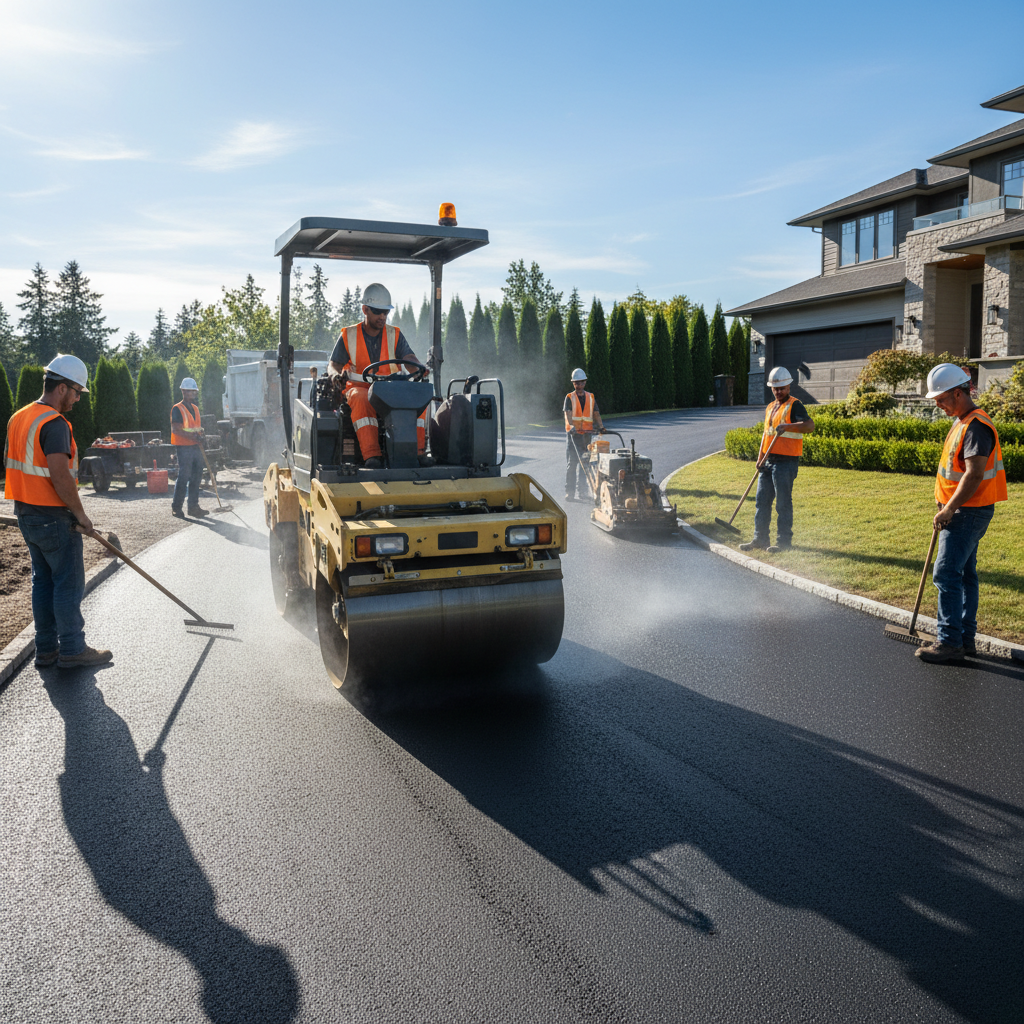
Driveway paving options and costs in Parkhill
Parkhill, Alberta is a small community where most private driveways are tied to single-detached homes, so paving decisions directly affect daily access, winter safety and long-term maintenance budgets. With a population of about 1,770 people (Statistics Canada, 2021 Census), you may notice pricing can swing more than in bigger centres when crews are busy or equipment is already committed. At the same time, local contractors who serve Parkhill from the broader Calgary area understand that frost and freeze–thaw cycles are not theoretical—they’re the main reason driveways cost more here than in milder climates.
In Calgary’s cold continental conditions, frost can penetrate roughly 1.2 m (4 ft). That depth drives the need for deeper, well-compacted granular base and positive drainage. Repeated freezing and thawing can move the subgrade and expand water, leading to cracking, heaving and raveling if the base isn’t built correctly. There’s also a practical scheduling factor: Alberta’s paving season is compressed, and hot-mix asphalt needs suitable weather and temperatures to place and compact properly (often above 10°C air temps). When that window tightens, availability and mobilization can increase for smaller lots and tight access areas in places like the outskirts and residential lanes that feed into Main Street.
Below are typical homeowner price ranges for Parkhill, Calgary-area pricing tiered for residential driveways, and based on proper base preparation and realistic maintenance expectations. Use this table to compare apples-to-apples before you call for a quote.
| Material |
Lifespan |
Maintenance |
Best For |
Price per sq ft |
| Asphalt (new installation, proper base) |
15–25 years |
Sealcoat every 3–5 years; patch as needed |
Lowest upfront cost with strong performance if base and drainage are done right |
$12 – $20 |
| Asphalt (overlay on existing gravel base) |
10–18 years |
Sealcoat and crack/edge repairs; monitor settlement |
Short-term upgrade where base is still sound and drainage is maintained |
$10 – $16 |
| Interlocking concrete pavers |
25–35 years |
Rinse/clean, re-level minor areas; replace individual stones |
Curb appeal and easy spot repairs without full replacement |
$18 – $30 |
| Poured concrete (broom finish) |
25–30 years |
Keep it sealed if required; manage joints and small spalls |
Clean look and predictable longevity when air-entrained mix and joints are right |
$15 – $25 |
| Exposed aggregate concrete |
25–35 years |
Seal periodically; address scaling/spalls early |
Slip-resistant surface and premium curb appeal |
$20 – $32 |
| Gravel / crushed stone (budget option) |
5–12 years |
Top up annually; re-grade; weed control |
Lowest initial cost where you’re planning a future hard-surface upgrade |
$4 – $10 |
Prices are estimates only and vary by project scope, site access and material selection.
What affects the price of paving in Parkhill
In Parkhill and across the Calgary economic region, the same “driveway paving” description can come in 30–50% apart because quotes often differ in what’s included: base thickness, drainage correction, tear-out, compaction testing, and edge restraint. Contractors may also price for winter-ready performance—especially important when frost repeatedly penetrates the ground and freeze–thaw cycles stress subgrades. In a cold continental climate, deeper frost means you typically need thicker compacted granular base to limit heaving and cracking; the longer the freeze–thaw season lasts, the more foundation work and aggregate quality matter. That’s one reason you’ll see asphalt pricing tied to the $12–$20 range, while pavers often fall in the $18–$30 band for fully built, properly restrained installs.
Concrete costs can move just as much depending on mix design and jointing. For example, in Parkhill, an air-entrained concrete mix and well-placed control joints help manage expansion and contraction. If a site has poor drainage and runoff flows toward the house, contractors may add subdrains, re-grade the slope, or rebuild the base to keep water from sitting under the pavement—these steps can raise costs, but they prevent the “soft spots” that later turn into potholes or edge failures. Conversely, if your existing base is well-graded, compacted and free-draining, you may get away with less tear-out—often lowering the total.
Two practical Parkhill examples: (1) a driveway that must be widened by a foot on both sides for proper plowing access adds base and compaction area; (2) a lot with heavy clay or variable fill often requires deeper granular rebuild, which increases material and labour. Even a 20–40 sq ft change can matter at Parkhill-scale project sizes, where mobilization from the Calgary area and seasonal demand can tighten availability. With that in mind, use the factors below to understand what you’re actually paying for when your quote lands above or below the typical price bands.
| Price Factor |
Why It Matters |
Cost Impact |
| Driveway area in sq ft |
The majority of cost scales directly with paving and base quantity |
Low-area changes can swing total price notably in smaller Parkhill projects |
| Base depth required |
Frost line depth and freeze–thaw cycles determine granular thickness to prevent heaving and cracking |
Increasing base thickness can add a large materials and labour component |
| Grading and drainage work |
Proper slope and positive drainage keep water from expanding under pavement |
May require re-grading, swales, or additional drainage rock/subdrains |
| Tear-out of existing surface |
Breaking and hauling old asphalt/concrete adds equipment time and disposal costs |
Concrete tear-out typically costs more than removing gravel |
| Edge restraints and curbing |
Prevents paver spread and asphalt edge breakdown during freeze–thaw movement |
Often underpriced in “budget” quotes, but essential for long life |
| Sealing requirement |
Asphalt performance depends on sealing to slow oxidation and water infiltration |
Expect a maintenance budget; skipping can reduce lifespan |
| Site access |
Narrow driveways or long distances slow equipment and increase labour time |
Mobilization and extra handling can lift per-sq-ft cost |
| Asphalt mix specifications |
Freeze–thaw-rated mixes and proper binder content improve durability in cold winters |
More specialized mix can increase material cost within the $12–$20 band |
Permits & regulations in Alberta
In Alberta, paving a private driveway within your own property typically doesn’t trigger a building permit. That said, the moment you touch areas tied to municipal infrastructure, approvals are often required. For Parkhill homeowners, work that may need municipal approval includes changes in the municipal right-of-way such as new curb cuts, modifying boulevard areas, altering or reconnecting storm drainage, or any grading changes that affect how runoff leaves the property. Some municipalities also have lot-grading bylaws that restrict how close to property lines a hard surface can be and how water must be directed—so it’s worth confirming before excavation starts.
Always start with utility locates. In Alberta you can use Alberta One-Call to request locates before anyone digs, even for “small” saw-cut tear-outs or trenching for drainage. Locates prevent expensive utility strikes and delays.
Here’s a practical step-by-step to verify your contractor before you sign in Parkhill:
- Ask for their Alberta business information and licence details, then verify through the appropriate provincial registry/service used for contractor status.
- Request a current certificate of insurance showing liability coverage appropriate for excavation and paving.
- Confirm workers’ coverage for employees via WCB (Workers’ Compensation Board) clearance; ask for proof/clearance letter.
- Require proof of insurance that matches the job period (not “general paperwork from last year”).
- Get the scope in writing: tear-out limits, disposal responsibility, and whether permits/approvals are included if your driveway ties into the boulevard.
If the quote includes any right-of-way work, ask who will apply, who pays, and how the contractor handles inspection timelines.
Asphalt vs pavers vs concrete for Parkhill driveways
For Parkhill’s freeze–thaw climate, the best choice is usually the one that matches your winter routine and drainage reality. Asphalt typically has the lowest upfront cost and a smooth ride, but it relies on a strong base and must be sealed regularly—often every 3–5 years—to protect against water infiltration and oxidation. Interlocking concrete pavers cost more at the start, but they’re repair-friendly: if one section settles or a utility line is later opened, individual stones can be reset without tearing up the entire driveway. Poured concrete sits in the middle for upfront cost and looks clean, but concrete is sensitive to freeze–thaw and de-icing conditions unless it’s properly air-entrained and jointed.
In Calgary-area soil conditions, base preparation is the common denominator. With frost routinely penetrating deep, you should expect contractors to build deeper granular layers and compact them thoroughly, plus ensure positive drainage away from the house. A driveway that drains well will hold up across the winter season better regardless of surface type; a driveway that holds water under the slabs or asphalt will fail sooner. For plowing, sand and salt exposure also matter—pavers generally take it well, while concrete requires correct mix design, and asphalt needs sealing to manage water at the surface.
Where the price difference makes sense: if your driveway paving quote lands at the asphalt $12–$20 per sq ft range and you’re considering pavers in the $18–$30 band, pavers can be worth the upgrade when curb aesthetics matter and you want the ability to repair only problem areas. For example, replacing a small settlement zone on pavers is typically far less disruptive than full asphalt reconstruction; with concrete, repairs may involve cutting and patching sections. If your priority is keeping initial cost down and you can commit to sealing, asphalt often offers the best value in Parkhill. If you want the most predictable repair path during future landscaping changes, pavers are usually the homeowner-friendly option.
| Material |
Frost Resistance |
Curb Appeal |
Repair Method |
Lifespan |
Price Band |
| Asphalt (sealed regularly) |
High when base and drainage are correct; performance depends on freeze–thaw-rated mix |
Medium (clean black surface, modest customization) |
Patch potholes/cracks; mill and pave localized sections if needed |
15–25 years |
$12 – $20 |
| Interlocking concrete pavers |
Very high with restrained edges and proper bedding; less “system-wide” failure |
High (pattern and colour options) |
Remove and reset individual pavers or re-level small zones |
25–35 years |
$18 – $30 |
| Poured concrete (air-entrained) |
High when air-entrained and properly jointed for freeze–thaw |
Medium (solid look; can be finished for texture) |
Cut out and patch sections; larger issues may require partial replacement |
25–30 years |
$15 – $25 |
| Exposed aggregate concrete |
High with correct mix, finishing, and curing; slip-resistant surface |
Very high (premium texture) |
Patch with matched finish (small spots), localized replacement if needed |
25–35 years |
$20 – $32 |
| Permeable pavers (drainage grid) |
High when installation details are correct; reduces water retention |
High (modern drainage-friendly look) |
Reset affected blocks; maintain with proper vacuuming to prevent clogging |
25+ years (depends on maintenance) |
$22 – $36 |
| Chip seal / tar-and-chip |
Moderate to high initially; performance varies with base and traffic |
Low to medium (textured surface) |
Maintenance overlays; spot rework in failing areas |
8–15 years |
$10 – $18 |
How to choose a paving contractor in Parkhill
Choosing the right contractor in Parkhill comes down to proof and clarity. Start with Alberta compliance: ask whether the business carries current liability insurance and whether workers are covered under WCB for employees. To check, request a certificate of insurance from the contractor (it should list your project area/end date or at least be current for the job period) and ask for a WCB clearance letter or proof tied to the business. If a contractor can’t provide current documents quickly, treat that as a major red flag.
Next, get 2–3 itemised written quotes. You want a labour and materials breakdown, not just a lump sum. A fair quote should specify base thickness, aggregate type, compaction expectations, any drainage work, the exact asphalt mix (or concrete air-entrainment and finish), and the scope of tear-out and disposal. Confirm whether permits are included if your driveway ties into municipal right-of-way work—especially if there’s any storm drainage adjustment.
Warranty matters too. Ask for a workmanship warranty length and what it covers (typically material defects are different from install defects), plus whether manufacturer coverage can be transferred to you if you sell the house. Payment schedule should be restrained: never pay more than 10–15% upfront; hold a portion until completion and final cleanup. Finally, insist on a written timeline—start date and completion estimate—because Parkhill projects often wait on the short late-spring to early-fall window.
- Verify Alberta licensing/status and request business proof before work begins.
- Confirm current liability insurance with coverage dates matching your project.
- Provide WCB proof/clearance letter for workers.
- Request a detailed scope: tear-out limits, base depth, drainage, and edge restraints.
- Ask what’s included for hauling and disposal of old asphalt/concrete.
- Confirm compaction method and whether they outline base build-up layers.
- Check asphalt mix specification for freeze–thaw suitability.
- For concrete, ask about air-entrainment and joint/control plan.
- Get warranty terms in writing (workmanship and product separately).
- Ask about schedule: start date, weather contingencies, and curing time.
- Confirm payment milestones and keep a holdback until final walk-through.
- Ensure the quote clarifies exclusions (sprinkler adjustments, sod replacement, grading beyond limits).
Red flags in Parkhill: (1) quotes that omit base thickness and drainage/slope details; (2) “cheap” asphalt that includes no sealcoat allowance or no plan for edge support; (3) no written timeline for a season-dependent job; (4) refusal to provide insurance/WCB proof; and (5) vague warranties that don’t specify what’s covered and for how long.
Frequently asked questions — paving in Parkhill
How do I compare paving quotes fairly?
To compare paving quotes fairly in Parkhill (and across Alberta), line up the scope first—don’t compare only the bottom-line total. Ask each contractor to break out labour and materials, including the base build-up (granular type and depth), drainage corrections, and edge restraints. Confirm whether tear-out and disposal are included, especially if you’re replacing older asphalt or concrete. If you’re getting asphalt bids, ask what freeze–thaw-rated mix they use and what their sealing plan is. A “low” quote often omits base depth or drainage, which can shorten lifespan and force earlier repairs—so the $12–$20 per sq ft band can look attractive until you see what’s missing. If you’re between materials, compare like-for-like: similar base preparation and site work are what truly drives long-term performance.
Can asphalt be laid in cold weather in Parkhill?
In Parkhill, cold weather is exactly why timing matters. Asphalt needs suitable temperatures for placement and compaction; hot-mix asphalt generally requires warm enough air and base conditions (commonly around 10°C air temperatures and acceptable pavement/base temperatures) so the mix compacts properly and doesn’t cool too fast. If a contractor pours asphalt on a borderline day or on a cold/wet base, you can get poor bond, weak compaction and early cracking that shows up as potholes and raveling. Because Alberta’s paving season is compressed, good contractors schedule within the late spring through early fall window and will postpone if conditions aren’t right. If someone pressures you to pave “no matter the weather,” that’s usually a sign they’re risking performance instead of building for Parkhill’s freeze–thaw cycles.
What is a driveway apron and do I need one in Parkhill?
A driveway apron is the transition area between your driveway and the roadway, curb, or municipal boulevard—essentially the finished surface that ties different elevations together. In Parkhill, whether you need one depends on how your driveway meets the street and whether any curb cut or boulevard drainage changes are required. If your driveway currently drops sharply, has standing water, or the edge breaks where vehicles enter, an apron can improve the flow of runoff and reduce damage from plowing and turning loads. If your apron work involves the municipal right-of-way (like changing a curb cut or adjusting storm drainage), it typically requires municipal approval, so it’s not something to assume is “just part of paving.” Ask your contractor to clarify right-of-way scope and whether any permits/approvals are included.
How do I maintain my driveway through Parkhill winters?
Maintenance in Parkhill is mainly about limiting water and protecting the surface during freeze–thaw. For asphalt, plan to seal on schedule (often every 3–5 years, depending on your product and weather exposure), and keep an eye on cracks near edges—water gets in there first. During winter, use sand/salt thoughtfully: too much salt and brine can accelerate surface degradation, and heavy sand buildup can trap moisture. Plow carefully to avoid scraping the edges and expose the base. For pavers, keep joint material in good shape and avoid washing out bedding. For concrete, ensure drainage keeps directing runoff away from the slab, and address small spalls promptly to prevent freeze–thaw expansion. In general, fast repairs are cheaper than waiting for a full section to fail—especially in a cold region where frost can penetrate deeply and move subgrades.
Is it worth sealing a new driveway right away in Parkhill?
In most cases, sealing a new asphalt driveway right away is not the right move—timing matters more than enthusiasm. Contractors typically wait until the asphalt has cured and is ready for the sealer, which is often after the initial set and depending on weather and product. Sealing too soon can trap moisture or interfere with proper bonding, creating early failure. That said, sealing is absolutely part of good asphalt lifecycle planning in Parkhill’s climate; skipping it can shorten performance and push you toward more frequent repairs. When sealed properly, homeowners can better protect their asphalt within the typical $12–$20 per sq ft range install economics. If you’re comparing quotes, ask what sealer they use, when they recommend the first application, and whether they include a maintenance plan (not just installation).
What is a chip seal driveway and is it suited to Parkhill?
A chip seal driveway (also called tar-and-chip) is a surfacing method where a binder (often emulsion/bitumen) is sprayed and aggregate chips are embedded to form a textured surface. It can be a practical option for budget-conscious homeowners and some low-traffic or interim surfaces. For Parkhill, it can work when the base is built properly and the application rate and aggregate gradation are correct—because freeze–thaw cycles can loosen chips if water gets under the surface. Longevity tends to be lower than paved asphalt or pavers, so you should expect maintenance overlays or spot rework sooner rather than later. If you’re looking at alternatives, remember asphalt paving often falls into the $12–$20 band with longer lifecycle when installed and sealed well. Ask the contractor how they’ll manage base depth, drainage, and winter durability before choosing chip seal in Alberta’s cold conditions.