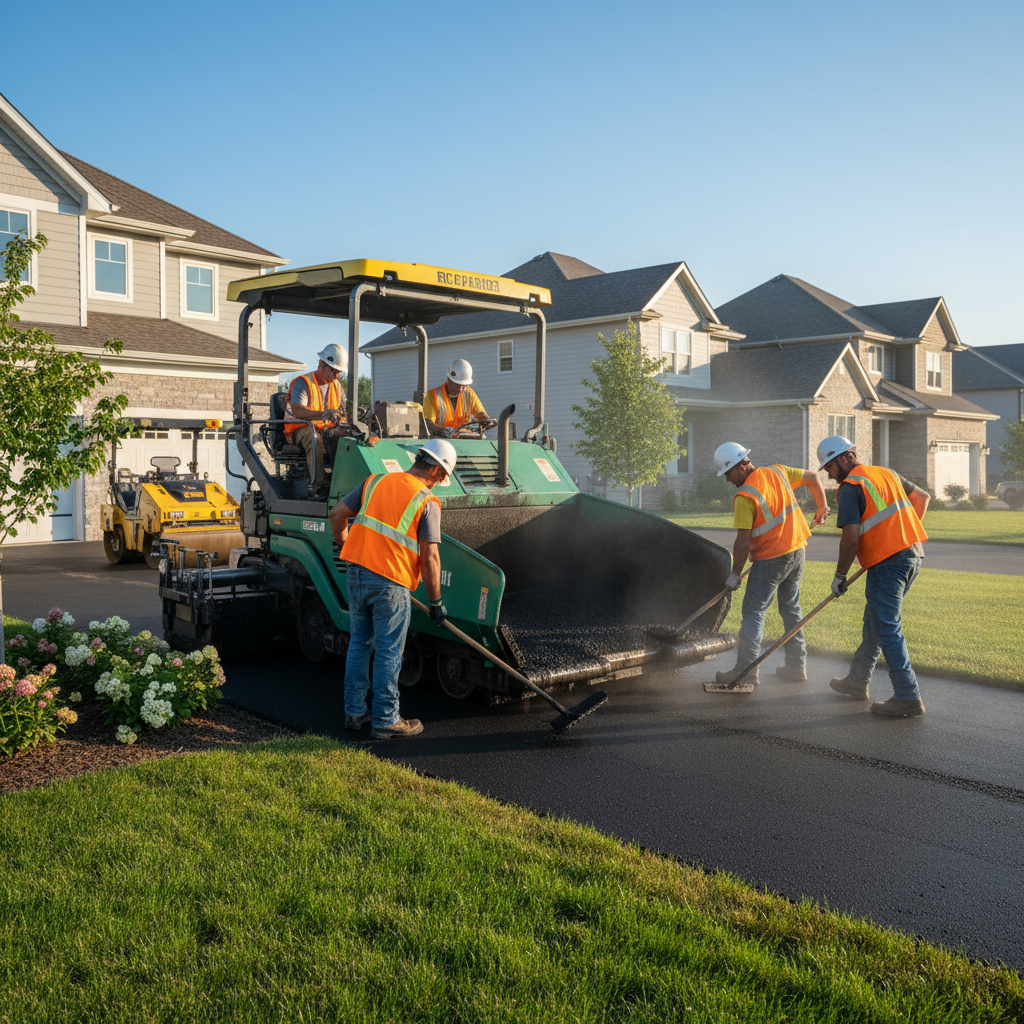
Driveway paving options and costs in Brooks
In Brooks, choosing the right driveway surface comes down to the blend of upfront cost, winter performance, and how much maintenance you want to manage. Most homes here are single-detached (54.5% of dwellings), so private driveways make up a big share of demand. It also helps to remember that a large portion of the housing stock is older—47.5% of homes were built before 1981—so many jobs start with upgrading tired granular bases, fixing drainage, or replacing settled approaches rather than paving “over top” in the same shape.
In the Lethbridge–Medicine Hat economic region, pricing is shaped by frost depth and freeze–thaw cycles. Southern Alberta frost penetration is commonly around the 6 ft range, and that means driveways need deeper, well-compacted granular base layers and robust drainage to reduce frost heave and early surface cracking. The practical paving season (late spring through early fall) is shorter than in milder areas, so contractor scheduling is tighter. That can affect unit rates—especially for smaller residential driveways where equipment mobilisation costs are spread across fewer square feet.
For Brooks neighbourhood work, you’ll often see high activity around newer growth pockets and established residential clusters such as near the downtown core and the thickly built residential streets off 1st Avenue and 2nd Avenue, where access and tie-ins to existing grades are common. Once the base and drainage are right, material choice largely determines your total cost and long-term feel. Use the table below to compare realistic installed ranges before you request an itemised quote.
| Material |
Lifespan |
Maintenance |
Best For |
Price per sq ft |
Price Range |
| Asphalt (new installation, proper base) |
15–25 years |
Seal 3–5 years; crack repairs as needed |
Best overall value when drainage and base are done right |
$5.50–$9.50 |
$6,000–$12,000 |
| Asphalt (overlay on existing gravel base) |
10–18 years |
Seal regularly; monitor edge settlement |
Budget upgrades when grading is already close |
$4.75–$8.50 |
$5,500–$10,500 |
| Interlocking concrete pavers |
25–40 years |
Weed control; occasional re-leveling of pavers |
Curb appeal and easier spot repairs without full replacement |
$9.00–$15.50 |
$9,000–$18,000 |
| Poured concrete (broom finish) |
20–30 years |
Minor patching; consider crack control strategy |
Low visual maintenance with strong base preparation |
$8.50–$13.50 |
$8,000–$16,000 |
| Exposed aggregate concrete |
20–30 years |
Sealer optional for stain resistance; repairs like concrete |
Slip-resistant look and upgraded appearance |
$10.50–$16.50 |
$10,500–$19,500 |
| Gravel / crushed stone (budget option) |
3–10 years |
Re-grade and top up; add fresh stone as it migrates |
Short-term solution or interim drive while you plan upgrades |
$3.00–$5.50 |
$3,000–$7,000 |
Prices are estimates only and vary by project scope, site access and material selection.
What affects the price of paving in Brooks
In Brooks and across the Lethbridge–Medicine Hat region, it’s normal to see quotes for the same driveway come in 30–50% apart—even when the homeowner thinks they’re comparing the “same” asphalt. The gap is usually about base depth, compaction quality, drainage, and the amount of excavation/tear-out required. Contractors can also charge differently based on equipment mobilisation and how tightly the paving season is booked; hot-mix asphalt production and placement really need air temperatures above about 10°C, and that limits flexible scheduling in late fall and early spring.
Frost line depth and freeze–thaw cycles are decisive cost factors in southern Alberta. When frost penetrates deeper, you need a thicker compacted granular base—commonly 6–12 inches for typical driveway builds when designed to resist heaving, rather than thinner assemblies. Less thickness means more movement, which shows up as cracking, rutting, or edge break-up. On top of that, the asphalt mix design has to be suited to local freeze–thaw performance, which can push material and quality-control costs higher than “generic” mixes.
Local conditions also swing prices. For example, a driveway that drains toward a low spot or onto clay can require extra excavation and a proper subdrain or regraded swales—often adding several days of labour and aggregate hauling. On the other hand, a newer lot with solid, well-draining soils and straightforward grading can land closer to the lower end of the $6,000–$12,000 asphalt band. If your scope escalates into a full tear-out of old concrete or settled asphalt and replacement of base, you can move toward the higher end—or justify pavers in the $9,000–$18,000 range when spot repairs are a priority.
| Price Factor |
Why It Matters |
Cost Impact |
| Driveway area in sq ft |
Most material and paving time is driven by square footage |
Often the biggest single swing (commonly 15%–40% differences) |
| Base depth required |
Frost resistance depends on granular thickness and compaction |
Can add 10%–35% depending on how much must be excavated and replaced |
| Grading and drainage work |
Correct slope and drainage reduce freeze–thaw pumping |
Typically 5%–25% increase if subdrains or major regrading are needed |
| Tear-out of existing surface |
Concrete breaking, asphalt milling, and disposal add labour and hauling |
Commonly +10%–30% versus “overlay” scenarios |
| Edge restraints and curbing |
Edges hold lines and prevent paver spread or asphalt edge failure |
Often +3%–15% depending on length and detail |
| Sealing requirement |
Asphalt needs sealing within the early service window |
Adding sealcoat budgeting usually adds a moderate recurring cost; plan for it within 6–12 months |
| Site access |
Narrow lanes slow equipment and can require smaller staging |
Can add 2%–15% for extra labour time and handling |
| Asphalt mix specifications |
Freeze–thaw rated mixes cost more but perform better locally |
Typically +5%–15% when premium mix/design controls are included |
Permits & regulations in Alberta
In Alberta, paving a private driveway within your own property usually does not require a building permit. Most homeowners in Brooks can proceed with typical driveway surfacing—removing existing material, excavating for a base, and installing asphalt, pavers, or concrete—without the same permit process you might see for structural additions.
However, work that affects municipal infrastructure commonly does require municipal approval. That includes changes in the boulevard such as a new or modified curb cut/approach, alterations to storm drainage direction, or any work that touches municipal right-of-way. Some municipalities also regulate lot grading and how close hard surfaces can be to property lines or how drainage must be handled to avoid impacting neighbouring lots.
Before excavation, the key step is to arrange utility locates through Alberta One-Call. In the field, this is what keeps you from damaging buried services and it’s also part of responsible contractor practice. When hiring, take the next step to verify your contractor’s Alberta credentials: confirm their business licence (as applicable) and request a current certificate of liability insurance. For workplace coverage, ask for proof of WSIB coverage or the applicable WCB status/clearance letter that matches the contractor’s classification. A solid contractor will provide these documents up front, before equipment arrives.
Finally, confirm the lot-grading rules with the City of Brooks (or the relevant municipal office) so your finished grade and drainage plan meet local expectations before paving locks everything in.
Asphalt vs pavers vs concrete for Brooks driveways
For Brooks driveways, asphalt, interlocking pavers, and concrete can all work—provided the base and drainage are engineered for freeze–thaw movement. The difference is how each material handles repairs and how quickly it shows wear under Alberta winters. Asphalt is usually the lowest upfront option, and in practice you’ll typically plan on sealing every 3–5 years to protect the binder from surface oxidation. Interlocking concrete pavers cost more to install, but they excel in curb appeal and let you lift and re-set individual sections if a base issue ever needs attention—an advantage when clay or drainage is imperfect. Poured concrete often sits in the mid-range, but it can crack over time if joints, thickness, and reinforcement aren’t designed for Alberta freeze–thaw and if de-icing practices are harsh without air entrainment.
Base preparation is the tie-breaker in the Lethbridge–Medicine Hat market. Because frost can penetrate deeply, all options benefit from a robust compacted granular base and properly sloped drainage so water can’t accumulate and pump during winter cycles. In salted/ploughed driveways, pavers generally tolerate repeated traffic and plow impacts better visually, while asphalt can rut and crack if the base is weak and if sealing is skipped. Concrete with proper air entrainment performs well, but it still relies on good drainage and thoughtful crack control to limit how cracks open and close through seasons.
Here’s a realistic budgeting example: if an asphalt driveway is quoted in the $6,000–$12,000 band, pavers might land in the $9,000–$18,000 range. That extra spend is often justified when you want long-term curb appeal, easy localized repairs, and a surface that can be refreshed without tearing out the entire driveway after a future base correction.
| Material |
Frost Resistance |
Curb Appeal |
Repair Method |
Lifespan |
Price Band |
| Asphalt (sealed regularly) |
Good when base is deep/compacted and drainage is correct |
Medium (clean, uniform finish; limited colour options) |
Patch and seal; localized asphalt repairs |
15–25 years |
$6,000–$12,000 |
| Interlocking concrete pavers |
Excellent with proper base and edge restraints |
High (varied patterns/colours) |
Remove and re-set affected paver sections |
25–40 years |
$9,000–$18,000 |
| Poured concrete (air-entrained) |
Very good when air-entrained and properly jointed |
Medium–High (broom finish; optional textures) |
Patch concrete; crack repair/sealing depending on severity |
20–30 years |
$8,000–$16,000 |
| Exposed aggregate concrete |
Very good with correct mix and curing |
High (premium look) |
Patch and re-finish local areas when needed |
20–30 years |
$10,500–$19,500 |
| Permeable pavers (drainage grid) |
Good to excellent when designed as a true drainage system |
High (modern look; clean lines) |
Lift/rebuild affected grid areas; clear clogged stone layer |
20–35 years |
$11,000–$22,000 |
| Chip seal / tar-and-chip |
Fair to good; performs best with strong base and proper traffic control |
Lower (more utilitarian appearance) |
Spot patch or re-seal cycles |
7–12 years |
$4,500–$9,500 |
How to choose a paving contractor in Brooks
Choosing the right paving contractor in Brooks starts with verifying credentials you can actually confirm. In Alberta, ask for proof of liability insurance (so you’re protected if something is damaged), and request their WSIB/WCB coverage documentation—many reputable trades provide a clearance letter or current coverage confirmation on request. Don’t rely on verbal answers. If they can’t provide paperwork quickly, that’s a process problem.
Next, get 2–3 itemised written quotes. Insist the quote breaks down labour and materials (excavation, haul/disposal, base materials, geotextile if used, asphalt/pavers/concrete supply, compaction, and finishing). A lump-sum number without a scope is risky, especially in freeze–thaw conditions where base and drainage choices drive performance.
Read the scope carefully for what’s excluded: disposal of excess material, saw-cutting/grinding for tie-ins, permit or municipal approval costs (when applicable), topsoil restoration, and any traffic control needed during placement and curing. Ask about warranty terms—workmanship warranty length, product/manufacturer warranty details, and whether warranties transfer if you sell the home.
For payment schedule, a safe approach is to never pay more than 10–15% upfront. Hold back a portion until the job is complete and deficiencies are corrected. Also get a written start date and completion estimate; in southern Alberta, the weather window matters, and contractors should plan staging around temperature and forecasted conditions.
- Request their current insurance certificate and verify the insured parties.
- Confirm WSIB/WCB coverage (clearance letter or proof) before work begins.
- Ask whether they engineer frost-resistant base thickness and how they justify it for your soil.
- Require an itemised excavation and disposal line item (not “included” without detail).
- Confirm whether geotextile is included and why (soil separation vs filtration).
- Check compaction requirements (proof rolling and density testing if available).
- Verify edge restraints/curb treatment (especially for pavers and asphalt edges).
- Ask about drainage fixes: regrading, ditch shaping, subdrain, or outlet tie-ins.
- Ensure saw-cutting and tie-in details are written for overlays or approach changes.
- Get a sealing plan for asphalt (timing within the 6–12 month window).
- Confirm warranty length for workmanship and whether it transfers to new owners.
- Agree on a written payment schedule with a holdback until final acceptance.
In Brooks, red flags include: contractors who won’t show insurance/coverage paperwork, quotes that skip base thickness and drainage details, “overlay only” proposals with no assessment of settlement, crews that start without utility locates, and vague warranties (or no written warranty at all).
Frequently asked questions — paving in Brooks
Asphalt vs interlocking pavers vs concrete — which is best in Brooks?
In Brooks, “best” depends on what you value most. Asphalt is often the best value if you’re willing to seal on schedule and if the base is deep and properly compacted for freeze–thaw conditions. Interlocking pavers usually win for curb appeal and for future-proofing against localized base issues because damaged sections can be lifted and reset without replacing the whole driveway; that’s helpful in older neighbourhoods where drainage and subgrade can be uneven. Poured concrete is a solid choice when air entrainment and jointing are handled correctly, but it’s less forgiving if water management is poor. Many homeowners end up choosing asphalt in the $6,000–$12,000 range, and pavers closer to $9,000–$18,000 when appearance and repair flexibility matter most. (Statistics Canada, 2021 Census)
How long does a paved driveway last in Brooks?
With proper base and drainage, typical expectations in Brooks are about 15–25 years for well-built asphalt when sealing is done, and around 20–30 years for properly prepared concrete. Interlocking pavers often last longer—25–40 years—because they tolerate minor movement better and can be repaired in sections. The real-world lifespan in southern Alberta is strongly tied to freeze–thaw cycles and moisture: if water can’t drain away, frost heave and pumping accelerate damage. That’s why jobs that remove settled granular base and rebuild to the required depth tend to outlast “fast overlays.” If your home is in a lot with older grades (many homes were built before 1981), it’s especially worth investing in a drainage-first approach. (Statistics Canada, 2021 Census)
When is the best time of year to pave in Brooks?
For Brooks, the best window is late spring through early fall when asphalt placement is reliable and weather risk is lower. Hot-mix asphalt generally needs air temperatures above about 10°C, so contractors typically avoid early spring pours and late fall work. The freeze–thaw pattern also matters: paving over thawed but still-wet subgrade can lead to weak compaction and future rutting or cracking. Plan for a schedule that finishes before prolonged cold snaps, and ask the contractor how they stage base work during workable days. If you’re considering sealing asphalt, also ask when the contractor recommends your first sealcoat—many schedules target within the early service period (commonly 6–12 months after paving), depending on weather and curing.
How deep should the base be for Brooks's frost?
Because southern Alberta can see significant frost penetration (commonly around the 6 ft range), base depth and composition are critical to resisting frost heave. For typical residential driveways in the Lethbridge–Medicine Hat area, contractors commonly design a thicker compacted granular base—often in the 6–12 inch range for frost-resistance—supported by proper grading and drainage. The exact depth should follow your soil conditions and the proposed drainage strategy, not a one-size number. If your yard drains toward the driveway or you have heavier clay, the required build-up is often greater and may include subdrain solutions. Ask your contractor to explain their frost-resistant assembly and how compaction is verified, especially if you’re paving an older driveway footprint.
How often should I seal my asphalt driveway?
Most Brooks homeowners should plan on sealing asphalt every 3–5 years, but timing starts with the curing window after installation. If the asphalt is new, contractors commonly recommend sealing after it has properly cured—often within 6–12 months—then following a regular cycle based on sun exposure, traffic (cars, turning movements), and winter wear from plowing and sand. Sealing is not just cosmetic: it helps reduce oxidation of the binder and can slow surface cracking and moisture intrusion. If you skip sealing for too long, small cracks can expand faster through freeze–thaw cycles. A good contractor will suggest a sealing schedule aligned with how your driveway actually performs in Brooks winters and how much maintenance you’re willing to do.
Why does my driveway crack and heave in winter?
Winter cracking and heaving in Brooks usually come back to two things: water and a base that isn’t built to resist frost movement. During freeze–thaw cycles, moisture in the pavement structure can freeze and expand, lifting sections (heave) or creating stress that shows up as cracks. Common triggers include insufficient base thickness, weak compaction, poor drainage that lets water pool, or edges that don’t have restraints (pavers shift, and asphalt edges break down). Older driveways—especially on lots with older grades or heavier soils—often need drainage corrections, not just resurfacing. That’s why a proper build typically includes deeper compacted granular layers and a drainage plan designed for Alberta conditions rather than a “quick patch.” (Statistics Canada, 2021 Census)