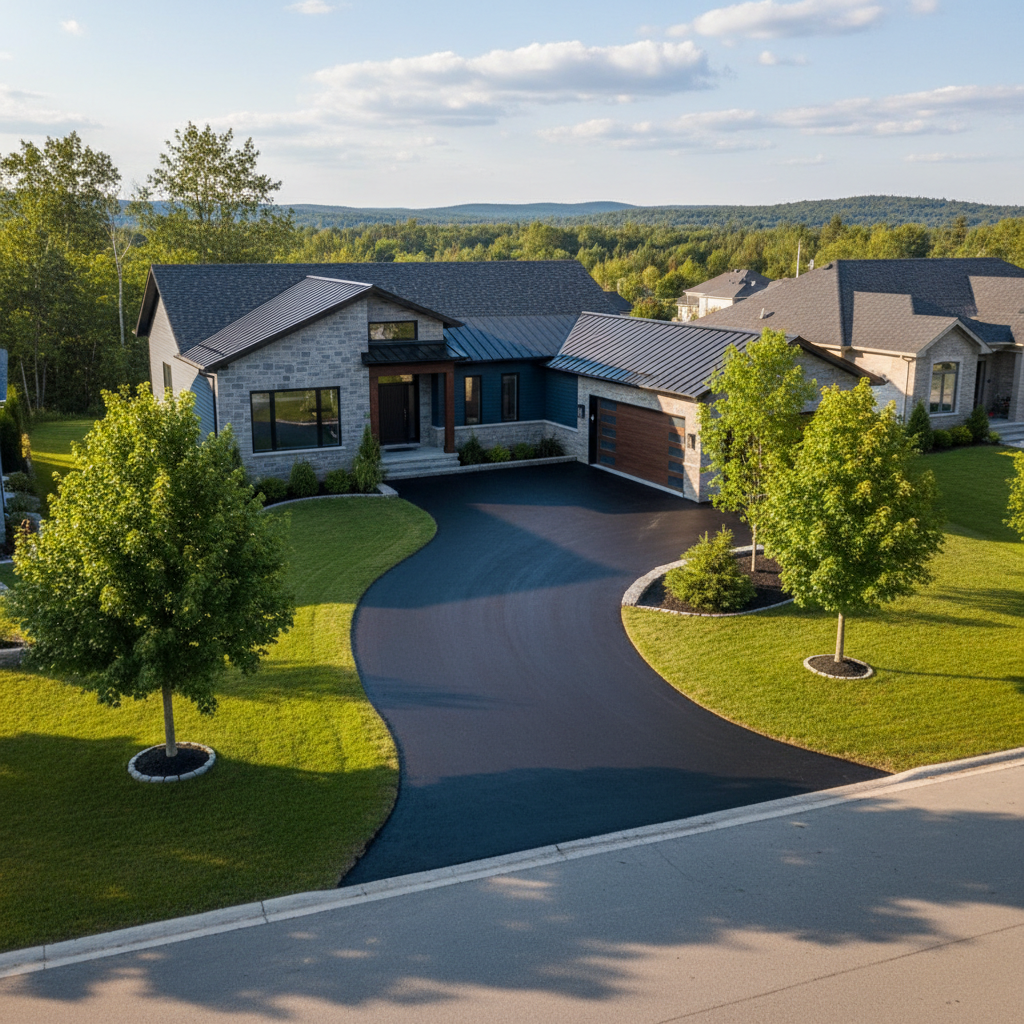
Driveway paving options and costs in Bedford Park-Nortown
Bedford Park-Nortown, Ontario is a great neighbourhood to upgrade a driveway, and with a 2021 population of 23,236 (Statistics Canada, 2021 Census), there’s steady demand for durable surfaces. Most driveways here service detached homes—so you’re typically paving a dedicated slab-width area with a clear parking path, not a shared laneway. Toronto’s frost-and-spring rush is a big reason quotes swing: frost in this region commonly freezes to roughly 3–4 feet, so contractors must overbuild the base and drainage to stop water from sitting under the pavement. On top of that, Toronto’s frequent freeze–thaw cycles across late fall, winter and early spring accelerate wear, and the workable paving season is effectively late spring through early fall. That compressed season can push pricing up for prime scheduling dates, especially around higher-demand pockets like the Bedford Park and south-neighbourhood approach corridors where contractors can be booked solid.
In practical terms, that means the “same” driveway can cost notably different amounts depending on excavation depth, haul-away/disposal needs, how tight the access is, and whether the contractor is building a frost-protected base system. Asphalt is often the lowest upfront path (but it needs sealing), while interlocking pavers carry the highest installation cost yet offer easier panel-by-panel repairs. Concrete sits in between depending on the finish type and control-jointing. Below is a realistic, homeowner-facing comparison to help you anchor your budget before you request quotes.
| Material |
Lifespan |
Maintenance |
Best For |
Price per sq ft |
| Asphalt (new installation, proper base) |
12–20 years |
Seal every 3–5 years; patch as needed |
Best value where you want a smooth, quiet surface |
$4.00–$9.50 |
| Asphalt (overlay on existing gravel base) |
8–15 years |
Seal every 3–5 years; more frequent patching if base settles |
Budget refresh when the existing base is sound |
$3.75–$7.25 |
| Interlocking concrete pavers |
25–35 years |
Replace individual stones/sections; periodic joint sand top-up |
High curb appeal and easier spot repairs |
$10.00–$18.50 |
| Poured concrete (broom finish) |
20–30 years |
Minimal, but watch for cracks; seal if desired |
Low maintenance look with a solid, monolithic surface |
$7.00–$13.50 |
| Exposed aggregate concrete |
20–30 years |
Sealer optional; crack control is critical |
Slip-resistant texture and premium appearance |
$9.00–$16.50 |
| Gravel / crushed stone (budget option) |
3–7 years |
Re-level, top up stone, weed control yearly |
Short-term solution or when you need the lowest up-front cost |
$2.25–$4.75 |
Prices are estimates only and vary by project scope, site access and material selection.
What affects the price of paving in Bedford Park-Nortown
In the Toronto economic region, it’s common to see driveway quotes for the same footprint vary by 30–50%. Part of that is simply scope: one contractor may include full excavation to remove organic topsoil, granular base replacement, and drainage upgrades—while another may price an “overlay” approach that still looks good initially but struggles after the next heavy freeze–thaw season. Another reason is timing. With the paving season running mostly from late spring through early fall, prime dates get bid up quickly, and late-season rush work can cost more because crews are limited and demand is high in busy areas across the Toronto region.
Frost depth and freeze–thaw cycles are decisive cost factors in Ontario. When ground freezing is roughly 3–4 feet deep, you can’t rely on a thin base—contractors need a thicker, well-compacted granular system to prevent heaving and cracking. As a rule of thumb in colder Canadian regions, base and preparation are often in the 6–12 inch range (depending on the design and existing conditions) to manage water and load transfer. Asphalt mix design also matters: freeze-thaw-rated asphalt costs a bit more than standard mixes. In concrete work, air-entrainment and correct control-joint spacing reduce the risk of freeze-related cracking.
Two Bedford Park-Nortown examples that move the needle: (1) if your driveway edge drains poorly toward the garage or porch, we may add or correct a subdrain/slope and that adds labour and excavation; (2) if there’s an old concrete pad that’s deteriorated, tear-out and hauling can push total pricing toward the higher end of concrete budgets (for reference, concrete driveway totals often sit in the $6,000–$15,000 band). Conversely, if you already have solid base and good drainage, asphalt can land closer to the lower mid-range of $3,500–$8,000 because less excavation is required. These same design decisions often explain why one quote may be closer to asphalt’s $3,500–$8,000 band while another lands higher after full base and drainage are included.
| Price Factor |
Why It Matters |
Cost Impact |
| Driveway area in sq ft |
Most materials and paving labour scale directly with square footage |
Typically the largest swing factor on your final number |
| Base depth required |
Frost line determines granular thickness to resist heaving and cracking |
More base can noticeably increase excavation and material cost |
| Grading and drainage work |
Proper slope and drainage prevent water from sitting under pavement |
Can add significant labour, pipe work and trucking/haul-away |
| Tear-out of existing surface |
Breaking concrete/asphalt and removing debris is time-consuming |
Often pushes projects toward the upper quote range |
| Edge restraints and curbing |
Prevents paver spread and maintains straight lines under freeze pressure |
Minor materials cost, but big impact on long-term performance |
| Sealing requirement |
Asphalt needs sealing after installation to protect against winter oxidation |
Maintenance can affect lifecycle cost and yearly budgeting |
| Site access |
Narrow driveways and tight turning radii slow equipment and delivery |
Higher labour time and sometimes smaller load planning |
| Asphalt mix specifications |
Freeze–thaw-rated mixes handle Toronto’s winter conditions better |
Costs more upfront, often reducing early-season failures |
Permits & regulations in Ontario
In Ontario, paving a private driveway within your own property usually does not require a building permit. Where things change is when your work affects the municipal right-of-way or municipal infrastructure. In Bedford Park-Nortown, that commonly means paving that involves new curb cuts, changes to the boulevard, or altering storm drainage (for example, reconnecting or modifying eavestrough discharge ties, catch basins, or roadside drainage flow paths). Those types of changes typically need municipal approval before construction begins.
Step one for homeowners is to schedule utility locates before excavation (Ontario One Call). This is essential even for small jobs like base removal because unseen services—hydro, communications, gas, and private services—can be present near driveways. Step two is confirming any lot-grading and drainage rules with the local municipality so your new surface doesn’t redirect water onto a neighbour’s property.
Then verify your contractor properly. Ask for an Ontario licence (where applicable to the type of work), liability insurance and WSIB/WCB coverage. How to check: request the certificate of insurance and ensure it lists the right insured business and includes adequate limits; confirm WSIB/WCB status using the contractor’s clearance letter or coverage proof they provide at your request; and keep a copy of everything for your records. Finally, don’t rely on “verbal scope”—make sure the permit/approval responsibilities are clearly stated in the written contract.
Asphalt vs pavers vs concrete for Bedford Park-Nortown driveways
For Bedford Park-Nortown, the big differentiator isn’t just appearance—it’s how each material handles Toronto’s freeze–thaw cycles, winter maintenance, and the way water behaves if drainage isn’t engineered. Asphalt is typically the lowest upfront option, with clean lines and a smooth ride, but it needs sealing about every 3–5 years to protect against winter oxidation and moisture intrusion. Interlocking concrete pavers cost more initially, yet they’re hard to beat when you want curb appeal and repairs that don’t require tearing out the entire driveway—one or two sections can be lifted, base corrected, and reset. Poured concrete is often mid-range in price and can last a long time if it’s properly air-entrained and finished with the right mix, control joints, and drainage.
In a frost-prone region where freezing to roughly 3–4 feet is typical, all three systems demand a properly compacted granular base and reliable surface/subsurface drainage. Asphalt that’s laid on weak base will reflect settlement and crack sooner. Pavers perform well when restraints and edge detailing hold the geometry during freeze expansion and contraction. Concrete can be excellent, but it’s less forgiving of poor jointing and drainage—freeze-related cracking can show up, especially if meltwater and salt-laden runoff sit against the surface for long periods.
To make the pricing difference real: if you’re comparing an asphalt driveway that lands in the $3,500–$8,000 band to interlocking pavers in the $9,000–$20,000 band, that extra cost is justified when you value long-term aesthetics and easy spot repairs after a base issue. If your priority is lowest upfront cost and you’re willing to budget sealing, asphalt is often the best match. If you want a premium look and straightforward future repairs, pavers usually win.
| Material |
Frost Resistance |
Curb Appeal |
Repair Method |
Lifespan |
Price Band |
| Asphalt (sealed regularly) |
Good with proper base and freeze-thaw-rated mix |
Moderate (clean, dark finish) |
Cut-and-patch localized sections |
12–20 years |
$3,500–$8,000 |
| Interlocking concrete pavers |
Very good with engineered base and edge restraints |
High (varied colours/patterns) |
Lift, re-compact base, reset stones |
25–35 years |
$9,000–$20,000 |
| Poured concrete (air-entrained) |
Good with correct air-entrainment and jointing |
Moderate to high |
Patch repairs; major issues may require sections or re-pour |
20–30 years |
$6,000–$15,000 |
| Exposed aggregate concrete |
Good with proper mix, drainage and control joints |
Very high (textured premium look) |
Patches possible but less seamless than pavers |
20–30 years |
$8,000–$17,000 |
| Permeable pavers (drainage grid) |
Very good where designed for controlled infiltration |
High (clean modern look) |
Replace individual units; maintain infiltration layers |
20–30 years |
$12,000–$22,000 |
| Chip seal / tar-and-chip |
Fair to good; best for specific site conditions |
Low to moderate |
Re-seal; localized repairs are less “clean” |
5–10 years |
$3,000–$7,000 |
How to choose a paving contractor in Bedford Park-Nortown
Choosing the right contractor in Bedford Park-Nortown means verifying coverage and paperwork, not just picking the lowest number. Start with Ontario licensing (for the type of work they’re contracted to do), then confirm liability insurance and WSIB/WCB coverage. How to check: (1) ask for their WSIB clearance letter or coverage documentation—if they can’t produce it, that’s a major warning; (2) request the certificate of insurance and verify the insured business name matches the quote/signing party and that limits are appropriate for driveway work; and (3) check they’re properly listed in their trade/contractor channels online where Ontario provides registries for the applicable category. If they refuse, delay, or “explain later,” move on.
Next, get 2–3 itemised written quotes that break out labour and materials (excavation, base, asphalt type or concrete mix, geotextile, compaction, disposal, edging, and sealing). A lump-sum quote can hide major omissions like drainage corrections or disposal fees. Read the scope line-by-line: is permit pulling included (when required), is disposal/haul-away included, and who supplies protection for landscaping? Confirm warranty details: workmanship warranty length (often longer for pavers), product/manufacturer warranty terms, and whether any warranty is transferable to future owners.
Finally, match payment to progress. A good standard is never more than 10–15% upfront; hold back the remainder until the job is complete and cleaned up. Ask for a written timeline with a start date window and completion estimate—Toronto’s late-spring rush means crews may be booked, but you should still get dates in writing.
- Ask for an itemised quote (labour + materials), not just a total.
- Confirm excavation depth and base thickness included (frost protection design).
- Ensure drainage/slope plan is described and priced if needed.
- Verify utility locates are included before digging.
- Check liability insurance and WSIB/WCB coverage before work starts.
- Request proof of past similar driveway projects in Toronto.
- Clarify tear-out scope: removal, breaking, and disposal/haul-away.
- Confirm edge restraints/curbing details (especially for pavers).
- For asphalt, confirm tack coat, compaction process, and joint strategy.
- Ask when sealing is due after installation (and what sealer is used).
- Review warranty: workmanship term, exclusions, and how claims are handled.
- Set payment schedule: 10–15% max upfront; hold back until completion.
Red flags in Bedford Park-Nortown: a contractor who won’t show insurance/WSIB documentation; quotes that don’t specify base depth or drainage provisions; “too-good-to-be-true” pricing compared with the $3,500–$8,000 asphalt or $6,000–$15,000 concrete bands; no written scope for disposal/haul-away; and a refusal to provide a written start date/completion timeline.
Frequently asked questions — paving in Bedford Park-Nortown
How long before I can drive on new asphalt?
In Bedford Park-Nortown, most new asphalt driveways are ready for careful driving after the surface has cooled and initial compaction has been completed—often within 24–48 hours depending on weather, lift thickness and mix type. If temperatures are cool or wind is low, curing can take longer because asphalt needs time to cool and stabilize. Your contractor should provide specific instructions for your day’s conditions, but a common local approach is to allow light vehicle movement first and full traffic only after the asphalt is fully set. If you want a strict timeline, ask the crew what temperature targets they’re using for placement and rolling, and when they recommend sealing (usually not immediately).
What causes potholes and how are they repaired?
Potholes usually start with water getting into weak spots—often from poor drainage, cracks that let water infiltrate, or base that didn’t get compacted properly for Toronto’s freeze–thaw cycles. As temperatures swing, that trapped moisture expands and contracts, loosening the base and breaking the asphalt surface. Repairs are typically done by cutting out the damaged asphalt in a clean square/rectangular shape, removing and replacing compromised base material, then repaving with a properly compacted asphalt patch. In Ontario, a good repair should also address the root cause (slope/drainage) so the same area doesn’t fail again. If your driveway is older, you may instead need a more comprehensive repair strategy rather than repeated pothole patching.
How do I prepare for a paving project?
Preparation is mostly about access and protection. Clear vehicles, remove barriers and move landscaping items away from the work zone, and confirm where you’d like the new surface edges to land relative to your garage and walkways. If you have existing fencing or planters near the driveway, ask the contractor how they’ll protect them during excavation and compaction. Make sure you know where downspouts discharge so drainage won’t be redirected incorrectly—this matters a lot in Toronto freeze–thaw weather. Before excavation, confirm utility locates are booked. Finally, review the written scope: disposal/haul-away, grading and drainage corrections, and asphalt sealing timing. Even if your project fits within an asphalt budget like $3,500–$8,000, skipping prep and access planning can still add costs.
How do I compare paving quotes fairly?
To compare quotes fairly in Bedford Park-Nortown, don’t start with the bottom-line number—start with the scope. Ask each contractor to confirm the same items: excavation depth, base thickness and compaction method, whether drainage corrections are included, and what exactly is being removed (tear-out and disposal). For asphalt, verify that the quote includes the correct process (tack coat if needed, compaction, and a freeze–thaw-rated mix) and whether sealing is planned after installation (seal timing is often after 6–12 months). For concrete, check mix type and whether air-entrainment and control joints are part of the scope. A meaningful price difference may exist—like asphalt at the $3,500–$8,000 band versus concrete at $6,000–$15,000—but it should reflect documented differences in preparation and materials.
Can asphalt be laid in cold weather in Bedford Park-Nortown?
Asphalt can sometimes be placed near the shoulder of the season, but in cold weather it’s much harder to achieve proper compaction and bond. In Toronto’s climate, hot-mix asphalt generally needs air temperatures above about 10°C to place and compact correctly, and crews watch pavement temperature too. If it’s too cold, the mix cools too quickly, rollers can’t achieve density, and you can end up with early raveling or cracking—especially with freeze–thaw cycles. That’s why paving is concentrated late spring through early fall in Ontario. If you’re trying to schedule a driveway outside that window, ask contractors what temperature thresholds they follow, whether they resurface in lifts, and whether they’ll protect the area to reach compaction targets. A reputable contractor won’t “force it” at the wrong temperatures.
What is a driveway apron and do I need one in Bedford Park-Nortown?
A driveway apron is the transition area where your driveway meets the curb or street edge—often the portion near a curb cut that helps manage water and creates a smooth, durable ramp. Whether you need one depends on your site conditions: how high the curb is, whether the existing approach creates a drainage problem, and whether your driveway’s grade matches the street flow. If there’s municipal involvement (like a curb cut or changes to boulevard drainage), that work typically requires municipal approval before paving. Even when not strictly required, adding an engineered apron can reduce water pooling at the driveway edge and help prevent premature cracking or settlement along the transition zone. A contractor should assess your slope and drainage and explain whether an apron is part of the best frost-resistant detailing for your Bedford Park-Nortown driveway.