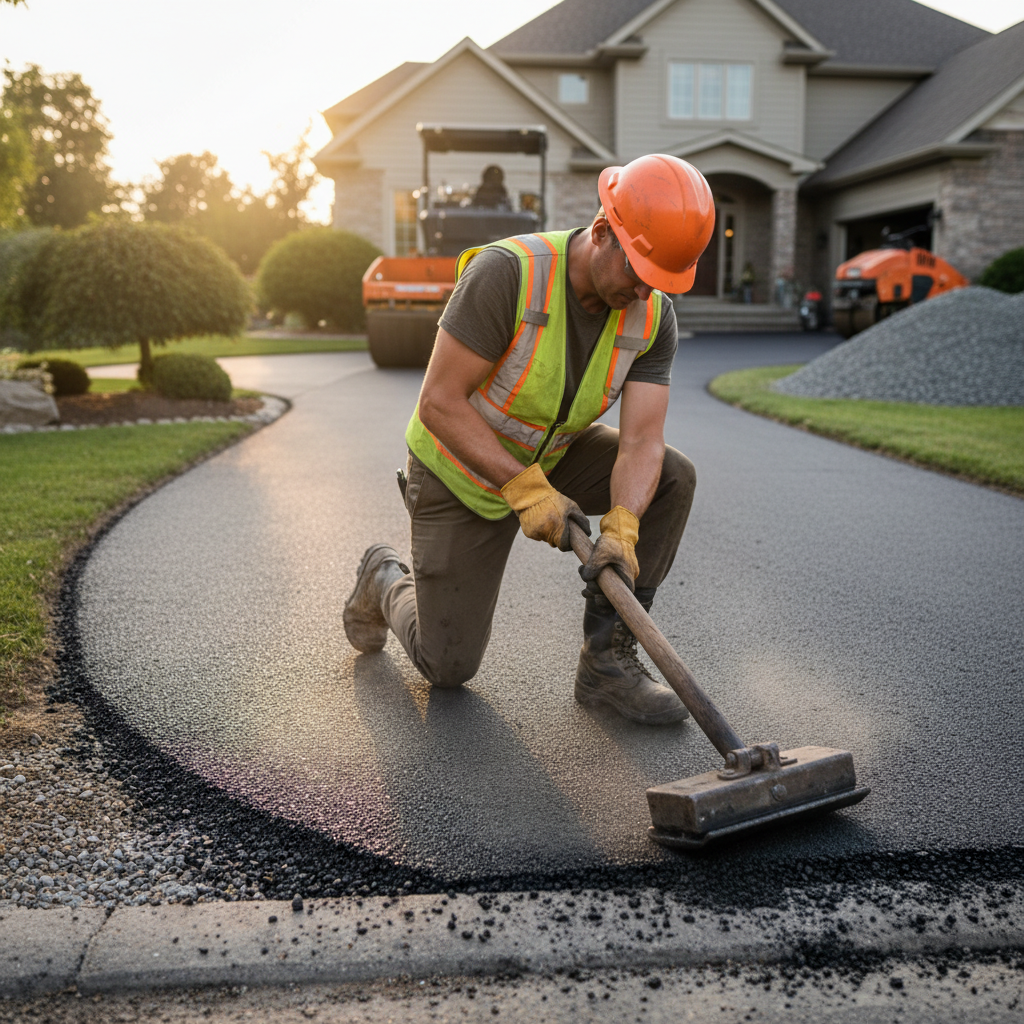
Driveway paving options and costs in Telkwa
Telkwa, BC has a lot going for it—but driveways still take a beating from winter. With 88.4% of homes in Telkwa being single-detached houses (Statistics Canada, 2021 Census), most residents are planning private driveway work rather than shared lanes, so there’s steady demand for durable, properly drained surfaces. Homeowner households make up 88.4% of households, and with 41.1% of homes built before 1981, you’ll often see older drive approaches where the base has settled or drainage is inadequate.
In the Nechako economic region, pricing is driven by cold continental winters, a deep frost line, and repeated freeze–thaw cycles that pump moisture through the driveway structure. That means contractors typically dig deeper, rebuild with well-graded granular base, and correct crossfall/ditch lines rather than just “patching and paving.” The paving season is also shorter—crews generally rely on late spring through early fall—so scheduling pressure can raise labour premiums on smaller jobs.
In Telkwa, demand is especially common around the residential core near the Bulkley River corridor where driveways often run across slopes or verge areas that need grading and drainage tune-ups. If your current asphalt is raveling or your gravel is pumping fines, the difference between “budget” and “built-right” becomes obvious in the quote.
Below is a practical comparison of common options and what you can expect to budget per square foot.
| Material |
Lifespan |
Maintenance |
Best For |
Price per sq ft |
| Asphalt (new installation, proper base) |
15–25 years |
Seal every 3–5 years; crack fill as needed |
Most cost-effective “all-in” paved driveway |
$12 – $18 |
| Asphalt (overlay on existing gravel base) |
8–15 years |
Earlier crack sealing; monitor rutting |
When the existing base is sound and excavation is limited |
$10 – $15 |
| Interlocking concrete pavers |
25–35 years |
Joint sand top-ups; replace individual blocks if needed |
Curb appeal and easy spot repairs |
$18 – $28 |
| Poured concrete (broom finish) |
25–30 years |
Crack control via saw cuts; seal if desired |
Low-maintenance, straightforward surface |
$20 – $30 |
| Exposed aggregate concrete |
25–30 years |
Periodic cleaning; seal optional |
Higher-end look with good traction |
$22 – $34 |
| Gravel / crushed stone (budget option) |
5–10 years |
Regrade and top up; add fines regularly |
Temporary or very limited budget |
$6 – $10 |
Prices are estimates only and vary by project scope, site access and material selection.
What affects the price of paving in Telkwa
Even when two homeowners want the “same size driveway,” Telkwa quotes can still vary by roughly 30–50% across Nechako and softer parts of BC. The main reason isn’t just asphalt or concrete material—it’s the engineering work needed to survive winter. In Telkwa and the broader Nechako area (including Bulkley-Nechako A and F, Smithers, Vanderhoof, and Houston), frost depth and freeze–thaw cycles are decisive cost factors. In practice, a deeper frost condition means you need a thicker compacted granular base to limit heaving and cracking. Contractors typically build deeper granular sections than in coastal BC because water migration through the structure can create surface pumping and early failure.
The paving season is also shorter. Hot-mix asphalt requires favourable air temperatures (commonly above about 10°C), so a cold snap can delay pours and tighter scheduling can increase labour and equipment premiums. Asphalt mix design matters too: freeze–thaw-rated mixes and correct grading reduce raveling and edge failures.
In Telkwa, local job conditions can raise costs in several concrete ways: excavation through glacial till or clay often takes extra time and haul-offs; replacing poor sub-base can add both material and compacting labour; and driveway approaches that intersect ditches or curb-like edges can require extra grading and positive drainage. On the other hand, if your existing base is well-drained and mostly stable, you may be able to stay closer to the lower end of the asphalt band—around $12 – $18 per sq ft—rather than stepping up to full-depth reconstruction.
| Price Factor |
Why It Matters |
Cost Impact |
| Driveway area in sq ft |
Most materials and paving labour scale directly with area |
Major driver (often the biggest line item) |
| Base depth required |
Frost line determines granular thickness to prevent heaving |
Can add significant excavation and material costs |
| Grading and drainage work |
Proper crossfall, ditching, and subdrains prevent moisture buildup |
Medium to high, depending on how far drainage is corrected |
| Tear-out of existing surface |
Breaking and hauling old asphalt/concrete adds labour and disposal |
Medium to high; disposal fees vary by volume |
| Edge restraints and curbing |
Prevents paver spread and asphalt edge breakdown |
Medium; often necessary for long-term stability |
| Sealing requirement |
Asphalt needs sealing after initial curing to protect binder |
Low to medium over time; helps extend service life |
| Site access |
Narrow or sloped lots slow equipment movement and increase handling |
Medium; may require smaller lifts or extra labour |
| Asphalt mix specifications |
Freeze–thaw-rated mix costs more and must be matched to conditions |
Low to medium, but important for longevity |
Permits & regulations in British Columbia
In British Columbia, paving a private driveway within your own property typically does not require a building permit. However, work that affects the municipal right-of-way usually needs municipal approval — for example, creating or changing a curb cut, altering boulevard areas, or modifying storm drainage patterns near the road. Some places also enforce lot-grading rules that limit how close hard surfaces can be placed to property lines and how water can be routed, especially where runoff could impact neighbours or ditches.
For Telkwa homeowners, the best approach is a quick step-by-step verification: (1) decide whether your scope touches the road frontage or any ditch/boulevard area; (2) call the municipality to ask if permits are needed for the specific curb/ditch portion; (3) before excavation, request utility locates using BC 1 Call so no one hits buried services; and (4) confirm any lot-grading bylaws before base work so you don’t end up rebuilding later.
On contractor compliance, don’t just accept verbal assurances. Ask for their British Columbia licence/registration details, then check their certificate of insurance (general liability) and ensure coverage limits match driveway-sized excavation and paving risks. For workers, confirm coverage under the applicable provincial workplace system (WCB coverage) by requesting proof/clearance documentation. Good contractors provide these documents readily before they start mobilizing equipment.
Asphalt vs pavers vs concrete for Telkwa driveways
For Telkwa driveways, asphalt, interlocking pavers, and concrete all can work—but the “best” choice depends on how you want to manage winter stress, maintenance, and curb appearance. Asphalt usually has the lowest upfront cost, and with correct base build-up it’s a practical option for most homeowners; plan on sealing every 3–5 years to protect the binder. Interlocking concrete pavers cost more initially, but they’re highly repairable—if a small area shifts due to frost heave or a drainage issue, individual units can be replaced without tearing up the whole driveway. Poured concrete sits in the middle on cost and is durable, but it must be properly designed (including air-entrainment and jointing) to limit freeze–thaw cracking.
In Nechako’s freeze–thaw conditions, base preparation is the deciding factor for all three options. A thicker compacted granular base and positive drainage (proper crossfall, ditches/subdrains where needed) help keep moisture from migrating into the pavement structure. With plowing and traction material in winter (typically sand and occasional de-icing use), paver joints and edge restraints should be detailed correctly so surfaces don’t pump or spread. Asphalt can handle plowing well, but it needs timely sealing and good crack management to reduce water entry during spring melt.
Here’s where price differences are sometimes justified: if asphalt is at roughly $12 – $18 per sq ft in Telkwa, pavers at around $18 – $28 per sq ft may be worth it on a long driveway with repeated access impacts, because localized repairs can cost far less than a full resurfacing. On a simple, well-drained driveway with stable base, asphalt is often the best value—while on a driveway that’s known to shift near edges or slopes, pavers may outperform in real-life serviceability.
| Material |
Frost Resistance |
Curb Appeal |
Repair Method |
Lifespan |
Price Band |
| Asphalt (sealed regularly) |
Good when base is built and drained correctly |
Good, modern look possible with finishing choices |
Crack fill and patch; full overlay if worn |
15–25 years |
$12 – $18 |
| Interlocking concrete pavers |
Excellent with proper base and restraints |
Very high; variety of patterns and edging |
Replace individual pavers and reset joints |
25–35 years |
$18 – $28 |
| Poured concrete (air-entrained) |
Good with air-entrainment and jointing |
Moderate to high (finish options) |
Patching; larger repairs may require sections |
25–30 years |
$20 – $30 |
| Exposed aggregate concrete |
Good when designed for freeze–thaw and sealed if needed |
High; textured finish hides wear |
Limited patching; often requires localized sections |
25–30 years |
$22 – $34 |
| Permeable pavers (drainage grid) |
Excellent at reducing standing water when detailed right |
High; “designed drainage” look |
Replace units; maintain sub-base drainage layers |
25–35 years |
$24 – $36 |
| Chip seal / tar-and-chip |
Moderate; depends heavily on base and mix |
Lower; functional finish |
Spot patch; may require re-coating |
5–12 years |
$10 – $15 |
How to choose a paving contractor in Telkwa
Start by confirming compliance with British Columbia requirements before anyone brings in equipment. Ask for their BC licence/registration information and request a certificate of insurance showing general liability—this should cover excavation risks, property damage, and typical site hazards. For worker protection, confirm they have the appropriate workplace coverage (WCB/clearance proof) and that it applies to the crews doing the paving and base work. If a contractor can’t provide these documents quickly, that’s a warning sign.
Next, get 2–3 itemised written quotes rather than a single lump sum. You want a labour + materials breakdown that clearly shows excavation, granular base type/depth, compaction/compaction testing (if included), drainage corrections, asphalt/paver/concrete supply, and surfacing. Pay attention to what’s excluded: disposal fees for removed material, hauling distance assumptions, restoration of damaged landscaping, permit handling (if any right-of-way work is involved), and surface grading/finishing. A detailed scope usually costs less in the end because it prevents change-order surprises.
Warranty matters for winter performance. Ask for the workmanship warranty length and whether it covers base settlement-related failures (when the base was built to spec). Also ask about product/manufacturer warranty terms and whether any coverage transfers if you sell your home. For payment, avoid paying more than 10–15% upfront; keep a holdback until cleanup and final acceptance. Finally, request an explicit start date and completion estimate in writing, because Telkwa’s short paving window can shift with weather.
- Verify BC licence/registration before booking equipment.
- Request a certificate of insurance and check dates/coverage limits.
- Confirm workplace coverage (WCB/clearance) for paving crews.
- Ask for at least 2–3 references from recent Nechako-area projects.
- Require itemised quotes (excavation, base, drainage, surfacing, cleanup).
- Confirm how base depth and granular specs are determined for your site.
- Ask whether compaction is tested and what method is used.
- Clarify disposal and hauling—where removed material goes and costs.
- Check inclusions for drainage: crossfall, ditch ties, subdrains if needed.
- For pavers, confirm edge restraints/curbs and joint sand type.
- For asphalt, confirm seal timing and whether sealing is included or optional.
- Use a payment schedule with a holdback until final grading and cleanup.
Red flags to watch in Telkwa: (1) vague scopes like “we’ll pave the driveway” with no base or drainage details; (2) no proof of insurance or workplace coverage; (3) asking for large deposits (much more than 10–15%) before work starts; (4) quoting winter work without addressing temperature limits and curing; and (5) dismissing cracked/heaved areas as “normal” instead of diagnosing drainage and sub-base.
Frequently asked questions — paving in Telkwa
How long does a paved driveway last in Telkwa?
In Telkwa and the Nechako region, paved driveway life depends heavily on base depth and drainage, not just the surface. Asphalt installed with a properly drained, compacted granular base often performs about 15–25 years, while pavers can be closer to 25–35 years when edges and joints are detailed correctly. Concrete commonly lands around 25–30 years if it’s air-entrained, properly jointed, and kept from trapping water at the edges. The reason is freeze–thaw: moisture and weak sub-base can create pumping that breaks up asphalt binders or leads to cracking. Because Telkwa has a shorter paving window, contractors who build for winter performance (rather than “fast and thin”) usually deliver longer service life.
When is the best time of year to pave in Telkwa?
For Telkwa, late spring through early fall is the practical window—crews need workable ground and suitable air temperatures. For hot-mix asphalt, paving typically requires air temperatures above about 10°C so the mix can place and compact correctly, and crews often avoid cold snaps that can compromise compaction. Concrete pours also need careful temperature planning to manage curing. The short Nechako season means schedules can tighten quickly, especially for small-driveway jobs, so booking earlier usually reduces premium labour pricing. If you’re comparing quotes, ask each contractor what weather thresholds they use and how they plan sequencing (excavation/base work vs. final surface) when conditions change.
How deep should the base be for Telkwa's frost?
There isn’t one universal “magic number” for every Telkwa driveway, because base depth is influenced by your subsoil (glacial till or clay vs. more stable material), groundwater/drainage, and the frost penetration expected for your area. What’s consistent in the Nechako region is the need for a deeper, well-compacted granular base compared with milder coastal BC conditions. Many successful designs end up using deeper granular build-ups to reduce heaving and cracking during freeze–thaw cycles. A good contractor will inspect drainage fall, check for pumping fines, and recommend the base thickness and granular gradation for your site rather than applying a one-size estimate.
How often should I seal my asphalt driveway?
After new asphalt is installed, sealing is typically recommended after the initial curing period—commonly in the first 6–12 months—then every 3–5 years depending on weather exposure and maintenance. In Telkwa’s colder winters, protecting the binder matters because freeze–thaw and moisture movement can accelerate raveling and edge breakdown. If your driveway sees heavy plowing, sealing helps reduce water entry through small surface cracks. Your paving contractor should explain the product type and timing for your specific mix and climate conditions, including whether you should crack-fill before sealing. If your contractor quoted asphalt at the lower end of the Telkwa band (around $12 – $18 per sq ft), ask whether sealing is included or expected as a separate maintenance step.
Why does my driveway crack and heave in winter?
The most common cause in Telkwa is moisture plus freeze–thaw: water finds its way into weak spots, freezes, expands, and then the freeze–thaw cycles repeat. When the base is too thin or poorly compacted, or when drainage is off (for example, poor crossfall or water pooling near the edges), the driveway structure can pump fines upward. Older homes—particularly those built before 1981—often have settled bases or ditches that no longer shed water effectively. Surface temperature swings can also contribute, but the underlying issue is usually sub-base and drainage detailing. If you see cracking and heaving together, get the contractor to evaluate whether you need full-depth base correction or whether spot patching and drainage fixes are enough.
Do I need a permit to pave my driveway in British Columbia?
In most cases in British Columbia, paving a private driveway within your own property does not require a building permit. However, you may need municipal approval if your work involves the road frontage or municipal right-of-way—such as adding/changing a curb cut, altering boulevard areas, or changing storm drainage. Telkwa homeowners should verify whether any portion of the job touches the ditch/boulevard or right-of-way before excavation. Regardless of permits, utility locates are essential before digging. When you’re reviewing quotes, ask the contractor whether permits/approvals are required for your specific site conditions and who is responsible for handling them, if applicable.