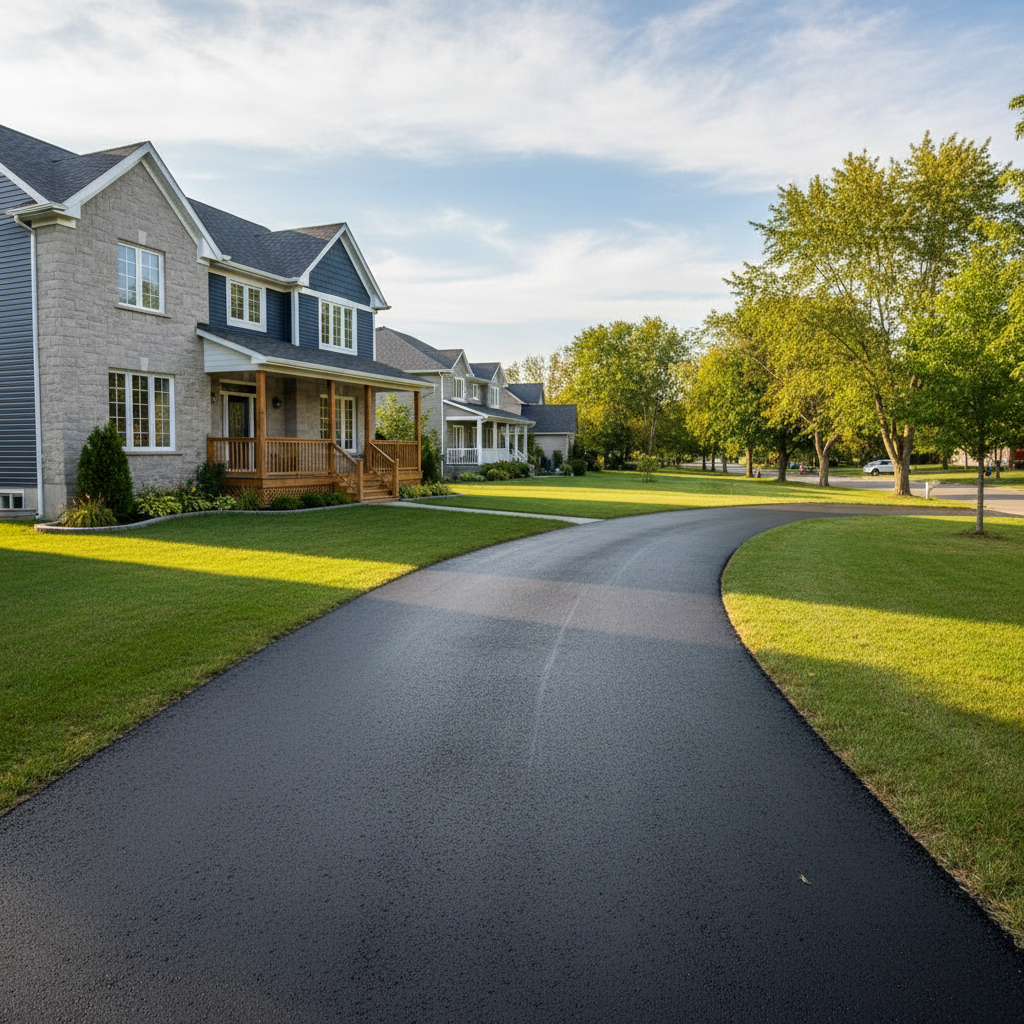
Driveway paving options and costs in Powell River
Powell River is a coastal community where driveways see a lot of wet weather and shoulder-season rain, so the “pavement” is only part of the story—drainage and base preparation drive the long-term performance. With 75.5% of households owning their homes and 72.1% of dwellings being single-detached houses, most private driveway work here is directly tied to detached homeowners (Statistics Canada, 2021 Census). That’s a healthy market for asphalt, pavers and concrete, but the quotes you receive can differ noticeably because proper excavation, granular base thickness, and compaction are not optional in a rainy climate.
In the Lower Mainland–Southwest, frost penetration is relatively shallow compared with Interior or Northern BC, but freeze–thaw around the assumed frost line still matters. Contractors price to handle repeated wetting and the risk of heaving, rutting and cracking when drainage is poor. Even though the paving season is longer than in colder regions, heavy winter rains and compressed spring scheduling windows can affect availability and crew productivity—especially in neighbourhoods with older housing stock. In areas like Westview, where many homes pre-date 1981, you’ll often see more aged subgrades and utility adjustments that require more excavation.
Use the ranges below as a practical starting point for budgeting. Next, you can compare what’s included so you’re not paying for a cheaper build that needs earlier repairs.
| Material |
Lifespan |
Maintenance |
Best For |
Price per sq ft |
Price Range |
| Asphalt (new installation, proper base) |
12–20 years |
Sealcoat every 3–5 years |
Value-focused driveways with good drainage |
$12–$20 |
$12 – $20 |
| Asphalt (overlay on existing gravel base) |
8–15 years |
Sealcoat as needed (often 3–6 years) |
When the old base is stable enough for overlay |
$10–$17 |
$10 – $17 |
| Interlocking concrete pavers |
20–30+ years |
Occasional panel lifting/relaying; re-sanding |
Curb appeal, easy spot repairs, flexible drainage edges |
$20–$40 |
$20 – $40 |
| Poured concrete (broom finish) |
20–30 years |
Minimal; patch as required |
Simple, durable surface with proper jointing |
$18–$35 |
$18 – $35 |
| Exposed aggregate concrete |
20–30+ years |
Minimal; sealer optional |
Slip resistance and upgraded appearance |
$22–$42 |
$22 – $42 |
| Gravel / crushed stone (budget option) |
3–8 years |
Top-ups yearly; weed control |
Short-term solution or low-traffic area |
$6–$12 |
$6 – $12 |
Prices are estimates only and vary by project scope, site access and material selection.
What affects the price of paving in Powell River
In Powell River and across the Lower Mainland–Southwest, the same driveway size can come back with a 30–50% price swing. That gap usually isn’t “contractor greed”—it’s differences in excavation depth, granular base design, drainage corrections, and how much of the existing surface is being removed. When you’re comparing asphalt at $12–$20 per sq ft versus pavers at $20–$40, the material is only one part of the equation; the labour to rebuild the supporting layers often dominates the real cost.
Freeze–thaw cycles are decisive in this region even though frost penetration is shallower than in Interior BC. In practice, deeper frost requires thicker compacted granular base (where Ontario/Alberta often plan 6–12 inches, coastal BC designs commonly focus on around 4–6 inches depending on subgrade). If the base and drainage aren’t corrected, repeated wetting and softening can lead to heaving, rutting and cracking. Asphalt mix design must also meet local freeze–thaw expectations; a less-specified mix can cost less upfront but fail sooner, which is why quotes for asphalt overlays can look attractive until the base is inspected.
Concrete costs can move up in Powell River when existing driveways are older (66.5% of local homes were built before 1981, Statistics Canada, 2021 Census) because subgrades are more likely to be inconsistent and require extra rebuild and proper joint layout. Conversely, costs can be lower when the existing base is firm and grading is already correct, allowing a thinner reconstruction plan or a straightforward tie-in.
| Price Factor |
Why It Matters |
Cost Impact |
| Driveway area in sq ft |
Most costs scale directly with square footage |
Typically 60–80% of total variation |
| Base depth required |
Base thickness tied to frost protection and subgrade condition |
Can add major excavation and material haul costs |
| Grading and drainage work |
Slope, ditching, and drainage correction prevent water damage |
Often the difference between short- and long-life pavement |
| Tear-out of existing surface |
Concrete or thick asphalt removal requires breaking, loading and disposal |
Can add significant labour and disposal fees |
| Edge restraints and curbing |
Prevents paver movement and asphalt edge breakdown |
Usually increases cost but improves longevity |
| Sealing requirement |
Asphalt benefits from sealing after cure (commonly 6–12 months) |
Direct add-on cost; boosts life expectancy |
| Site access |
Narrow drives and tight turning radii slow equipment and increase labour |
Higher hourly rates due to productivity limits |
| Asphalt mix specifications |
Freeze–thaw-rated mix costs more and needs correct placement/compaction |
Moderate to noticeable increase in material costs |
Permits & regulations in British Columbia
In British Columbia, paving a private driveway within your own property typically does not require a building permit. Where permits and approvals do come into play is when the work touches municipal infrastructure or affects drainage flow. For Powell River homeowners, that means you should plan on municipal approval (and possibly permits) if your project involves work in the municipal right-of-way, such as changing a curb cut, altering the boulevard area, or modifying storm drainage patterns that connect to city systems. Some municipalities also maintain lot-grading or drainage bylaws that restrict how close to property lines a hard surface can be and how runoff must be handled.
Before any excavation, the most important step is calling for utility locates through BC 1 Call so contractors can verify where services run under your driveway footprint. Then, verify your contractor’s credentials: (1) licence/registration as required for the type of work they’re doing, (2) liability insurance, and (3) workers’ compensation coverage (WSBC/WCB coverage where applicable). A homeowner can verify these by reviewing the contractor’s posted documentation, requesting a current certificate of insurance showing your address/project named if offered, and checking clearance/coverage letters when contractors provide them.
Step-by-step, do it in this order: confirm whether your scope touches boulevard/right-of-way, schedule utility locates, request written proof of coverage, then finalize a scope that clearly states who handles any municipal approvals.
Asphalt vs pavers vs concrete for Powell River driveways
For Powell River driveways, asphalt, interlocking concrete pavers, and concrete all can work well—what changes is upfront cost, how repairs are handled, and how each surface performs under wet winters and periodic freeze–thaw. Asphalt is usually the lowest upfront option, with the trade-off that it typically needs sealing every 3–5 years to protect against moisture infiltration. Interlocking pavers cost more at the start, but they shine when you want repairability: a failed area can often be lifted and rebuilt without resurfacing the entire driveway. Poured concrete sits in the middle on price, but it must be properly designed with air-entrainment and correct jointing to reduce cracking risks from freeze–thaw and moisture. If you use de-icing products near the driveway edge, concrete can degrade faster when the concrete mix is not air-entrained or when drainage keeps water against the slab.
In the Lower Mainland–Southwest, the “right” base is about granular thickness plus drainage, not just asphalt thickness. A well-compacted granular base and proper slope details help keep water from saturating the soil and causing movement. In practice, asphalt failures often come from poor drainage or inadequate base, while pavers can tolerate minor movement better—though the base still matters. For winter maintenance routines like plowing and sanding, pavers usually hold up well if restraints are correct; asphalt performs best when sealed and not left to dry out and ravel.
A concrete example: if asphalt comes in at about $12–$20 per sq ft and pavers at $20–$40 per sq ft, the extra cost can be justified if you expect future utility work, value curb appeal, or want localized repairs. If your priority is lowest upfront cost and you’ll commit to proper base + regular sealing, asphalt often wins.
| Material |
Frost Resistance |
Curb Appeal |
Repair Method |
Lifespan |
Price Band |
| Asphalt (sealed regularly) |
Good with correct base and drainage |
Moderate |
Mill and pave patch; crack repair then seal |
12–20 years |
$12–$20 per sq ft |
| Interlocking concrete pavers |
Very good with restrained edges |
High |
Lift and relay individual units or panels |
20–30+ years |
$20–$40 per sq ft |
| Poured concrete (air-entrained) |
Good when air-entrained and jointed |
Moderate to high |
Patch spalls; re-surface rarely needed early |
20–30 years |
$18–$35 per sq ft |
| Exposed aggregate concrete |
Good with proper curing and sealing (if specified) |
High |
Localized patching; aesthetic matching can vary |
20–30+ years |
$22–$42 per sq ft |
| Permeable pavers (drainage grid) |
Excellent for water management |
High (modern look) |
Spot repairs similar to standard pavers |
20+ years (if base is designed correctly) |
$25–$45 per sq ft |
| Chip seal / tar-and-chip |
Fair; best for low-traffic or specific sites |
Lower |
Re-seal/re-surface; spot chip repairs |
6–12 years |
$10–$18 per sq ft |
How to choose a paving contractor in Powell River
Choosing a paving contractor in Powell River is mostly about verifying credentials and comparing apples-to-apples scopes. In British Columbia, you should request proof of the contractor’s current ability to do the work (licensing/registration as applicable), and you should also verify liability insurance—ask for a certificate of insurance showing your property/project details where possible. Confirm workers’ compensation coverage (WSBC/WCB coverage where applicable) by requesting a current clearance letter or equivalent documentation that matches the contractor’s legal name. If a contractor can’t provide these documents promptly, pause the process.
Next, get 2–3 itemised written quotes, not lump sums. Each quote should break out excavation, disposal, base materials, compaction, asphalt/paver/concrete thickness, edge restraints, and finishing. Watch for exclusions: is permit/municipal approval included if the work touches right-of-way? Is disposal included or billed separately? Is removal of old asphalt/concrete part of the base price? Ask what they do if they discover soft subgrade during excavation—does the price adjust based on actual depth and engineered drainage corrections?
Warranty matters too: confirm the workmanship warranty length and whether it covers base issues, and keep track of product/manufacturer warranty terms. Payment schedule should be conservative—never more than 10–15% upfront, and hold a completion retainage until the job is finished and cleaned up. Finally, insist on a written start date and completion estimate; in coastal BC, weather windows can shift, and you want that reflected in the schedule.
- Request proof of liability insurance and WSBC/WCB coverage before work starts.
- Get 2–3 itemised quotes with labour and materials separated.
- Confirm base design (granular thickness) and compaction requirements in writing.
- Ask how drainage is handled (slope, ditch ties, avoiding ponding).
- Specify tear-out scope: what’s removed and what’s reused.
- Confirm edge restraints/curbing details for pavers and how asphalt edges are protected.
- Check whether sealing is included (for asphalt, plan for sealing after cure).
- Clarify disposal fees and haul-away for old asphalt/concrete.
- Ask what happens if utility locates show conflicts.
- Review warranty length, what’s covered, and whether it includes labour for workmanship.
- Use a payment schedule with a small upfront deposit and holdback until completion.
- Get the timeline in writing, including weather-dependent adjustments.
Red flags to watch in Powell River: contractors who won’t provide insurance/coverage paperwork; quotes that skip base depth or compaction details; “overlay only” proposals without inspecting the subgrade; pressure for a large upfront deposit; and vague scopes that exclude drainage corrections while promising long service life.
Frequently asked questions — paving in Powell River
How long before I can drive on new asphalt?
In Powell River, most crews will allow light foot traffic within a short period, but driving depends on temperature and the asphalt’s placement/compaction. Typically, drivers are kept off fresh asphalt until it has cooled and reached sufficient stability; in many residential jobs, that’s often the same day for some sections and longer for thicker lifts or humid conditions. Because coastal BC weather can stay damp, contractors usually manage curing time carefully and schedule work when they expect the surface to cool properly and drain as intended. If your driveway is new installation with proper base, asphalt commonly needs sealing later—plan for a sealcoat after cure (often 6–12 months). If you’re budgeting, remember asphalt projects in this area often fall in the $12–$20 per sq ft band depending on thickness and base preparation.
What causes potholes and how are they repaired?
Potholes usually start with water. In Powell River and the Lower Mainland–Southwest, heavy rainfall and shoulder-season storms can saturate the base. When water expands/contracts around freeze–thaw zones and the base weakens, the asphalt surface loses support and breaks down into potholes. Poor drainage, insufficient granular base, or inadequate compaction after excavation can accelerate this. Repairs are not just “fill and hope”—a good contractor removes loose, failed asphalt down to stable material, checks the base condition, and then rebuilds base if needed before placing asphalt in lifts and compacting properly. For spot repairs, expect patching and tack coat; for widespread failures, an overlay or full resurfacing may be more cost-effective. If you maintain sealing on schedule, you reduce water ingress and can extend service life, which matters in older housing-stock areas.
How do I prepare for a paving project?
Before your driveway is paved in Powell River, preparation starts with access and documentation. Clear vehicles, grills and moveable items off the driveway so the crew can work without damaging landscaping. Mark any obstacles like sprinkler heads, low-voltage lighting, or existing handrails. Contact BC 1 Call/utility locates before excavation so utilities are identified—this protects you and the contractor. Ask your contractor whether they will handle any municipal approval if the project affects boulevard/right-of-way or storm drainage. Also, consider your slope and drainage: if water currently ponds, ask how they’ll correct it in the base/grading plan. Finally, review the written scope: confirm what tear-out includes, what disposal costs are, and when sealing will occur for asphalt. If your quote is in the $12–$20 per sq ft range, confirm what base depth is included so you’re getting true long-term performance.
How do I compare paving quotes fairly?
To compare quotes fairly in British Columbia, focus on scope equivalency rather than just the headline total. Make sure each quote specifies: the excavation depth and compacted granular base thickness; drainage/grade corrections; removal vs reuse of the existing surface; edge restraints/curbing; and final surface thickness (asphalt lift thickness, paver bedding sand thickness, or concrete slab thickness and jointing). Confirm compaction requirements and whether disposal is included. For asphalt, check whether the quote includes sealing planning (often after cure, commonly 6–12 months) and whether the mix is freeze–thaw rated for the region’s conditions. For pavers, confirm restraint details so the panels don’t shift over time. It’s also important to ask whether quotes assume “overlay only” or if they include full reconstruction based on subgrade inspection.
Can asphalt be laid in cold weather in Powell River?
Asphalt placement in Powell River is possible in cooler shoulder months, but temperature and moisture control are critical. Hot-mix asphalt generally requires air temperatures above about 10°C for best placement and compaction, and crews adjust scheduling around weather. If it’s too cold or damp, asphalt can cool too quickly and won’t compact properly, increasing the risk of early cracking or raveling. That’s why many contractors concentrate on the more reliable paving windows in spring/summer, even though coastal conditions can extend the season. A well-run crew will check forecasts, follow mix design requirements, and ensure proper compaction—especially with the local wet climate that affects base saturation. If your project timing is flexible, asking for weather-conditioned scheduling can protect your budget, whether you’re planning an asphalt driveway in the $12–$20 per sq ft range or choosing a different material.
What is a driveway apron and do I need one in Powell River?
A driveway apron is the paved section at the transition between your driveway and the sidewalk/boulevard area—often where a curb cut or road edge changes elevation. In Powell River, whether you need an apron depends on how your existing driveway ties into the street or sidewalk and whether the work touches municipal right-of-way or storm drainage. If you’re creating or modifying a curb cut, improving drainage patterns, or changing how runoff reaches municipal systems, an apron (or equivalent structural transition) is commonly required to control washout and protect the edge from cracking and settlement. The best way to determine the requirement is during site inspection with the contractor, and if municipal involvement is required, confirm with the municipality before work begins. This also affects cost because edge reconstruction and correct drainage detailing can change excavation quantities, particularly on older properties.