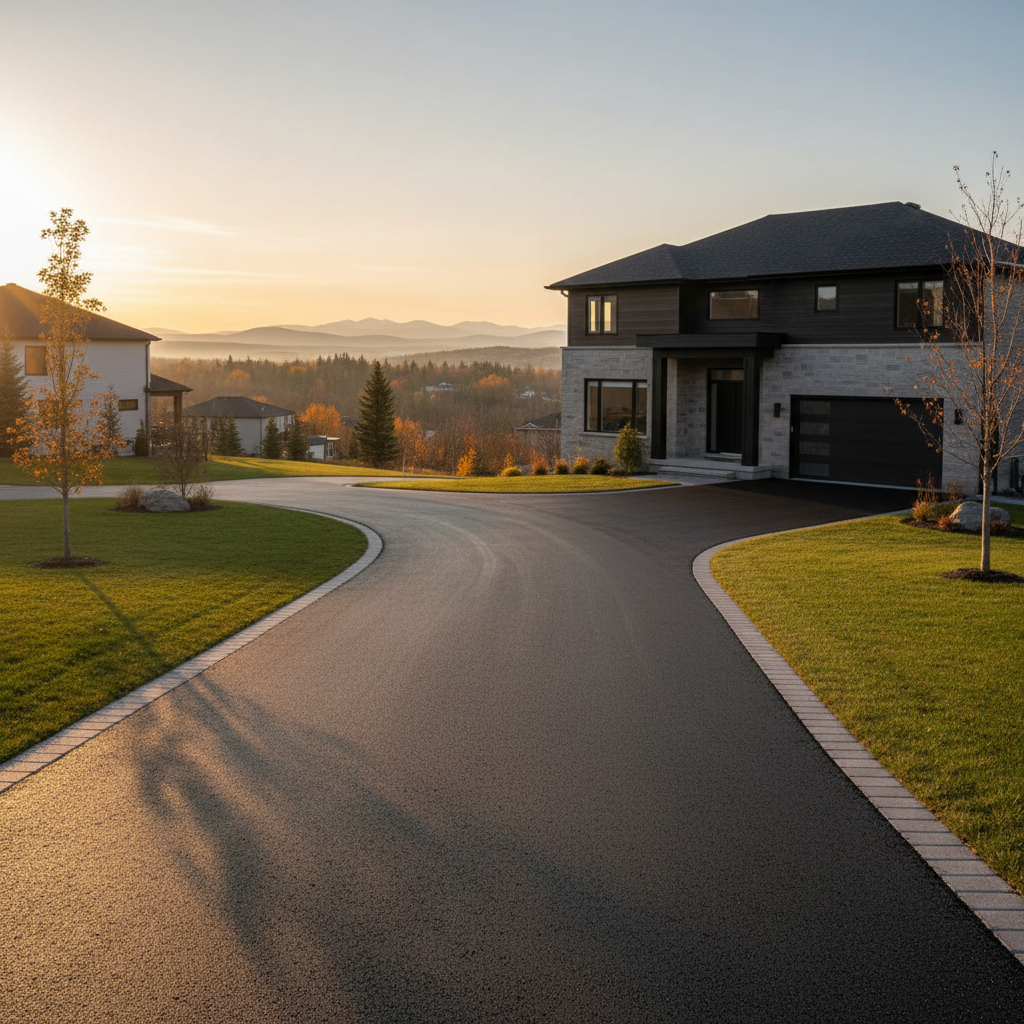
Driveway paving options and costs in Tofield
Tofield homeowners typically start with one of three driveway routes—fresh asphalt, interlocking pavers, or concrete—because the right choice depends on how your driveway performs through Alberta’s winter. In Tofield, most dwellings are single-detached homes (76.5% of housing stock), and the area supports a large pool of homeowner households (76.5% of households own), so private driveway work is in steady demand. Another factor behind pricing is the town’s housing age: homes built before 1981 make up 48.8%, which often means more existing driveways that need tear-out, re-grading, and drainage corrections before any new surface can last.
In the Camrose–Drumheller economic region, frost depth and freeze-thaw cycling materially affect lifecycle cost. Expect a shorter paving season than milder parts of Canada—hot-mix asphalt generally requires warm air conditions (typically above 10°C)—so crews book quickly in spring and early summer. That scheduling pressure, plus the need for a properly compacted granular base and water control, is why you’ll see broader asphalt and concrete quote ranges across the region—especially around neighbourhoods where lots are older and driveway rebuilds are more common, such as the older residential streets near the town core.
Below is a practical comparison of what you’re likely to budget for different materials, assuming a proper base and typical Tofield site conditions. Use it to anchor your itemised quote review.
| Material |
Lifespan |
Maintenance |
Best For |
Price per sq ft |
| Asphalt (new installation, proper base) |
15–25 years |
Sealcoat every 3–5 years; patch potholes promptly |
Lowest upfront cost with strong performance when drainage is fixed |
$6 – $10 · |
| Asphalt (overlay on existing gravel base) |
10–18 years |
Sealcoat every 4–6 years; watch for base pumping |
Budget upgrade when excavation is limited and base is sound |
$5 – $9 · |
| Interlocking concrete pavers |
25–35 years |
Re-sand joints as needed; lift-and-replace for localized repairs |
Curb appeal and easier repairs (no full slab replacement) |
$10 – $16 · |
| Poured concrete (broom finish) |
20–30 years |
Limited sealing; crack monitoring; patch spalls |
Durability with straightforward maintenance and plow traffic |
$9 – $14 · |
| Exposed aggregate concrete |
25–30 years |
Occasional cleaning; protect edges from freeze-thaw water intrusion |
Slip-resistant finish and premium look |
$10 – $15 · |
| Gravel / crushed stone (budget option) |
3–8 years |
Top up annually; re-grade; manage washouts |
Temporary solution or low-traffic driveways |
$2.50 – $4.50 · |
Prices are estimates only and vary by project scope, site access and material selection.
What affects the price of paving in Tofield
Even when you’re comparing the “same driveway,” Tofield quotes can swing by 30–50% because the real work is often in the prep: excavation, base thickness, drainage correction, and how much of the old driveway must come out. In Alberta’s colder markets, contractors also face higher labour and scheduling pressure during the short paving window. For Camrose–Drumheller, those pressures often show up more in spring than in late summer, when curing and weather risk can compress available days.
Frost depth and freeze-thaw cycles are decisive cost factors in Tofield. Deeper frost means you need a thicker, well-compacted granular base and better moisture control so water doesn’t sit in the structure and expand. If the base is under-designed, you’ll often see cracking, settlement, and early edge failure—then the job becomes an expensive do-over. As a rule of thumb, the Camrose–Drumheller frost-protection guidance puts frost depth roughly in the 6 to 10+ foot range depending on local soil and elevation, so contractors commonly plan for thicker granular layers and robust subgrade stabilization. That pushes base-related costs toward the middle or upper end of the $6,000 – $15,000 asphalt driveway band for new installs, particularly when drainage repairs are needed.
Concrete costs can also rise quickly in older neighbourhoods of town where you find poor drainage, soft subgrade, or existing slabs that are failing. For example, a re-grade plus drainage corrections can move a basic pour toward the $7,500 – $18,000 concrete driveway band. On the other hand, if a driveway is already well-drained and the footprint is accessible, you may only need surface-level corrections, keeping your final number closer to the lower end.
| Price Factor |
Why It Matters |
Cost Impact |
| Driveway area in sq ft |
More square footage means more asphalt/concrete, base, forms, and compacting passes |
Major driver (often 50%+ of total) |
| Base depth required |
Frost protection depends on frost depth and subgrade condition |
Moderate to high (can add thousands) |
| Grading and drainage work |
Fixing slope, low spots, and water pathways prevents freeze-thaw damage |
High when soil is wet or drains need redesign |
| Tear-out of existing surface |
Breaking, hauling, and disposing of old concrete or old asphalt adds time and equipment use |
Moderate to very high on older driveways |
| Edge restraints and curbing |
Prevents paver spread and controls asphalt edge raveling |
Moderate; essential for longevity |
| Sealing requirement |
Asphalt sealcoat helps protect binder from oxidation and water infiltration |
Low upfront; impacts long-term cost |
| Site access |
Narrow entrances or long pushes slow equipment movement and increase labour |
Moderate (especially with tight lots) |
| Asphalt mix specifications |
Freeze-thaw-rated mixes perform better under Alberta temperature swings |
Moderate; can raise material costs |
Permits & regulations in Alberta
In Alberta, paving a private driveway within your own property boundary typically doesn’t require a building permit when you’re simply replacing a driveway surface and not changing the footprint or affecting public infrastructure. Where permits and approvals commonly come in is when your work touches municipal assets—especially the area in the road allowance (right-of-way). For Tofield homeowners, that usually includes new or altered curb cuts/driveway approaches, changes to boulevard drainage, or any work that affects stormwater flow to the street.
Before work starts, you should also consider any lot-grading bylaws your municipality has in place. These rules can restrict how close a hard surface can get to property lines, and they often require that surface water be directed properly so it doesn’t run onto neighbouring lots or pool against foundations. Because older homes are common (48.8% built before 1981), it’s also smart to confirm expectations around drainage correction—contractors may need to re-grade or adjust subdrainage within the driveway area.
Step-by-step, verify your contractor properly in Alberta:
- Check their Alberta licence status through the appropriate provincial contractor licensing channel (as applicable to their trade and work scope).
- Request a certificate of insurance (liability) showing coverage active for your project dates.
- Ask for proof of WSIB/WCB coverage for any workers they employ (or confirm they use subcontractors who carry coverage).
- Request a written clearance letter or documentation that matches their coverage obligations.
- Confirm utility locates are ordered before excavation (Alberta One-Call).
Asphalt vs pavers vs concrete for Tofield driveways
For Tofield’s freeze-thaw climate, material performance comes down to water control, base thickness, and how the surface tolerates winter maintenance. Asphalt usually wins on lowest upfront cost, but it needs regular sealcoating to protect against binder aging and water infiltration. Interlocking concrete pavers cost more to install, yet they’re repair-friendly—if a spot fails from settlement or drainage issues, a contractor can remove and replace individual units instead of replacing an entire section. Poured concrete often sits in the mid-range price band, but it can crack from freeze-thaw movement if it’s not air-entrained and detailed correctly. Exposed aggregate can improve traction but still depends on correct mix and finishing to manage moisture.
In Camrose–Drumheller, a well-compacted granular base and proper drainage are not optional for any of the three. Asphalt and concrete both perform best when the base is thick enough for frost protection and when the driveway is graded to shed water away from the house. With pavers, the system is still frost-sensitive—if water migrates into the bedding layer and the joints aren’t maintained, you can see shifting or loss of level.
Salt, sand, and ploughing are real-world pressures in Alberta winters. Asphalt typically handles plough traffic fine when it’s thick enough and properly sealed, but untreated edges can ravel. Concrete can be durable, yet de-icing salts can be hard on non-air-entrained surfaces, increasing risk of scaling. If your budget is tight, asphalt is often the smartest first choice—especially when your driveway is already mostly sound—while pavers are usually justified if curb appeal and “repair without full replacement” matter to you.
For example, if you’re looking at a basic driveway rebuild in the $6,000 – $15,000 asphalt band versus a paver finish closer to $9,000 – $22,000, that extra cost is mainly buying longer visual durability and easier spot repairs—useful in older areas of town where drainage corrections sometimes reveal weak subgrade spots after tear-out.
| Material |
Frost Resistance |
Curb Appeal |
Repair Method |
Lifespan |
Price Band |
| Asphalt (sealed regularly) |
Good with proper base + drainage; depends on seal timing |
Medium (clean, dark finish; less varied patterns) |
Cut patch and replace localized sections |
15–25 years |
$6,000 – $15,000 |
| Interlocking concrete pavers |
Very good when bedding and drainage are designed correctly |
High (varied colours/patterns) |
Lift-and-replace individual pavers or sections |
25–35 years |
$9,000 – $22,000 |
| Poured concrete (air-entrained) |
Good to very good if air-entrained and properly finished |
Medium to high (depends on finish) |
Patch spalls/cracks; re-surface in some cases |
20–30 years |
$7,500 – $18,000 |
| Exposed aggregate concrete |
Good with correct mix and edge detailing |
Very high (textured premium look) |
Patch repairs can be blended; sometimes localized rework |
25–30 years |
$8,500 – $19,500 |
| Permeable pavers (drainage grid) |
Excellent for water management where design matches soil |
High (modern layout) |
Replace affected pavers; inspect drainage media |
20–30 years |
$10,500 – $24,000 |
| Chip seal / tar-and-chip |
Fair; sensitive to base prep quality and surface wear |
Low to medium (more utilitarian) |
Spot chip loss repair and re-application |
6–12 years |
$4,500 – $9,000 |
How to choose a paving contractor in Tofield
Choosing a contractor in Tofield is less about the brochure and more about proof—especially in Alberta where you want the right coverage and documented workmanship. Start by verifying Alberta licensing for the scope they’re offering, then ask for a current certificate of insurance (liability) naming your property and project dates. For workers, confirm WSIB/WCB coverage: ask for proof of coverage or a clearance/coverage letter and ensure it covers the crew that will actually be on site (not just the office admin). If they use subcontractors, you should still see coverage documents for those trades as well.
Next, request 2–3 itemised written quotes rather than a single lump sum. Good quotes separate labour and materials and clearly list excavation depth, base thickness, drainage correction items, disposal/haul-away, edge restraints, and the asphalt mix or concrete spec. Also check what’s excluded: permit pull, utility locates, topsoil restoration, sod/seed, and whether they include compacting and testing. Disposals and haul-away are commonly forgotten until you see change orders.
For warranty and payment, ask for a written workmanship warranty length and confirm whether the product warranty is manufacturer-backed and transferable. For payment scheduling, a safe approach is to keep upfront payments capped around 10–15% and hold back a portion until final grading, cleanup, and punch-list items are complete. Finally, require a start date and an estimated completion timeline in writing; with Alberta’s freeze-thaw and short season, you want clarity on what happens if weather delays curing.
- Confirm licence and the specific trade/installation scope matches your driveway work.
- Review certificate of insurance and ensure it’s active for the project period.
- Verify WSIB/WCB coverage (or clearance documentation) for listed workers.
- Ask for their method for base preparation (compaction approach and target thickness).
- Ensure drainage and grading corrections are included (not “assumed”).
- Get a written plan for frost protection—what they build under the surface.
- Require disposal/haul-away details for tear-out material.
- Ask whether edge restraints/curbs are included (especially for pavers).
- Confirm whether sealing is included and the recommended schedule for asphalt.
- Check product specs: air-entrainment for concrete; freeze-thaw-rated mix for asphalt.
- Review warranty terms in plain language and who you contact for service.
- Use a payment schedule with a holdback until punch-list completion.
Red flags in Tofield include: quoting without a site visit, refusing to itemise base thickness and drainage work, saying they’ll “just pour over” soft subgrade, offering warranties that cover nothing related to freeze-thaw movement, or asking for large upfront payments before excavation and base prep are complete.
Frequently asked questions — paving in Tofield
What causes potholes and how are they repaired?
Potholes in Tofield usually start when water gets into cracks or weak spots in the base. Alberta’s freeze-thaw cycles then expand the wet material, pushing up the pavement and breaking binder over time. Heavy plough impacts and turning loads can speed up the failure at driveway edges or the wheel path. Repairs typically begin with cutting back to sound asphalt, removing any saturated base material, and rebuilding with compacted granular base. After that, the contractor places a proper asphalt patch, compacts it to match the existing grade, and blends the surface. If multiple potholes appear in the same area, it can be more cost-effective to address base/drainage first rather than only patching. Depending on the size, small patches fall well under a full resurfacing budget, but widespread base failure can push you toward the higher end of the $6,000 – $15,000 driveway paving band.
How do I prepare for a paving project?
Preparation is mostly about making the site workable and reducing surprises. In Tofield, clear the driveway area of vehicles, trailers, and stored items at least the day before excavation. Plan for utility locates by ensuring the contractor orders Alberta One-Call tickets before digging; you can also request the locate ticket details in writing. If you have mature shrubs or lawn edging close to the driveway, decide whether they’ll be removed and reinstated as part of the scope—many quotes exclude landscaping restore. If you’re replacing an older driveway (many in town were built well before 1981), expect extra time and cost for tear-out and haul-away, so confirm disposal is included. Lastly, mark any sprinkler heads or private lines you know about and provide access for equipment. A good quote should outline staging, cleanup, and curing expectations so you know when the driveway will reopen.
How do I compare paving quotes fairly?
Compare quotes the way contractors price them: scope and specs, not just totals. Ask each contractor to itemise labour and materials, including excavation depth, base thickness, drainage/grading corrections, compaction steps, edge restraints, and disposal/haul-away. For asphalt, confirm the mix is freeze-thaw rated and ask whether sealcoat is included and when it should be applied (typically after the new asphalt has cured). For concrete, confirm air-entrainment and finishing method (broom finish or exposed aggregate) and whether joints are planned. Make sure the quoted size is the same square footage and confirm how the apron/approach to the street is handled if it’s part of the work. Quotes that omit base and drainage details often look cheaper but create early failures—especially in a freeze-prone climate. As an anchor, a full asphalt install commonly sits within $6,000 – $15,000, while interlocking pavers are often higher at $9,000 – $22,000. Fair comparisons should land you in the same zone once the scope is truly equivalent.
Can asphalt be laid in cold weather in Tofield?
In Tofield, cold weather limits asphalt placement because hot-mix asphalt needs suitable air temperatures and proper curing conditions. While paving can sometimes occur near shoulder seasons depending on the day’s temperatures, asphalt quality depends on whether crews can achieve adequate compaction while the mix is workable and whether it can cool/compact without trapping too much moisture. Freeze-thaw cycling is unforgiving: if the surface doesn’t cure correctly, you can get early raveling and cracking. A reputable contractor will base the decision on current conditions and not promise a “set schedule” regardless of weather. In Alberta, that short spring window is real—so planning the project early is key. If your driveway is delayed, it’s better to wait for appropriate conditions than to lay material that can’t be properly compacted and finished.
What is a driveway apron and do I need one in Tofield?
A driveway apron is the transition area where your driveway meets the street/road approach—often involving the curb cut area, boulevard grading, and sometimes adjustments to drainage so water doesn’t flow toward your foundation or neighbouring properties. Whether you need an apron depends on what you currently have and whether your project touches municipal right-of-way. In Alberta, work in the right-of-way typically requires municipal approval, so a contractor should clarify if they’re only paving within your lot boundary or if they’re changing the driveway approach. If your apron is failing (settlement, broken edges, poor drainage), fixing it can significantly improve driveway longevity because water won’t be dumped at the edge of the pavement. If you’re unsure, ask the contractor to describe exactly where the paving starts and stops on drawings, and confirm whether any municipal permits/approvals are included.
How do I maintain my driveway through Tofield winters?
Winter maintenance in Tofield is mainly about controlling water and minimizing surface stress. Start with timely patching: if you see small cracks or early potholes, address them before freeze-thaw expands the damage. For asphalt, plan sealcoating on schedule after installation—sealcoat timing commonly falls in the first 6–12 months after paving for best results, then every few years depending on traffic and wear. When ploughing, avoid excessive blade contact; repeated scraping at the same spots can break edges and expose material layers to moisture. Use sand thoughtfully—too much can hold moisture—while salt use should be reasonable; concrete can be more vulnerable to scaling if the mix and finish aren’t right, so avoid over-salting. Keep an eye on drainage: if water pools after storms, get it corrected early. In a community with many long-lived driveways and a meaningful share built before 1981 (48.8%), fixing drainage and edge failures early usually costs far less than waiting for full replacement.