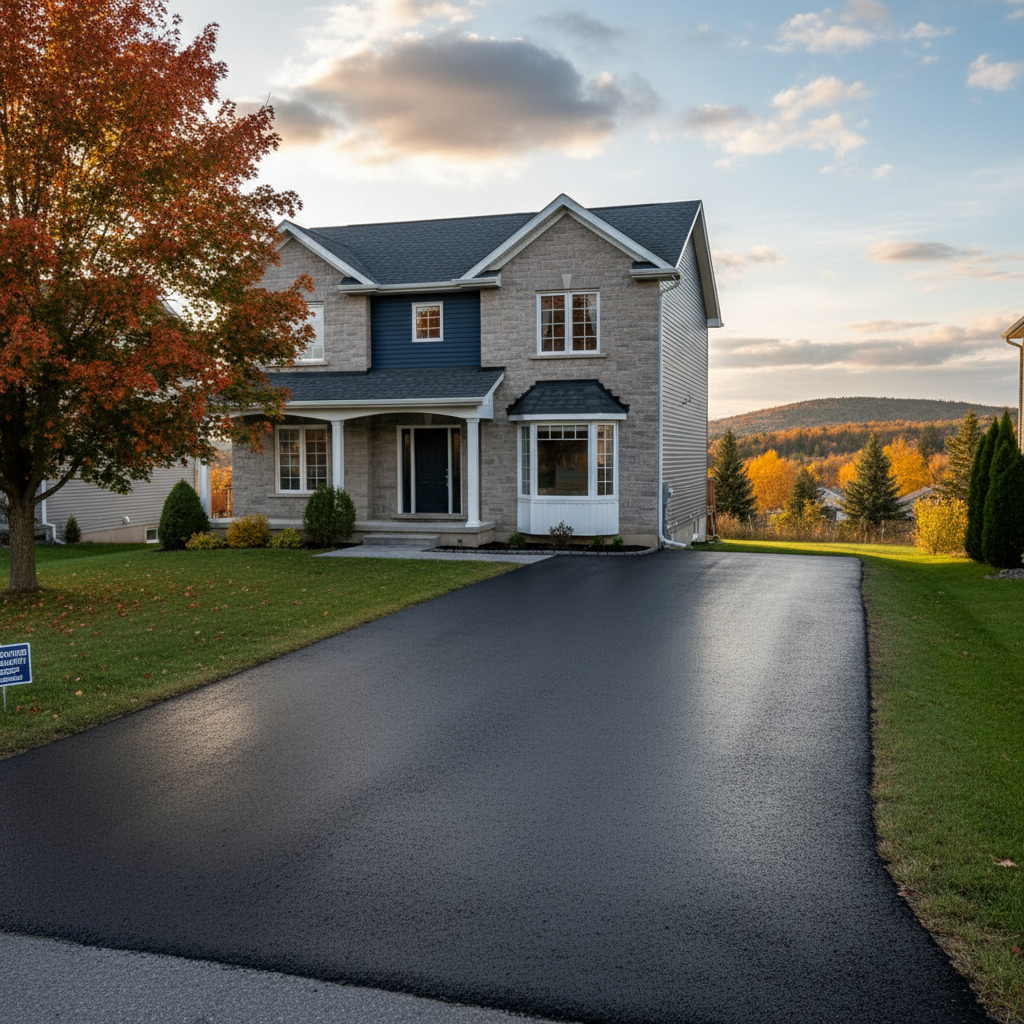
Driveway paving options and costs in Three Hills
Three Hills homeowners typically have a straightforward driveway decision because the housing stock is dominated by single-detached homes—75.1% of dwellings—so most driveways are serving regular family vehicles and snow-storage needs, not shared traffic. With 805 homeowner households (68.8% of households own) in the local area (Statistics Canada, 2021 Census), demand for durable surfaces that can handle a long winter is steady, particularly around well-used neighbourhood streets and older properties.
In the Lethbridge–Medicine Hat economic region, pricing is strongly shaped by frost depth and repeated freeze–thaw cycles. Frost penetration is commonly around the 6 ft range, so contractors design the driveway structure around a deeper, well-compacted granular base and robust drainage. That increases excavation, aggregate quantity, and labour time compared with milder climates. Also, asphalt production and placement are weather-sensitive; hot-mix asphalt needs favourable temperatures, and the paving season is effectively late spring through early fall, which can tighten scheduling and affect availability.
Where this shows up in Three Hills is most noticeable on older lots, especially where soils are clayey or drainage is poor—conditions that are common on properties built before 1981 (56.0% of homes). For many homeowners, a good starting point is comparing standard residential options side-by-side, because a properly built base can mean the difference between a driveway that lasts and one that heaves or cracks early.
Below are typical installed cost bands for standard residential-scale driveway work, so you can compare options quickly before you request quotes—especially if you’re near the downtown/central area where access can be tighter.
| Material |
Lifespan |
Maintenance |
Best For |
Price per sq ft |
Price Range |
| Asphalt (new installation, proper base) |
15–25 years |
Seal every 3–5 years |
Balanced cost and performance in freeze–thaw climates |
$4.50–$8.50 |
$6,000–$12,000 |
| Asphalt (overlay on existing gravel base) |
10–18 years |
Seal every 3–5 years; monitor settlement |
When the existing subgrade is stable enough to avoid full tear-out |
$4.00–$7.50 |
$5,500–$10,500 |
| Interlocking concrete pavers |
25–35 years |
Occasional panel replacement; re-leveling as needed |
Curb appeal and repairability without full replacement |
$8.00–$14.00 |
$9,000–$18,000 |
| Poured concrete (broom finish) |
20–30 years |
Seal as recommended; keep joints maintained |
Lower long-term upkeep with clean, uniform look |
$7.00–$12.50 |
$8,000–$16,000 |
| Exposed aggregate concrete |
20–30 years |
Seal periodically; manage snow/ice safely |
Textured traction and a higher-end look |
$9.00–$15.00 |
$10,500–$18,500 |
| Gravel / crushed stone (budget option) |
3–8 years (varies) |
Re-grade annually; top up stone; weed control |
Short budget window or temporary surface |
$2.25–$4.50 |
$3,000–$7,500 |
Prices are estimates only and vary by project scope, site access and material selection.
What affects the price of paving in Three Hills
In Three Hills and the wider Lethbridge–Medicine Hat region, it’s common to see quotes for the “same driveway” vary by 30–50%. The difference usually isn’t the asphalt or concrete itself—it’s what’s happening underneath and around it: excavation depth, base preparation, drainage corrections, disposal, and how the crew can work inside the time window. Because the practical paving season is late spring through early fall, weather risk can also push contractors to schedule fewer jobs at once, which influences labour allocation and pricing on smaller residential drives.
Frost line depth and freeze–thaw cycles are decisive. In this region, frost penetration is often around the 6 ft range, so driveways need a thicker, well-compacted granular base and careful subgrade stabilization to prevent heaving and cracking. When companies build shallow or skip proper granular thickness, the driveway may look fine at installation but can fail sooner—especially on clay or poorly drained soils. Asphalt placement is also temperature-sensitive; hot-mix asphalt generally requires air conditions above 10°C, so scheduling pressure concentrates in spring and early summer. Mix design matters too: freeze–thaw-rated asphalt blends and proper compaction help reduce surface raveling and early cracking.
Concrete costs can rise when homeowners require extensive re-grading, thicker slabs, or additional reinforcement to manage jointing and movement in Alberta winters. Paver costs can also swing when there are tight corners, complex borders, or the need for edge restraints and underdrain improvements. As a quick reference, a well-built asphalt driveway commonly lands in the $6,000–$12,000 band, while interlocking pavers often follow the $9,000–$18,000 band once base and drainage are done properly.
On homes built before 1981 (56.0% of dwellings), driveway drainage is frequently older and less consistent, and that typically increases the amount of excavation and rework needed—sometimes by hundreds of dollars—because getting water away from the subgrade is what protects the investment.
| Price Factor |
Why It Matters |
Cost Impact |
| Driveway area in sq ft |
Most material and labour scale directly with square footage. |
Often the biggest swing: add 200 sq ft and pricing can jump by thousands. |
| Base depth required |
Frost demands thicker, well-compacted granular layers to resist heaving. |
Deeper bases increase excavation, aggregate haul, and compaction time. |
| Grading and drainage work |
Proper slope and drainage stop water from saturating clay subgrade. |
Can add significant labour if regrading or installing drainage is needed. |
| Tear-out of existing surface |
Breaking and hauling asphalt/concrete requires equipment time and disposal fees. |
Often a major add-on, especially for thick concrete and constrained access. |
| Edge restraints and curbing |
Pavers and some asphalt edges need restraints to prevent spreading and washout. |
Additional forms/materials labour increase cost but protect long-term performance. |
| Sealing requirement |
Asphalt needs sealcoating to reduce oxidation and moisture intrusion. |
Planning for ongoing maintenance helps avoid premature surface failure. |
| Site access |
Narrow lots slow equipment setup and can require smaller/extra trips. |
Higher unit labour and more time on-site for staging and traffic control. |
| Asphalt mix specifications |
Freeze–thaw rated mix designs and correct binder selection cost a bit more. |
Higher material and production costs, but better cracking resistance. |
Permits & regulations in Alberta
In Alberta, paving a private driveway within your own property typically does not require a building permit, as long as you’re not changing the municipal right-of-way or altering major services. Where permits and approvals often come into play is when the work touches municipal infrastructure—especially new or modified curb cuts, changes to boulevard grading, driveway approaches that alter storm drainage patterns, or any work that affects how water flows from the street. If your plan includes redirecting runoff, replacing or modifying catch basins, or altering municipal drainage features, you should expect municipal approval requirements.
Before excavation in Three Hills, the homeowner should require utility locates through Alberta One-Call. A good contractor will handle this, but you should confirm the locates are ordered before the first shovel goes into the ground. Also, some municipalities apply lot-grading or drainage rules (even on private property) that restrict how close a hard surface can be to property lines and how water must be managed to avoid impacting neighbours.
To verify an Alberta contractor, do it step-by-step: (1) check their business details and any applicable registration/licence information through the appropriate provincial/consumer-facing online resources; (2) request a current certificate of liability insurance showing coverage amount and effective dates; (3) confirm WSIB/WCB coverage for their crews—ask for a clearance letter or proof of coverage before work starts; and (4) ensure they provide a written scope and warranty terms. If a contractor hesitates on insurance or coverage documentation, that’s a red flag.
Asphalt vs pavers vs concrete for Three Hills driveways
For Three Hills, the decision between asphalt, interlocking concrete pavers, and concrete comes down to upfront cost versus long-term repair strategy in freeze–thaw conditions. Asphalt usually offers the lowest upfront cost and a smooth finish, but it performs best when sealed regularly—typically every 3–5 years—so moisture doesn’t accelerate oxidation and surface cracking. In contrast, interlocking concrete pavers cost more upfront, but they’re highly repairable: if a section settles or is damaged, crews can remove and re-lay the affected area without tearing out the whole driveway. Poured concrete sits in the middle range, but in Alberta you must rely on correct mix design (including air entrainment), proper joints, and good base prep to manage movement. Without that, freeze–thaw can contribute to cracking.
Base preparation matters for all three options. With frost penetration commonly reaching around the 6 ft range, the granular base and drainage design must be built deep enough and compacted properly to prevent heaving. In practice, that means protecting the subgrade from saturation with correct grading and—when needed—improving drainage pathways. For winter maintenance routines in Three Hills (ploughing, sand, and sometimes salt on edges), pavers generally handle impacts well because damaged units are replaceable. Asphalt can scar from repeated blade contact and then deteriorate faster if not sealed. Concrete can also chip at edges if salt and repeated impact combine, so good finishing and jointing are important.
Example: If your driveway is a standard residential size, an asphalt install often lands around $6,000–$12,000. If you opt for interlocking pavers, you might be closer to $9,000–$18,000. That extra cost is justified when curb appeal and future repair flexibility matter, or when you expect periodic access needs (utility work, drainage adjustments). If you want the best value and can commit to sealing, asphalt is often the practical choice—provided the base is built to handle Alberta’s cycles.
| Material |
Frost Resistance |
Curb Appeal |
Repair Method |
Lifespan |
Price Band |
| Asphalt (sealed regularly) |
Good when base/drainage are correct; vulnerable if drainage is poor |
Medium (smooth, dark finish) |
Mill and patch damaged areas; full overlay if needed |
15–25 years |
$6,000–$12,000 |
| Interlocking concrete pavers |
Very good with proper bedding and edge restraints |
High (varied patterns and colours) |
Replace individual pavers or panels; re-level locally |
25–35 years |
$9,000–$18,000 |
| Poured concrete (air-entrained) |
Good with correct air-entrainment, joints, and base |
Medium to high (clean uniform look) |
Localized crack repairs; slab replacement for major failure |
20–30 years |
$8,000–$16,000 |
| Exposed aggregate concrete |
Good when sealed and properly constructed |
Very high (textured finish) |
Crack repair and patching; reseal as needed |
20–30 years |
$10,500–$18,500 |
| Permeable pavers (drainage grid) |
Good where you can manage infiltration safely |
High (modern look) |
Replace units; clean out aggregate chamber as needed |
20–30 years |
$11,000–$20,000 |
| Chip seal / tar-and-chip |
Moderate; depends heavily on base and binder |
Medium (more rustic texture) |
Spot repair or re-chip/overlay |
8–15 years |
$5,000–$10,000 |
How to choose a paving contractor in Three Hills
Choosing the right paving contractor in Three Hills starts with proof, not promises. In Alberta, you should ask for (and review) their certificate of liability insurance—confirm the coverage amount and that it’s current. Next, verify WSIB/WCB coverage for their workers: request a clearance letter or proof of coverage before the job begins (don’t wait until after). Then confirm they carry proper experience with frost-depth-ready base builds—especially for freeze–thaw conditions in southern Alberta. If they can’t explain their base design (granular thickness, compaction testing, and drainage approach), you’re guessing.
When you request quotes, get 2–3 itemised written quotes instead of a single lump-sum number. The best estimates break down labour and materials: excavation, base material, geotextile (if used), asphalt/paver/concrete supply, compaction, forms/finishing (for concrete), edging, and disposal. Make sure the scope is clear on what’s included or excluded: Is permit/municipal approval support included if your work touches the boulevard? Is tear-out included? Is hauling and dump disposal included? What about protecting landscaped areas?
Warranty should be in writing. Ask for (1) workmanship warranty length, (2) product/manufacturer warranty terms, and (3) whether warranties are transferable to a future homeowner. For payment scheduling, don’t pay more than about 10–15% upfront; hold back a portion until completion and cleanup are verified. Finally, insist on a start date and completion estimate in writing—seasonal weather can change timelines, but a written timeline helps you plan.
- Ask for their current liability insurance certificate and verify effective dates.
- Request WSIB/WCB clearance/proof before work starts.
- Confirm they order Alberta One-Call locates and follow up after locates are marked.
- Get itemised pricing for excavation, base depth, and drainage/grade corrections.
- Confirm disposal/hauling of old materials is included if tear-out is required.
- Ask whether they use compaction testing (and what target they follow).
- For asphalt, ask about freeze–thaw-rated mix and compaction procedure.
- For pavers, confirm edge restraint details and bedding thickness.
- For concrete, confirm air-entrained mix and jointing plan (where applicable).
- Clarify who is responsible for any municipal approval if the boulevard is affected.
- Review the warranty: workmanship length, exclusions, and who honours it.
- Use a payment schedule with a holdback until the final walk-through passes.
In Three Hills, common red flags include: contractors who won’t provide insurance/WSIB proof, quotes that omit base thickness and drainage grading details, vague warranties (no written workmanship term), “cash-only” pressure to pay more than 10–15% upfront, and crews that start excavation without utility locates marked on site.
Frequently asked questions — paving in Three Hills
Can asphalt be laid in cold weather in Three Hills?
Generally, in Three Hills (and across Alberta), asphalt shouldn’t be laid in cold conditions because proper compaction and mix workability are temperature-dependent. Hot-mix asphalt is typically placed when air temperatures are favourable—commonly above 10°C—so crews usually work in late spring through early fall. If a contractor offers “cold weather paving,” ask what method they use to ensure the mix is properly heated, compacted, and protected during cool-down. Also confirm the base is built for freeze–thaw: a strong granular base and drainage plan matter as much as the surface. If you’re scheduling, plan around the season and have the contractor coordinate grading and base prep so asphalt placement happens during the best weather window.
What is a driveway apron and do I need one in Three Hills?
A driveway apron is the section where the driveway meets the street or where the grade transitions at the curb cut. It’s often where the surface takes the most stress from ploughing, vehicle turning, and water run-off. In many cases, you may not “need” an apron for purely aesthetic reasons, but you may need it to create a smooth, durable transition and to protect the edges from erosion—especially if your lot grading or drainage is inconsistent. If your driveway work involves a new curb cut, changes to the boulevard, or drainage impacts near the street, municipal approval requirements can apply. In practical terms, an apron can also help reduce premature edge cracking that many homeowners notice on older drives.
How do I maintain my driveway through Three Hills winters?
Winter maintenance in Three Hills is less about “not using salt ever” and more about managing water and protecting the surface edges. For asphalt, keep blades off the surface as much as possible; avoid aggressive scraping that creates shallow ruts that then trap water during thaws. Use sand for traction when appropriate, and if salt is used, apply sparingly and focus on safe access rather than piling it against the driveway edges. After freeze–thaw seasons, watch for settlement or small cracks; fixing minor issues early typically costs far less than waiting for full-depth failure. If you have asphalt, sealing every 3–5 years (based on wear) is one of the most practical steps homeowners take to slow oxidation and moisture intrusion in Alberta’s cycles.
Is it worth sealing a new driveway right away in Three Hills?
In Alberta, sealing a brand-new asphalt driveway “immediately” is usually not what you want. Asphalt needs time to cure and set so the sealant bonds properly. Many homeowners in Three Hills are best served by waiting until the surface has had adequate cure time and then sealing according to the contractor’s recommended schedule, often within the first year window depending on weather and mix. Think of sealing as a protection layer against Alberta freeze–thaw moisture cycling and surface oxidation. If you’re budgeting, sealing & repair commonly falls in a $300–$2,500 band depending on driveway size and condition. The key is correct timing and a reputable product applied to the right surface—not rushing the process.
What is a chip seal driveway and is it suited to Three Hills?
Chip seal (also called tar-and-chip) is a surface treatment where asphalt binder is applied and aggregate is broadcast to create a durable wearing layer. It can be suited to Three Hills in some situations—especially where you want a more cost-conscious surface or you’re improving a base that’s otherwise in good shape. That said, chip seal performance depends heavily on base construction, drainage, and binder selection because freeze–thaw cycles can accelerate wear if water can’t escape. For that reason, it’s not always the best choice for every residential driveway where the homeowner expects a uniform, smooth finish or frequent traffic turning. If you consider chip seal, ask how the contractor will address edge restraint, drainage slope, and how repairs will be handled over time.
How much does driveway crack repair cost in Three Hills?
Crack repair in Three Hills varies with the type of crack, whether water is getting underneath, and how much prep is needed (cleaning, routing, and sealing). Small surface crack sealing is usually less than deeper repairs that require patching and possibly base stabilization. As a planning estimate, sealing and repair commonly comes in around $300–$2,500 for typical residential work, depending on driveway size and condition. The biggest value is catching cracks early—because a minor crack that stays dry can remain stable, but one that becomes a pathway for water can lead to heaving or broader failure during winter freeze–thaw cycles. A good contractor will assess the crack pattern and recommend the right approach rather than simply filling everything.