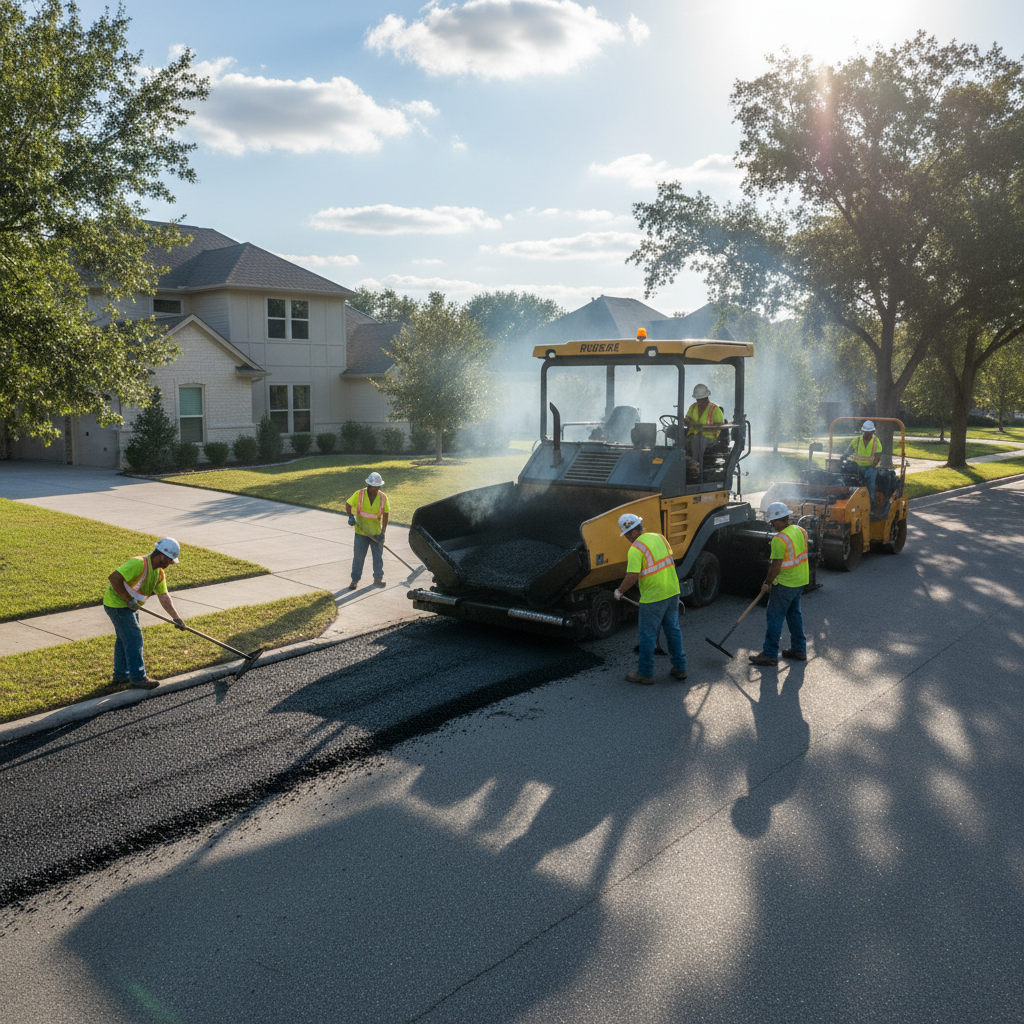
Driveway paving options and costs in Spruce Grove
Spruce Grove homeowners typically have three front-runners when planning a driveway upgrade: asphalt, interlocking pavers, and concrete. With the community at about 37,645 people (Statistics Canada, 2021 Census) and roughly 76.3% of households owning their home (Statistics Canada, 2021 Census), it’s no surprise that driveway projects are in steady demand—especially because most private driveways serve single-detached houses, a dwelling type that makes up 63.4% of homes.
In the Edmonton area, pricing is driven less by the “surface” you pick and more by frost protection and drainage. Central Alberta sees deep seasonal frost and frequent freeze-thaw cycling; water trapped in an underbuilt base expands when frozen, then loosens the structure when it thaws. Contractors therefore price in extra excavation, granular base, compaction time, and drainage detailing. The region also has a tighter paving window; hot-mix asphalt production needs warm conditions (typically above 10°C), which can pressure spring and early-summer scheduling.
If you’re in a neighbourhood like Site 5 / downtown Spruce Grove area (and similarly older, more established pockets), contractors often get called to rebuild drive approaches and fix drainage because grades and access were laid out decades ago. That’s where you’ll notice bids shift: resurfacing an okay base can land near the lower end, while rebuilding the base for frost protection moves the job into the higher ranges.
Use the comparison table below as a starting point for budgeting before you request itemised quotes.
| Material |
Lifespan |
Maintenance |
Best For |
Price per sq ft |
| Asphalt (new installation, proper base) |
15–25 years |
Sealcoat every 3–5 years; patch as needed |
Lowest upfront cost with a smooth, uniform finish |
$3.75–$6.50 |
| Asphalt (overlay on existing gravel base) |
10–18 years |
Sealcoat every 3–5 years; address soft spots early |
When the base is mostly stable and drainage is correct |
$4.25–$7.50 |
| Interlocking concrete pavers |
25–40 years |
Replace individual units; re-sweep/joint sand as needed |
Repairability and curb appeal for detached homes |
$7.50–$12.00 |
| Poured concrete (broom finish) |
20–30 years |
Clean and seal selectively; jointing and crack monitoring |
Heavy-duty traffic areas with a simple maintenance routine |
$6.50–$10.50 |
| Exposed aggregate concrete |
20–30 years |
Sealer reapplication; joint inspection |
Premium look with improved skid resistance |
$7.25–$13.00 |
| Gravel / crushed stone (budget option) |
3–10 years |
Top up and re-grade yearly; manage washboarding |
Temporary solution or very budget-sensitive upgrades |
$2.25–$4.25 |
Prices are estimates only and vary by project scope, site access and material selection.
What affects the price of paving in Spruce Grove
In Spruce Grove and the wider Edmonton economic region, two quotes for what looks like the “same” driveway can differ by 30–50% because the hidden work—frost protection, drainage, and tear-out—often changes once a contractor sees the existing base. A job that’s truly a straightforward resurfacing can be priced near the lower end of asphalt budgets, while a job that requires rebuilding the base (because the subgrade is soft, the slope is wrong, or water is migrating) moves toward the higher end seen in Edmonton-area bids. On top of that, the shorter paving season in colder markets tightens crew schedules, and mobilization costs can get baked into spring and summer work.
Frost line depth and freeze-thaw cycling are decisive cost factors in central Alberta. Deeper frost means you typically need a thicker, well-graded compacted granular base to reduce frost heave, cracking, and settlement. Contractors usually plan on substantial granular thickness and careful compaction; when water is left in the base, it freezes, expands, and weakens the layers during thaw. That’s why asphalt mix design is also selected for freeze-thaw durability—local specifications matter.
Concrete examples: if your driveway approach ties into an existing sidewalk apron that’s offset, contractors may need additional excavation and re-levelling before they can broom-finish or place air-entrained mix. If you want exposed aggregate or paver edging, you’re paying for more formwork or restraint and more labour hours, but you can reduce future surface replacement costs because the surface system is more forgiving.
As a rough guide, asphalt driveways in the Edmonton region often land in the ballpark of $7,000–$15,000, but base rebuilds and drainage correction can push toward the upper band. If you choose interlocking pavers, project pricing often starts around $12,000–$28,000, largely due to excavation depth, bedding sand, edging restraints, and the extra labour required to set a stable, level pattern.
| Price Factor |
Why It Matters |
Cost Impact |
| Driveway area in sq ft |
The more square footage, the more excavation, base, asphalt/concrete, and labour time |
Major driver (often 50–70% of total) |
| Base depth required |
Frost protection depends on adequate granular thickness and compaction |
Can add hundreds to thousands |
| Grading and drainage work |
Proper slope and subsurface drainage prevent water from sitting in the base |
Often a large swing factor |
| Tear-out of existing surface |
Concrete/asphalt removal requires breaking, hauling, and disposal |
Typically increases cost significantly |
| Edge restraints and curbing |
Prevents paver spread and keeps asphalt/concrete edges from failing |
Moderate to high for pavers |
| Sealing requirement |
Asphalt needs sealcoat after curing (commonly 6–12 months) to protect from Alberta freeze-thaw |
Small-to-medium but impacts long-term performance |
| Site access |
Narrow driveways or tight turns slow equipment movement and staging |
Can add mobilization/labour time |
| Asphalt mix specifications |
Freeze-thaw-rated mix and correct grading reduce cracking and raveling |
Moderate increase in material cost |
Permits & regulations in Alberta
In Alberta, paving a private driveway within your own property usually does not require a building permit. That’s the typical case when you’re staying on your lot and replacing the driveway surface and base as needed. However, work that affects the municipal right-of-way often triggers municipal approval. Examples include new or modified curb cuts, changes to the boulevard approach, alterations to storm drainage pathways, and any excavation that ties into municipal infrastructure. If your driveway reconstruction changes how water drains toward a ditch or catch basin, don’t assume it’s “just paving”—confirm requirements with the City of Spruce Grove before you start.
Regardless of permits, always call for utility locates before excavation. In Alberta, use Alberta One-Call for underground services. That’s a key step for homeowner safety and project scheduling.
To verify a contractor properly in Spruce Grove, ask for three things and check them in writing:
- Alberta licence (where applicable): confirm the contractor is properly registered for paving work and business operations using provincial/official business listings.
- Liability insurance: request a current Certificate of Insurance showing limits appropriate for construction and that the policy is active for the job period.
- WCB (workers’ compensation) coverage: verify coverage status/clearance through the WCB clearance process or documentation provided with the quote.
Then match those documents to the proposal scope—if they can’t provide them, consider it a major red flag before you sign.
Asphalt vs pavers vs concrete for Spruce Grove driveways
For Spruce Grove’s freeze-thaw winters, the “best” driveway material usually comes down to how much you want to pay upfront versus how repairable and resilient you need the surface to be. Asphalt is typically the lowest upfront option, with a smooth finish that plows well, but it depends on maintenance: sealcoating is commonly needed every 3–5 years to protect from Alberta moisture and thermal cycling. Interlocking concrete pavers cost more to install, but they’re highly repairable—individual pavers can be removed and reset if settlement occurs, which is helpful where the base needs careful frost protection. Poured concrete sits in the middle price range and can last a long time if the mix is properly air-entrained and the slab is designed with control joints; otherwise, freeze-thaw can lead to cracking, and salt/sand from winter maintenance can accelerate surface wear.
In Edmonton-area projects (including Spruce Grove), base preparation is critical regardless of material. Contractors commonly build a deeper, well-compacted granular base and design drainage so water doesn’t remain in the layers. Pavers often pair well with drainage grids where you want more control over runoff. Concrete can be robust, but poor base compaction or missing drainage can still create movement.
Where does the price difference make sense? Suppose you’re choosing between asphalt and pavers for a typical driveway: if asphalt is priced around the $7,000–$15,000 band and pavers come in around $12,000–$28,000, the extra can be justified when you value long-term curb appeal and easier, targeted repairs—especially if you expect the driveway approach to see settlement risk.
For winter performance, all three can handle plowing, but pavers and properly jointed concrete tend to “show” problems later because repairs are localized, while asphalt relies on the integrity of the sealcoat and surface.
| Material |
Frost Resistance |
Curb Appeal |
Repair Method |
Lifespan |
Price Band |
| Asphalt (sealed regularly) |
Good when base and drainage are correct; best with freeze-thaw-rated mix |
Medium (clean blacktop look) |
Cut-and-patch for localized failures |
15–25 years |
$7,000–$15,000 |
| Interlocking concrete pavers |
Very good with proper bedding/base and edge restraint |
High (pattern and colour options) |
Replace individual units; re-level and reset if needed |
25–40 years |
$12,000–$28,000 |
| Poured concrete (air-entrained) |
Good to very good with air-entrainment and correct base/joins |
Medium to high (finish options) |
Crack repair/seal; may require localized patching |
20–30 years |
$9,000–$22,000 |
| Exposed aggregate concrete |
Good with proper mix and sealing; surface durability is strong |
Very high (textured premium look) |
Localized repairs; re-seal for aesthetic upkeep |
20–30 years |
$10,000–$24,000 |
| Permeable pavers (drainage grid) |
Excellent for water management when designed correctly |
High (modern drainage-focused look) |
Replace units and service drainage layer if settlement occurs |
20–35 years |
$14,000–$30,000 |
| Chip seal / tar-and-chip |
Variable; can be good on compacted base but is maintenance sensitive |
Low to medium (texture finish) |
Re-chip or localized overlay |
6–12 years |
$6,000–$12,000 |
How to choose a paving contractor in Spruce Grove
Choosing the right contractor in Spruce Grove is less about who’s cheapest on day one and more about who builds for Alberta’s frost and drainage realities. Start by verifying Alberta coverage and credentials. Ask for their liability insurance (Certificate of Insurance showing the policy is active and limits suitable for driveway work), and confirm WCB/WCB coverage by requesting clearance documentation or status proof they can provide with the quote. Then ask for their Alberta business registration/licensing information and match it to the contract name on the invoice. A legitimate crew should provide documents quickly without pushing you to “just sign.”
Next, get 2–3 itemised written quotes—not one lump sum. You want separate line items for excavation/t tear-out, granular base thickness, compaction, drainage (if needed), geotextile (if proposed), asphalt mix or concrete mix type (including air-entrainment for concrete), and edging/restraints. Clarify what’s excluded: permit pull, disposal, saw-cutting and jointing, replacement of cracked sidewalks/approaches, and the cost for any required utility coordination.
For warranty, request both workmanship duration and any product/manufacturer warranty terms. Ask whether workmanship is transferable to future owners. Payment schedule matters: don’t pay more than 10–15% upfront, and hold a portion until the job is complete and defects are corrected. Finally, require a written timeline with a start date and realistic completion estimate based on seasonal conditions.
- Request current insurance certificate and confirm job-site coverage dates.
- Verify WCB clearance/status documentation before work begins.
- Confirm the contract includes material types (freeze-thaw-rated asphalt; air-entrained concrete).
- Ask for the proposed granular base depth and compaction method.
- Ensure drainage and slope are described (not just “we’ll pave it”).
- Get a clear tear-out and disposal plan for existing asphalt/concrete.
- Confirm whether edging/restraints are included.
- For asphalt, ask about sealing timing (often after curing, commonly within 6–12 months).
- Confirm concrete jointing/control strategy is included in the scope.
- Ask if they include a site protection plan for plants, lawn sprinkler lines, and driveway gates.
- Make sure the quote states the payment schedule in writing.
- Require a written schedule and start/completion windows tied to weather.
Red flags we see in Spruce Grove include: contractors who can’t produce insurance/WCB documentation, quotes that ignore base depth or drainage, “guarantees” without a defined scope, vague exclusions (no mention of disposal or tear-out), and pricing that doesn’t match the stated material specs—especially for freeze-thaw durability in Alberta winters.
Frequently asked questions — paving in Spruce Grove
What is a chip seal driveway and is it suited to Spruce Grove?
Chip seal (tar-and-chip) is a surface treatment where a tack coat is sprayed and topped with aggregate. It can be suited to rural or low-speed surfaces, but in Spruce Grove it’s usually less ideal for a long driveway used daily unless your contractor has a very solid, well-compacted base and a maintenance plan. Alberta freeze-thaw and moisture can work loose aggregate faster if drainage and base quality aren’t excellent. If you’re comparing budgets, chip seal often falls below full asphalt paving—roughly in the band of $6,000–$12,000 depending on access and prep. If your goal is a plow-friendly, durable driveway with minimal long-term attention, asphalt in the $7,000–$15,000 range or properly built pavers are often a safer fit.
How much does driveway crack repair cost in Spruce Grove?
Crack repair pricing depends on whether you’re doing simple crack sealing (filling narrow joints) or structural patching after base movement. For a typical Spruce Grove asphalt driveway, sealing existing cracks is often relatively economical, but it still depends on how many feet are affected and how wide/deep the cracks are. If water intrusion has already softened the base, you may need localized cut-and-patch rather than filler. In Alberta’s freeze-thaw conditions, small repairs can prevent larger failures, but delays can raise the eventual cost. As a budgeting reference, sealing and repair work commonly ranges about $600–$3,500 for driveway-scale fixes, with larger or multiple areas going higher. Always request photos, a crack length count, and a scope that explains whether drainage correction is included.
What base thickness do I need for pavers in Spruce Grove?
For pavers in Spruce Grove, base thickness should be designed for frost protection and drainage, not just “a standard number.” Because central Alberta can experience deep frost and frequent freeze-thaw cycling, contractors typically build a thicker compacted granular base than what you’d see in mild coastal climates. The practical approach is to remove unstable material, install well-graded aggregate in lifts, compact each lift, and add a bedding layer designed for pavers. Exact thickness varies with your current subgrade condition, groundwater/meltwater risk, and the distance between the driveway and any low points. That’s why the most accurate quotes include a base rebuild plan and compaction notes. If a quote only lists the bedding sand and skips base depth, it’s a common sign they haven’t priced the frost risk correctly.
How do I get the most accurate paving quote in Spruce Grove?
To get an accurate paving quote in Spruce Grove, insist on an on-site assessment, not a guess from Google photos. Before pricing, a solid contractor should evaluate the existing base (including soft spots), confirm drainage direction, and note any grade issues at the edge where water can collect during spring melt. Ask for itemised line items: excavation/t tear-out, granular base thickness, geotextile (if used), compaction, drainage correction, and the surface build (asphalt mix or concrete mix type; paver bedding and restraints). For asphalt, ask whether sealing is scheduled after curing (commonly within 6–12 months). If you’re choosing among materials, you can use local price bands as sanity checks—such as asphalt around $7,000–$15,000 or concrete around $9,000–$22,000—but the true difference is usually in base and drainage scope, especially in Alberta’s freeze-thaw cycle.
How much does it cost to pave a driveway in Spruce Grove?
Most Spruce Grove driveway paving projects land inside the established local bands, but your final number depends on driveway size, access, base rebuild needs, and drainage. For asphalt, typical full driveway paving is often around $7,000–$15,000. Interlocking concrete pavers generally run higher, commonly about $12,000–$28,000, because of excavation, bedding sand, and edging restraints. Concrete driveway paving often falls between $9,000–$22,000 depending on finish (standard broom vs exposed aggregate) and whether joints and prep work are extensive. In Edmonton-area conditions, jobs that require frost-protection base reconstruction and drainage correction cost more than resurfacing that keeps a stable base. Request itemised quotes so you can see what portion is surface versus what portion is frost protection and drainage.
Asphalt vs interlocking pavers vs concrete — which is best in Spruce Grove?
In Spruce Grove’s Alberta winters, the “best” choice is the one that matches your tolerance for maintenance and your risk profile for frost-related movement. Asphalt is usually the best value upfront in the $7,000–$15,000 range, but it performs best when the base is properly built and you plan for sealcoating every 3–5 years. Interlocking pavers (often $12,000–$28,000) are the most repair-friendly—if settlement occurs, you can remove and reset affected sections rather than replacing the entire surface. Poured concrete (often $9,000–$22,000) can be excellent when it’s air-entrained, properly jointed, and built over a compacted base with drainage. If you want curb appeal and easy future repairs, pavers tend to win; if you want smooth and cost-efficient, asphalt is usually best; if you want a solid, permanent look with less surface upkeep, concrete is a strong option.