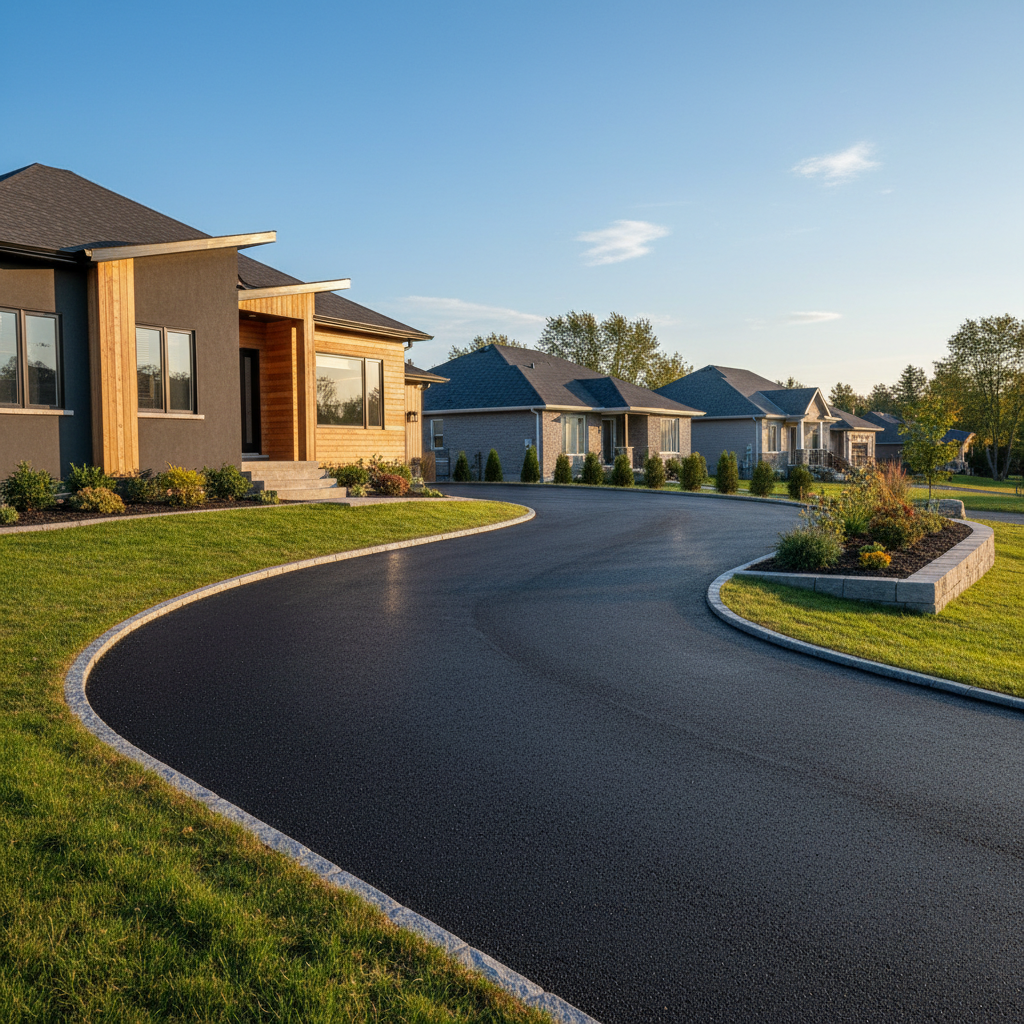
Driveway paving options and costs in Claresholm
Claresholm homeowners typically have a lot to choose from when it comes to driveway paving—because most houses in the area are single-detached homes (72.8% of dwellings), and a large share of households are owner-occupied (76.6%). In practical terms, that means more people are investing in long-term drive surfaces rather than “just getting through one season.” If you’re looking at paving around the busy commercial and residential stretch near the downtown core off Highway 3, you’ll also find more contractors willing to price competitively due to repeat demand.
In the Lethbridge–Medicine Hat economic region, costs are heavily shaped by frost depth, freeze–thaw cycling, and the shortened paving window. Southern Alberta frost penetration is commonly in the 6 ft range, so paving contractors design driveways with deeper, well-compacted granular bases and stronger drainage to reduce heaving and cracking. Since hot-mix asphalt generally requires air temperatures above 10°C, scheduling in Claresholm concentrates in late spring through early fall—tight weather windows can raise unit rates even when material prices are steady. You’ll also see pricing differences because some jobs start as overlays (less excavation) while others require full tear-out, haul-away, and base rebuilds.
Below are realistic installed price ranges for standard residential driveway sizes in Claresholm, so you can compare “apples to apples” when reviewing quotes.
| Material |
Lifespan |
Maintenance |
Best For |
Price per sq ft |
| Asphalt (new installation, proper base) |
15–25 years |
Seal every 3–5 years; patching as needed |
Lowest upfront cost with a smooth finish when base is built for frost |
$6,000–$12,000 |
| Asphalt (overlay on existing gravel base) |
10–18 years |
Seal every 3–5 years; monitor base settlement |
When the existing base is stable and drainage is already good |
$5,000–$9,500 |
| Interlocking concrete pavers |
25–40 years |
Re-sand joints as needed; replace a few pavers if damaged |
Curb appeal and easier spot repairs without resurfacing the whole driveway |
$9,000–$18,000 |
| Poured concrete (broom finish) |
25–35 years |
Seal if desired; crack monitoring/patching |
Clean, consistent look; good when properly air-entrained and reinforced |
$8,000–$16,000 |
| Exposed aggregate concrete |
20–35 years |
Sealer as recommended by installer; occasional patching |
Higher-end surface texture and skid resistance |
$9,500–$17,500 |
| Gravel / crushed stone (budget option) |
3–8 years |
Re-grade and top up; weed control; periodic stone addition |
Short-term budget or where drainage needs improvement first |
$3,500–$7,000 |
Prices are estimates only and vary by project scope, site access and material selection.
What affects the price of paving in Claresholm
Even when two contractors quote “the same driveway,” the final numbers can swing 30–50% across Lethbridge–Medicine Hat and elsewhere in Alberta. The biggest reason is that frost depth and freeze–thaw cycles force the design: you’re not just buying surface material, you’re paying for the buried system that keeps the driveway stable. In southern Alberta, deeper frost commonly means thicker compacted granular base and more meticulous grading, so “cheap” paving quickly becomes expensive if the base and drainage aren’t built to last.
Weather also changes the economics. Hot-mix asphalt needs air temperatures above about 10°C to place properly, so Claresholm’s paving season is effectively late spring through early fall. When the window is short and crews are competing for jobs, contractors tighten schedules and sometimes adjust unit rates. On the concrete side, air-entrainment and proper curing matter more in freeze–thaw climates; if a mix or finishing plan doesn’t match local freeze conditions, you can see early scaling or cracking that costs money later.
Concrete examples in Claresholm: (1) If your driveway ties into an existing apron or culvert area, extra excavation and regrading can push costs upward even if the square footage is modest. (2) Older lots often have buried drainage issues, and fixing those—new subdrains or improved slope—can raise the budget above a basic asphalt range like $6,000–$12,000. (3) Conversely, a homeowner with an already-stable gravel base and good drainage may qualify for an asphalt overlay scenario, keeping the job closer to the lower band like $5,000–$9,500.
Homes built before 1981 (61.4% of dwellings) are more likely to have older drainage patterns, uneven settlement, and fewer “modern” base layers—so the excavation and base replacement portion of the quote can be larger. That’s why two quotes that “look similar” on paper often differ once you inspect the base and subgrade.
| Price Factor |
Why It Matters |
Cost Impact |
| Driveway area in sq ft |
The surface material and crew time scale directly with square footage |
Highest driver of cost; typical large swings with small size changes |
| Base depth required |
Frost line depth determines granular thickness and compaction requirements |
More base = more excavation, aggregate, and machine time |
| Grading and drainage work |
Slope corrections and drainage prevent water pooling that leads to heaving |
Can add substantial labour and hauling if rework is needed |
| Tear-out of existing surface |
Breaking concrete or old asphalt and disposing of debris increases time |
Often one of the largest “surprise” line items on retrofit jobs |
| Edge restraints and curbing |
Prevents paver spread and keeps asphalt edges from crumbling |
Adds materials plus set-up, but improves long-term performance |
| Sealing requirement |
Asphalt typically needs sealing after initial curing, especially in freeze–thaw |
Regular seal coats protect and reduce oxidation-related deterioration |
| Site access |
Narrow entrances and tight lots slow equipment movement |
Can increase labour due to extra staging and handling |
| Asphalt mix specifications |
Freeze-thaw-rated mixes cost more but improve rutting and cracking resistance |
Usually raises unit rates, but it’s the difference between “lasting” and “failing early” |
Permits & regulations in Alberta
In Alberta, paving a private driveway within your own property typically does not require a building permit. If you’re replacing an existing driveway surface on your property and you’re not changing how stormwater flows into public infrastructure, it’s usually straightforward. However, work in the municipal right-of-way (the area between property lines and often the boulevard), including new curb cuts, changes to boulevard, or altering storm drainage that affects how water leaves your lot, generally requires municipal approval.
Claresholm homeowners should also confirm lot-grading rules. Some municipalities restrict how close a hard surface can be to property lines and may have expectations around drainage so that runoff doesn’t get pushed onto neighbours. Before any excavation, call for utility locates through Alberta One-Call and have services marked on site—damaging buried utilities can become expensive fast.
To verify a contractor properly, do this step-by-step:
- Check the contractor’s Alberta licence status in the appropriate provincial registry information available online (and confirm the exact legal name matches the quote and invoice).
- Ask for a current Certificate of Insurance showing general liability coverage (and request that your address is referenced as applicable).
- Confirm Workers’ Compensation coverage (WCB) paperwork—contractors should be able to provide clearance/confirmation on request.
- Get the insurance certificate and WCB confirmation dated and ensure they align with your project start and duration.
- Review the quote for disposal, excavation limits, and any traffic/municipal coordination if the job touches near-boulevard areas.
If your driveway ties into an engineered drainage feature, culvert, or curb and gutter area, treat municipal approval as “needed until proven otherwise.” That’s the safest way to avoid delays and redo work later.
Asphalt vs pavers vs concrete for Claresholm driveways
For Claresholm driveways, asphalt, interlocking pavers, and concrete all work when the base and drainage are designed for freeze–thaw. The trade-offs are mainly upfront cost, surface behaviour in winter, and how easy repairs are after years of ploughing and vehicle traffic. In Lethbridge–Medicine Hat’s climate, water management matters as much as the surface—if meltwater can’t drain and the base isn’t compacted, you’ll see heaving, cracking, and pothole formation earlier.
Asphalt is usually the lowest upfront option, especially when you’re installing new asphalt over a properly built granular base or doing an overlay where the existing base is stable. It’s smooth and easy to plow, but it needs sealing every 3–5 years to slow oxidation and protect against winter damage. Interlocking concrete pavers cost more to install, but they’re often the best choice if you want repairability: you can lift and replace damaged sections without tearing up the whole driveway. Poured concrete typically sits in the middle on price and can look great with broom finish or exposed finishes, but freeze–thaw performance depends on correct air entrainment, curing, and jointing—otherwise you can get cracking that gets worse when de-icing products are overused.
Base preparation for Claresholm should account for deep frost by using a thicker, well-compacted granular system and proper slope away from the house. When homeowners in older neighbourhood pockets (many homes built before 1981) have drainage issues, fixing those usually adds more than the “material difference” between asphalt and concrete because excavation is required.
A simple cost justification example: if asphalt is priced around $6,000–$12,000 for your driveway size, and pavers come back closer to $9,000–$18,000, the extra cost is often worth it when you expect future utility work, prefer spot repairs, or want a higher curb-appeal look near the home’s main entry.
| Material |
Frost Resistance |
Curb Appeal |
Repair Method |
Lifespan |
Price Band |
| Asphalt (sealed regularly) |
Good with deep base and strong drainage; relies on proper mix for freeze–thaw |
Medium (clean, dark finish) |
Patch potholes/ruts; re-surface or seal as needed |
15–25 years |
$6,000–$12,000 |
| Interlocking concrete pavers |
Very good; individual units tolerate movement better than monolithic surfaces |
High (design options and crisp edges) |
Remove and replace affected pavers; re-sand joints |
25–40 years |
$9,000–$18,000 |
| Poured concrete (air-entrained) |
Good when air-entrained, properly cured, and jointed |
Medium to high (broom or decorative options) |
Patch cracks; full resurfacing/replace only if widespread failure |
25–35 years |
$8,000–$16,000 |
| Exposed aggregate concrete |
Good if base is engineered correctly; texture holds up in winter better than smooth finishes |
High (premium finish) |
Localized patching and grind/reseal options |
20–35 years |
$9,500–$17,500 |
| Permeable pavers (drainage grid) |
Good when designed correctly; helps reduce water saturation in freeze–thaw |
Medium to high (modern look) |
Replace damaged units; periodic vacuuming/sweeping to keep pores clear |
20–35 years |
$10,000–$19,000 |
| Chip seal / tar-and-chip |
Moderate; depends on base quality and maintenance discipline |
Low to medium (serviceable, not decorative) |
Spot repairs; recoat cycles may be needed |
7–15 years |
$5,500–$10,000 |
How to choose a paving contractor in Claresholm
Choosing the right paving contractor in Claresholm starts with verifying Alberta compliance and matching their work to the freeze–thaw reality here. First, ask for their Alberta licence status and ensure the legal name on the quote matches their paperwork. Next, confirm liability insurance: request a current Certificate of Insurance and verify the coverage is active for your project dates. For Workers’ Compensation, ensure they have WCB clearance/coverage—contractors should be able to provide confirmation when requested. If a contractor won’t provide documents, treat that as a serious warning.
Then get 2–3 itemised written quotes. You want labour and material breakdowns, not just one lump sum. Look for line items for excavation, granular base depth, compaction, drainage grading, geotextile (if needed), asphalt/concrete placement, and disposal/tipping fees. Confirm what’s excluded: are permits included if you’re touching boulevard or right-of-way? Is removal of existing asphalt or concrete included? Are edge restraints included? A good quote will state the assumptions and the measurements used.
Warranty matters too. Ask for the workmanship warranty length and what it covers (for example, base settlement vs surface patching). Also ask about manufacturer warranties for asphalt mixes or concrete admixtures, and whether those warranties transfer if you sell the home. For payment, never agree to more than 10–15% upfront; a holdback until the job is complete is a common, reasonable practice. Finally, insist on a written timeline with a start date and estimated completion date so you can plan around Claresholm’s weather window.
- Ask for the licence and document your contractor’s legal business name.
- Request a current Certificate of Insurance (liability) before signing.
- Get WCB coverage/clearance confirmation in writing.
- Require an itemised quote with base depth, excavation, and drainage scope.
- Clarify disposal: what is hauled away and where it goes.
- Confirm edge restraints/curbing are included where needed.
- For asphalt, ask about sealing schedule and whether a first-seal is recommended.
- Check whether the quote includes geotextile under base (when soils are soft).
- Ask how they handle tight access for compactors and pavers.
- Verify warranty details: coverage duration, exclusions, and claim process.
- Set payment milestones with a holdback tied to punch-list completion.
- Get a written start date and a realistic completion estimate.
Red flags to watch: (1) quotes that assume “existing base is fine” without confirming compaction/drainage; (2) no stated base depth for Claresholm freeze–thaw conditions; (3) refusal to provide insurance/WCB paperwork; (4) only one lump-sum number with no disposal or tear-out detail; (5) pushing for high upfront deposits or skipping a written timeline.
Frequently asked questions — paving in Claresholm
When is the best time of year to pave in Claresholm?
In Claresholm, the best paving window is typically late spring through early fall. Asphalt depends on warm conditions—hot-mix asphalt is normally placed only when air temperatures are high enough (commonly above 10°C) so the mix can be properly compacted and set. Because Lethbridge–Medicine Hat has frequent freeze–thaw events outside that window, trying to pave too early or too late increases the risk of poor compaction and early surface problems. For concrete, the contractor will also watch overnight temperatures and curing conditions; if frost is possible, they may delay. A well-run crew will schedule around weather windows and may phase work if conditions change. If you’re planning, start quote comparisons in spring so you can lock a start date before the busiest periods.
How deep should the base be for Claresholm's frost?
Because Claresholm sits in a region where frost penetration can be deep (commonly around 6 ft in southern Alberta scenarios), your driveway base design needs to be built for freeze–thaw stability, not just “what’s typical.” In practice, the granular base thickness can vary by soil condition, drainage, and driveway loading, but it’s usually thicker where soils hold water or where the existing base is weak. Many homeowners are surprised that base depth can change the quote more than the surface material itself. A contractor should assess subgrade, confirm drainage slope, and propose a granular system with proper compaction. If you’re being quoted only for asphalt surface without a clear base depth and compaction plan, that’s a major mismatch for Claresholm conditions. This is one reason asphalt jobs here often land in bands like $6,000–$12,000 when a full base rebuild is required.
How often should I seal my asphalt driveway?
For most Claresholm driveways, sealing is typically done after the asphalt has cured—often after the first season—then repeated every 3–5 years depending on traffic, sun exposure, and how much sand or snow melt gets tracked onto it. Sealing helps slow oxidation and protects the binder against winter wear from freeze–thaw and ploughing. If you skip sealing, the surface can lose flexibility sooner and you may see raveling or cracking accelerate, especially where water pools or where the driveway has low spots. A good contractor will discuss a sealing plan during install and include guidance for when to do the first seal. If your driveway is quoted in the higher end of the asphalt range (for example, $6,000–$12,000), the expectation is that the full system—base, drainage, and proper surface—will be maintained, not just installed once.
Why does my driveway crack and heave in winter?
Cracking and heaving in Alberta winter usually comes back to water and movement. When meltwater or rainfall can’t drain properly, it saturates the granular layers and can increase the risk of freeze heave during cold snaps. If the base wasn’t compacted to the required density or if the granular depth is insufficient for the local frost conditions, the driveway is more likely to move. Old or poorly drained lots—common in homes built before 1981—may have hidden drainage issues, and those show up after a few freeze–thaw cycles. De-icing chemicals can also make surface issues worse over time, especially if the pavement is already aging. The fix is rarely “just patching the top.” The contractor should inspect slope, check for soft subgrade, and determine whether drainage corrections and base rebuild are needed before you spend on surface repairs.
Do I need a permit to pave my driveway in Alberta?
In most cases in Alberta, replacing or paving a private driveway within your own property does not require a building permit. However, if your project affects municipal right-of-way—for example, new curb cuts, changes to boulevard, or altered storm drainage that impacts public infrastructure—municipal approval is typically required. Claresholm homeowners should also confirm any lot-grading rules that affect how close hard surfaces can be to property lines and how runoff must be directed. Before excavation, always arrange utility locates through Alberta One-Call. A practical tip when hiring a contractor: ask whether their quote includes any approvals/coordination if you’re working near curb and gutter or drainage structures. It’s a good way to prevent delays and avoid situations where work has to be redone.
How long before I can drive on new asphalt?
Most residential asphalt driveways in Alberta are ready for light traffic after they cool and properly set, which is often within 24–48 hours depending on weather conditions, thickness, and mix type. Warm, dry conditions can allow earlier use, while cooler nights and heavy moisture can slow curing. A reputable Claresholm crew will control compaction and avoid damaging the surface during the early curing period. For heavy loads or parking for the first few days, many installers recommend waiting longer—sometimes up to 48–72 hours—especially if the driveway is thick or if temperatures drop at night. The most important thing is to follow the contractor’s guidance on restrictions and not to allow spinning/turning that can damage the surface while it’s still gaining strength. If your project is in the asphalt band around $6,000–$12,000, the installer should also explain placement and curing expectations as part of your job close-out.