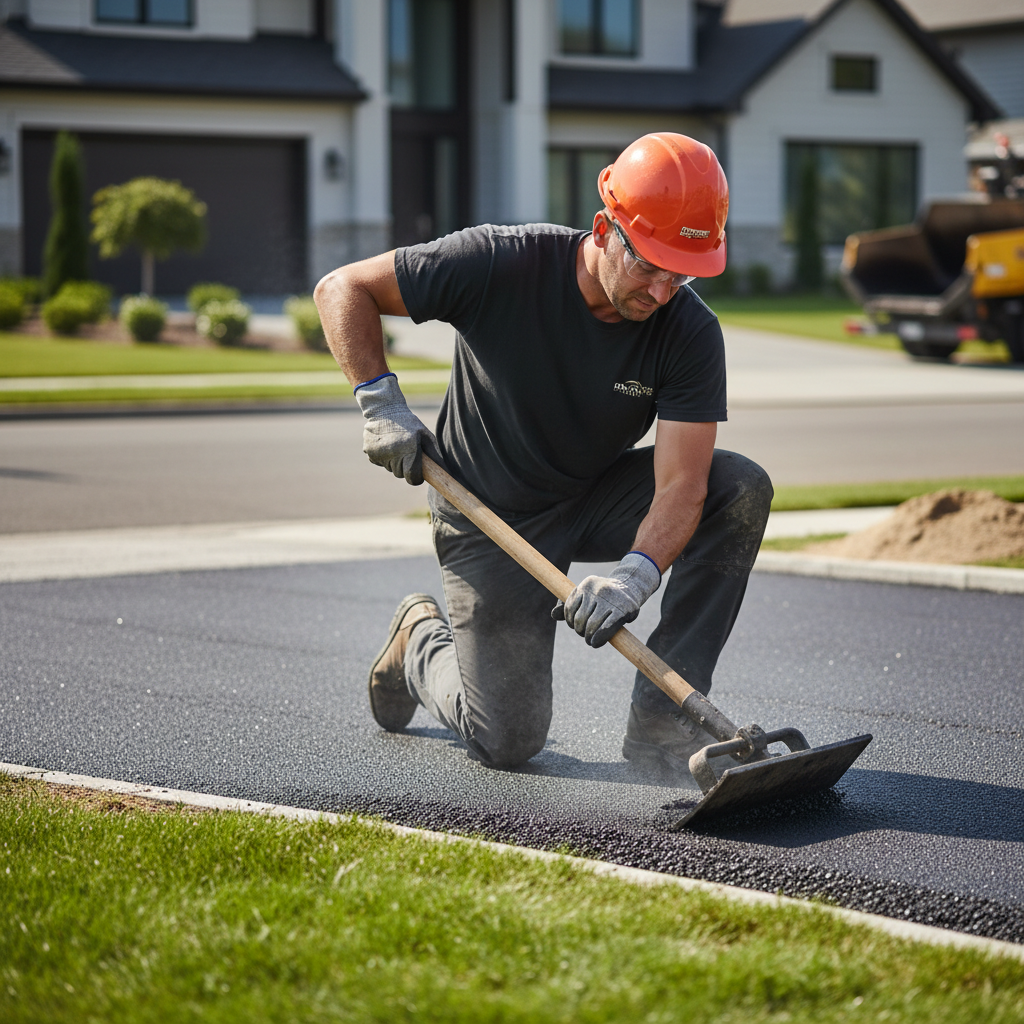
Driveway paving options and costs in Silver Berry
Silver Berry homeowners usually have three main routes for a long-lasting driveway: asphalt, interlocking pavers, or concrete. With Silver Berry’s population at 8,089 (Statistics Canada, 2021 Census), the community is small enough that driveway paving tends to cluster around the busiest late-spring to early-fall months—so timing can affect pricing. Most private driveways here serve detached houses and family garages, which means projects are commonly medium-sized and require strong subgrade prep to handle Calgary-region freeze–thaw conditions.
In this cold continental climate, frost can penetrate to about 1.2 m (4 ft). That depth isn’t just a “problem for foundations”—it drives how deep contractors must build and compact granular base, and how carefully they manage drainage. If water sits under the driveway, it expands during freezes, pushing up slabs and loosening asphalt edges. Calgary-area crews are also stretched during peak season, and that can raise labour and mobilization costs—especially for smaller jobs or sites with tighter access.
In Silver Berry, demand is especially strong on the newer residential pockets near local road access points where homeowners are upgrading from gravel or older asphalt. If you’re comparing options, the quickest way is to look at material choice and realistic maintenance needs together—then confirm your base thickness and drainage plan with a contractor before you decide.
Below is a practical cost comparison (installed) to help you budget for your Silver Berry driveway project.
| Material |
Lifespan |
Maintenance |
Best For |
Price per sq ft |
| Asphalt (new installation, proper base) |
15–25 years |
Seal every 3–5 years; patch minor cracks early |
Best balance of cost and performance on well-drained sites |
$12–$20 |
| Asphalt (overlay on existing gravel base) |
10–20 years (depends on base condition) |
Seal every 3–5 years; more frequent patching if base is unstable |
Smaller budgets where the underlay is stable and draining well |
$10–$16 |
| Interlocking concrete pavers |
25–35 years |
Replace individual stones as needed; keep edges restrained |
Curb appeal + easy repairs without tearing out the whole surface |
$18–$30 |
| Poured concrete (broom finish) |
25–35 years |
Minor joint maintenance; seal if you want extra stain protection |
Clean, modern look with strong load capacity |
$15–$25 |
| Exposed aggregate concrete |
25–35 years |
Reseal periodically if specified; keep joints in good condition |
Textured surface for traction in winter |
$20–$28 |
| Gravel / crushed stone (budget option) |
5–10 years |
Regrade and top up yearly or every 2–3 years |
Short-term solution or low-traffic pads |
$6–$12 |
Prices are estimates only and vary by project scope, site access and material selection.
What affects the price of paving in Silver Berry
In Silver Berry and across the Calgary region, it’s common to see quotes for “the same driveway” come back 30–50% apart. Most of that difference is explained by what’s happening under the surface: base preparation, drainage correction, and how much tear-out and hauling is required. A contractor may price a thin patchy base “as-is,” while another includes a properly graded granular build-up that resists freeze–thaw movement. Even when both companies use asphalt or concrete, those under-layer choices change the labour hours and the quantity of aggregate, which is where the real cost lives.
Frost line depth is decisive in this region. Calgary-area frost can penetrate to about 1.2 m (4 ft), and that means the granular thickness and compaction requirements must be planned for subgrade stabilization—not just a 2–3 inch surface fix. Deeper frost increases the need for well-graded aggregates and sufficient thickness to prevent heaving and cracking. The paving season is also compressed: hot-mix asphalt typically requires air temperatures above 10°C, so spring and summer scheduling pressure can increase demand and mobilization costs. Asphalt mix design also matters; freeze–thaw-rated mixes cost more but perform better.
Concrete costs can move up or down in Silver Berry depending on how much jointing and subbase preparation is needed. For example, a driveway that needs significant drainage slope correction or removal of old concrete can cost more than a straightforward broom-finished pour. Conversely, if your existing subgrade is already firm and well-draining, concrete can come closer to the lower end of the $15–$25 band.
Asphalt may also look cheaper on paper, but if you’re comparing paving versus overlay, make sure the base isn’t the hidden problem—overlay pricing might start in the lower end near $12–$20, yet unstable base conditions can shorten lifespan and drive repeat patching.
| Price Factor |
Why It Matters |
Cost Impact |
| Driveway area in sq ft |
Materials and production time scale directly with square footage |
Typically the largest swing; can change the total by thousands |
| Base depth required |
Frost line conditions demand thicker, well-compacted granular layers |
More aggregate, more lift thickness, and more compaction labour |
| Grading and drainage work |
Slope correction and drainage fixes prevent water pooling |
Added excavation, regrading, and sometimes underdrain costs |
| Tear-out of existing surface |
Breaking and hauling concrete or removing old asphalt adds heavy labour |
Can add significant disposal and equipment time |
| Edge restraints and curbing |
Prevents paver spread and asphalt edge failure in thaw cycles |
Extra materials and form/setting labour |
| Sealing requirement |
Asphalt needs sealing after installation and over time to protect binder |
Recurring cost; delaying it can increase future repairs |
| Site access |
Narrow lanes slow equipment movement and can restrict dump trucks |
Higher mobilization and sometimes smaller batch placement |
| Asphalt mix specifications |
Freeze–thaw rated mix improves performance against cracking and raveling |
Better mix design adds material cost and QA handling |
Permits & regulations in Alberta
In Alberta, paving a private driveway within your own property usually does not require a building permit. However, if your project touches municipal infrastructure, you should expect approval steps. Work that typically does require municipal involvement includes new curb cuts or changes to an existing curb opening, alterations to the boulevard, and anything that impacts storm drainage (for example, changing how runoff flows or modifying drainage in the road allowance). If your driveway requires changes near the road frontage or within the municipal right-of-way, confirm the required approvals with your local municipality before excavation.
Also keep in mind that some places enforce lot-grading rules that restrict how close to property lines a hard surface can be and how drainage must be directed. In Silver Berry, it’s wise to check your lot grading expectations early, because drainage corrections are one of the biggest cost drivers in the Calgary climate.
Before any excavation, always arrange utility locates through Alberta One-Call. That’s the safety and legal baseline. After you confirm the scope, you can verify a contractor properly: check the contractor’s Alberta registration/licence (if applicable for their work category) and request a certificate of insurance showing liability coverage. For workers, confirm they carry valid WSIB/WCB coverage and ask for a clearance letter or proof number. Don’t rely on a verbal “we’re covered”—ask for documentation before the crew starts.
Asphalt vs pavers vs concrete for Silver Berry driveways
For Silver Berry’s freeze–thaw winters and typical homeowner priorities, asphalt, interlocking pavers, and concrete each have a “right place.” Asphalt is usually the lowest upfront choice and can be a good fit when you want a smooth surface without the highest material cost. In Calgary-region conditions, though, asphalt needs a proper seal schedule—typically every 3–5 years—to protect against binder aging and winter surface wear from plowing and sand/salt.
Interlocking concrete pavers cost more up front (often within the $18–$30 band), but they’re highly repairable. If a section settles from water issues or a utility repair later, you can lift and re-set only the affected area rather than replacing the full driveway. That matters in a climate where water management is everything; pavers also benefit from well-planned edge restraints to keep lines tight through heave cycles.
Poured concrete (commonly in the $15–$25 band) sits in the middle for upfront cost. The key is air entrainment and proper finishing plus jointing—without those, freeze–thaw and de-icing salt can accelerate surface scaling and cracking. Exposed aggregate adds texture and traction for winter traction, but it still depends on the same foundation prep and curing discipline.
Here’s a practical dollar example: if your driveway is 400 sq ft, asphalt at the midrange of $12–$20 may land around $4,800–$8,000 installed, while pavers could push to roughly $7,200–$12,000 for the same footprint. That difference is often justified when you expect long service life, want easy future repairs, and care about curb appeal in Silver Berry’s detached-home streetscapes.
| Material |
Frost Resistance |
Curb Appeal |
Repair Method |
Lifespan |
Price Band |
| Asphalt (sealed regularly) |
Good if base is thick and drained; seal helps protect binder |
Medium (clean, uniform look) |
Patch and tack; localized milling if needed |
15–25 years |
$12–$20 |
| Interlocking concrete pavers |
Very good when edges are restrained and drainage is correct |
High (design flexibility) |
Lift/replace individual units or small sections |
25–35 years |
$18–$30 |
| Poured concrete (air-entrained) |
Good with proper air entrainment, joints, and curing |
Medium to high (depends on finish) |
Concrete patching; replace slab if widespread cracking |
25–35 years |
$15–$25 |
| Exposed aggregate concrete |
Good with correct mix + base + drainage |
High (textured, premium look) |
Section patching; often limited to affected areas |
25–35 years |
$20–$28 |
| Permeable pavers (drainage grid) |
Very good when engineered for infiltration and base is stabilized |
High (modern look) |
Lift and replace; clean/check drainage components |
25–35 years |
$22–$35 |
| Chip seal / tar-and-chip |
Fair to good short-term; relies on good drainage and frequent upkeep |
Low to medium |
Spot treatments and re-tarring; periodic refresh coats |
7–15 years |
$10–$16 |
How to choose a paving contractor in Silver Berry
Choosing the right contractor in Alberta comes down to proof and clarity. Start with licensing/registration as applicable for their scope of work, then confirm liability insurance and worker coverage. Ask for a certificate of insurance showing general liability limits and make sure the certificate lists you or your property correctly if requested. For WSIB/WCB, request evidence of coverage and, where offered, a clearance letter or proof number. If they hesitate to provide documentation before pricing, that’s a major warning sign for Silver Berry homeowners.
Next, get 2–3 itemised written quotes. You want a breakdown that separates labour from materials (and excavation/tack/aggregate base where applicable), not just a single lump sum. Pay attention to what’s excluded: disposal fees, permit handling (if any municipal approvals are needed), saw-cutting, and whether they include base re-compaction after grading changes.
Warranty should be specific: workmanship warranty length (for example, asphalt placement and compaction work) and whether the surface material has a separate manufacturer warranty. Ask if warranties are transferable to new owners and what conditions void coverage (poor sealing, altered drainage, adding weight too soon).
Finally, payment schedule matters. Never agree to paying more than about 10–15% upfront. Hold back a portion until completion and final cleanup. Get your timeline in writing too—start date and a completion estimate—because in Calgary-area weather, delays can push curing or finishing windows.
- Ask for their past local projects in the Calgary region and similar driveway sizes
- Confirm they include full subgrade inspection and compaction testing (or documented compaction process)
- Require a written base build-up thickness and aggregate type (well-graded, not “whatever’s there”)
- Insist on a drainage plan: slope, edge drains (if needed), and no water routing onto neighbours’ property
- Clarify tear-out limits: what gets removed and where disposal goes
- Check for edge restraint details (especially for pavers) to prevent movement in spring thaw
- Ask how joints/controls are planned for concrete (spacing and reinforcement details)
- Confirm asphalt mix specification is freeze–thaw appropriate for the Calgary market
- Get the exact sealing plan for asphalt: timing after install and expected frequency
- Review what’s included in site access (hoses, small equipment, traffic control if needed)
- Ensure cleanup and final grading are part of the contract, not “extra if we get time”
- Verify warranty start date, coverage scope, and what maintenance you must do to keep it valid
In Silver Berry, red flags I commonly see include: (1) quotes that skip granular base thickness details, (2) promises of “no need for sealing” on asphalt, (3) vague warranty wording that only covers “materials,” (4) contractors who won’t show proof of liability insurance/WSIB coverage, and (5) no written schedule or no clear scope exclusions for disposal and drainage correction.
Frequently asked questions — paving in Silver Berry
How often should I seal my asphalt driveway?
In Silver Berry and the Calgary region, asphalt sealing is mainly about protecting the binder from winter wear, moisture intrusion, and the freeze–thaw cycle. For most properly built driveways, homeowners should plan to seal about 6–12 months after installation (once the asphalt has cured), then again every 3–5 years depending on traffic, sun exposure, and how much you plow or sand/salt. If you delay sealing, fine surface raveling and small cracks can widen and then turn into patchwork. Sealing also helps your contractor’s long-term repair strategy—spot repairs work far better when water can’t get underneath the surface.
Why does my driveway crack and heave in winter?
Cracking and heaving in an Alberta driveway almost always trace back to water and movement under the surface. In this climate, frost can penetrate deeply, and repeated freeze–thaw causes subgrade expansion. If the driveway base is too thin, poorly graded, or not compacted, it won’t resist pumping and loss of support. Poor drainage is a big culprit too—if the slope is wrong or runoff is routed toward the slab, water collects during shoulder seasons and then expands during freezes. De-icing salt can also contribute to surface deterioration, especially on concrete that isn’t air-entrained. Fixing the base and drainage in the quote is what separates long-term performance from repeat repairs.
Do I need a permit to pave my driveway in Alberta?
For most Silver Berry homeowners, paving a driveway on private property typically doesn’t require a building permit. The situation changes when work affects the municipal right-of-way—for example, a new or modified curb cut, changes to the boulevard, or modifications that impact storm drainage. In those cases, municipal approval is usually required. Since rules can vary by municipality, the safest approach is to ask your contractor to confirm whether any approvals are needed based on your exact frontage and drainage plan, and then verify with the municipality. Regardless of permitting, always arrange utility locates through Alberta One-Call before excavation.
How long before I can drive on new asphalt?
After asphalt is placed, it needs time to cool and set so tires don’t leave marks or displace aggregates. In practice, many driveways are ready for light vehicle traffic the same day or within about 24 hours, but this depends on mix type, weather, and compaction. If temperatures are cool or damp, the wait can be longer. The best indicator is whether the surface has cooled sufficiently and whether the contractor has finished compaction roller passes and any edge work. If your contractor is offering a “rush,” ask how they handle curing and whether they expect the driveway to be fully protected. If you’re budgeting, many Silver Berry homeowners are in the $12–$20 asphalt range, and proper curing is part of what you’re paying for.
What causes potholes and how are they repaired?
Potholes form when water gets into a failure point—often around cracks, joints, or weak edges—then freezes and thaws, pulling material loose. In Calgary-area winters, that cycle can turn a small crack into a hollow spot quickly, especially where plowing creates stress. For repair, contractors typically remove the loose asphalt to reach stable material, clean the edges, tack the base (if asphalt), then patch with hot mix and compact properly. On bigger failures, milling and re-paving a section is more durable than a thin patch. The best long-term prevention is sealing on schedule and addressing small cracks early, before water starts undermining the driveway.
How do I prepare for a paving project?
Preparation in Silver Berry is mostly about access, protection, and decisions that affect drainage. Clear the driveway area of vehicles and stored items, and let your contractor know where you want runoff directed (and where it must not go). Remove planters or barriers that are in the way of excavation or equipment. If you have pets, arrange care so crews can work without interruptions. Ask your contractor what they need for utility locate marks and whether any municipal approval is required (especially near curb/boulevard areas). Review the written scope: disposal included? tear-out limits? sealing plan timing? For homeowners comparing budgets, it’s also smart to align your expectations with the likely price band—many asphalt projects fall around $12–$20, while premium paver work often lands in $18–$30—because your preparation and base/drainage requirements directly influence the final total.