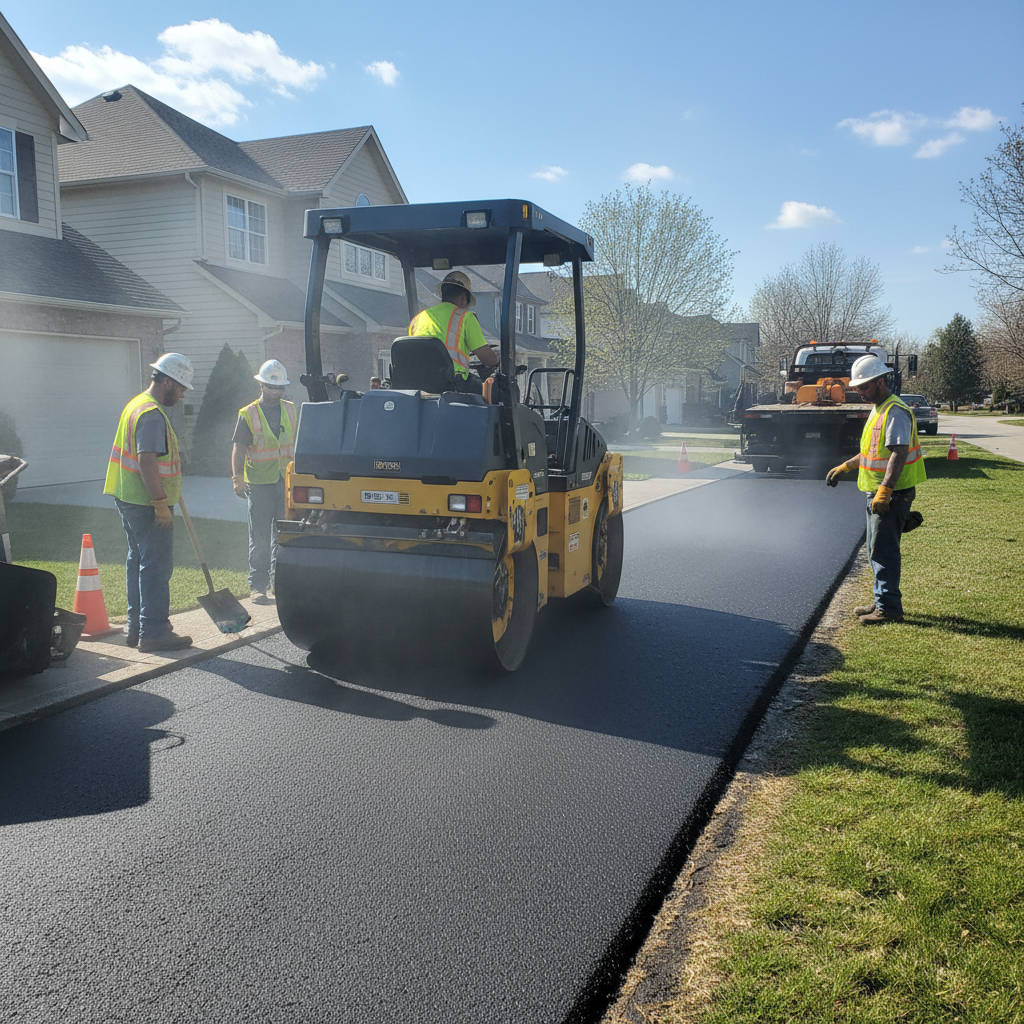
Driveway paving options and costs in Rimbey
Rimbey homeowners typically have a few solid driveway paving routes to choose from, and the “right” one usually comes down to frost performance, maintenance tolerance, and curb appearance. With 2,470 people (Statistics Canada, 2021 Census) and a housing mix where 69.9% of dwellings are single-detached homes, most driveways are designed to serve a detached house and need a hard surface that survives Alberta’s freeze-thaw cycles. That’s especially relevant because 49.3% of homes in the area were built before 1981 (Statistics Canada, 2021 Census), so many streets and lots have older base and drainage patterns that may need upgrading before asphalt or pavers will perform long-term.
In the Red Deer economic region, pricing is strongly influenced by frost action. Practical field work often includes more excavation and a thicker, well-compacted granular base—plus better drainage—to reduce heaving and edge cracking. The paving season is also tighter than in milder markets, so crews and asphalt plant output can be booked quickly in spring and early summer, which affects scheduling and can push pricing upward during peak weeks. Demand is particularly noticeable in established residential areas around the downtown/Rimbey core and along commonly used access routes into neighbourhoods on the outskirts, where driveways tend to be longer and equipment access is tighter.
Below is a realistic comparison of common driveway options and typical cost ranges you’ll see from contractors in Rimbey, using Red Deer-area expectations for base prep and materials.
| Material |
Lifespan |
Maintenance |
Best For |
Price per sq ft |
| Asphalt (new installation, proper base) |
15–25 years |
Seal coat every 3–5 years; patching as needed |
Strong value with good ride quality when base/drainage are corrected |
$8.50–$14.50 |
| Asphalt (overlay on existing gravel base) |
10–18 years |
Seal coat more frequently; more patching possible |
Budget-focused upgrades where base is still serviceable |
$6.50–$10.50 |
| Interlocking concrete pavers |
25–40 years |
Re-leveling small sections; occasional re-sanding |
Curb appeal and easy spot repairs without tearing out the whole driveway |
$16.00–$24.00 |
| Poured concrete (broom finish) |
25–35 years |
Sealant as needed; crack monitoring and patching |
Low visual fuss with a solid, durable surface for winters |
$12.00–$19.00 |
| Exposed aggregate concrete |
25–35 years |
Sealant to maintain appearance; crack patching if needed |
Slip resistance and upgraded appearance |
$13.50–$21.00 |
| Gravel / crushed stone (budget option) |
3–10 years |
Annual re-grading; top-ups; weed control |
Lowest upfront cost where drainage is managed |
$3.50–$6.00 |
Prices are estimates only and vary by project scope, site access and material selection.
What affects the price of paving in Rimbey
In Rimbey, you’ll often see quote differences of 30–50% for what looks like the “same” driveway, and it usually comes down to how each contractor sizes the job for Alberta’s frost-and-drainage reality. Two driveways with the same square footage can cost very differently if one lot needs deeper excavation, a better-drained base, or significant tear-out. In the Red Deer region, frost action is a design factor—not a minor detail—so deeper frost requirements push crews toward thicker, compacted granular base and careful grading to prevent heaving and cracking.
Asphalt pricing can also swing with timing. Hot-mix asphalt generally requires warm air temps (commonly above 10°C), and the shorter central Alberta season concentrates demand. When schedules tighten, plant utilization and labour availability increase costs. Mix design matters too: freeze-thaw-rated asphalt spec costs more than generic mixes because of binder and aggregate choices that help it tolerate repeated expansion/contraction.
Concrete costs are affected by the same groundwork but can shift based on details like reinforcement, control joint layout, and air-entrainment. For example, a driveway over older, frost-prone fill may need extra base and subgrade stabilization before any concrete is poured—adding work that can push a project from the mid-range into the upper end. Conversely, a newer lot with stable soil and good drainage may let contractors stay closer to the lower end of the typical asphalt band of $5,500 – $12,000 for asphalt driveway paving or use concrete closer to the $8,500 – $18,000 band.
| Price Factor |
Why It Matters |
Cost Impact |
| Driveway area in sq ft |
Surface area drives material quantity and paving time |
Largest driver; linear pricing effect |
| Base depth required |
Frost protection depends on granular thickness and compaction |
Deeper excavation increases hauling and material costs |
| Grading and drainage work |
Proper slope prevents water from sitting under the surface |
Can add significant labour and granular/pipe costs |
| Tear-out of existing surface |
Old asphalt/concrete may need breaking, removal, and disposal |
Equipment time + dump fees + patching make it jump |
| Edge restraints and curbing |
Pavers need confinement; asphalt needs stable edges to resist raveling |
Improves longevity but adds forms, materials, and labour |
| Sealing requirement |
Asphalt performs best with timely seal coats |
Shortens or extends life; impacts long-term budgeting |
| Site access |
Narrow lots slow skid steer/roller movement and affect staging |
Higher labour hours and potential equipment changes |
| Asphalt mix specifications |
Freeze-thaw-rated mixes improve resilience in Alberta winters |
Upcharges for binder/aggregate spec |
Permits & regulations in Alberta
In Alberta, paving a private driveway on your own property is often done without a building permit, especially when the work is confined to the yard surface and doesn’t alter municipal infrastructure. However, work in the municipal right-of-way typically requires municipal approval. That includes situations like building or changing a curb cut/apron where it meets the boulevard, altering storm drainage patterns, or modifying existing catch basins/ditches that service the street.
In practice for Rimbey homeowners, the safe approach is to assume municipal approval is needed whenever you touch anything in the boulevard area (the strip between your property line and the road). Some municipalities also have lot-grading or surface-water management expectations that restrict how close hard surfaces can be to property lines and how runoff must be directed—especially where neighbouring lots slope toward each other.
Utility locates are non-negotiable before excavation. Call Alberta One-Call (your locator service) so underground services are marked prior to removing the old base. Then, confirm contractor compliance: ask for a copy of their Alberta business licence/registration details, liability insurance certificate, and proof of WCB coverage (WCB/coverage clearance letter). You should also confirm whether their policy lists you as “additional insured” for your project and verify the certificate dates match your start window. If a contractor can’t provide documentation quickly, that’s usually a red signal—particularly for excavation and base work that penetrates deeper layers.
Asphalt vs pavers vs concrete for Rimbey driveways
For Rimbey’s freeze-thaw winters and typical plowing/sanding routine, asphalt, interlocking pavers, and concrete can all work well—but they perform differently under edge movement and repeated moisture cycling. Asphalt is typically the lowest upfront option and gives a smooth ride, but it relies on correct base prep and needs periodic sealing (commonly every 3–5 years). If the granular base and drainage are weak, Alberta’s freeze-thaw cycles can bring cracking and raveling sooner.
Interlocking concrete pavers have the highest upfront cost, but they shine where you want curb appeal and easy repairs. If you have a localized settlement spot from water or a utility patch, pavers can be lifted and rebuilt without tearing up the whole driveway. That’s a practical advantage in older Rimbey areas with established drainage patterns. Poured concrete sits in the middle: it’s durable and can last decades, but freeze-thaw resistance depends heavily on proper air-entrainment, finishing method, and joint strategy. De-icing products and winter traffic can widen cracks if the concrete mix and joints aren’t specified for Alberta conditions.
In Red Deer-region pricing, the justification often looks like this: an asphalt driveway commonly lands in the $5,500 – $12,000 band, while pavers frequently move into the higher end (often closer to the upper driveway paving tier). That difference is worth it when you value long-term, repairable performance and a premium appearance. If your priority is solid performance with predictable maintenance and you’re okay budgeting seal coats, asphalt can be the best match.
| Material |
Frost Resistance |
Curb Appeal |
Repair Method |
Lifespan |
Price Band |
| Asphalt (sealed regularly) |
Good with proper base and freeze-thaw mix |
Moderate |
Cut-and-patch localized sections |
15–25 years |
$5,500 – $12,000 |
| Interlocking concrete pavers |
Excellent when base is properly compacted and well-drained |
High |
Lift/replace affected paver sections |
25–40 years |
$9,000 – $22,000 |
| Poured concrete (air-entrained) |
Good with air-entrained mix and correct joints |
Moderate to High |
Crack repair/patch; large sections may require more work |
25–35 years |
$8,500 – $18,000 |
| Exposed aggregate concrete |
Good with correct mix and drainage |
High |
Targeted patching; noticeable colour match may matter |
25–35 years |
$9,500 – $19,500 |
| Permeable pavers (drainage grid) |
Very good if installed with engineered subdrainage |
High (design dependent) |
Replace affected grid/pavers; flush/maintain drainage channels |
20–35 years |
$10,500 – $24,000 |
| Chip seal / tar-and-chip |
Fair for heavier loads; depends on maintenance |
Low to Moderate |
Spot top-ups and re-cover coats |
7–12 years |
$6,000 – $11,000 |
How to choose a paving contractor in Rimbey
Choosing a contractor in Rimbey is mostly about verifying three things before you talk design: Alberta compliance, jobsite capability, and whether their quote matches the real scope. First, verify their Alberta licensing/registration status, and ask for a current certificate of liability insurance. For work involving excavation, base hauling, and forming, make sure they also have WCB coverage (or a clearance letter showing coverage status). When you receive documents, check they’re current for the projected work dates—not expired paperwork.
Next, ask for 2–3 itemised written quotes. You want line items that separate excavation and disposal, granular base depth and compaction, any drainage/grading corrections, removal of the existing surface, trucking, asphalt/concrete/pavers supply, and finishing/sealing. Avoid “lump sum” quotes without a scope—especially where frost protection is involved, because that’s where cost differences usually hide. Confirm what’s excluded: permit pulls (if any), utility locate costs, dump fees, landscape restoration, and whether restoration includes seeding/sod or just backfill. Ask whether materials are quoted with the right spec for freeze-thaw performance.
For warranty, request the workmanship warranty length in writing, plus any product/manufacturer warranty terms. Clarify if warranties are transferable if you sell the home. Payment should be staged: never pay more than 10–15% upfront, and keep a holdback until final cleanup and punch-list completion. Get a start date and a completion estimate in writing, because Alberta’s shorter season can delay work if staging isn’t managed.
- Ask for their Alberta registration/licence details and confirm the business name matches the quote.
- Provide a certificate of liability insurance with coverage limits suitable for paving/excavation.
- Confirm WCB coverage with a clearance letter for your project dates.
- Get 2–3 itemised quotes with base depth, drainage scope, and disposal listed.
- Require site conditions notes: soil type, drainage observations, and any stabilization plan.
- Confirm whether utility locates are scheduled and who pays for locates.
- Ask what’s included in tear-out: breaking, hauling, and dump fees.
- For asphalt, confirm seal coat timing and whether a first seal is included or recommended.
- For pavers, confirm edge restraints, bedding sand type, and polymeric sand (if used).
- Verify slope and runoff plan to avoid water pooling near garages and house foundations.
- Review warranty: workmanship term, exclusions (acts of God/settlement), and claim process.
- Use a payment schedule with a holdback until final grading, clean-up, and any repairs are complete.
Red flags I see in Rimbey include contractors who won’t discuss base thickness or drainage design, quotes that ignore frost protection and only “count square feet,” missing insurance/WCB documentation, vague warranty language, and requests for large upfront payments without a written schedule and scope.
Frequently asked questions — paving in Rimbey
What is a driveway apron and do I need one in Rimbey?
An apron is the sloped section that transitions between your driveway and the road/boulevard area—often where a curb cut is formed or where the driveway meets the ditch/boulevard profile. In Rimbey, whether you “need” it comes down to how your driveway currently drains and how the boulevard is graded. If you’re changing the driveway approach at the road edge, municipal approval is commonly required because you may be altering the right-of-way and potentially storm drainage. If you’re only resurfacing within your property limits, you usually don’t need a new apron. Practically, a properly built apron helps reduce erosion and washboarding, which is important in Alberta freeze-thaw cycles where water movement contributes to base failure.
How do I maintain my driveway through Rimbey winters?
In Rimbey winters, maintenance is mostly about controlling water and avoiding mechanical damage. Start with winter clearing: plow early and keep the cutting edge off the surface to prevent gouges, especially on asphalt and pavers. Sand is usually safer than aggressive de-icing salts for protecting the surface finish; salts can accelerate deterioration on some materials. After freeze-thaw transitions, do a quick inspection for soft spots, edge lift, and widening cracks—small issues are much cheaper to patch than letting water get under the base. If you have asphalt, plan for sealing on a cycle of about every 3–5 years (timing depends on how much sand/salt you use and traffic load). If you see recurring ponding, address drainage immediately—fixing water issues is often more cost-effective than repeated surface repairs.
Is it worth sealing a new driveway right away in Rimbey?
For a new asphalt driveway in Rimbey, sealing “right away” isn’t usually the best idea. Fresh asphalt needs time to cure so the seal coat can adhere properly. Many contractors recommend waiting until the asphalt has cured and the surface is ready for sealing—often after about 6–12 months, depending on weather and mix. When you seal too early, you can trap moisture and reduce adhesion, which can shorten lifespan. The decision is still worth it because proper sealing protects against oxidation, water penetration, and surface raveling during freeze-thaw cycling. As a ballpark, asphalt driveway work in Rimbey often falls within the $5,500 – $12,000 range, and budgeting for routine sealing maintenance is typically cheaper than replacing failed asphalt later.
What is a chip seal driveway and is it suited to Rimbey?
Chip seal (also called tar-and-chip) is a surface treatment where asphalt binder is applied and covered with aggregate chips, then rolled. It can work as an economical driveway solution, particularly where you want a lower upfront cost, and where traffic loads are moderate. In Rimbey’s Alberta climate, chip seal can be more maintenance-sensitive than asphalt or pavers—freeze-thaw cycles and plowing can loosen chips over time if the base isn’t well-prepared and well-drained. If your driveway will see heavy vehicles regularly, chip seal may not be your best long-term value. The typical cost band for chip seal driveway approaches can land roughly in the $6,000 – $11,000 range, but you should expect spot top-ups rather than “set-and-forget.” A contractor should start with base and drainage corrections first to help it last.
How much does driveway crack repair cost in Rimbey?
Crack repair pricing in Rimbey depends on how wide the crack is, whether water is tracking underneath, and whether it’s a surface-only issue or indicates base movement. For many homeowners, crack repairs fall into the sealing and repair band of $500 – $3,500, especially when the work is limited to crack routing/cleaning and sealing plus small localized patching. Larger, alligator-style cracking or multiple failed areas usually means the driveway needs more than simple sealing—often a patch-and-overlay approach. The biggest cost lever is whether the contractor can correct the drainage problem that caused the cracking. If you keep patching without improving water flow, freeze-thaw cycling will reopen cracks. Getting an on-site assessment is the fastest way to separate minor surface repair from base-related rehabilitation.
What base thickness do I need for pavers in Rimbey?
For pavers in Rimbey, base thickness is driven by frost protection and drainage—not just the paver “system” itself. In central Alberta freeze-thaw conditions, contractors typically design for deeper, well-compacted granular layers so the subgrade doesn’t heave and push the paver edges up over time. A common practical target is a granular base in the range of about 4–6 inches for many lighter applications when drainage is excellent, but deeper base and undercut/stabilization are often required when soils are weaker, water is present, or the existing base is not reliable. If your driveway is on older fill or has a history of ponding near the garage approach, expect the contractor to excavate deeper. The best way to confirm your exact thickness is a site assessment that checks subgrade stability and drainage flow—because for pavers, the base is what determines lifespan, not the surface alone.