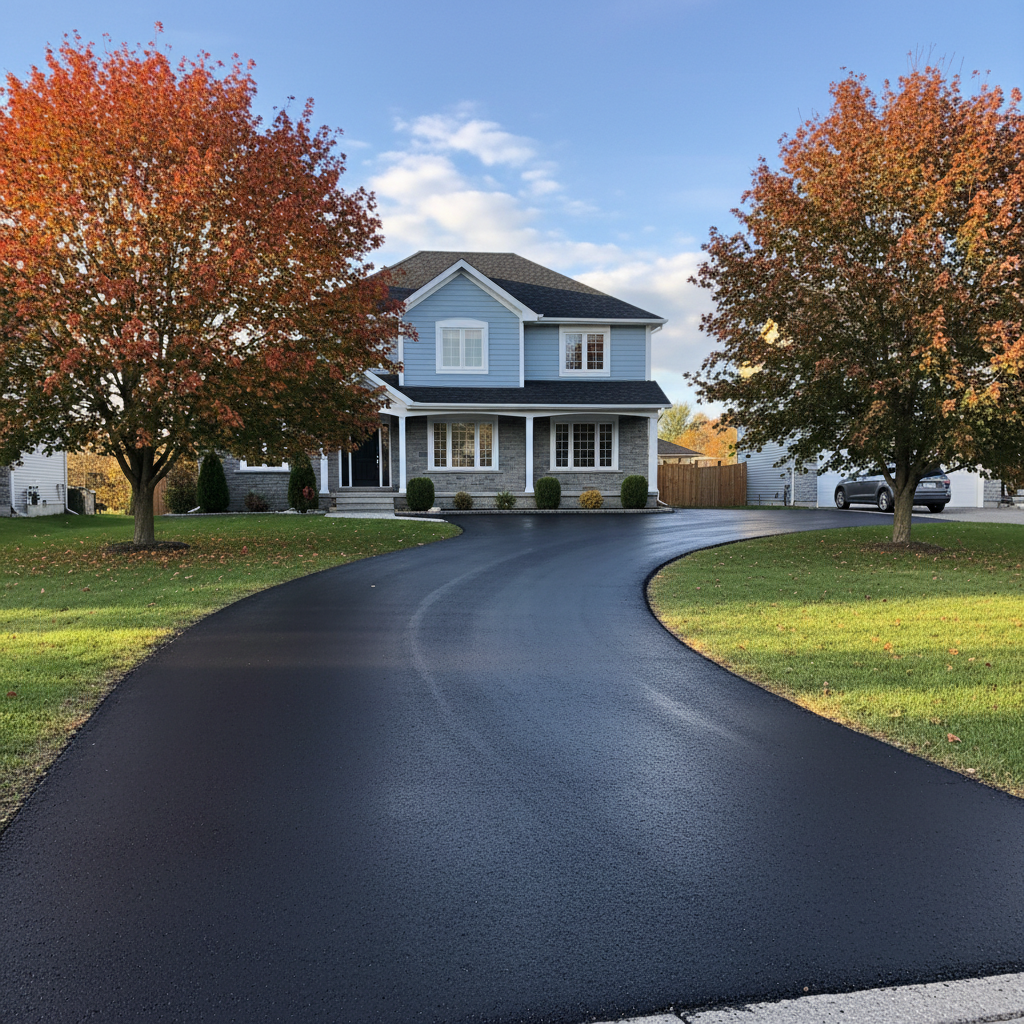
Driveway paving options and costs in Didsbury
Didsbury homeowners usually have three practical driveway directions: asphalt for value, interlocking pavers for appearance and patchability, and concrete for a longer, more rigid slab. In Didsbury’s housing stock, single-detached homes make up 71.7% of dwellings, and 79.0% of households are homeowner households (Statistics Canada, 2021 Census). That matters because most private driveways tied to detached homes benefit from proper base construction and good edge support—especially on sites built up over older soils.
In the Calgary economic region, pricing is shaped by the cold continental climate and a frost line that can reach about 1.2 m (4 ft). Freeze–thaw cycles move moisture through the subgrade, so contractors typically build a deeper, well-graded granular base and focus on positive drainage. The paving season is also compressed: hot-mix asphalt generally needs air temperatures above 10°C to place and compact properly. In peak spring and early summer, that tighter scheduling can raise per-job labour and mobilization costs, particularly for smaller driveways where crews are already stretched.
Demand is especially steady around older core areas and established neighbourhoods where many properties were built before 1981 (43.8% of homes). Updating driveways in these areas often means tear-out, grading corrections, and improved runoff control before asphalt or pavers go down. From there, it’s mostly a question of what you want to pay for upfront versus what you’ll budget for later maintenance.
The comparison table below shows typical ranges for common driveway choices in Didsbury.
| Material |
Lifespan |
Maintenance |
Best For |
Price per sq ft |
| Asphalt (new installation, proper base) |
15–25 years |
Sealcoat every 3–5 years; spot crack repair |
Best value where drainage and base are done right |
$3.50–$6.00 |
| Asphalt (overlay on existing gravel base) |
12–20 years |
Sealcoat every 3–5 years; re-stone/patch low spots |
When you’re upgrading a basic gravel pad with minimal demo |
$2.75–$5.25 |
| Interlocking concrete pavers |
25–35 years |
Rinse/weed control; lift-and-relay for localized repairs |
Curb appeal and easy access to subgrade repairs |
$6.00–$9.50 |
| Poured concrete (broom finish) |
25–40 years |
Joint maintenance; seal if desired; crack monitoring |
Stable, uniform surface where expansion joints are planned |
$4.50–$8.25 |
| Exposed aggregate concrete |
25–35 years |
Seal if specified; periodic cleaning; patching as needed |
Premium look with slip resistance |
$6.50–$10.75 |
| Gravel / crushed stone (budget option) |
3–10 years |
Top-ups; regrading; weed control; periodic re-compaction |
Lowest upfront cost before you upgrade later |
$1.50–$3.00 |
Prices are estimates only and vary by project scope, site access and material selection.
What affects the price of paving in Didsbury
Even when two neighbours in Didsbury describe the “same” driveway, it’s common to see quotes differ by 30–50% across the Calgary area. The biggest drivers aren’t the surface material alone—they’re what’s happening underneath: how much base depth is required, whether drainage has to be corrected, and how difficult it is to remove and haul away the old surface. Labour and equipment availability also matters; because the paving season is short and weather-dependent, contractors often price peak months with higher mobilization risk and scheduling demand.
Frost line depth and freeze–thaw cycles are decisive cost factors in the Calgary region. Frost can penetrate to around 1.2 m (4 ft), and repeated freezing and thawing can lift moisture-bearing subgrade. To prevent heaving, cracking, and surface raveling, you typically need a thicker, well-graded granular base and a properly sloped build-up with positive drainage. That’s why a driveway that’s simply “repaved” in a milder climate may require more excavation and granular import here. Asphalt also has mix design expectations for freeze–thaw performance, and cold-weather placement rules matter: hot-mix asphalt generally needs suitable air temperature (often above 10°C) to compact well.
Concrete examples that affect Didsbury pricing: an older property built before 1981 may have settlement or poor roadside grading that forces extra base replacement and joint layout changes (many of those homes sit on less uniform backfill). If you’re switching from gravel to asphalt, bringing the base up to spec may move the job into the mid-range of the Asphalt driveway paving band ($12–$20). If you want pavers, the extra labour of bedding, edging, and setting blocks usually aligns with the Interlocking pavers band ($18–$30), but it’s often easier to repair later without full replacement—useful on sites where ploughing or water runoff creates localized failures.
| Price Factor |
Why It Matters |
Cost Impact |
| Driveway area in sq ft |
Material and compaction time scale directly with surface area |
Typically the largest line item |
| Base depth required |
Frost protection depends on granular thickness and proper compaction |
Can swing total cost by tens of percent |
| Grading and drainage work |
Fixing low spots, adding slope, and correcting runoff prevents future heaving |
Common add-on on uneven lots |
| Tear-out of existing surface |
Old asphalt/concrete removal increases labour and hauling disposal costs |
Often adds significant cost on mature driveways |
| Edge restraints and curbing |
Edges hold pavers and prevent migration/spread |
Modest for asphalt; larger for paver installs |
| Sealing requirement |
Asphalt needs sealcoat after curing (often within 6–12 months) |
Adds a future maintenance budget item |
| Site access |
Tight lots slow down equipment movement and may require smaller gear |
Can raise labour rates per hour |
| Asphalt mix specifications |
Freeze–thaw-rated mixes may cost more but perform better in winter |
Shifts material cost upward |
Permits & regulations in Alberta
In Alberta, paving a private driveway within your own property typically does not require a building permit. That usually includes the driveway surface itself and any work entirely inside your lot lines—like removing old asphalt, excavating for base, and installing new asphalt, pavers, or concrete. However, work in the municipal right-of-way may require municipal approval. That’s the category to watch: if your project includes new curb cuts, changes to the boulevard area, or altered storm drainage, you should expect a permitting/approval process through the municipality.
Some areas also enforce lot-grading rules that affect how close a hard surface can be to property lines and how runoff is directed during spring melt and rain events. Before excavation, every homeowner should arrange utility locates through Alberta One-Call. That step protects you and the contractor, because driveway excavation can hit service lines even when the location “seems obvious.”
To verify a contractor in Didsbury step-by-step, start with their Alberta business and licensing details (where applicable), then request updated liability insurance and confirm their coverage for workers through WSIB/WCB. Ask for a clearance letter/certificate of coverage showing active status. You can check the contractor’s online registry entry (where they publish their status), review the date and address on their certificate of insurance, and verify coverage details on their proof documents before any work starts. A reputable paving company will share paperwork quickly and clearly.
Asphalt vs pavers vs concrete for Didsbury driveways
For Didsbury’s freeze–thaw winters, the “best” driveway material depends on how you balance upfront cost, maintenance comfort, and repair flexibility. Asphalt is typically the lowest upfront option, and with proper base preparation it performs well for years. The trade-off is maintenance: sealing is usually recommended every 3–5 years to protect the binder from water intrusion and winter damage. Interlocking concrete pavers cost more to install, but they offer the highest curb appeal and the best repair practicality—if a section fails due to drainage or settlement, you can lift and rebuild that area instead of replacing the whole driveway.
Poured concrete sits in the middle on cost and can last decades when done with air-entrainment, correct joint spacing, and good drainage. But like any rigid surface, concrete is more sensitive to foundation movement. In Calgary-area frost conditions (frost can reach about 1.2 m), both asphalt and concrete need properly compacted, well-graded granular bases. If drainage is off—common on older lots—water gets trapped, freezes, and lifts the subgrade. Pavers can tolerate localized fixes, while asphalt may develop cracks that need sealing and targeted crack repair.
Winter maintenance also matters. If you regularly plough or shovel and use sand/ice melt, a well-designed asphalt or paver base with strong edge support will generally hold up well. Concrete can be durable, but it needs correct air entrainment and joint detailing to manage freeze–thaw expansion. As a rough example of where the price difference can be justified: if asphalt pricing lands in the $12–$20 per sq ft band and pavers land in the $18–$30 band, paying the premium can make sense when you want long-term curb appeal and easier partial repairs after a driveway apron or drainage adjustment.
| Material |
Frost Resistance |
Curb Appeal |
Repair Method |
Lifespan |
Price Band |
| Asphalt (sealed regularly) |
Good when base and drainage are built to spec |
Medium |
Mill/patch or crack seal + patch |
15–25 years |
$12–$20 |
| Interlocking concrete pavers |
Very good with proper bedding and edge restraint |
High |
Lift, re-grade/rebed, and relay localized sections |
25–35 years |
$18–$30 |
| Poured concrete (air-entrained) |
Good when joints and drainage are engineered |
Medium |
Section replacement for major failures; crack repair for smaller issues |
25–40 years |
$15–$25 |
| Exposed aggregate concrete |
Good to very good with correct mix and curing |
Very high |
Patch/replace affected areas; limited pattern matching |
25–35 years |
$18–$32 |
| Permeable pavers (drainage grid) |
Excellent when designed for infiltration/controlled runoff |
High (design-forward) |
Localized paver replacement; inspect drainage layers |
20–35 years |
$22–$38 |
| Chip seal / tar-and-chip |
Moderate; depends heavily on base quality and thickness |
Low to medium |
Top-up reseal and spot patch |
7–15 years |
$8–$16 |
How to choose a paving contractor in Didsbury
Choosing the right contractor is the fastest way to protect your investment in Didsbury. Start with verification: ask for proof of an Alberta business presence, liability insurance, and WSIB/WCB coverage for workers. How to check each is simple—request certificate(s) of insurance showing active coverage and matching business name/address, then verify the WSIB/WCB status with the clearance letter or proof of coverage dated within the last few weeks. If a contractor can’t provide documents promptly, treat that as a major warning sign.
Next, get 2–3 itemised written quotes. You want a breakdown that includes labour and materials separately—especially excavation, granular base, asphalt mix or concrete material, edging/restraints, compaction, and disposal. Avoid “lump sum only” quotes unless the scope is extremely detailed.
Read the scope line-by-line. Ask what’s included (permit pull if needed for right-of-way work, disposal of old asphalt/concrete, whether grading and drainage corrections are part of the base bid, and whether they’re supplying the correct number of compacted lifts). Warranty also matters: confirm the workmanship warranty length, whether it covers full base/subbase issues or only surface defects, and whether manufacturer product warranty is separate. Payment should stay controlled—never pay more than 10–15% upfront, with a holdback until the job is fully complete and cleaned up. Finally, insist on a start date and completion estimate in writing so you’re not left waiting out the short paving window.
- Ask for their WSIB/WCB clearance letter (active coverage for the crew).
- Confirm liability insurance limits and match them to the certificate date.
- Get a written scope: excavation depth, base type, and compaction requirements.
- Request a drainage plan note (slope targets, low-spot corrections, runoff direction).
- Ensure disposal/haul-away is explicitly included for tear-out.
- Verify edging/restraints are included (especially for pavers).
- For asphalt, ask when sealcoat will be applied and whether it’s scheduled after curing (often within 6–12 months).
- Confirm concrete is air-entrained and joint spacing is specified.
- Ask about frost-focused practices: well-graded aggregates and compaction lift thickness.
- Get a detailed timeline tied to weather readiness for Didsbury’s season.
- Require an itemised quote with labour + materials (not only a single total).
- Check warranty terms in writing: length, what’s covered, and claim process.
In Didsbury, common red flags include: vague scope language (“we’ll do the base properly” without depth specs), missing WSIB/WCB or outdated insurance certificates, quotes that exclude tear-out/disposal without warning, no mention of drainage or frost protection (just “pave over it”), and pressure to pay most of the money upfront before the base is built and inspected.
Frequently asked questions — paving in Didsbury
Can asphalt be laid in cold weather in Didsbury?
In Didsbury, asphalt placement in cold weather is usually where jobs go wrong. Hot-mix asphalt needs suitable air temperatures for proper placement and compaction—often requiring conditions above about 10°C—so the paving season typically runs late spring through early fall. If it’s too cold, the mix can cool before it’s compacted, which leads to weak spots, faster moisture damage, and earlier cracking. Because frost penetrates deeply in the Calgary area (about 1.2 m), the contractor also needs the subgrade to be stable and not frost-affected. A reputable company will only proceed when weather and ground conditions are right, and they’ll explain any limitations in writing rather than rushing to meet a date.
What is a driveway apron and do I need one in Didsbury?
A driveway apron is the transition area between your driveway and the adjacent curb/boulevard section—often where water runoff and vehicle entry meet the municipal sidewalk/road edge. Whether you “need” one depends on your lot and how your driveway ties into the frontage and drainage patterns. If your project involves changes near the right-of-way, like a curb cut adjustment or altered storm drainage, approvals may be required and the apron detail becomes important for safe, smooth entry and to reduce edge breakdown. In many Didsbury situations, the contractor will propose an apron design to prevent raveling at the first wheel path and to keep meltwater from undermining the edge. Confirm requirements with the municipality and have the contractor spell out whether apron work is included in the scope.
How do I maintain my driveway through Didsbury winters?
Winter maintenance in Alberta is mostly about limiting water intrusion and protecting the surface edges. For asphalt, keep the surface free of ruts and standing meltwater; remove sand buildup in spring so drainage pathways don’t clog. Use ice melt carefully: avoid aggressive salt application directly into cracks and joints more than necessary, because repeated moisture and freeze–thaw can widen defects. For concrete, don’t let sand/ice melt pool against expansion joints. For pavers, focus on edge stability—if you see any lifting or soil washing out, address it early so water doesn’t reach the base. A simple schedule works: clean in spring, inspect after freeze–thaw periods, and budget for preventative maintenance (like crack repair and, for asphalt, sealcoat often within 6–12 months and then every 3–5 years).
Is it worth sealing a new driveway right away in Didsbury?
For asphalt, sealing “right away” is usually not the goal; curing timing is. Most contractors recommend sealing after the asphalt has sufficiently cured—commonly within a 6–12 month window depending on weather, mix design, and how quickly the surface dries out and stabilizes. Sealing too early can trap moisture and accelerate binder breakdown. That said, sealing is typically worth the cost because it helps protect the binder from water penetration and freeze–thaw damage. In practice, homeowners in Didsbury often plan for sealcoating as part of lifecycle costs rather than skipping it. If you’re choosing between options, remember asphalt installation may land around the $12–$20 per sq ft band, but sealing is a follow-up item you should factor in (often in the $400–$1,500 range depending on driveway size and condition).
What is a chip seal driveway and is it suited to Didsbury?
Chip seal (tar-and-chip) is a sprayed asphalt binder covered with stone chips, then rolled. It can be a cost-effective surface when the base is strong and the drainage is correct, but it generally has lower durability than asphalt or pavers for driveways that see frequent turning, ploughing, and heavier tire loading. In Didsbury’s freeze–thaw climate, chip seal can work best where the base is built to spec and where maintenance is accepted—think spot top-ups and resealing rather than “set it and forget it.” If you’re comparing, chip seal often falls below the main paving bands, but longer-term performance may be shorter (commonly around the 7–15 year range). If you need a driveway that stays neat and uniform for years, asphalt or pavers usually perform more predictably in Calgary-area winter conditions.
How much does driveway crack repair cost in Didsbury?
Driveway crack repair costs vary by crack width, length, and whether drainage has caused movement below the surface. In Didsbury, a simple router-and-seal or crack fill repair is usually a manageable add-on, while areas with settlement may require localized patching. As a budget reference for Alberta homeowners, many driveway repair projects land in the general $400 – $1,500 range, with smaller jobs toward the low end and larger or deeper repairs toward the high end. The key question is whether you’re sealing only the surface crack (maintenance) or fixing an underlying base issue (prevention). A good contractor will inspect the base conditions around the crack and recommend the right approach instead of just filling everything blindly.