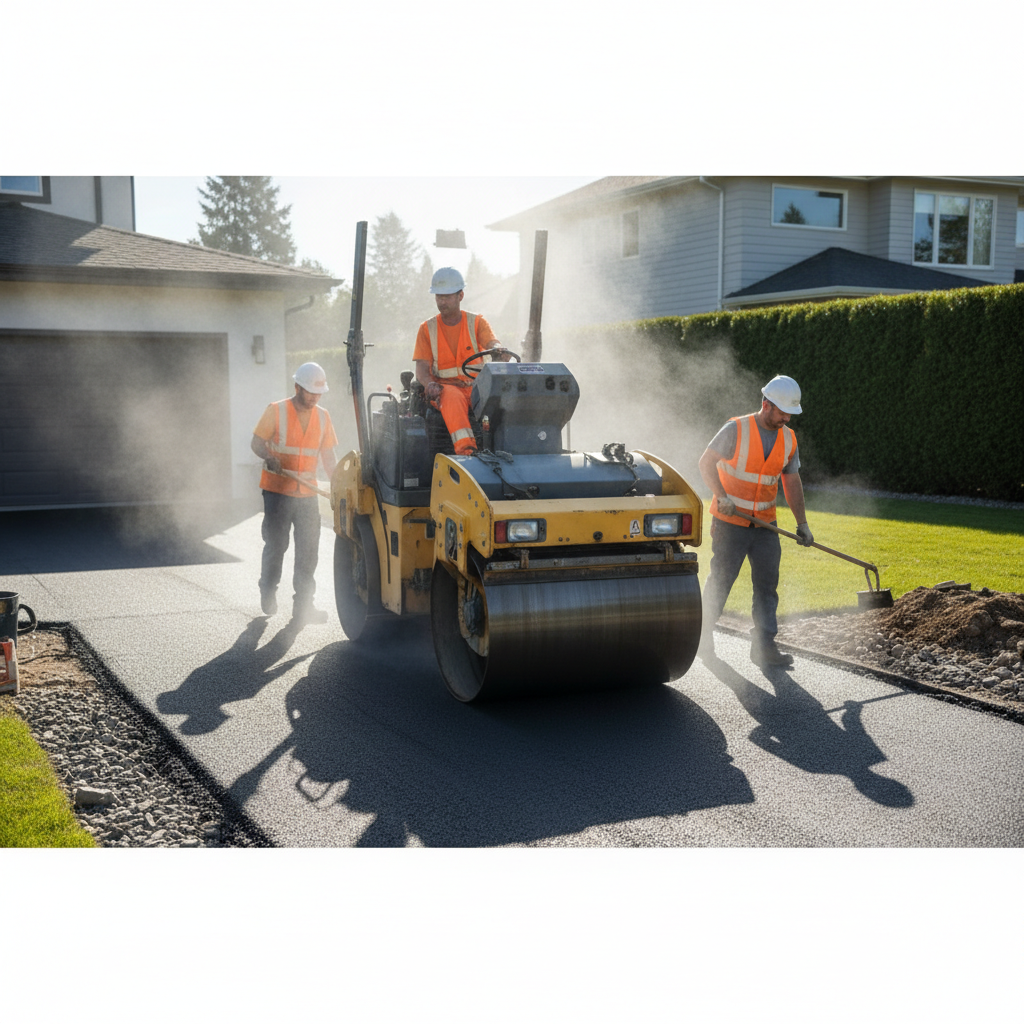
Driveway paving options and costs in Manning
Manning, Alberta is a small community where driveways matter—most homes sit on private lots, and with 78.7% of dwellings being single-detached homes, you’re typically paving for one household’s daily traffic, parking turns, and snow-plough access. It also helps explain demand: homeowner households make up 70.4% of households, so many projects are planned with long-term durability in mind (Statistics Canada, 2021 Census). In the Athabasca–Grande Prairie–Peace River economic region, the cost picture is shaped by a cold, frost-susceptible subgrade. Frost penetration can routinely exceed 1 m, which means contractors design thicker granular bases, add meticulous drainage, and often plan more undercutting or stabilization for fine-grained soils (clays and silts). That extra groundwork is a big reason Manning quotes can trend toward the upper end of Alberta norms.
Timing also affects pricing. The freeze–thaw season in northern Alberta is long, but the effective asphalt and concrete window is short—hot-mix asphalt needs warm air temperatures, so spring and early summer scheduling pressure can add mobilization and labour premiums. In Manning, work is especially in demand around the town’s busier residential core and areas with higher snow storage needs, where driveway shape and drainage control are critical to prevent winter heave.
Below is a practical comparison of common driveway paving choices so you can align budget, lifespan, and maintenance expectations before you request quotes.
| Material |
Lifespan |
Maintenance |
Best For |
Price per sq ft |
Price Range |
| Asphalt (new installation, proper base) |
12–20 years |
Seal every 3–5 years; quick patching as needed |
Most value-focused homeowners; smooth driving surface |
$6.00–$10.50 |
$6,500–$12,000 |
| Asphalt (overlay on existing gravel base) |
8–15 years |
Seal; monitor for reflection cracking and rutting |
When you have usable gravel but need a clean finished surface |
$5.50–$9.50 |
$6,000–$10,500 |
| Interlocking concrete pavers |
25–40 years |
Periodic re-sanding of joints; spot repairs |
Curb appeal + repairability; resisting localized failures |
$10.50–$16.00 |
$9,000–$18,000 |
| Poured concrete (broom finish) |
25–35 years |
Minimal; crack monitoring and occasional patching |
Low-maintenance look with a strong, rigid slab |
$9.00–$14.50 |
$8,000–$16,000 |
| Exposed aggregate concrete |
20–30 years |
Seal less often; remove debris and manage surface staining |
Non-slip surface and premium appearance |
$11.00–$16.50 |
$10,000–$18,500 |
| Gravel / crushed stone (budget option) |
3–8 years |
Top up annually; grading after spring thaw |
Short-term budget, drainage-friendly surfaces |
$3.00–$6.00 |
$2,500–$6,500 |
Prices are estimates only and vary by project scope, site access and material selection.
What affects the price of paving in Manning
In Manning and across the Athabasca–Grande Prairie–Peace River area, the same “average driveway” can come in 30–50% apart because the real work isn’t just asphalt or concrete—it’s what happens below it. Two contractors can quote the same square footage, but one may include deeper granular base, more undercutting, and extra drainage corrections to address frost action. In northern Alberta’s cold frost-susceptible zone, frost penetration can exceed 1 m, and freeze–thaw cycling is hard on thin sections and poorly drained subgrades. If the base is undersized, you can see heaving, edge failure, and cracking that shows up sooner, meaning you end up paying twice.
Cost is also influenced by the short usable paving window. Hot-mix asphalt generally requires air temperatures above 10°C, so projects compress into mid-May–September. When scheduling tightens, mobilization and crew premiums rise. On the materials side, asphalt mix design matters: a freeze-thaw rated mix typically costs more than basic mixes, but it’s part of making your driveway survive winter rutting and spring soft spots. That’s why you’ll often see asphalt paving budgets trend between $6,500–$12,000 depending on base scope and drainage.
Concrete pricing swings too. In Manning, homeowners with older lots—43.9% of homes built before 1981 (Statistics Canada, 2021 Census)—often discover unknown fill depth or weaker soils after old paving is removed. If the contractor has to excavate and replace subgrade, poured concrete can move from “mid-range” into the upper band near $8,000–$16,000. Conversely, a straightforward site with good drainage, firm native soil, and easy access can keep the project closer to the low-to-mid side.
| Price Factor |
Why It Matters |
Cost Impact |
| Driveway area in sq ft |
Material and compaction effort scale directly with surface area. |
Major (often the biggest single line item) |
| Base depth required |
Deep frost requires thicker, well-graded granular base to reduce heaving. |
Major; can add substantial aggregate and labour |
| Grading and drainage work |
Positive drainage prevents meltwater from cycling through freeze–thaw. |
Moderate to major, especially on flat sites |
| Tear-out of existing surface |
Breaking, haul-away, and haul time add labour and disposal costs. |
Moderate; varies with thickness/material |
| Edge restraints and curbing |
Pavers need restraints to prevent lateral spread; concrete needs edge support. |
Moderate; small materials, meaningful labour |
| Sealing requirement |
Asphalt needs sealing after the initial curing period to slow oxidation. |
Moderate; impacts long-term performance budgeting |
| Site access |
Narrow lots or limited staging slow equipment movement and increase time. |
Moderate; can raise mobilization costs |
| Asphalt mix specifications |
Freeze-thaw rated mixes help durability in northern winters. |
Moderate; affects per-ton and placement planning |
Permits & regulations in Alberta
In Alberta, paving a private driveway within your own property typically does not require a building permit, as long as you’re staying on your lot and not changing municipal infrastructure. However, work in the municipal right-of-way usually needs municipal approval. That includes new curb cuts (or changes to an existing one), any alteration to boulevard grading that affects drainage, and modifications to storm drainage patterns. If the project involves changing how water leaves the property—especially in areas where ditching or culverts carry runoff—confirm requirements with your local municipality before work starts. Also note that some municipalities have lot-grading bylaws that restrict how close a hard surface can be to property lines or how drainage must be handled.
Utility protection is non-negotiable. Call for utility locates (Alberta One-Call) before any excavation, even if you “know” where lines are—paving base work and undercutting can still hit buried services. Step-by-step, a Manning homeowner can verify a contractor properly:
- Check the contractor’s Alberta business licensing status (where applicable) and confirm the company name matches the quote paperwork.
- Request a Certificate of Insurance: verify liability coverage is current and includes paving/asphalt work.
- Ask for WSIB/WCB clearance (Workers’ Compensation Board) and keep a copy for your records.
- Confirm the permit/approval responsibilities: who pulls right-of-way approvals if needed.
- Verify the contractor has experience with frost-susceptible base builds (depth/aggregate specs) for northern Alberta conditions.
Asphalt vs pavers vs concrete for Manning driveways
For Manning driveways, asphalt, interlocking pavers, and concrete each have strengths—but the frost-susceptible climate in the Athabasca–Grande Prairie–Peace River region demands strong subgrade prep and drainage regardless of the finish. Asphalt usually offers the lowest upfront cost and a smooth driving surface, but it needs a plan: sealing typically every 3–5 years helps slow oxidation and keeps water out of surface pores. In practice, a properly built asphalt driveway on a deeper granular base and well-drained subgrade can perform in the $6,500–$12,000 band. If you skip base depth or drainage corrections, asphalt often shows distress sooner.
Interlocking concrete pavers cost more upfront, but they’re repairable. If one area heaves, a crew can lift and reset affected blocks without replacing the whole driveway. That’s a real advantage in northern winters where localized failure can happen around dips, culvert transitions, or snow-plough pathways. Pavers often land in the $9,000–$18,000 range depending on thickness, restraints, and excavation.
Poured concrete sits mid-range and can last decades when air-entrained and built with proper base preparation. Still, freeze–thaw can crack concrete if the mix, finishing, and base drainage aren’t right. Salt and sand from winter maintenance can also accelerate surface wear, so jointing and mix design matter. As a concrete example: if a 600 sq ft driveway comes with a roughly $3,000 premium to go from asphalt in the lower part of the band to pavers, that premium is often justified when you want maximum curb appeal and easy spot repairs—especially if your lot has any grading quirks.
Across all three, the “winner” for Manning is usually the one with the best base, correct slopes, and a drainage plan that keeps meltwater from cycling through freeze–thaw right under the surface.
| Material |
Frost Resistance |
Curb Appeal |
Repair Method |
Lifespan |
Price Band |
| Asphalt (sealed regularly) |
Good when base is deep and drainage is positive |
Medium |
Patch/overlay; re-seal on schedule |
12–20 years |
$6,500–$12,000 |
| Interlocking concrete pavers |
Very good; blocks tolerate localized movement |
High |
Lift and replace individual units or sections |
25–40 years |
$9,000–$18,000 |
| Poured concrete (air-entrained) |
Good with correct mix and base |
Medium to high |
Crack patching and sectional repairs |
25–35 years |
$8,000–$16,000 |
| Exposed aggregate concrete |
Good with air entrainment and proper curing |
Very high |
Patch and resurface spots; careful colour matching |
20–30 years |
$10,000–$18,500 |
| Permeable pavers (drainage grid) |
Very good when underdrain design is correct |
High |
Replace affected grid sections; maintain base permeability |
25–40 years |
$11,000–$20,000 |
| Chip seal / tar-and-chip |
Fair; more sensitive to base issues |
Low to medium |
Top-up treatments; patching distressed spots |
5–12 years |
$5,500–$9,500 |
How to choose a paving contractor in Manning
Choosing the right paving contractor in Manning is mostly about verification and clarity. In Alberta, confirm licensing/business registration where applicable, and make sure the contractor carries liability insurance and proper WSIB/WCB coverage. To check: request their Certificate of Insurance (verify dates and that paving/asphalt work is covered) and ask for a WSIB/WCB clearance letter for the workers who will be on site. If they hesitate or only provide outdated documents, keep looking.
Then get 2–3 itemised, written quotes—not just a lump sum. Ask for a labour + materials breakdown that shows excavation/undercut, base thickness and aggregate type, grading and drainage work, the asphalt or concrete thickness, and the finish (including compaction and edge restraints). Clarify what’s excluded: permit pulling for any right-of-way work, disposal/haul-away, and whether the quote includes topsoil reinstatement if needed. For asphalt specifically, ask about sealing plans because sealing typically happens after the initial curing period (often 6–12 months after placement depending on conditions and product).
Warranty should be in writing: workmanship warranty length, and whether the product/manufacturer warranty is included. Know if it’s transferable to future owners. Payment schedule matters too—never pay more than 10–15% upfront, and hold a portion back until completion and final cleanup. Finally, confirm the start date and estimated completion in writing so you aren’t relying on verbal promises during a short northern paving window.
- Ask for an Alberta insurance certificate and verify the policy is current.
- Request WSIB/WCB clearance and keep it on file.
- Confirm who pulls any required municipal approvals for right-of-way work.
- Get base specs in the quote (thickness in inches and aggregate type).
- Require compaction details (how they test and verify compaction).
- Insist on positive drainage/slope plans, not just “flat and compact.”
- Check whether tear-out and disposal are included or billed separately.
- Verify edge restraints/curbing details for pavers and concrete edges.
- Clarify thickness of asphalt/concrete and whether it matches your quote.
- Ask about tack coat (asphalt) and curing/air-entrainment (concrete).
- Confirm sealing timing and who performs it (asphalt only).
- Use a payment schedule with a holdback until final inspection.
Common red flags in Manning include: (1) vague base descriptions like “we’ll do some gravel” without thickness, (2) contractors who won’t show insurance/WSIB/WCB clearance, (3) no written timeline or no start-date commitment during the mid-May–September paving period, (4) quotes that don’t address drainage corrections, and (5) asking for large upfront payments (beyond roughly 10–15%).
Frequently asked questions — paving in Manning
What causes potholes and how are they repaired?
Potholes in Manning are usually the result of water getting under the surface. In our Athabasca–Grande Prairie–Peace River freeze–thaw cycle, meltwater can infiltrate through small cracks or rough edges; when temperatures drop, the freeze expands and breaks the material further. Heavy snow-plough turns and turning wheels can also concentrate stress on softer spots, especially after spring thaw. Repairs typically start with removing all loose, broken material down to firm base, then cleaning and drying the area as much as weather allows. Contractors should re-compact and replace base if needed, then patch with asphalt matched to the existing pavement. For repeat offenders, a proper drainage fix or full-depth section replacement may be more cost-effective than repeated surface patches.
How do I prepare for a paving project?
Preparation is mostly about access and site clarity. In Manning, you’ll want to clear the driveway area of vehicles, trailers, and stored items at least a day before work starts so equipment can stage and haul safely. Mark any areas where you have sprinklers, low-voltage lighting, or landscaping that must be protected. If you have buried services near the edge, ensure utilities are located before excavation—Alberta One-Call is the standard step to confirm locations. Decide whether you want topsoil reinstatement or if you’ll seed later, because that can affect the quote scope. Finally, ask for a written plan showing drainage slope and base thickness; that’s the part that prevents frost heave and keeps the driveway from failing early.
How do I compare paving quotes fairly?
To compare quotes fairly in Manning, don’t start with the total price—start with what’s included. Make sure each quote lists the same driveway area (sq ft), the same base depth, and the same asphalt or concrete thickness. Ask for line items for excavation/undercut, granular base, grading and drainage corrections, tack coat/curing steps, edge restraints/curbing, and disposal. The quotes should also state whether sealing is included later (for asphalt) or excluded. If one contractor proposes deeper base and drainage adjustments while another stays at the minimum, the cheaper quote may fail sooner in a frost-susceptible zone where frost penetration can exceed 1 m. A “like-for-like” comparison usually prevents surprise costs.
Can asphalt be laid in cold weather in Manning?
In Manning, cold-weather asphalt depends on the day’s conditions, but the general rule is that asphalt placement needs warm temperatures to place and compact properly. Hot-mix asphalt typically requires air temperatures around or above 10°C (and stable conditions) so the mix can be compacted to the proper density and won’t cool too quickly. During early fall or unexpected cold snaps, crews may postpone paving to protect quality. If asphalt is laid too cold, you can see poor compaction, lower durability, and faster breakdown under freeze–thaw cycling. The best approach is to plan for the mid-May–September window, confirm the paving forecast, and ask the contractor what temperature thresholds they follow.
What is a driveway apron and do I need one in Manning?
A driveway apron is the transition section at the bottom of your driveway—often at the curb cut or where the driveway meets the street or walkway—built to take traffic loads and manage drainage. In Manning, whether you “need” an apron depends on how your driveway ties into the road or any municipal right-of-way grading. If you’re changing a curb cut, adjusting boulevard drainage, or modifying how water flows, you’ll likely be in the area where municipal approval and apron-style upgrades are considered. For many private-lot driveways, an apron helps reduce edge spalling and rutting at the contact point between driveway and approach. Ask your contractor to show the proposed tie-in detail on a sketch, and confirm with the municipality if your work touches right-of-way.
How do I maintain my driveway through Manning winters?
Winter maintenance is about preventing water intrusion and limiting surface damage. For asphalt, keep an eye on small cracks and patch them early so meltwater doesn’t get under the surface. During plowing, avoid scraping too aggressively at edges and corners—edge breakdown is a common start to bigger repairs in frost-susceptible areas. Use sand as needed for traction, but try not to flood the driveway with excess slurry; too much moisture adds fuel to freeze–thaw cycles. If you have asphalt, plan for sealing after the surface cures (often 6–12 months after install), because proper sealant reduces moisture penetration. If you’re noticing heaving, recurring potholes, or drainage pooling after snowmelt, address the drainage cause—not just the surface—before the next thaw.