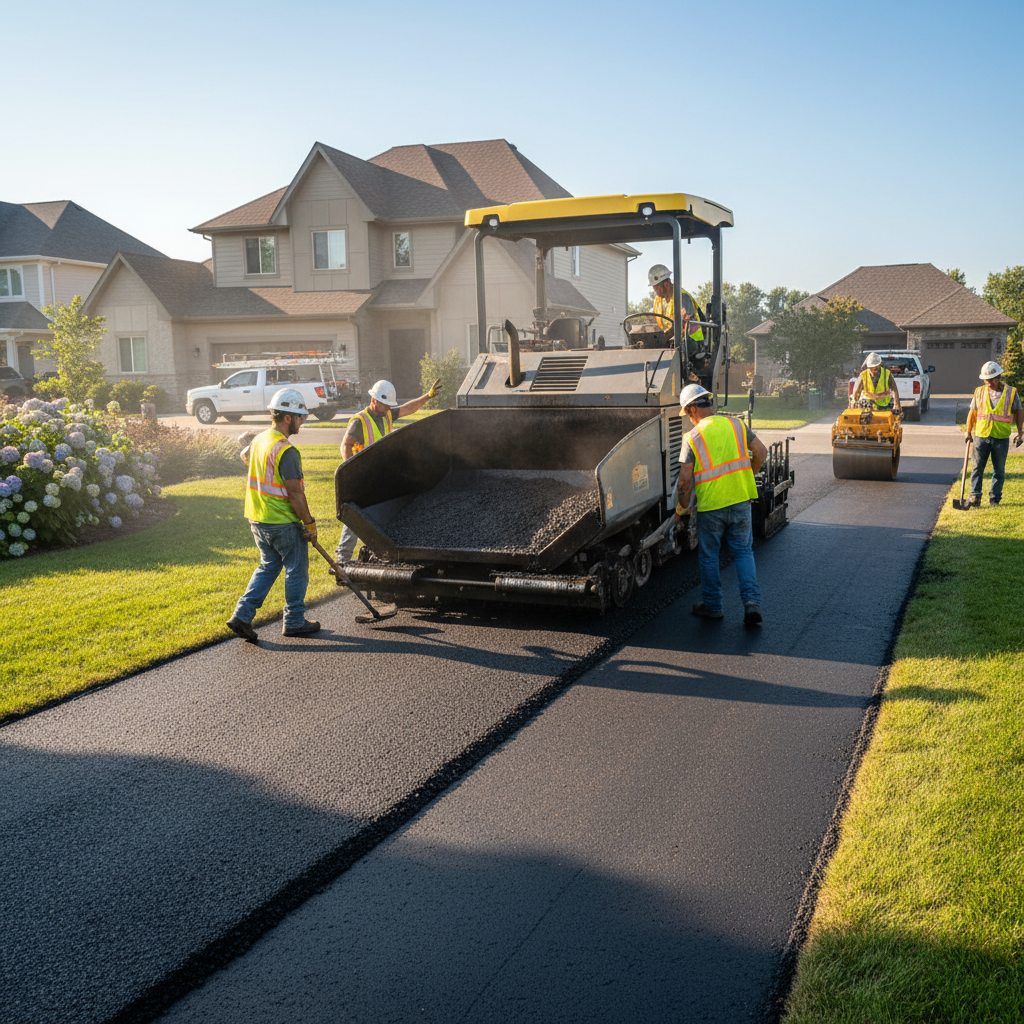
Driveway paving options and costs in Quesnel
Quesnel homeowners usually start by comparing driveway paving options against a tough reality: our Cariboo winters bring deep frost penetration and repeat freeze–thaw cycles, so the “same” driveway on paper can cost noticeably more once the base, drainage, and mix design are engineered for winter performance. In Quesnel, the housing stock also matters. With 59.6% of dwellings being single-detached homes, most private driveways in town serve detached houses, which makes driveway upgrades a frequent, multi-phase project for owner-occupiers. And because 62.3% of homes were built before 1981, many drives are on older grades or have older granular layers that need correction before new asphalt or concrete will last.
In neighbourhoods such as Colinfield, where turnover and home improvement cycles are active, demand tends to spike in late spring and again early fall—right when weather windows tighten. Cariboo’s shorter paving season compresses scheduling and affects crew productivity, which can raise mobilization and base-building costs. Asphalt projects also require air-temperature and cure timing discipline, while concrete needs cold-weather protection and a properly designed base to limit frost movement.
Below are practical price ranges you can use to compare materials. Use them as a baseline, then ask for an itemised quote that shows how thick the base is, what drainage work is included, and whether any tear-out is part of the scope—those items drive the final number in Quesnel.
| Material |
Lifespan |
Maintenance |
Best For |
Price per sq ft |
| Asphalt (new installation, proper base) |
12–20 years |
Sealcoat every 3–5 years; spot patch as needed |
Balanced cost with good appearance when drainage is correct |
$12 – $20 |
| Asphalt (overlay on existing gravel base) |
10–16 years |
Sealcoat as directed; monitor edges and low spots |
When the existing base is sound enough to keep settlement low |
$10 – $18 |
| Interlocking concrete pavers |
25+ years |
Resanding/joint maintenance; individual-stone repairs |
Homes where curb appeal and easy localized repairs matter |
$20 – $35 |
| Poured concrete (broom finish) |
20–30 years |
Minimal routine care; patching for cracks; seal optional |
Clean, durable surface when base is engineered and drainage works |
$18 – $30 |
| Exposed aggregate concrete |
20–30 years |
Less slippery texture; occasional sealing if desired |
High-traction look with improved surface texture |
$20 – $33 |
| Gravel / crushed stone (budget option) |
3–8 years |
Regrading and adding stone every 1–3 years |
Short budgets or interim surface while drainage is improved |
$4 – $10 |
Prices are estimates only and vary by project scope, site access and material selection.
What affects the price of paving in Quesnel
In Quesnel and across the wider Cariboo region, it’s common to see the same driveway concept priced 30–50% apart between contractors and between communities—mainly because frost performance isn’t just “about the surface.” The big drivers are what gets built below the pavement (base thickness, compaction, and drainage), what gets removed (tear-out), and how tight the scheduling window is during colder shoulder seasons. Asphalt and concrete also depend on weather and cure conditions; in freeze–thaw country, crews can’t simply “push through” when air temperatures drop or when the subgrade is thawing.
Frost line depth is decisive: deeper frost requires a thicker compacted granular base to reduce heaving and cracking. In coastal BC you may see thinner structures because winter temperatures are milder; in the Cariboo, the granular base typically needs to be built thicker and well-graded (often 12–18 inches or more under driveways) to keep the structure below frost movement. The paving season is also shorter—hot-mix asphalt needs air temperatures above 10°C for reliable placement—so demand concentrates into fewer workable months, tightening schedules and raising mobilization costs.
Concrete examples in Quesnel: (1) if the existing grade has low spots that hold water, you’ll pay more up front for regrading and proper slope/drainage before concrete is poured; (2) if you need to remove older slabs or badly broken asphalt, tear-out and hauling can add material and labour days; (3) if you choose broom-finish concrete on a poorly prepared base, early cracking risk rises, and repairs become frequent—often making the mid-range option costlier over time.
That’s why an asphalt driveway may land in the $12 – $20 per sq ft band when base and drainage are done correctly, while pavers or upgraded concrete sit higher (often $18 – $30 or $20 – $35) when the installer has to rebuild a robust foundation and install edge restraints properly.
| Price Factor |
Why It Matters |
Cost Impact |
| Driveway area in sq ft |
Materials and production time scale directly with surface area |
Low to high (largest variable on most quotes) |
| Base depth required |
Frost line determines granular thickness and compaction lift requirements |
Can raise costs materially when thicker base is needed |
| Grading and drainage work |
Slope, ditches/edge drains, and drainage corrections prevent saturated freeze damage |
Medium to high (often overlooked, then added later) |
| Tear-out of existing surface |
Breaking asphalt/concrete and hauling debris costs labour and equipment time |
Medium to high depending on thickness and access |
| Edge restraints and curbing |
Prevents paver spread and asphalt edge raveling |
Medium (small area, big effect on longevity) |
| Sealing requirement |
Asphalt needs sealing after initial cure (commonly 6–12 months) to protect from water intrusion |
Low to medium as a follow-up cost |
| Site access |
Narrow lots slow equipment movement and increase time per truckload |
Medium (crews must work slower and reposition equipment) |
| Asphalt mix specifications |
Freeze–thaw-rated mix design can cost more but performs better in Cariboo winters |
Medium (worth it for long-term stability) |
Permits & regulations in British Columbia
In British Columbia, paving a private driveway within your own property typically does not require a building permit. Most homeowners in Quesnel can replace or install a driveway surface (as long as it’s on their land and doesn’t change municipal infrastructure) without a formal permit process. That said, the moment your work touches the municipal right-of-way—think new curb cuts, changes to the boulevard, or alterations to storm drainage—municipal approval is often required.
Additionally, some communities apply lot-grading rules that restrict how close a hard surface can be to property lines and how stormwater must be managed. In practice, the contractor and homeowner should confirm these requirements before excavation so you don’t end up redoing base work.
Before any digging in Quesnel, homeowners should also ensure utility locates are completed (in BC, contact BC 1 Call) so excavators know where services run. After that, you can verify a contractor properly: ask for their British Columbia licence details and confirm liability insurance (request a current certificate of insurance listing you and your property, when appropriate). For work coverage, confirm how they handle worker protection coverage (WSIB/WCB) for their crews; request documentation and keep copies for your records.
Asphalt vs pavers vs concrete for Quesnel driveways
For Quesnel driveways, the “best” material depends on how you want to manage winter stress. Asphalt typically has the lowest upfront cost (often aligning with the $12 – $20 per sq ft range for new installation on a proper base), but it needs sealing every 3–5 years to reduce water penetration—water is what drives freeze damage and edge deterioration. Interlocking concrete pavers cost more upfront (commonly within $20 – $35 per sq ft), yet they’re forgiving: if you ever have to address drainage issues or settle a utility area, pavers can often be lifted and re-laid without replacing the entire driveway.
Poured concrete usually lands in the mid-range (often within $18 – $30 per sq ft), and it looks clean, but freeze–thaw cracking risk remains if the base isn’t engineered and drainage isn’t corrected. In Cariboo conditions, proper base preparation depth and edge control are not optional—often the difference between “looks great for years” and “hairline cracks after a few winters” is base thickness and drainage design, not just the concrete surface finish. Concrete also should be air-entrained for freeze resistance, and it performs best with routine winter maintenance practices (plowing without gouging and careful use of de-icing products).
One example: If your driveway is priced at about $16 per sq ft for asphalt versus $25 per sq ft for pavers, the $9 per sq ft difference can be justified when you expect future soil movement or want the ability to repair a localized problem. If the base and drainage are already excellent and you’re budget-focused, asphalt can be the smarter value—provided you budget for sealing.
| Material |
Frost Resistance |
Curb Appeal |
Repair Method |
Lifespan |
Price Band |
| Asphalt (sealed regularly) |
Good with engineered base and sealing |
Medium (clean, black profile) |
Spot patch and re-seal; occasional full resurface |
12–20 years |
$12 – $20 |
| Interlocking concrete pavers |
Excellent with proper base/drainage |
High (varied colours/patterns) |
Lift-and-replace individual units |
25+ years |
$20 – $35 |
| Poured concrete (air-entrained) |
Good to very good when air-entrained and well based |
Medium to high (broom/exposed finishes) |
Crack repair/patch; larger repairs may need re-sectioning |
20–30 years |
$18 – $30 |
| Exposed aggregate concrete |
Very good with freeze-rated mix and base |
High (textured, premium look) |
Patch and re-finish areas (small repairs best) |
20–30 years |
$20 – $33 |
| Permeable pavers (drainage grid) |
Excellent where drainage design is engineered |
High (modern look) |
Targeted replacements of sections |
25+ years |
$25 – $40 |
| Chip seal / tar-and-chip |
Fair to good; depends on base prep and maintenance |
Low (utilitarian finish) |
Spot patch and periodic re-chip |
7–12 years |
$10 – $16 |
How to choose a paving contractor in Quesnel
When you’re hiring a driveway contractor in Quesnel, focus on proof—not promises. First, verify the contractor’s British Columbia licensing (ask for their licence details and confirm they are current). Next, request liability insurance and review the certificate of insurance for current dates and coverage limits. Finally, confirm worker coverage for their crews (WSIB/WCB). You want the paper trail before work starts: ask for the clearance/certificate information that matches the crews and dates on your project.
For pricing, get 2–3 itemised written quotes rather than one lump sum. The quote should break down labour and materials (base materials, asphalt/concrete, compaction, drainage components, edge restraints, and any tack/seal). Make sure the scope is clear: what’s included in tear-out and disposal, whether permit approvals are handled (when required for right-of-way/boulevard work), and what is excluded (like repairing damaged underground services).
Warranty matters more in our climate. Ask for the workmanship warranty length and whether manufacturer warranties apply to materials (and if they’re transferable to you). In freeze–thaw areas, a good contractor should also address how they’ll protect the subgrade, how thick the base will be, and how they’ll manage drainage.
Payment schedule is a safeguard: never pay more than about 10–15% upfront. Hold back a portion until the job is complete and cleanup is verified. Also, demand a start date and completion estimate in writing so you aren’t stuck waiting through a seasonal window.
- Ask for a project schedule tied to weather realities (spring thaw and early fall frosts).
- Confirm the base design: thickness, gradation, and compaction testing approach.
- Get the quote in writing with itemized labour/material lines, not a single number.
- Ensure drainage is addressed: ditching/edge drains and any needed geotextile.
- Verify edge restraints (pavers) or proper asphalt edge detailing.
- Check what’s included in tear-out: breaking, loading, hauling, and disposal.
- Confirm whether your contractor includes final line-out, slope checks, and clean-up.
- Ask about mix design or standard specs for freeze–thaw conditions.
- Require the timeline for curative steps (including sealing timing for asphalt).
- Review the warranty: workmanship term, what triggers it, and exclusions.
- Keep copies of licence details, insurance, and worker coverage documentation.
- Agree on a payment schedule with a holdback until final grading and inspection.
Red flags in Quesnel include: a quote that ignores drainage or base thickness; no written itemization (especially disposal and tear-out); refusing to provide proof of insurance/licensing/worker coverage; asking for large deposits (well beyond 10–15%); and promises like “one-and-done” sealing for asphalt without a realistic 6–12 month cure window.
Frequently asked questions — paving in Quesnel
How often should I seal my asphalt driveway?
In Quesnel, sealing timing is tied to cure and freeze–thaw protection. For most new asphalt, plan on sealing after the surface has properly cured—commonly after about 6–12 months—then re-seal every 3–5 years depending on traffic, water behaviour, and how much plowing abrasion you get. If your driveway has low spots where water pools, sealing alone won’t fix the underlying problem; drainage and grade corrections are what prevent the freeze “pumping” that leads to raveling and early cracking. A well-installed asphalt driveway (often priced in the $12 – $20 per sq ft band when base and drainage are right) can last much longer when sealing is maintained. Ask for your contractor’s recommended sealcoat product and schedule for northern climates.
Why does my driveway crack and heave in winter?
Cracking and heaving in Quesnel usually comes from moisture and frost interacting with a pavement structure that isn’t staying dry or isn’t built thick enough. Freeze–thaw cycles pull water into frost-susceptible layers; when that water freezes, it expands and can lift the surface. Common causes are a thin or poorly compacted granular base, weak edge restraint, or drainage that doesn’t shed water away from the driveway. If your driveway was built with older, uneven materials or has become uneven over time, saturated soil can repeatedly freeze. Another contributor is plowing with the blade too low, which breaks surface integrity and accelerates water entry. Proper base prep and drainage design are why asphalt projects and concrete slabs should be done on a robust structure, not just a “top layer.”
Do I need a permit to pave my driveway in British Columbia?
Generally, paving a private driveway within your own property in British Columbia typically does not require a building permit. In Quesnel, most homeowners can replace or resurface their driveway without a permit as long as the work stays on their land and doesn’t change municipal infrastructure. Where you may need municipal approval is when the job affects the municipal right-of-way—such as creating/changing a curb cut, altering the boulevard, or modifying storm drainage patterns. Some municipalities also have lot-grading or surface runoff rules that restrict how water can be directed. The practical way to handle this: confirm with the municipality for right-of-way/boulevard impacts, and ensure utilities are located before excavation (BC 1 Call). Your contractor should tell you up front whether any permits/approvals are required for your specific site.
How long before I can drive on new asphalt?
Driving on fresh asphalt depends on temperature, thickness, and whether the contractor used a compacted base and correct lift schedule. In general, newly placed and compacted asphalt can often be driven on shortly after it’s cooled and set, but it’s common practice to avoid heavy loads and sharp turning until the surface has fully cooled. In Quesnel’s shoulder-season conditions, crews may be more conservative because cold nights and early freezes can affect cure and compaction. Follow the contractor’s instructions for your specific mix and day-of-work temperatures. Also remember that sealing is not immediate: most systems should wait until the asphalt has cured—often 6–12 months—before applying a sealcoat. If you’re budgeting, that sealing step is part of long-term performance for a driveway typically in the $12 – $20 per sq ft range.
What causes potholes and how are they repaired?
Potholes in Quesnel usually start with water. When water penetrates cracks or weak joints, it undermines the base during freeze–thaw cycles. Each winter cycle can enlarge the void, and plowing traffic can accelerate the breakdown. Potholes are more likely where drainage is poor, where the asphalt edge is failing, or where an overlay was placed over a base that didn’t have adequate thickness/compaction. Repairs typically include cutting out loose material, removing the contaminated base, reinstating proper base material, compacting, and then placing fresh asphalt to match grade and compaction. For best results in our climate, repairs should be done promptly—waiting often turns a patchable issue into a larger base failure. Ask whether the contractor will address the cause (drainage/grade) or only replace the surface area.
How do I prepare for a paving project?
Start with site planning. Clear vehicles, trailers, and stored materials from the work zone and ensure access for trucks and compactors. If there are low areas or spots that hold water, point them out—those details help the contractor design drainage rather than guessing. Before excavation, confirm utilities have been located (BC 1 Call) and be ready to mark any buried items you have. Take photos of existing conditions for reference. If tear-out is included, ask how disposal will work and where debris will be staged. For timing, choose a weather window that supports compaction and proper cure—Cariboo schedules are tighter due to spring thaw and early fall frosts. Finally, ask for an itemised written quote (labour + materials, not a lump sum), including base thickness and whether edge restraints are included, so you can compare like-for-like across contractors.