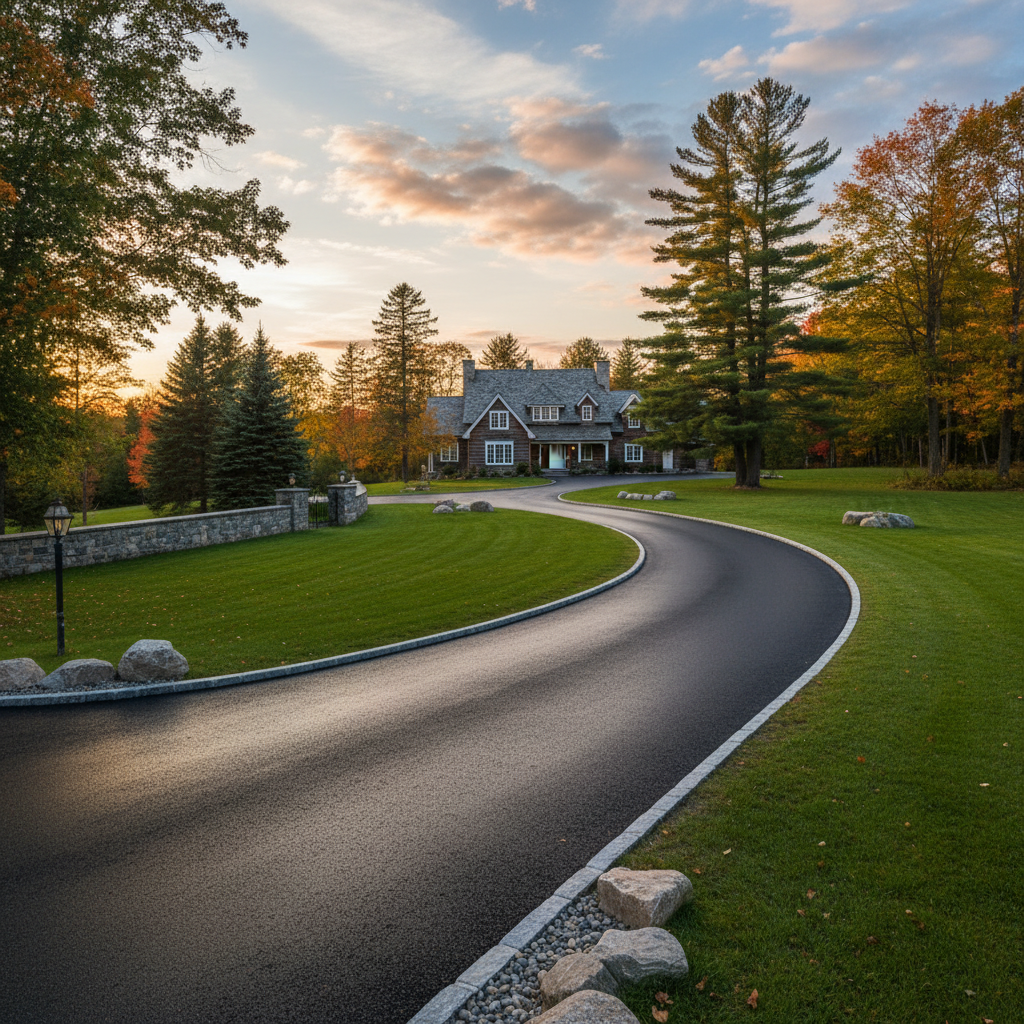
Driveway paving options and costs in Central Coquitlam
Central Coquitlam homeowners have three common driveway paths: asphalt, interlocking pavers, and concrete. With a 2021 population of 15,480 (Statistics Canada, 2021 Census), the neighbourhoods around the tri-city area see steady demand from routine resurfacing, drainage fixes, and new builds. Most private driveways in the Lower Mainland–Southwest are tied to detached and semi-detached homes, where practical, weather-ready surfaces matter year-round.
Pricing here is shaped less by deep freeze and more by intense rainfall, fast shoulder-season storms, and the way moisture moves through clay-heavy pockets in the Fraser Valley. Even though frost penetration is relatively shallow along the coast, contractors still design for a frost line on the order of about 18 inches for exposed applications—meaning you pay for proper excavation, compacted granular base, and drainage corrections more than you pay for “extra thickness because it’s freezing hard.” That base work drives your total cost, and it also helps explain why a “same-looking” driveway can come in 30–50% apart between quotes when one contractor includes drainage/grading and the other doesn’t.
Trade is especially active around Ranch Park and the broader Como Lake–Hockaday corridor, where older driveways often show rutting near garage entrances after wet winters. Below is a practical comparison of typical material options in Central Coquitlam, with realistic lifespan and maintenance expectations to match the Lower Mainland–Southwest climate.
| Material |
Lifespan |
Maintenance |
Best For |
Price per sq ft |
| Asphalt (new installation, proper base) |
15–20 years |
Seal every 3–5 years (typically) |
Good value, smooth ride, fast install |
$12 – $20 |
| Asphalt (overlay on existing gravel base) |
10–15 years |
Seal every 3–5 years; monitor settlement |
When existing base is stable and excavations are limited |
$12 – $18 |
| Interlocking concrete pavers |
25–30 years |
Re-level individual stones as needed |
Curb appeal and easier localized repairs |
$20 – $40 |
| Poured concrete (broom finish) |
25–30 years |
Seal periodically; repair hairline cracks |
Low maintenance, straight-edged look |
$18 – $35 |
| Exposed aggregate concrete |
20–30 years |
Seal/clean regularly; spot repairs |
Improved slip resistance and decorative finish |
$22 – $40 |
| Gravel / crushed stone (budget option) |
3–8 years |
Top up and re-grade as ruts form |
Temporary solution or drainage-focused lots |
$8 – $14 |
Prices are estimates only and vary by project scope, site access and material selection.
What affects the price of paving in Central Coquitlam
In Central Coquitlam, it’s common to see bids for the “same driveway” come in 30–50% apart across the Lower Mainland–Southwest and the rest of British Columbia. The reason is rarely the surface material alone—it’s the amount of excavation, how deep and how well the granular base is compacted, and whether drainage and grading corrections are included. Two contractors can quote asphalt at the same nominal rate, yet one may include full tear-out, a properly drained base, and an asphalt thickness aligned to freeze-thaw performance, while another assumes the existing base will behave.
Frost line depth and freeze-thaw cycles are decisive cost factors in the coastal region. Even with a milder climate, local practice still assumes a frost line on the order of about 18 inches for sensitive exposed areas. That means compacted granular base and subgrade preparation can’t be “thin and hopeful.” In colder parts of Canada, you often see base requirements closer to 6–12 inches; in coastal BC the typical base may be closer to 4–6 inches, but it still needs to be built correctly to manage moisture and prevent heaving, rutting, and cracking. Asphalt mix design also matters: freeze-thaw-rated mixes tend to cost more than generic mix, and that cost shows up in your installed price.
Concrete cost can change quickly with local conditions too. If your driveway slopes toward the garage, additional grading and drainage adjustments can add labour and disposal. If your existing slab is badly broken, tear-out and hauling can push a “poured concrete” quote toward the upper end of the $18 – $35 band. Conversely, if you’re overlaying an asphalt surface over a stable gravel base, you may stay closer to $12 – $18 per sq ft.
| Price Factor |
Why It Matters |
Cost Impact |
| Driveway area in sq ft |
Most line items (excavation, base, asphalt/concrete) scale with area |
Largest driver; can account for 50–70% of total variation |
| Base depth required |
Frost-line design and moisture control determine granular thickness |
More base can add substantial cost via extra material and compaction time |
| Grading and drainage work |
Correct slope and outlet locations reduce water pooling and freeze-thaw stress |
Can raise pricing when swales, curtain drains, or regrading are needed |
| Tear-out of existing surface |
Breaking/hauling asphalt or concrete affects equipment time and disposal |
Often adds a noticeable premium vs. “overlay” scenarios |
| Edge restraints and curbing |
Prevents paver spread and asphalt edge failure |
Costs more but protects long-term shape and prevents water infiltration |
| Sealing requirement |
Asphalt needs sealing after cure to manage moisture and oxidation |
Typically adds 1 line item (commonly $2 – $6) depending on scope |
| Site access |
Small gates, steep driveways, and tight turns slow excavation and hauling |
May require handwork and additional labour for material movement |
| Asphalt mix specifications |
Freeze-thaw-rated mixes perform better under coastal moisture swings |
Higher material cost, but improved durability in Central Coquitlam winters |
Permits & regulations in British Columbia
In British Columbia, paving a private driveway within your own property typically does not require a building permit. Where approvals commonly come in is if you’re changing the municipal right-of-way—such as adding a new curb cut, modifying the boulevard, altering storm drainage that connects to municipal infrastructure, or changing items that affect how water flows in the street interface. Some municipalities also have lot-grading bylaws that restrict how close a hard surface can be to property lines and how drainage must be managed. For Central Coquitlam homeowners, the practical takeaway is to confirm whether any part of the work touches boulevard areas, driveway approaches at the street, or stormwater routing.
Before excavation, always arrange utility locates through the applicable BC 1 Call process (the same “call before you dig” principle applies in BC). Then, verify your contractor’s compliance: ask for a copy of their BC licence/registration (where applicable for their trade), current liability insurance, and their workers’ compensation coverage (WSIB is Ontario—so in BC you should confirm the equivalent coverage for the workers doing the job). To check legitimacy:
- Request a current clearance letter for workers’ compensation coverage (or equivalent documentation your contractor can provide).
- Review the insurance certificate for policy limits and the effective dates; ensure your address is covered for the work.
- Confirm the contractor’s business details match the quote (legal name, phone/email) and that the licence/registration information is valid.
- Ensure the scope includes the required safety measures for trenching, saw-cutting, and hauling.
Asphalt vs pavers vs concrete for Central Coquitlam driveways
For Central Coquitlam driveways, asphalt usually wins on upfront cost, interlocking concrete pavers win on curb appeal and repairability, and concrete sits in the middle—often with excellent long-term performance when it’s built properly for freeze-thaw and moisture. In the Lower Mainland–Southwest, the big winter pressure is moisture and heavy rainfall, not extreme freeze. That’s why base drainage design matters more than “extra frost thickness.”
Asphalt is typically the lowest upfront option in the local market, often within the $12 – $20 per sq ft range depending on your base and whether you’re doing new installation. The trade-off is maintenance: sealing every 3–5 years helps protect the binder from oxidation and moisture intrusion. Interlocking concrete pavers usually sit in the $20 – $40 band and require a properly compacted base plus bedding sand. The benefit is you can lift and re-level a localized section if a spot settles, instead of replacing an entire driveway.
Poured concrete (broom finish) is generally competitive on price versus pavers, often in the $18 – $35 range, but it is more susceptible to visible cracking if the base is underbuilt or if drainage is poor. For winter maintenance routines in Central Coquitlam—think plowing contact, sand/grit, and de-icing compounds—proper jointing and air entrainment are key to reducing freeze-thaw distress. For example, if your driveway is 400 sq ft, the upfront difference between a mid-range asphalt and pavers can be meaningful (often hundreds to a few thousand dollars), and it’s usually justified when you want curb appeal, plan to keep the home long-term, or anticipate future localized repairs.
| Material |
Frost Resistance |
Curb Appeal |
Repair Method |
Lifespan |
Price Band |
| Asphalt (sealed regularly) |
Good when built on compacted base and sealed |
Moderate |
Patch and re-seal affected areas |
15–20 years |
$12 – $20 |
| Interlocking concrete pavers |
Excellent with correct base and edge restraints |
High |
Remove/re-set individual pavers |
25–30 years |
$20 – $40 |
| Poured concrete (air-entrained) |
Good when properly drained and air-entrained |
Medium |
Crack repair and patching; possible slab fixes |
25–30 years |
$18 – $35 |
| Exposed aggregate concrete |
Good when base and finishing are consistent |
High |
Patch with matching mix; limited resurfacing options |
20–30 years |
$22 – $40 |
| Permeable pavers (drainage grid) |
Excellent moisture management with engineered drainage |
High (modern look) |
Lift/re-level pavers; clear drainage cells |
20–30 years |
$25 – $45 |
| Chip seal / tar-and-chip |
Moderate; depends heavily on maintenance |
Low to moderate |
Spot patch and recoat as it ages |
7–12 years |
$10 – $16 |
How to choose a paving contractor in Central Coquitlam
Choosing the right contractor in Central Coquitlam starts with verifying British Columbia credentials and coverage—not just a phone number and a nice before/after photo. Ask for the contractor’s licence/registration details (where applicable to their trade), then confirm liability insurance. For worker protection, request proof of workers’ compensation coverage applicable to BC (you’ll see clearance-letter documentation from the insurer/board). Do not assume it’s covered—call or request documentation and check dates.
Next, get 2–3 itemised written quotes. The best quotes show labour and materials separately: excavation, hauling/disposal, granular base, geotextile (if specified), compaction, edge restraints/curbing, asphalt mix specification or concrete air-entrainment, and any sealing line item. Avoid “lump sum only” quotes when you’re comparing asphalt repair versus new installation; the cheaper number is often missing base depth or drainage corrections. Also confirm what’s included: permit pulling (when required), saw-cutting, formwork, disposal of old concrete/asphalt, and clean-up. If the contractor says “we’ll figure it out later,” that usually means change orders.
Warranty matters too. Ask for the workmanship warranty length and what it covers (settlement, cracking, adhesion issues, workmanship defects) and whether the manufacturer warranty is product-specific. Payment should be conservative: never pay more than 10–15% upfront. Hold back a portion until the job is complete and you’ve confirmed final grading, compaction, and surface cure times.
- Verify BC licence/registration details in the proposal and request proof if asked.
- Confirm liability insurance certificate and policy limits; check the effective dates.
- Request proof of BC workers’ compensation coverage (clearance letter/documentation).
- Get 2–3 itemised quotes with base thickness, drainage work, and disposal spelled out.
- Ask for asphalt mix specification details and whether it’s rated for freeze-thaw performance.
- Confirm compaction method and passes (not just “we compacted”).
- Ensure edge restraints/curbing are included where needed for pavers or to protect asphalt edges.
- Ask who supplies and installs geotextile (if required for separation) and bedding sand (pavers).
- Clarify what’s excluded: replacement of broken retaining walls, landscaping restoration, or sidewalk tie-ins.
- Confirm disposal/hauling is included if tear-out is required.
- Confirm sealing timeline for asphalt (after cure) and whether sealing is included or a future allowance.
- Get the start date and completion estimate in writing, plus a weather/protection plan.
Common red flags in Central Coquitlam include: quoting asphalt without specifying base depth/compaction, skipping drainage slope details, refusing to show insurance/coverage documentation, pushing large upfront payments, and providing a quote that doesn’t clearly state disposal/tear-out assumptions. If the scope reads vague (“we’ll prep as needed”), ask for a written scope revision before you sign.
Frequently asked questions — paving in Central Coquitlam
How do I prepare for a paving project?
Start by confirming where water should go. In Central Coquitlam and the broader Lower Mainland–Southwest, drainage problems often show up as soft spots, rutting, or cracks after heavy rainfall, so review your current slope and whether downspouts discharge near the driveway. Next, arrange utility locates and ensure your contractor confirms any local requirements if work touches the street interface or boulevard. Gather photos and measurements (driveway length/width, garage apron area, any low spots). Clear vehicles, relocate planters, and identify any fencing you want protected. Finally, ask for an itemised plan so you know whether the contractor will include tear-out, disposal, base gravel depth, edge restraints, and—if asphalt is chosen—whether sealing is included and when it will be applied after cure. (Statistics Canada, 2021 Census)
How do I compare paving quotes fairly?
To compare quotes fairly in Central Coquitlam, insist on like-for-like scopes. The biggest differences usually come from base depth, drainage/grading correction, and whether disposal and tear-out are included. Ask for line items: excavation, granular base depth, compaction requirements, geotextile (if specified), asphalt mix design, concrete air entrainment, edge restraints, and cleanup. If one bid is “asphalt supply and install” while another includes full preparation and compaction, that gap can easily be 30–50% even within the same market. Use the local pricing bands as a check: for example, a new asphalt driveway often lands within $12 – $20 per sq ft when base preparation and proper thickness are included, while pavers commonly sit within $20 – $40. Don’t compare only the totals—compare what’s in the scope.
Can asphalt be laid in cold weather in Central Coquitlam?
Asphalt placement in Central Coquitlam is usually feasible for a longer season than in colder parts of Canada, but it still depends on air temperature and surface conditions. Hot-mix asphalt generally needs air temperatures above about 10°C to place and compact effectively, and the base must not be frozen or overly wet. Heavy rains and shoulder-season storms can delay paving even when temperatures are mild, because contractors need controlled conditions for proper compaction. If your driveway is scheduled for late fall or early spring, ask the contractor what temperature and moisture limits they follow and whether they can provide protection and scheduling flexibility. A credible contractor will also explain how freeze-thaw performance depends on base preparation and asphalt mix design, not only on the day of paving.
What is a driveway apron and do I need one in Central Coquitlam?
A driveway apron is the transition area where your driveway meets the sidewalk/curb interface. In Central Coquitlam, whether you “need” one depends on your site conditions: the slope, drainage, and how water flows from the driveway toward the street interface. If you have an apron area that’s broken, ponding, or causing settlement near the garage entry, upgrading the apron can improve drainage and reduce the likelihood of edge failures. If you’re modifying the boulevard or the street interface (such as a new curb cut), you may need municipal approval rather than just driveway-surface work. Ask your contractor to identify the exact apron limits on your property before you sign, and confirm whether any right-of-way work is involved so permits/approvals are handled properly.
How do I maintain my driveway through Central Coquitlam winters?
Winter maintenance in Central Coquitlam is mostly about moisture control and minimizing surface stress. For asphalt, keep the surface clean of loose debris so water drains properly, and avoid over-application of de-icing chemicals—some products can accelerate surface wear. Use sand for traction rather than heavy salt sprays when possible, and plow with care to avoid gouging edges. Inspect after big rain events for signs of soft spots or water pooling; localized drainage fixes early are cheaper than waiting for a full failure. For pavers, check that edge restraints are holding and that joints aren’t washing out—re-sanding is often a quick remedy. For concrete, avoid sharp impacts and ensure meltwater doesn’t refreeze in the same spot, which can worsen cracking. Proper sealing on asphalt, typically after cure and then every 3–5 years, is a key part of winter readiness.
Is it worth sealing a new driveway right away in Central Coquitlam?
In Central Coquitlam, sealing is usually worth planning, but not immediately “the next day” in most cases. Asphalt needs adequate cure time so the surface can properly accept the sealant. A reputable paving contractor will specify when sealing should happen based on weather and mix readiness, then recommend sealing intervals—commonly every 3–5 years—to manage moisture and oxidation in our wet-season conditions. If your quote includes sealing as part of the work, ask for the product type and the expected timeline; if it’s not included, budget the sealing allowance using the local band of $2 – $6 per sq ft depending on surface condition and scope. Sealing too early can trap moisture and reduce performance, so the “worth it” answer is yes, but only when the asphalt is ready.